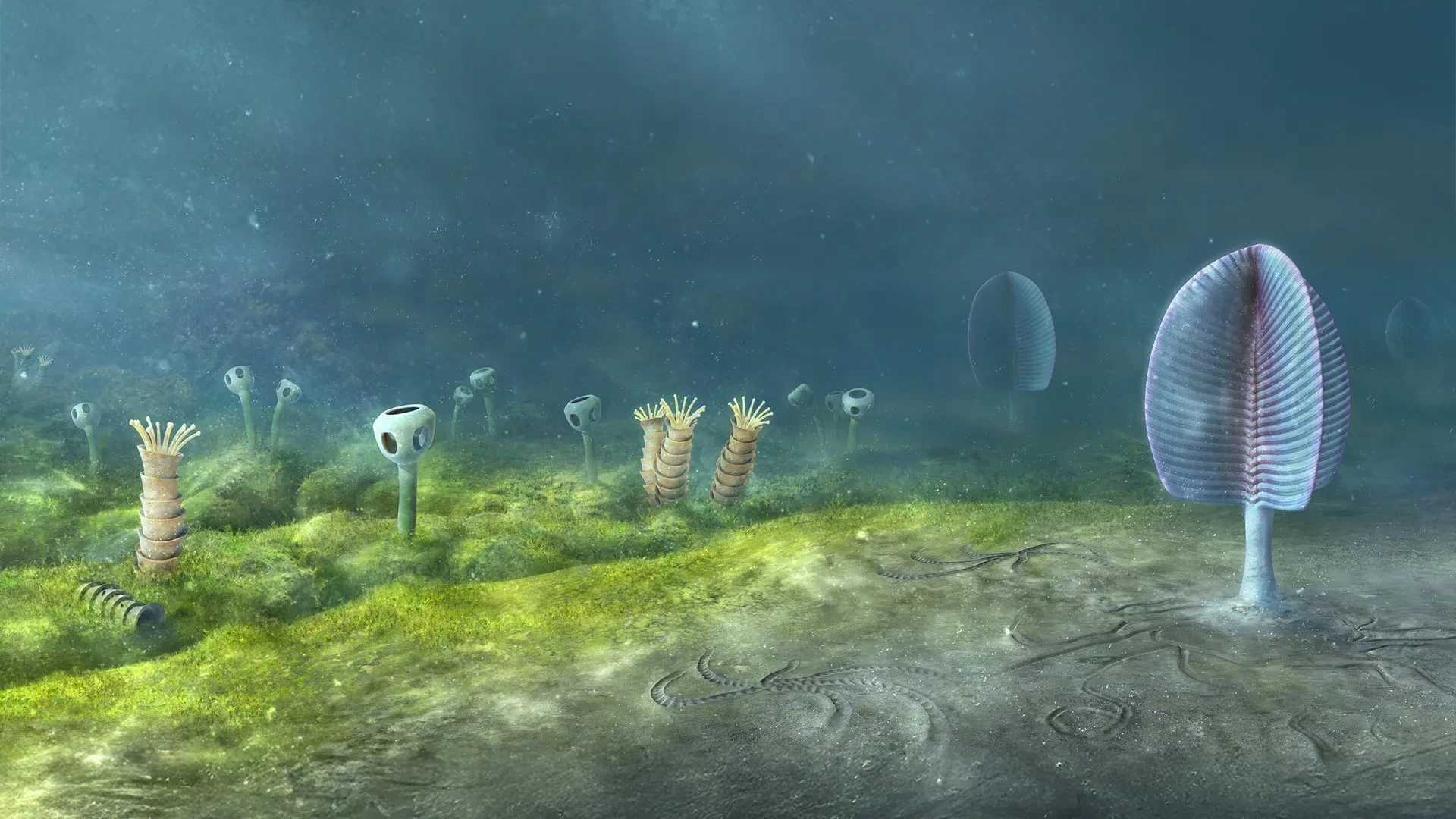

Executive Overview
For generations, paleontologists and evolutionary biologists have relied on a foundational assumption to map the dawn of animal life: if a fossil deposit is exceptionally well-preserved and yet completely devoid of animal remains, it constitutes robust proof that animals had not yet evolved. This logical benchmark has served as a cornerstone for calibrating molecular clocks and determining the maximum antiquity of the metazoan lineage.
However, groundbreaking research published on October 2 in Science Advances shatters this long-held premise. Led by an international team of scientists from the University of Oxford, alongside colleagues from the University of California Berkeley, ETH Zürich, and Yale University, the new study reveals that animals may have originated up to 200 million years earlier than their earliest appearance in the clear fossil record.
By analyzing extraordinarily preserved microfossils from the Kheseen Biota in Mongolia—a site roughly 40 to 50 million years younger than China’s famous Weng’an Biota—the researchers demonstrated that exquisite preservation does not automatically guarantee the capture of animal remains, even when it is independently known that animals existed elsewhere on Earth at the time. This revelation breaks the interpretive power of "absence of evidence" in Ediacaran fossil deposits.
Consequently, when the research team recalculated their molecular clock models using much older geological constraints—spanning 850 to 730 million years ago—the estimated timeline for the emergence of the animal kingdom was pushed backward by roughly two centuries of millions of years. This places the possible dawn of animal life deep in the Neoproterozoic Era, between 800 and 700 million years ago, raising profound questions about whether Earth’s earliest complex organisms weathered, or even emerged during, the catastrophic "Snowball Earth" glaciations.
Detailed Chronology: From the Cambrian Explosion to the Neoproterozoic Roots
To understand the magnitude of the Oxford-led discovery, one must trace the historical narrative of how science has interpreted the appearance of animal life. For decades, the dominant timeline of evolutionary biology struggled to reconcile two conflicting categories of data: the physical fossil record and molecular clock estimates.
The Apparent Abruptness of the Cambrian Explosion
Traditionally, the fossil record portrayed the origin of animals as a relatively sudden event. Shortly before the dawn of the Cambrian Period—spanning from 539 to 487 million years ago—complex, multicellular animal fossils appeared globally in astonishing abundance. This geological heartbeat, often referred to in broader contexts alongside the Cambrian Explosion, displayed an array of shelled organisms, early arthropods, mollusks, and strange stem-group creatures.
Yet, beneath this visible explosion of diverse body plans lay a paradox. Molecular clock analyses—which calculate evolutionary divergence by measuring genetic mutations across modern species and calibrating them with known fossil dates—repeatedly suggested that the ancestral lineages of animals must have branched off hundreds of millions of years earlier. This created a jarring temporal disconnect: where were the Precambrian ancestors of these complex organisms?
The Weng’an Biota Benchmark
To bridge this gap, scientists turned to older microfossil deposits to establish hard boundaries for when animals could not have existed yet. Among the most critical of these sites is the Weng’an Biota in South China. Dated to approximately 590 million years ago during the Ediacaran Period, the Weng’an Biota is famous for preserving microscopic organisms, colonial algae, and delicate cellular structures in breathtaking, three-dimensional detail.
For years, paleontologists reasoned that if animals had already populated the Earth at 590 million years ago, a deposit as exceptional as Weng’an would undoubtedly have trapped their microscopic embryos, larval stages, or soft-bodied fragments. Because no definitive animal fossils have ever been discovered in Weng’an, researchers established a maximum age constraint: the animal kingdom must have evolved after the Weng’an Biota was laid down. This single assumption effectively bottlenecked the maximum antiquity of metazoan evolution.
The Kheseen Biota Test and the Breaking of the Paradigm
The new study targeted this foundational assumption by examining a geological benchmark located thousands of miles away: the Kheseen Biota in Mongolia.
The Kheseen Biota is roughly 40 to 50 million years younger than the Weng’an Biota, yet the two assemblages share striking similarities, including overlapping species of microscopic flora and protists. Crucially, the paleontological community already possesses incontrovertible evidence that animals existed globally by the time the Kheseen Biota formed, with confirmed animal fossils and trace fossils recovered from contemporary strata in Namibia and South China.
Deploying advanced scanning electron microscopy across more than 140 meticulously collected samples—including material gathered from previously unstudied field localities—the international research team uncovered exquisitely preserved microfossils. These included complex acritarchs (tiny, spherical marine organisms decorated with intricate spines and branching projections) and delicate, embryo-like structures containing visible internal cells.
Despite the phenomenal quality of preservation, the researchers found a complete absence of animal fossils.
This discovery delivered a fatal blow to the traditional logic of the Weng’an Biota. As the data demonstrated, an exceptionally preserved microfossil assemblage can completely lack animal remains even during an epoch when animals are definitively known to have inhabited the planet. The absence of animals in a fossil deposit can no longer be used as proof of their non-existence.
Recalibrating the Molecular Clock
Freed from the restrictive boundary imposed by the Weng’an Biota, the researchers turned their attention to much older, pre-Ediacaran sedimentary formations dating between 850 and 730 million years ago. These included:
- The Svanbergfjellet Formation in Norway.
- The Bitter Springs Group in central Australia.
- The Chuar Group in the Grand Canyon, Arizona, USA.
These rock formations are recognized as exceptionally rich in microfossils and possess the chemical and physical characteristics capable of preserving fragile biological materials. Although no confirmed animal fossils have yet been discovered within them, they have long served as theoretical candidates for defining the maximum age of the biosphere’s early complex life.
When the research team integrated these older geological constraints into sophisticated molecular clock models, the mathematical output shifted dramatically. The estimated origin of the animal kingdom was pushed backward by approximately 200 million years. Instead of emerging shortly before the Ediacaran, the statistical window for the birth of animals now centers firmly between 800 and 700 million years ago.
Supporting Context & Metrics: Biomarkers, Taphonomy, and "Snowball Earth"
To evaluate the plausibility of a 200-million-year ghost lineage, scientists must examine auxiliary lines of evidence, including organic geochemistry, taphonomy (the study of how organisms decay and become fossilized), and Earth’s paleoclimate history.
Chemical Fossils and the Sponge Hypothesis
Even before this latest study, growing clues hinted that animals possessed a much deeper, hidden history. Organic geochemists have long studied ancient sedimentary rocks for molecular fossils, or biomarkers—stable chemical compounds synthesized exclusively by specific biological groups.
Lipid biomarkers recovered from ancient rock strata provide compelling evidence consistent with the presence of demosponges living at least 650 million years ago. These chemical traces predate the oldest definitive macroscopic animal body fossils by tens of millions of years.
The Fragility of Early Soft-Bodied Life
Why have pre-Ediacaran animal fossils eluded discovery? The answer lies in the harsh realities of taphonomy and anatomy.
The earliest animals were overwhelmingly tiny, delicate, and entirely soft-bodied. Lacking mineralized skeletons, shells, teeth, or robust chitinous carapaces, these primitive organisms possessed an extremely low fossilization potential. When an early sponge, placazoan, or worm-like creature died, its tissues typically decomposed rapidly through microbial action or scavenging long before mineral replacement could secure its likeness in stone.
Furthermore, the preservation of soft-bodied microfossils requires an exceedingly rare convergence of environmental factors:
- Rapid burial by fine-grained sediment to cut off oxygen and scavengers.
- Specific localized chemical conditions, such as early-stage silicification or pyritization, that lock cellular structures in place before decay sets in.
- Minimal subsequent thermal alteration or tectonic deformation over hundreds of millions of years.
If the earliest animals occupied ecological niches or micro-environments poorly suited for these rare fossilization windows—such as pelagic open oceans, turbulent high-energy shallows, or deep-sea floors lacking rapid sediment influx—their bodies would vanish from the geological record entirely.
Did Animals Pre-date "Snowball Earth"?
Pushing the origin of animals back to the 800-to-700-million-year window intersects directly with one of the most violent climatic chapters in planetary history: the Cryogenian Period.
Beginning around 720 million years ago, Earth experienced a series of extreme global glaciations known colloquially as "Snowball Earth." During these cryogenic episodes, continental ice sheets expanded from the poles to the tropics, locking the global oceans beneath thick layers of glacial ice for millions of years.
If animals truly originated between 800 and 700 million years ago, it means the metazoan lineage either successfully navigated these apocalyptic climatic bottlenecks—perhaps surviving in deep-sea hydrothermal vent refugia, equatorial polynyas (open patches of water surrounded by ice), or subglacial meltwater lakes—or that the environmental stresses of the Cryogenian environment actively catalyzed the genetic innovations that drove multicellular evolution.
Official Statements from Leading Researchers
The implications of the study have reverberated across the global paleobiological community. The lead authors and senior investigators have emphasized both the revolutionary nature of the findings and the rigorous caution required moving forward.
Associate Professor Ross Anderson, senior author of the study from the Oxford University Museum of Natural History, explained the core rupture with traditional methodology:
"The Kheseen Biota breaks the argument that the exceptional microfossils of Weng’an mean we would have seen animal fossils in the assemblage had they existed at the time. The Kheseen microfossils are just as well-preserved, yet animals continue to be absent—despite the fact we know at that point they existed."
Professor Anderson added a note of pragmatism regarding the broader search for physical evidence:
"Until that evidence becomes available, the precise birth date of the animal kingdom remains uncertain. Pre-Ediacaran animal body fossils still elude us, and this analysis does not prove that animals existed 800 million years ago. However, our new fossil evidence from Mongolia undermines one of the main arguments for restricting animal origins to the Ediacaran interval. Meanwhile, our molecular-clock analyses show how much further back their evolutionary history could extend."
Orin Lole Durbin, first author of the study (who served as an undergraduate student at Oxford University during the research and is now a PhD student at Virginia Tech), underscored the methodological shift:
"Our new fossil evidence from Mongolia undermines one of the main arguments for restricting animal origins to the Ediacaran interval. Meanwhile, our molecular-clock analyses show how much further back their evolutionary history could extend, opening up entirely new frameworks for understanding how complex life responded to Earth’s most severe climatic upheavals."
Future Outlook: The Multidisciplinary Hunt for Precambrian Metazoans
As the scientific community digests the conclusions published in Science Advances, researchers are charting a multi-pronged roadmap to solve the mystery of the deep Neoproterozoic biosphere. Resolving the true birth date of the animal kingdom will require moving beyond single-site analysis and embracing an integrated, multidisciplinary approach.
1. Expanding the Search Across Diverse Environments
Paleontologists stress that future fieldwork must cast a wider net, exploring sedimentary basins from a diverse array of paleogeographic settings—from shallow carbonate platforms to deep-water basin slopes. By targeting depositional environments with varying chemical signatures and sedimentation rates, researchers hope to stumble upon the elusive taphonomic "sweet spots" where early soft-bodied metazoans might have been trapped.
2. Synthesizing Multiple Lines of Evidence
The future of early animal research lies in convergence. Investigators are increasingly calling for studies that simultaneously integrate:
- Advanced micro-paleontology and high-resolution scanning electron microscopy.
- Trace fossil analysis, searching for microscopic burrowing, bioturbation, or bio-erosion patterns that betray the movement of soft-bodied creeping organisms long before their body fossils appear.
- Organic biomarker stratigraphy, tracking lipid signatures and isotopic shifts through continuous drill cores spanning the Tonian and Cryogenian periods.
- Refined molecular clocks, incorporating constantly updated genomic datasets from non-model basal organisms like placozoans, ctenophores, and poriferans.
Conclusion
The research led by the University of Oxford does not definitively prove that animals were swimming, crawling, or filtering water 800 million years ago. However, by dismantling the interpretive monopoly of the Weng’an Biota and validating a 200-million-year ghost lineage through molecular clock recalibration, the study marks a paradigm shift in evolutionary science.
The history of animal life on Earth is longer, deeper, and far more resilient than previously understood. As scientists redouble their efforts across the fossil-rich strata of the globe, the curtain is slowly being pulled back on the shadowy Neoproterozoic world where our most ancient ancestors first took shape.