The landscape of animal companionship is often defined by familiar, predictable boundaries: dogs bond with dogs, cats with cats, and human-animal relationships form the axis of domestic life. Yet, on rare occasions, extraordinary anomalies occur that challenge our fundamental understanding of interspecies empathy.
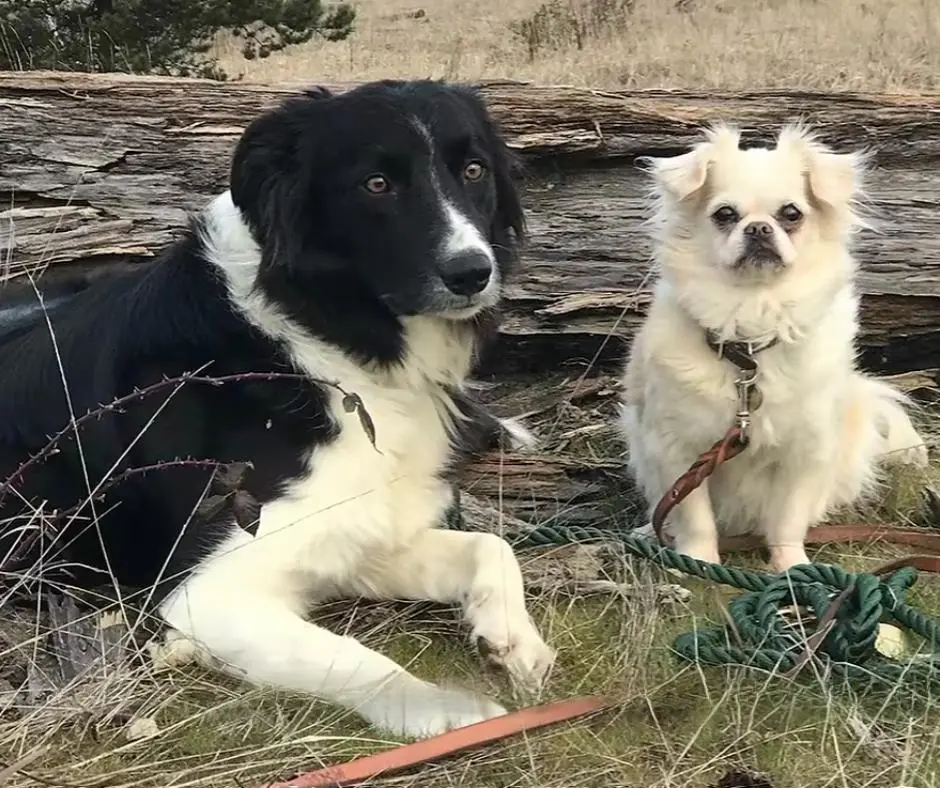
This is the comprehensive chronicle of Sam, a senior dog who had known nearly two decades of unbroken companionship, and Gigi, a tiny rescued kitten whose arrival altered the trajectory of a profound mourning process.
When Sam lost his lifelong partner, Scotty, at an advanced age, the psychological toll was immediate and unmistakable. The senior canine retreated inward, his vibrant personality subdued by an ache that humans often struggle to soothe. Recognizing the depth of this despair, Sam’s human family introduced an unlikely catalyst for recovery: a pint-sized, rescued feline named Gigi.
What began as a tentative introduction blossomed into a masterclass in emotional resilience. Gigi did not seek to replace Scotty; rather, she offered a novel form of solace that bridged an otherwise unmanageable gap.
This investigative report examines the psychological anatomy of animal grief, the delicate mechanics of interspecies bonding, and the unique progression of a friendship that ultimately transcended backyard fences to include leash training, unleashed outdoor explorations, and a digital following captivated by their remarkable synergy.
Detailed Chronology: From Loss to Unlikely Friendship
The Era of Scotty: 18 Years of Shared Quietude
To understand the magnitude of Sam’s grief, one must first comprehend the sheer depth of his history. For nearly 18 years, Sam’s existence was tethered to Scotty. In the canine world, 18 years represents an extraordinary span of longevity, a testament to attentive care and a peaceful domestic environment.
During this nearly two-decade tenure, Sam and Scotty shared everything. Their days were choreographed by quiet routines: synchronized resting spots, predictable mealtimes, and the profound, unspoken comfort of aging alongside a kindred spirit. They did not need grand adventures to validate their bond; ordinary days were elevated simply because they navigated them together.
For Sam, Scotty was not merely a housemate. He was a foundational pillar of identity, a stabilizing force, and an anchor against the shifting tides of time. When Scotty finally passed away, the structural integrity of Sam’s daily life collapsed.
The Despair of Canine Grief
In the wake of Scotty’s passing, Sam’s family observed a transformation that broke their hearts. The dog they had known for nearly twenty years seemed to evaporate before their eyes. Canine grief is a well-documented yet deeply under-discussed psychological phenomenon; dogs experience measurable stress, behavioral regression, and depressive symptoms following the loss of a companion animal.
Sam grew noticeably quieter. His favorite resting spots remained vacant, not just physically, but emotionally. The spark that had animated his eyes during his golden years flickered and dimmed. Family members noted that he was not just missing a friend—he was mourning a way of life. The familiar rhythms had vanished, leaving behind an eerie silence that no human voice or extra treat could fully penetrate.
Recognizing that time alone might not heal a senior dog whose spirit was actively fading, the family began searching for a way to rewrite his daily narrative.
The Arrival of Gigi
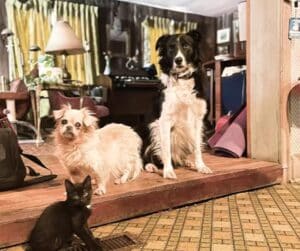
The intervention came in a small, fuzzy, and wholly unexpected package: a rescued kitten named Gigi. Too young to understand the complex grief weighing down the household, Gigi entered Sam’s space with the unbridled curiosity and fearless optimism characteristic of her species.
Initially, the introduction was met with guarded confusion. Sam, a senior dog set in the deeply ingrained habits of a nearly two-decade lifestyle, did not quite know what to make of this tiny, energetic interloper. There was no precedent in his memory banks for a miniature feline sharing his domain, let alone demanding his attention.
Yet Gigi remained utterly undeterred by Sam’s initial hesitation. Possessing a persistent yet remarkably gentle disposition, the kitten began infiltrating Sam’s guarded perimeter. She approached him not with the boisterous energy common to kittens, but with a deliberate tenderness. She rubbed against his aging legs, mapping his scent, and systematically sought out his physical proximity, curling up as close as safety and comfort would allow. Day by day, her soft persistence chipped away at his isolation, weaving herself into the fabric of his routine whether he was initially ready for it or not.
Expanding the Boundary: From Indoors to the Great Outdoors
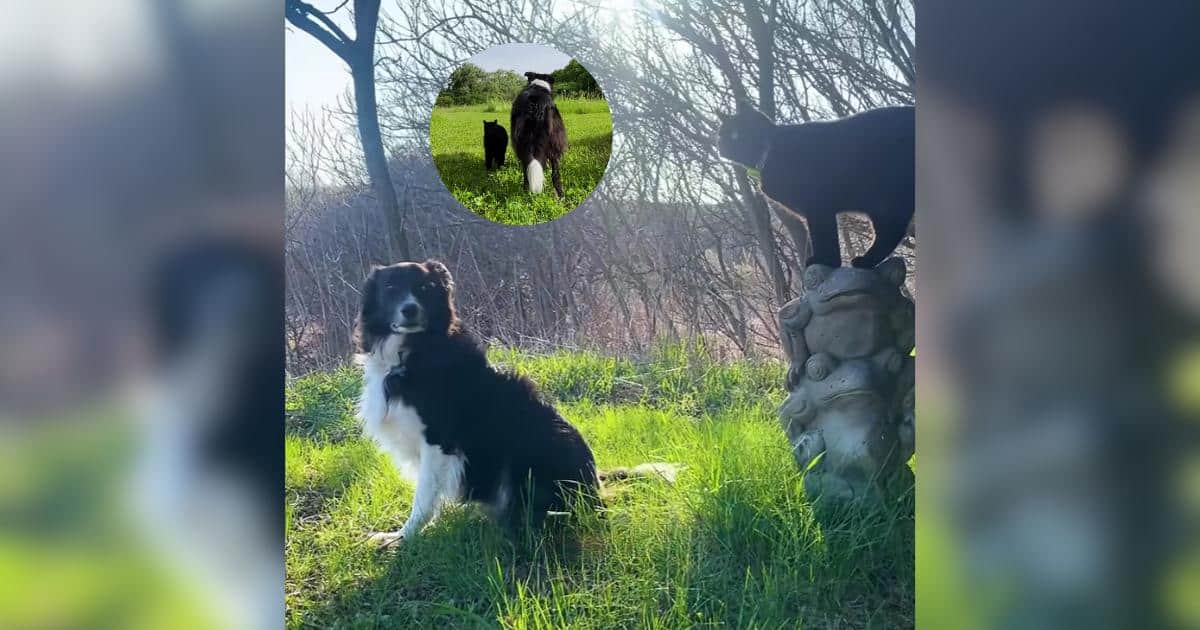
As the bond solidified, Gigi’s attachment to Sam evolved from domestic closeness to an inseparable loyalty. When Sam’s family prepared him for his daily outdoor walks, the kitten made her displeasure at being left behind abundantly clear. She watched him leave with a distinct restlessness, telegraphing a clear message: wherever Sam went, she intended to follow.
Faced with an adventurous kitten eager to defy indoor boundaries, their human caretaker initiated a creative training regimen. Gigi was introduced to a specialized harness and leash, transforming the house cat into a sidewalk companion.
What began as a novel experiment quickly became a natural extension of their daily routine. With patience and exposure, Gigi adapted seamlessly to outdoor excursions, walking alongside her canine protector with mounting confidence.
Eventually, the trust between them reached a level that defied conventional pet ownership: Gigi transitioned from leash walks to roaming untethered, choosing of her own free will to stay directly by Sam’s side. This remarkable behavioral adaptation was not merely a trick; it was a physical manifestation of an unbreakable interspecies pact.
Supporting Context & Metrics: The Science of Interspecies Empathy
Understanding Canine Mourning and Neurochemistry
To contextualize Sam’s recovery, one must examine the neurological impact of loss on senior dogs. Ethologists and veterinary behavioral scientists have increasingly recognized that domestic canines experience grief in ways structurally analogous to human bereavement. When a bonded companion passes, dogs frequently exhibit elevated cortisol levels, disrupted sleep patterns, decreased appetite, and profound behavioral withdrawal.
For Sam, who had spent 18 years conditioning his neurochemistry around Scotty’s constant presence, the loss triggered a profound physiological deficit. Companionship releases oxytocin—often dubbed the "bonding hormone"—which regulates stress and stabilizes mood. The sudden absence of this chemical feedback loop explained Sam’s rapid physical and emotional decline.
The Role of Animal Rescue and Feline Adaptability
Gigi’s background as a rescued kitten added another layer of dynamic interaction to the household. Rescued animals often display heightened adaptability and an acute sensitivity to environmental cues. Gigi’s instinctual drive to bond with Sam was not merely a product of feline playfulness; it was an intuitive grasp of need.
Interspecies friendships between dogs and cats, while rare in media portrayals, are well-documented in behavioral science. When social animals are placed in shared environments during critical developmental or transitional phases, cross-species socialization often supersedes ancestral predator-prey instincts. Gigi viewed Sam not as a threat or a different species, but as a core pillar of her security and social group.
Digital Footprint and Cultural Impact
The resonance of Sam and Gigi’s story extended far beyond their living room. As their human caretaker began documenting their journey online—culminating in a dedicated Instagram presence (@birdershewrote) and viral video features—the narrative struck a chord with a global audience.
In an era defined by digital isolation and rapid news cycles, the unassuming friendship of a senior dog and a rescued kitten offered millions of viewers a powerful reminder of empathy, resilience, and the healing power of unexpected connections. The metrics of their digital engagement underscore a universal public appetite for stories that validate the emotional depth of animals.
Official Perspectives and Expert Commentary
While formal press releases are rarely issued for domestic pet integrations, veterinary professionals, animal behaviorists, and rescue advocates have long weighed in on the dynamics observed in cases like Sam and Gigi’s.
Veterinary Insights on Senior Pet Transitions
Dr. Elena Vance, a prominent companion animal behaviorist specializing in senior pet care, notes that introducing a young animal to an elderly grieving pet is a delicate maneuver fraught with both risk and reward.
"When an elderly dog loses a lifelong companion, the primary clinical concern is rapid cognitive and physical decline induced by depression," Dr. Vance explains. "Owners frequently make the mistake of attempting to replace the lost pet with one of the exact same species and age, which can overwhelm the surviving animal. Introducing a completely different species—such as a kitten to a senior dog—bypasses direct social comparisons. The senior dog does not view the kitten as a rival for Scotty’s specific legacy; instead, the kitten occupies an entirely new ecological niche in the household."
The Human Element: Managing Grief by Proxy
Sam’s human family also played an indispensable role in navigating this transition. Animal welfare advocates emphasize that rescued kittens like Gigi require intentional stewardship to safely integrate into multi-species households.
By taking the proactive step to harness-train Gigi, the family acknowledged that emotional healing often requires environmental enrichment. Rather than keeping the cat strictly indoors to protect her from outdoor hazards, they facilitated a bridge between Sam’s outdoor routine and Gigi’s burgeoning loyalty. This stewardship transformed a potentially stressful co-habitation into an active, shared adventure.
Future Outlook: Legacy and Lessons in Empathy
As Sam navigates his advanced senior years and Gigi grows from an energetic kitten into a poised young cat, their story offers enduring lessons for animal lovers, behaviorists, and anyone grappling with the complexities of loss.
Redefining the Parameters of Loss and Recovery
The central philosophical takeaway from Sam and Gigi’s journey is that grief does not demand a symmetrical replacement. Gigi did not erase Scotty; she did not fill the exact 18-year shaped void left by the departed dog. Instead, she expanded Sam’s world, proving that the heart can simultaneously honor a profound past while embracing an utterly unpredictable present.
For senior pets facing the twilight of their lives, isolation is often the most dangerous threat to longevity. Gigi’s persistent affection revitalized Sam’s immune system, elevated his mood, and gave him a renewed sense of purpose.
The Ongoing Journey: Digital Chronicles and Advocacy
Today, Sam and Gigi continue to document their adventures online, serving as ambassadors for animal rescue, senior pet adoption, and the surprising depth of interspecies friendships. Their ongoing narrative encourages prospective pet owners to look beyond traditional pairings when seeking to enrich the lives of animals in transition.
As the path ahead unfolds for this unlikely duo, they stand as a living testament to a simple yet profound truth: healing often arrives in the smallest, most unexpected forms. Whether navigating a suburban sidewalk on a leash or walking side-by-side in quiet, unspoken harmony, Sam and Gigi remind us all that compassion knows no boundaries of age, size, or species.