
Executive Overview
In the realm of professional wildlife conservation, milestones are rarely marked by dramatic, cinematic spectacles. More often, they are measured in millimeters—the span of an aluminum band, the width of a bird’s tarsus, or the incremental growth of native shrubland. However, conservationists at the Bent of the River Audubon Center in Southbury, Connecticut, recently experienced a moment that broke entirely from this quiet norm: a biological "grand slam."
During a single routine avian-banding session this season, the center’s licensed bird bander successfully captured, cataloged, and banded all four of the sanctuary’s primary focal species: the Prairie Warbler (Setophaga discolor), the Field Sparrow (Spizella pusilla), the Blue-winged Warbler (Vermivora cyanoptera), and the Indigo Bunting (Passerina cyanea). For the staff, researchers, and volunteers who dedicate their lives to local ecological stewardship, this occurrence was nothing short of historic. It marked the first time in the center’s recorded history that all four target species were documented utilizing the same localized habitat simultaneously during a single trapping and assessment window.
This milestone is far more than a statistical curiosity or a feather in the cap of local researchers; it serves as a powerful, empirical validation of intensive, hands-on habitat management. The convergence of these four sensitive species in a single zone is a direct result of a rigorous ecological restoration project executed in the sanctuary’s Cedar Fields. By deploying aggressive habitat intervention—removing invasive species, clearing overgrown saplings, and engineering an early successional ecosystem—conservationists have effectively turned back the ecological clock, creating a thriving nursery for shrubland-dependent migratory birds.
As songbird populations face steep, well-documented declines across North America due to habitat fragmentation and ecological succession, the success at Bent of the River offers a vital blueprint for localized conservation. This comprehensive report explores the chronology of the restoration effort, the empirical metrics driving the center’s success, the methodologies behind professional bird banding, and the broader implications for biodiversity stewardship in the Northeast.
Detailed Chronology: From Overgrown Acres to an Ecological Renaissance
To understand the magnitude of the recent "grand slam," one must examine the landscape of the Bent of the River Audubon Center prior to intervention. Spanning over 700 acres of diverse ecosystems—including rich deciduous forests, wildflower meadows, pristine riverfronts, and brushy fields—the sanctuary serves as a crucial ecological anchor in the Housatonic River watershed.
Among these diverse zones, the Cedar Fields historically stood as a vital haven for shrubland birds. However, like many open and semi-open landscapes in the northeastern United States, the Cedar Fields were slowly succumbing to a natural, yet problematic, ecological process: succession. Without regular disturbance or active management, open brushlands inevitably transition into closed-canopy forests. Trees and woody saplings encroach upon the space, while aggressive invasive plant species choke out the native understory vegetation that ground-nesting and shrub-nesting birds desperately require for survival.
Recognizing the impending loss of this critical early successional habitat, the conservation staff at Bent of the River initiated a multi-year assessment of the Cedar Fields. Utilizing long-term datasets gathered from regular bird banding and systematic territory mapping, researchers identified a troubling stagnation. Certain focal species were utilizing the fields in diminishing numbers, finding it increasingly difficult to forage, shelter, and raise broods amid the tightening botanical competition.
The Autumn Intervention
The turning point arrived in the autumn months, when the center’s ecology team executed the most intensive habitat management campaign the property had seen in several years. Moving away from passive observation, the staff adopted a hands-on, interventionist approach designed to reset the ecological clock of the Cedar Fields.
Working systematically through the cooler months, conservationists and specialized field crews engaged in heavy brush-clearing operations. They targeted encroaching native trees and woody saplings that were beginning to shade out the low-growing shrubs. Concurrently, the team waged a war against invasive plant species—such as multiflora rose, autumn olive, and Oriental bittersweet—which outcompete native flora and offer inferior nutritional and structural support for native wildlife.
The goal of this intensive labor was singular: to recreate a healthy, dynamic early successional habitat. This specific ecological phase—characterized by dense thickets, briars, scattered saplings, and rich herbaceous ground cover—is among the most endangered habitat types in modern New England. As surrounding regions have either been developed into commercial and residential zones or allowed to mature into unbroken forest, early successional habitats have vanished, taking specialized wildlife populations down with them.
The winter gave way to spring, and the newly rejuvenated Cedar Fields were put to the test as migratory songbirds returned from their wintering grounds in Central and South America, the Caribbean, and the southern United States. The results of the autumn intervention were not merely positive; they were nearly instantaneous.
Supporting Context & Metrics: Measuring the Success of Habitat Engineering
In modern conservation science, anecdotal observations must be backed by hard, verifiable data. At Bent of the River, the proof of the Cedar Fields’ ecological revival is quantified through rigorous avian monitoring protocols, primarily focusing on bird banding and territory mapping.
The Power of Focal Species
The four species captured during the historic banding session—the Prairie Warbler, Field Sparrow, Blue-winged Warbler, and Indigo Bunting—are not chosen at random. They serve as reliable "bioindicators" of ecosystem health. Because each species has distinct micro-habitat requirements within early successional zones, their presence, absence, and reproductive success tell a nuanced story about the condition of the landscape.
- Prairie Warbler (Setophaga discolor): A striking yellow warbler distinguished by its facial markings and rapid, buzzing song, this species relies almost exclusively on brushy pastures, clearcuts, and regenerating scrub oak fields. They require dense, low woody vegetation for nesting, typically placing their cups just a few feet off the ground.
- Field Sparrow (Spizella pusilla): Known for its cascading, bouncing-ball song, the Field Sparrow favors overgrown fields interspersed with small trees and shrubs. They forage on the ground for seeds and insects and nest low in shrubs or tufts of grass.
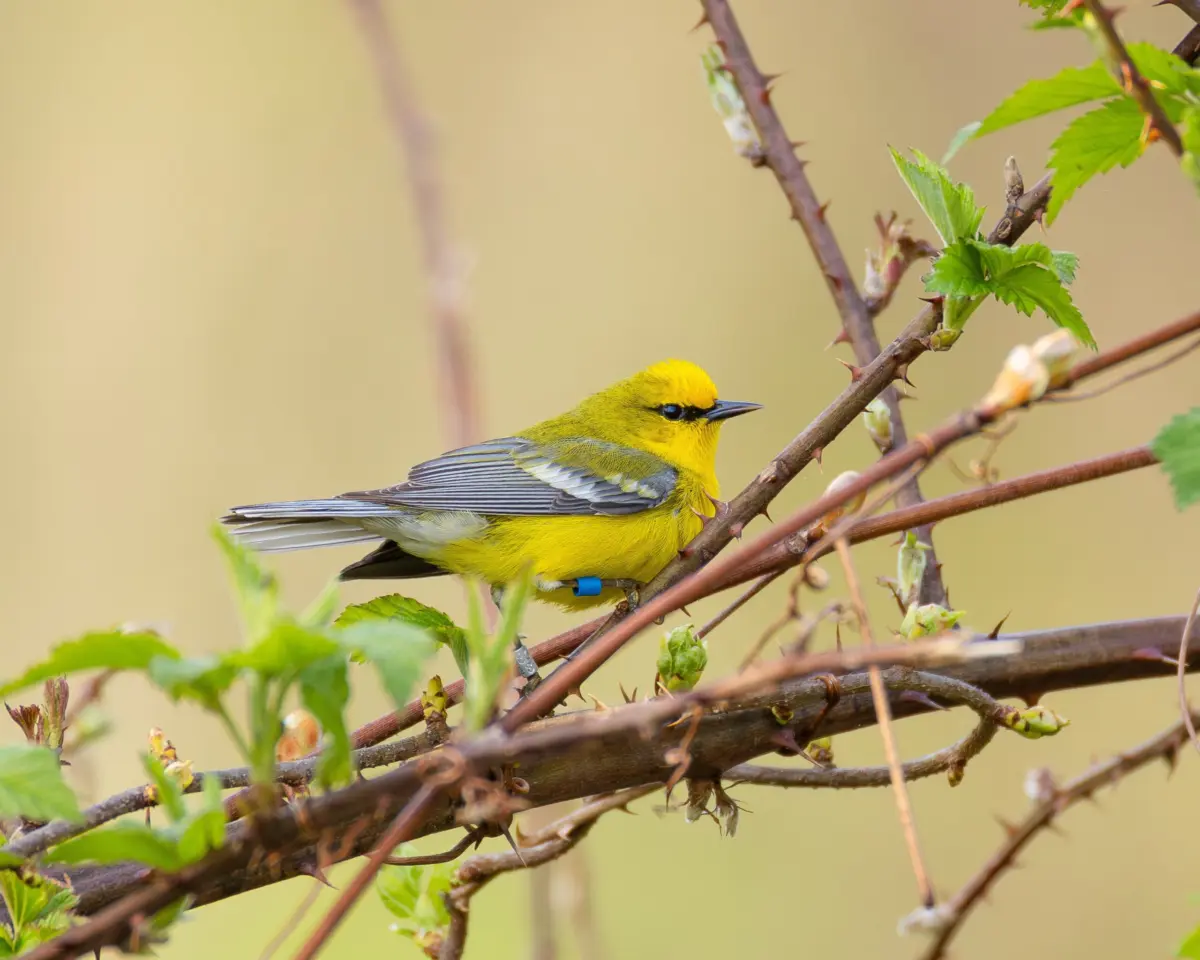
- Blue-winged Warbler (Vermivora cyanoptera): This bright yellow warbler with distinctive wing-bars thrives in transitional zones—the ecotones where mature forest meets open brushland or old fields. They are highly sensitive to habitat degradation and require a mosaic of herbaceous ground cover and scattered saplings.
- Indigo Bunting (Passerina cyanella): The brilliant, sapphire-blue male bunting is a quintessential bird of brushy edges, roadsides, and abandoned farmlands. They utilize shrubby vegetation for nesting and feed heavily on seeds and insects found in open, sunny patches.
Quantifying the Jump: A 400% Increase
The most compelling metric emerging from the Bent of the River management project centers on the Prairie Warbler population. Prior to the heavy clearing and invasive species removal in the Cedar Fields, systematic territory mapping recorded just one active Prairie Warbler territory within the zone.
Following the autumn intervention, the landscape was surveyed anew for the breeding season. The number of active Prairie Warbler territories surged from 1 to 5—representing a staggering 400 percent increase.
This dramatic population spike illustrates a fundamental ecological principle: if you build the right habitat, the wildlife will respond with remarkable speed. The cleared fields provided the specific structural density, insect prey base, and nesting substrates that Prairie Warblers required, prompting multiple pairs to settle, defend territories, and attempt breeding in an area they had previously largely bypassed.
The Banding Methodology and Long-Term Tracking
Every bird captured during these sessions undergoes a meticulous, highly regulated scientific assessment. Handled exclusively by licensed professionals and trained Audubon biologists, each bird is carefully examined for age, sex, fat stores, and physical condition before being fitted with two distinct markers.
First, the bird receives a standard United States Geological Survey (USGS) aluminum leg band, stamped with a unique nine-digit tracking number. This federal band acts as an identity card, allowing researchers across the continent to track long-term survival rates, movement patterns, and longevity if the bird is ever recaptured.
Second, the center utilizes a combination of colored "auxiliary" bands. By placing specific sequences of plastic colored bands alongside the USGS metal band, researchers create a unique visual "license plate" for each individual bird. This ingenious system allows staff, field researchers, and even observant visitors to identify specific birds in the field through binoculars or spotting scopes without the stress of recapturing them.
This color-banding protocol has yielded profound insights into avian longevity and site fidelity at Bent of the River. Notably, the center previously documented an 11-year-old Blue-winged Warbler—a remarkably advanced age for a migratory songbird of its size—that was originally banded on the property as a hatchling or adult years prior. This same veteran individual was re-sighted in the sanctuary during subsequent migration seasons, and remarkably, again this spring. Such longevity records are rare in ornithology and stand as an undeniable testament to the high quality, safety, and ecological stability of the sanctuary’s managed habitats.
Official Statements and Conservation Philosophy
The success at Bent of the River is deeply rooted in a philosophy that rejects passive preservation in favor of active, science-driven stewardship. While the concept of leaving nature entirely untouched has its place in certain wilderness areas, human-influenced landscapes in the Northeast require active management to maintain biodiversity.
The Philosophy of Active Stewardship
"People often assume that true conservation means walking away and letting nature take its course," notes conservation leadership at the center. "However, in a fragmented landscape surrounded by roads, suburban development, and invasive species, ‘letting nature take its course’ often results in uniform forests and the complete loss of critical, specialized habitats like shrublands. Our recent ‘grand slam’ proves that active, thoughtful stewardship is essential. By rolling up our sleeves and doing the heavy lifting of clearing invasives and resetting succession, we are actively creating the conditions that vulnerable species need to survive."
This philosophy aligns with broader regional and national initiatives spearheaded by the National Audubon Society, which increasingly emphasizes the conservation of declining migratory birds through landscape-level habitat management. Shrubland birds, in particular, have suffered some of the steepest population declines over the past half-century compared to forest-dwelling or wetland species. Without dedicated human intervention to maintain early successional stages through controlled clearing, mowing, or burning, these species face a narrowing window of viable habitat.
Furthermore, the integration of community science and public engagement remains a cornerstone of the center’s mission. Staff members emphasize that the success in the Cedar Fields does not belong solely to the researchers; it is shared by the broader community of supporters, volunteers, and visitors who help monitor the sanctuary’s changing landscape.
Future Outlook: Sustaining Momentum and Community Involvement
As the warmth of summer slowly transitions into the crisp air of autumn, the ecological cycle at Bent of the River Audubon Center turns its focus toward the future. The data gathered from this season’s record-breaking banding sessions will not be filed away; instead, it will serve as the foundational dataset for shaping the center’s land-management plans for the upcoming seasons.
Data-Driven Adaptive Management
Adaptive management—the practice of implementing management strategies, monitoring their biological outcomes, and adjusting future actions based on those results—will continue to guide the stewardship of the Cedar Fields and surrounding habitats. With concrete evidence that the autumn 400% increase in Prairie Warbler territories yielded a successful breeding season, staff plan to expand and refine their early successional management protocols.
Future phases of the project will likely involve rotating management zones within the broader sanctuary. By staggering clearing efforts across different parcels of land over multi-year cycles, the center can ensure a continuous mosaic of habitat ages—providing fresh, ideal conditions for shrubland birds while maintaining mature brush for species that prefer older thickets.
How the Public Can Participate
While professional bird banding is strictly regulated and restricted to permitted biologists to ensure the safety and welfare of the birds, everyday nature enthusiasts have a vital role to play in the ongoing research.
Staff are actively encouraging visitors, local birders, and naturalists to keep a sharp eye out for color-banded birds while exploring the trails at Bent of the River. Because individual birds wear unique combinations of colored auxiliary bands, keen-eyed observers can contribute directly to the sanctuary’s scientific tracking database.
Anyone fortunate enough to spot a color-banded bird within the sanctuary is encouraged to record the specific arrangement, colors, and relative positions of the bands on the bird’s legs, along with the date, time, and precise location of the sighting. These reports should be submitted directly to the center’s research team via email at [email protected].
By turning every trail walker into a citizen scientist, the center multiplies its observational capacity, ensuring that the legacy of stewardship, discovery, and avian conservation at Bent of the River continues to soar to new heights for generations to come.