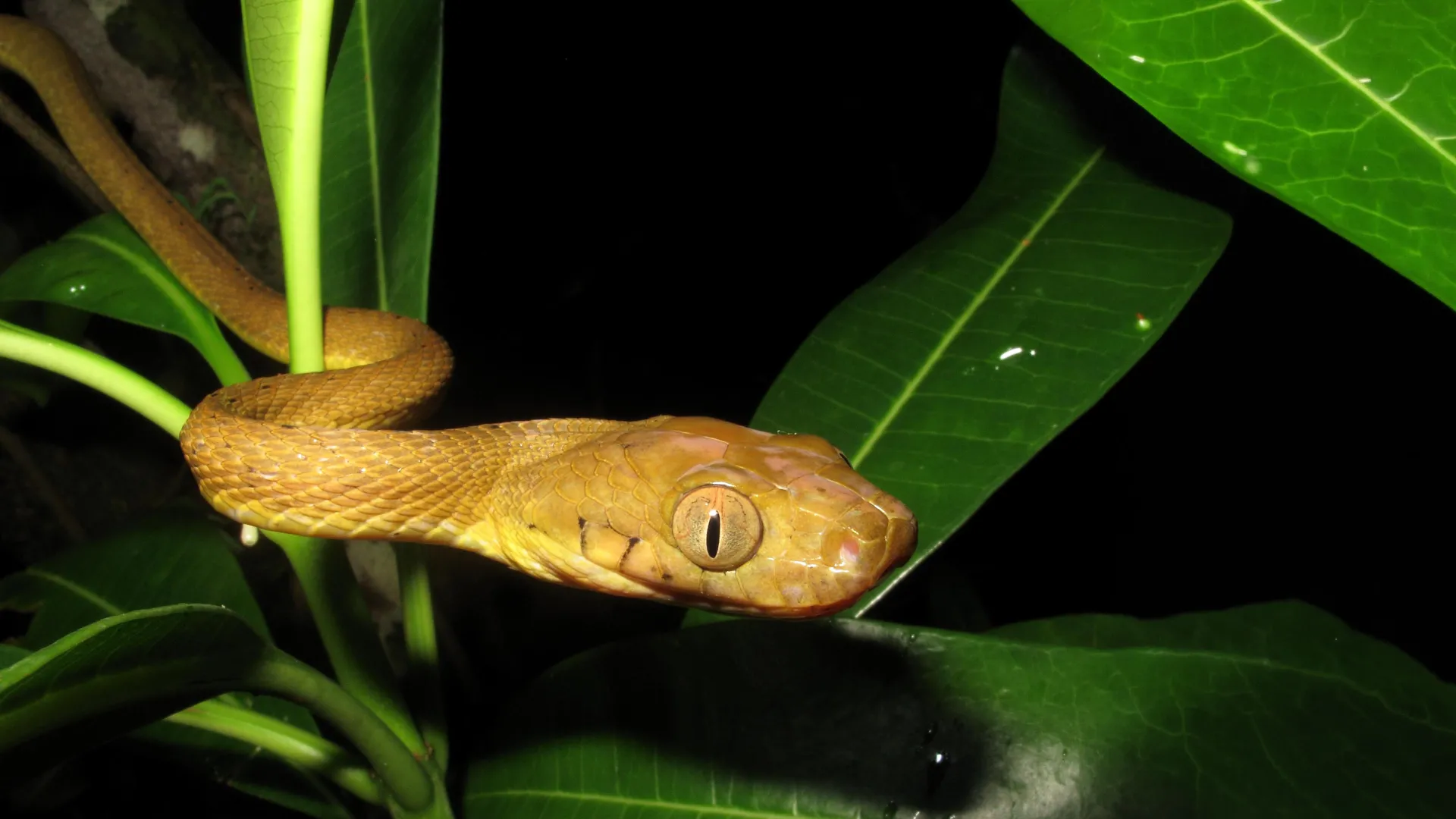

The brown tree snake (Boiga irregularis) stands as a sobering masterclass in ecological disruption. Native to the forested ecosystems of Australia and the South Pacific, this nocturnal, mildly venomous predator accidentally hitched a ride on military cargo planes in the aftermath of World War II, establishing a beachhead on the strategic U.S. island territory of Guam. What followed was an environmental catastrophe of unprecedented proportions. Without native predators to check their growth, brown tree snakes proliferated violently, driving many of Guam’s endemic forest birds to local extinction and disrupting human infrastructure by scaling utility poles, triggering widespread electrical blackouts, and causing hundreds of thousands of dollars in damages each year.
In certain localized zones across Guam, population densities have reached an astonishing 30,000 snakes per square mile—a biological saturation point that defies conventional ecological theory. For decades, evolutionary biologists and conservationists have been deeply puzzled by this population explosion. Historical accounts and genetic models suggest that the initial invasion of Guam was sparked by a mere handful of founding individuals. Under standard biological paradigms, such a drastic founding population should trigger a catastrophic genetic bottleneck. Inbreeding depression, resulting from a lack of genetic diversity, normally strips a species of its adaptive flexibility, leading to lowered fertility, increased susceptibility to disease, and eventual population collapse.
However, the brown tree snake rewrote the biological rulebook.
A landmark study published on July 24 in the journal Science Advances, led by a multidisciplinary team from the University at Buffalo (UB) in collaboration with the U.S. Geological Survey (USGS), reveals that these invasive predators possess a hidden reservoir of genetic variation far greater than previously understood. By deploying cutting-edge long-read DNA sequencing technologies, researchers uncovered more than 19,000 structural variants within the snake’s genome—large-scale chromosomal alterations involving duplicated, deleted, or rearranged DNA segments.
These structural mutations, heavily concentrated in genes governing immune defense and olfaction (the sense of smell), allowed the snakes to bypass the hazards of inbreeding depression. The findings not only explain how a microscopic founding group conquered an entire island, but they also signal a paradigm shift in how science measures genetic health, offering sobering news for invasive species control while casting a surprising ray of hope for endangered species battling the brink of extinction.
Detailed Chronology
To fully grasp the magnitude of the recent discovery, it is essential to trace the timeline of the brown tree snake’s invasion and the technological evolution that ultimately cracked the code of its survival.
The Post-WWII Arrival and Ecological Collapse
- Circa 1945–1950: Following the conclusion of World War II, increased military logistics and cargo transport inadvertently transport a small number of brown tree snakes from their native habitats in coastal Australia, Papua New Guinea, and the Solomon Islands to the island of Guam.
- The 1960s–1980s: Hidden from immediate public notice, the snake population multiplies exponentially. By the 1980s, the ecological toll becomes undeniable. Guam’s rich avian fauna—having evolved in the absence of mammalian or reptilian tree-climbing predators—is decimated. Birds such as the Guam flycatcher, the rufous fantail, and the Guam rail vanish from the wild. The silencing of the island’s bird songs transforms lush forests into silent landscapes, while secondary ecological effects ripple outward, causing plant pollination rates to plummet.
- Infrastructure Impact: Beyond ecological devastation, the snakes adapt to human presence. Their penchant for climbing electrical infrastructure causes frequent short circuits, plunging residential and commercial sectors into darkness on a regular basis.
The Decades-Long Genetic Enigma
- 1990s–2010s: Federal agencies, including the USGS Brown Tree Snake Rapid Response Team (RRT), launch intensive containment, trapping, and eradication protocols. Biologists analyze the snakes using standard genetic sequencing tools available at the time. These early assays, focused primarily on single nucleotide polymorphisms (SNPs)—minor mutations where a single DNA base pair changes—suggest low genetic diversity. Scientists are left scratching their heads: How can a population with seemingly impoverished genetic material experience such explosive growth and environmental adaptation?
The Genomic Breakthrough
- Recent Years: Recognizing the limitations of legacy genetic tools, a research team led by UB’s Dr. Trevor Krabbenhoft joins forces with USGS geneticists to examine archived DNA samples obtained via the RRT.
- July 24 (Publication Date): The team publishes its groundbreaking paper in Science Advances. Utilizing advanced long-read sequencing technologies, they peer deeper into the genome than ever before. Rather than merely counting single-letter typos in the genetic code, they map large structural rearrangements across the chromosomes, revealing thousands of hidden variations that shatter previous assumptions about inbreeding, adaptation, and evolutionary resilience.
Supporting Context & Metrics
The revelation that brown tree snakes harbor thousands of structural variants forces a total re-evaluation of how genetic diversity is defined, measured, and applied to conservation biology.
The Limitations of Legacy Sequencing
For decades, the scientific community relied heavily on short-read DNA sequencing technologies. These tools were revolutionary for their time, allowing researchers to read millions of short DNA fragments and piece them back together by aligning them to a reference genome. However, short-read sequencing excels primarily at detecting localized single nucleotide variations (SNPs)—points where an individual DNA letter (A, T, C, or G) differs from the norm.
Think of comparing two editions of a massive historical manuscript. Short-read sequencing is like using a magnifying glass to check if individual letters were mistyped. While effective at catching minor typos, it completely misses the fact that entire chapters have been ripped out, duplicated, or pasted into a completely different section of the book.
Enter Long-Read Sequencing
Long-read sequencing technology changed the game. By sequencing continuous stretches of DNA that are thousands of base pairs long, researchers can resolve complex genomic landscapes that were previously invisible. This approach makes it possible to detect structural variants (SVs)—large-scale genomic mutations affecting 50 or more base pairs, including insertions, deletions, inversions, and translocations.
The metrics uncovered by the UB and USGS research team underscore the sheer scale of these hidden alterations:
- Over 19,000 Structural Variants: When analyzing the snake genomes, researchers identified more than 19,000 distinct locations where DNA segments were structurally rearranged, duplicated, or deleted.
- Amplified Genomic Footprint: Structural variants alter nearly eight times more of the total genome than single base pair mutations combined. Without long-read technology, the vast majority of the snake’s actual genetic variation remained entirely unmapped.
- Functional Hotspots: These structural shifts were not randomly distributed across the genome. Instead, they clustered densely around specific functional categories, most notably genes associated with immune system function and olfaction (the sense of smell).
The Behavioral Mystery of Olfactory Adaptation
The heavy concentration of structural variants in olfactory genes sheds light on a fascinating behavioral paradox. In their native Australian and South Pacific ranges, brown tree snakes frequently engage in cannibalism, occasionally preying upon one another. Yet, despite reaching hyper-dense populations of up to 30,000 snakes per square mile on Guam, widespread cannibalism is notably absent.
How do thousands of venomous, highly competitive predators coexist in such cramped quarters without turning on each other en masse?
The answer likely lies in their heightened, structurally diverse sense of smell. Brown tree snakes navigate their world and hunt by flicking their forked tongues, capturing chemical cues from the environment to analyze prey. The researchers hypothesize that the unique structural variations in their olfactory receptors allow the snakes to chemically recognize their dense neighbors not as prey, but as kin. By identifying relatives via scent, the snakes mitigate internal predation, preserving population momentum during the critical phases of post-invasion expansion.
Official Statements
The implications of this study extend far beyond the tropical jungles of Guam, striking a chord across evolutionary biology, wildlife management, and conservation science.
Dr. Trevor Krabbenhoft, associate professor in the UB Department of Biological Sciences and corresponding author of the study, emphasizes that the scientific community has long misjudged the true genetic makeup of invasive species:
"The brown tree snake is maybe not wildly diverse, but it has important sources of genetic diversity that have been underappreciated."
Krabbenhoft notes that standard metrics of genetic health have historically led scientists to underestimate resilient populations that undergo severe population bottlenecks.
Dr. Christopher Osborne, formerly a PhD student in Krabbenhoft’s lab and now an aquatic biologist at SUNY Oswego, highlights the double-edged sword of the discovery—offering both a warning for pest eradication and a glimmer of hope for endangered species:
"It’s possible that endangered species may have more flexibility in their genes than we realize. We’re now getting a better understanding of unappreciated sources of genetic diversity that may explain how some inbred species can still respond to their environment."
Dr. Levi Gray, a postdoctoral researcher in Krabbenhoft’s lab and former USGS researcher who studied Guam’s snake crisis firsthand, uses a literary analogy to articulate the technological leap achieved by the research team:
"It’s like looking at portions of two books letter by letter with a magnifying glass and thinking they’re the same, but not realizing entire paragraphs have been moved around or duplicated. Older sequencing technology didn’t allow us to easily see that DNA in one individual might be in a completely different place on the chromosome than in another. How we define genetic diversity and how we actually measure it is shaped largely by the technology of the day."
Addressing the evolutionary origin of these structural variants—specifically whether they evolved natively in Australia before transport or emerged rapidly on Guam in response to environmental pressures—Gray points toward the next frontier of research:
"Is it possible some of this diversity emerged after the invasion? It is, but we would have to sequence snakes from the native populations to know for sure."
Future Outlook
The publication of this study in Science Advances marks the closing of one chapter in invasion biology and the opening of several critical new ones.
Ramifications for Invasive Species Management
For agencies like the USGS Brown Tree Snake Rapid Response Team, the news is sobering. Decades of containment strategies have relied on the assumption that a restricted founding population would eventually suffer from genetic decay, making them increasingly vulnerable to environmental stressors or targeted control measures.
However, if brown tree snakes possess an intrinsic genomic elasticity driven by thousands of structural variants, their capacity to adapt to new control methods, tolerate chemical deterrents, or expand into new island territories may be far greater than previously calculated. Environmental protection agencies across the Pacific and Indian Oceans—including Hawaii, where authorities maintain constant vigilance against potential snake introductions—must factor this enhanced resilience into biosecurity planning.
A Beacon of Hope for Endangered Taxa
Conversely, conservation biologists working to save critically endangered species trapped in small, isolated habitats can draw cautious optimism from the findings.
Many endangered animals—from island foxes to specialized big cats—suffer from extreme population bottlenecks and high levels of inbreeding. Historically, conservation geneticists viewed these populations as walking dead, doomed by an inevitable loss of genetic adaptability. The brown tree snake study demonstrates that structural variants can act as a hidden genetic savings account. Even when single-base genetic diversity appears dangerously low, complex chromosomal rearrangements may provide the raw evolutionary fuel necessary for a species to adapt, mount immune responses, and weather environmental change.
The Road Ahead: Native Range Sequencing
To fully resolve the mystery of the brown tree snake, the UB and USGS research coalition is setting its sights on the next phase of investigation. By obtaining and sequencing DNA samples from brown tree snakes across their native Australian and South Pacific ranges, scientists hope to determine whether the 19,000 structural variants arrived fully formed on Guam’s shores in the mid-20th century, or if genomic architecture can adapt at lightning speed under the intense evolutionary pressure of an island invasion.
Until those answers emerge, the brown tree snake remains an imposing testament to nature’s adaptability—a creature that defied the mathematical laws of inbreeding, conquered an island paradise, and forced science to rewrite its understanding of the code of life.