
Executive Overview
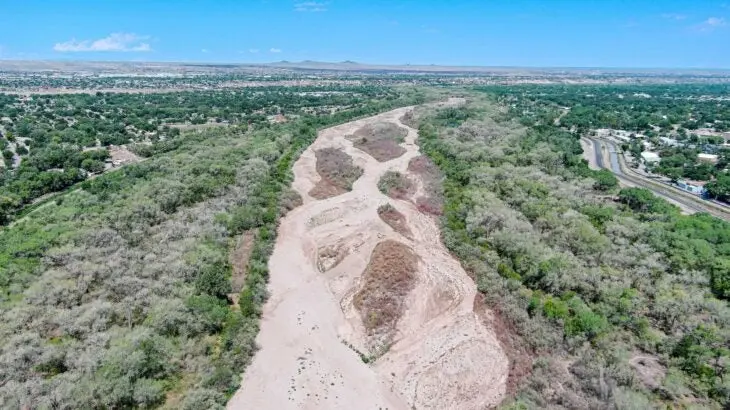
The American Southwest is currently ground zero for some of the most severe climate-driven aridification events in modern history. Along the storied banks of New Mexico’s Rio Grande, an ecological catastrophe is unfolding in slow motion, testing the limits of water management, institutional resilience, and conservation science. Unprecedented and prolonged river drying over the summer months has triggered a massive, distress-level die-back within the Middle Rio Grande’s bosque—the fragile, cottonwood-willow riparian forest that snakes through Albuquerque and surrounding counties.
For decades, seasonal drying events primarily wreaked havoc on native aquatic ecosystems, particularly endangering vulnerable fish populations. However, the sheer intensity and depth of the current drought cycle have breached a critical ecological threshold. For the first time on a massive scale, the region’s iconic cottonwood trees—which depend entirely on saturated, shallow groundwater tables to survive—are turning brown, grey, and brittle. Conservationists warn that without immediate intervention, up to 50 percent of the treasured Rio Grande bosque through Albuquerque faces irreversible collapse, a loss of green canopy equivalent in ecological scale to a catastrophic, high-severity forest fire.
In response to this unfolding emergency, a coalition of environmental organizations, municipal water authorities, and agricultural water districts has mobilized. Spearheaded by the National Audubon Society, the Albuquerque-Bernalillo County Water Utility Authority (ABCWUA), the Middle Rio Grande Conservancy District (MRGCD), and the U.S. Bureau of Reclamation, a high-stakes emergency water release has been initiated. This coordinated rescue mission aims to flood a parched stretch of the Rio Grande riverbed, recharge the depleted shallow aquifer, and deliver a vital, life-sustaining "irrigation" to stressed and dying riparian zones. Simultaneously, scientists and hydrologists have deployed a rigorous monitoring framework to study the bosque’s response, generating critical empirical data to inform future climate adaptation strategies across the arid West.
Detailed Chronology: From Field Alarm to Emergency Mobilization
Early-Summer Routine Monitoring and the First Warning Signs
The crisis did not announce itself with a sudden catastrophe; rather, it was uncovered during routine field operations. Approximately one month prior to the emergency water release, field researchers from the Audubon Society—including conservation staff members Tucker and his colleague—headed out to conduct baseline habitat monitoring at a restoration and conservation site in Corrales, New Mexico, just north of Albuquerque.
Since early June of this year, this specific stretch of the river had been receiving supplemental environmental water deliveries facilitated by Audubon’s ongoing environmental water leasing program. Stepping into the river corridor, the field team immediately noticed a striking dichotomy. The specific outfall point associated with their managed water delivery was thriving—vibrant, green, and biologically active. However, just beyond the immediate reach of the leased water, the landscape presented a grim, dystopian reality.
Surrounding areas that had appeared completely healthy a mere fortnight prior were now enveloped in widespread, severe stress. The vegetation had turned a sickly brown, and the sheer scale of the blighted zone signaled an alarming departure from historical seasonal norms. For veteran conservationists, the visual cues triggered immediate, visceral flashbacks to the early 2000s drought in southeastern Arizona, where a rapid, cascading collapse wiped out a vital cottonwood-willow riparian forest at the Leslie Canyon National Wildlife Refuge.
Aerial Reconnaissance and the Unprecedented Extent of Damage
Alarmed by what they witnessed on the ground, the monitoring team expanded their scope of observation. Over the subsequent few days, aerial surveys utilizing advanced drone imagery were deployed across the entirety of the Middle Rio Grande corridor.
The resulting aerial data confirmed the team’s worst fears. The ecological trauma was not localized to Corrales; it spanned the length of the riparian forest cutting through the heart of Albuquerque, with heavily stressed and dying timber extending southward into the Los Lunas area.
Historically, during seasonal dry-ups over the preceding decade, mature riparian trees managed to endure dry riverbeds by tapping into resilient, shallow subterranean aquifers. Consequently, historical mitigation efforts were almost exclusively tailored toward rescuing stranded aquatic species, such as the endangered Rio Grande silvery minnow. This year, however, the depth and geographic footprint of the dry-up surpassed anything recorded in modern hydrological logs.
When the initial batch of drone imagery was processed and reviewed, the visual evidence of systemic failure was undeniable. Younger cohorts of trees had completely turned brown or slate-grey, their cellular structures compromised beyond recovery. Even the ancient, deeply rooted cottonwoods—long considered the stoic pillars of the floodplain—showed thinning canopies shifting from pale green to sickly grey. Because Fremont cottonwoods and Goodding’s willows lack physiological mechanisms to bounce back from prolonged soil desiccation, the window for intervention was rapidly closing.
Supporting Context & Metrics: The Human and Ecological Toll
A Multifaceted Crisis Across the Valley
The environmental degradation of the bosque is occurring against a backdrop of sweeping human and agricultural hardship throughout the Middle Rio Grande valley. The compounding effects of climate change, persistent drought, and overallocation have strained the entire socio-ecological network:
- Agricultural Strains: Many local farming communities and independent agriculturalists operating within the valley have gone without surface water irrigation for upwards of 120 days during the peak growing season, forcing reliance on rapidly depleting groundwater reserves.
- Pueblo Communities: Indigenous Rio Grande Pueblos, whose cultural and economic survival is inextricably linked to the river’s historical flow regimes, have been forced to scrape by on meager, highly restricted irrigation releases.
- The Scale of Forest Loss: Experts project that without an immediate reversal of hydrological conditions, the region could witness up to a 50 percent die-back of the urban bosque through Albuquerque by next year. Ecologically, this loss mirrors the aftermath of a catastrophic mega-fire. Managing the resulting deadfall—comprising thousands of standing dead snags—will require millions of dollars in post-mortem forest management, fuels reduction, and hazard mitigation to protect surrounding urban infrastructure.
The Mechanism of Environmental Water Leasing
The current rescue operation relies heavily on a relatively novel conservation tool: environmental water leasing. Established in 2019, Audubon’s program allows water rights holders to lease a portion of their legally secured water specifically for instream environmental purposes. Rather than being diverted for municipal or agricultural use, this water is kept in the river or intentionally released to minimize critical dry stretches, maintain baseline ecological functions, and uplift local wetlands.
This mechanism does not function in a vacuum. It requires intricate administrative coordination, regulatory compliance, and real-time operational flexibility among the Middle Rio Grande Conservancy District, the U.S. Bureau of Reclamation, municipal utilities, and environmental NGOs. It represents a shift from adversarial water litigation to cooperative, market-based environmental stewardship.
Official Statements and Collaborative Intervention
Mobilizing the Partner Network
Armed with the urgent photographic evidence captured by the drone surveys, Audubon leadership compiled a comprehensive visual dossier and dispatched an emergency appeal to their regional network of water managers, conservation partners, and municipal stakeholders.
The response was swift and definitive. Recognizing that a localized die-off of the Albuquerque bosque would permanently degrade the city’s microclimate, aesthetic value, and wildlife corridors, institutional barriers were temporarily set aside to orchestrate a unified rescue effort.
The Multi-Agency Water Release Operation
At the time of this writing, a complex, multi-party water delivery operation is actively underway. By pooling and redirecting resources, the Albuquerque-Bernalillo County Water Utility Authority (ABCWUA), the Middle Rio Grande Conservancy District (MRGCD), and the Audubon Society have engineered a targeted pulse release into the parched channel of the Rio Grande.
The primary operational objectives of this coordinated release include:
- Bed Inundation: Saturating the dry riverbed through the urban corridor of Albuquerque for a sustained four-day window.
- Aquifer Recharge: Replenishing the shallow, alluvial groundwater table that feeds the root zones of the riparian canopy.
- Arboricultural Irrigation: Providing a much-needed biological drink to stressed cottonwoods and willows teetering on the edge of mortality.
Pioneering Scientific Monitoring
Beyond the immediate firefighting nature of the water release, the coalition has implemented a robust, multi-disciplinary monitoring protocol. Researchers are tracking groundwater response curves, soil infiltration and seepage rates, the specific hydrological characteristics of the artificial pulse, and the physiological recovery metrics of the trees.
This scientific initiative is designed to transform a localized crisis into a learning opportunity. The empirical data harvested during this operation will provide invaluable insights for water managers, urban planners, and conservationists grappling with how to manage future aridification events across the American Southwest.
Future Outlook: Resilience, Hope, and Adaptation
While the narrative of the Rio Grande this summer is undeniably rooted in climate despair, it simultaneously underscores an inspiring story of institutional resilience and human collaboration. The rapid mobilization of the ABCWUA, MRGCD, and conservation partners demonstrates that communities can pivot quickly when confronted with existential ecological threats.
However, conservation leaders are quick to emphasize that pulse releases are temporary stopgap measures, not permanent solutions. As global temperatures continue to rise and snowpack-driven runoff becomes increasingly erratic, New Mexico must confront long-term structural realities. Ensuring the survival of the Rio Grande bosque will require institutionalizing environmental water leasing, modernizing irrigation infrastructure, reimagining urban water conservation, and adopting flexible, science-based river management policies.
The trees currently pulled back from the brink of mortality are more than mere timber; they are essential biological anchors. They provide critical migratory bird habitat, cool the urban heat island effect, and sustain the cultural identity of the communities that call the valley home. As New Mexico navigates an increasingly arid future, the cooperative defense of the Rio Grande bosque serves as a testament to what can be achieved when diverse stakeholders unite in defense of a living river.