In recent years, the premium pet food landscape has experienced a monumental shift. Driven by consumer demand for healthier, less-processed nutrition for their companion animals, the fresh pet food sector has morphed from a niche market into a multi-billion-dollar industry. In response, traditional "Big Pet Food" conglomerates—historically built on shelf-stable kibble and canned products—have moved aggressively to stake their claim in the fresh dog food space.
Five of the largest legacy kibble manufacturers in the United States have launched fresh dog food lines. However, an in-depth analysis of these corporate offerings reveals a stark disparity between marketing claims and actual product standards. Despite premium price tags ranging from $6.50 to $17.28 per day to feed a modest 30-pound dog, only one single fresh product line offered by these traditional manufacturing giants meets human-grade standards. Furthermore, none of the products make certified humanely raised meat claims or include certified organic ingredients, and not a single manufacturer has introduced a fresh alternative for cats.
Compounding consumer confusion is a systemic regulatory vacuum: neither the U.S. Food and Drug Administration (FDA) nor the Association of American Feed Control Officials (AAFCO) has legally defined what constitutes "fresh" pet food. In the absence of enforceable legal standards, industrial manufacturers are free to market refrigerated, frozen, shelf-stable, cooked, raw, or heavily processed foods under the alluring "fresh" moniker. This investigative report examines the major corporate players entering this category, scrutinizes their ingredient and facility standards, details the wild pricing discrepancies across virtually identical feed-grade products, and addresses the critical questions facing pet parents today.
Detailed Chronology and Brand Breakdown
The entry of legacy kibble giants into fresh dog food has largely been executed through corporate acquisitions and line extensions. Below is a detailed breakdown of the five major traditional manufacturers, their seven fresh dog food brand offerings, and the specific claims—or lack thereof—associated with each line.
       +-------------------------------------------------------------------+
       |          TRADITIONAL KIBBLE MANUFACTURERS IN FRESH FOOD           |
       +-------------------------------------------------------------------+
                                         |
     +-------------------+---------------+-------------------+--------------------+
     |                   |               |                   |                    |
[Mars Petcare]   [Wellness Pet Food] [Blue Buffalo] [Hill's Science Diet] [Fromm Pet Food]
     |                   |               |                   |                    |
     +-- NomNom          +-- Protein     +-- Love Made       +-- Fresh Roll       +-- Bonnihill Farms
     +-- Royal Canin         Bowls           Fresh                                    Chickibowls
     +-- Orijen
1. Mars Petcare
As one of the largest pet care conglomerates globally, Mars Petcare has expanded its foothold in the fresh dog food market through multi-brand diversification, leveraging both legacy brands and strategic corporate acquisitions.
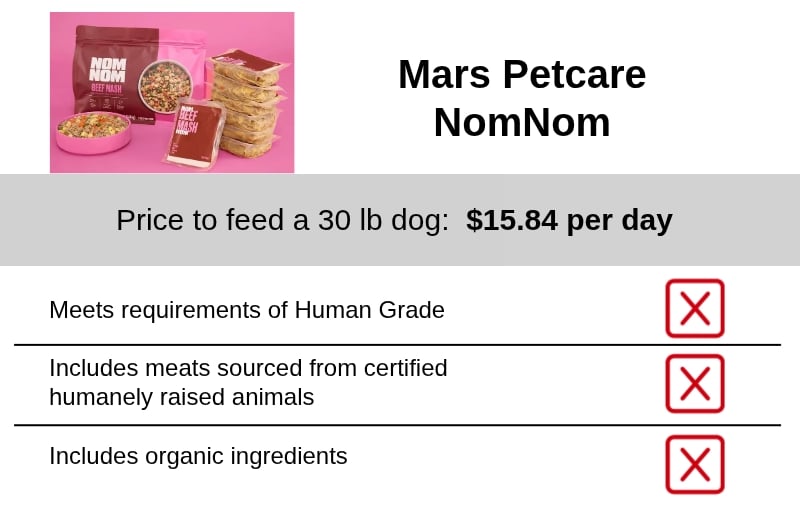
NomNom: Acquired by Mars Petcare in 2022, NomNom was initially built as a direct-to-consumer fresh pet food brand. Despite its high market positioning, the product line makes no human-grade claims, contains no certified organic ingredients, and does not claim to source meat from certified humanely raised animals.
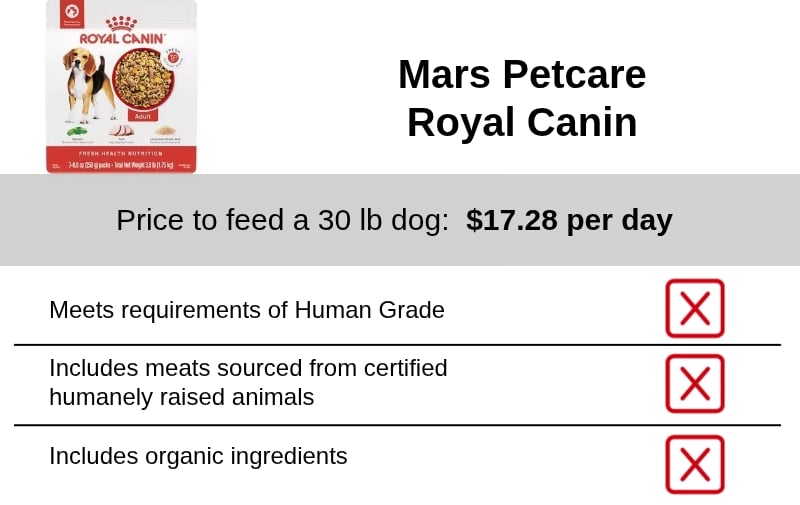
Royal Canin ("Fresh Health Nutrition"): Mars Petcare’s veterinary and specialized retail brand introduced "Fresh Health Nutrition" to capture consumers seeking therapeutic or targeted fresh meals. Like NomNom, this feed-grade line carries no human-grade claims, no organic ingredients, and no humane meat sourcing certifications.
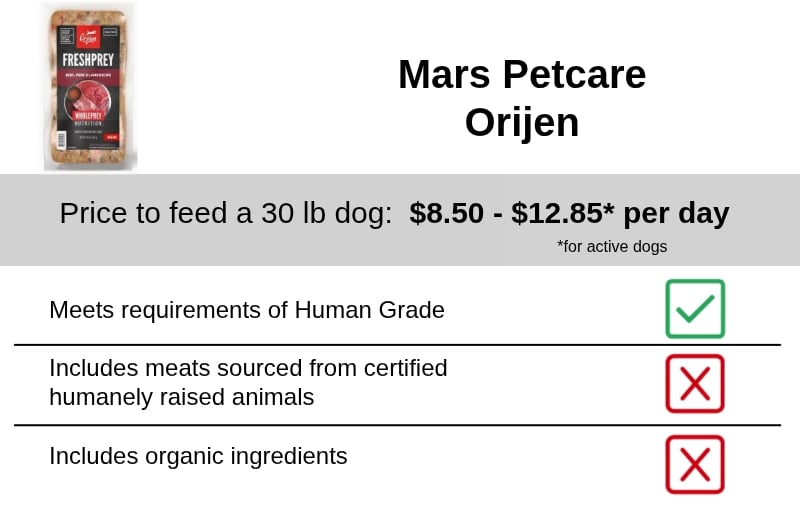
Orijen ("Fresh Prey"): Mars Petcare acquired Champion Petfoods (the parent company of Orijen and Acana) in 2022. Under the Orijen brand, the company manufactures "Fresh Prey" dog food. Orijen stands alone as the only product among all five major kibble manufacturers to carry a "human-grade" claim on its label, indicating manufacture within a licensed human food facility. However, it still contains no certified organic ingredients and makes no claims regarding certified humanely raised livestock.
2. Wellness Pet Food
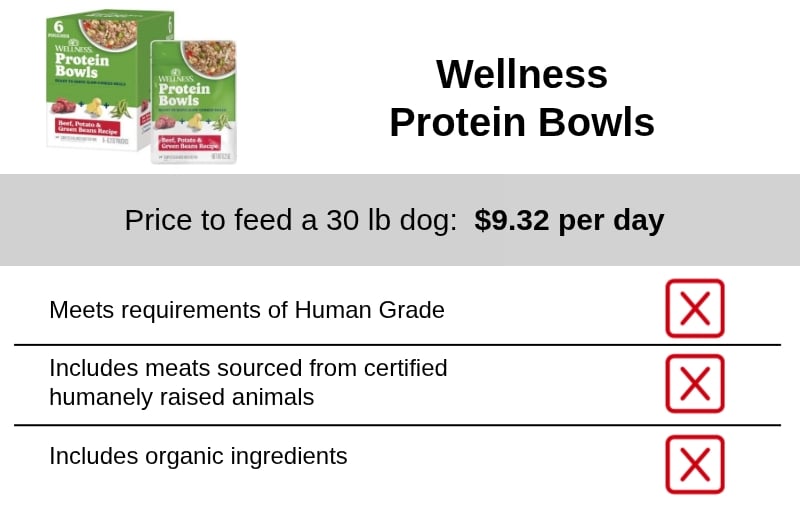
Wellness Pet Food entered the fresh dog food category with its "Protein Bowls" product line. Packaged to appeal to health-conscious consumers, this offering remains firmly within standard pet feed parameters:
Human-Grade Claim: None
Certified Organic Ingredients: None
Humanely Raised Meat Sourcing: None
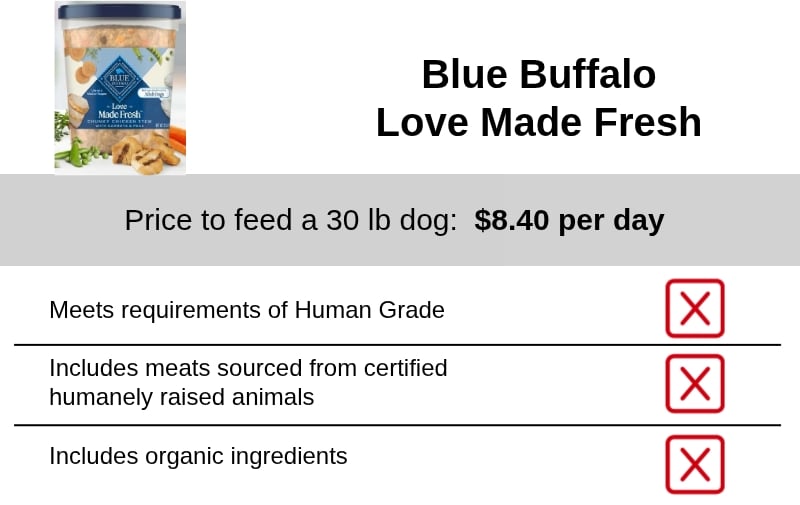
3. Blue Buffalo
Owned by General Mills, Blue Buffalo built its brand history on "real meat" kibble marketing. Its entry into the fresh sector comes via "Love Made Fresh":
Human-Grade Claim: None
Certified Organic Ingredients: None
Humanely Raised Meat Sourcing: None
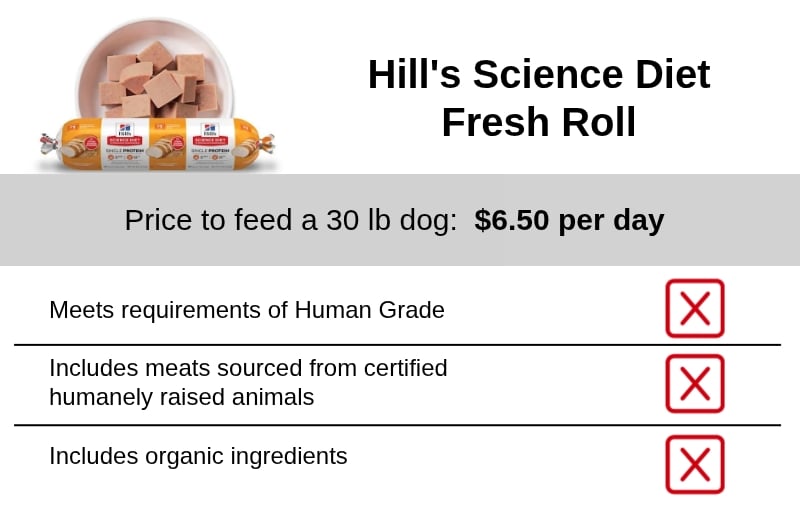
4. Hill’s Science Diet
A staple of veterinary clinics and conventional pet retail, Hill’s Science Diet entered the category utilizing a refrigerated chub format, marketed as "Fresh Roll" (such as their Single Protein Chicken and Brown Rice recipe):
Human-Grade Claim: None
Certified Organic Ingredients: None
Humanely Raised Meat Sourcing: None
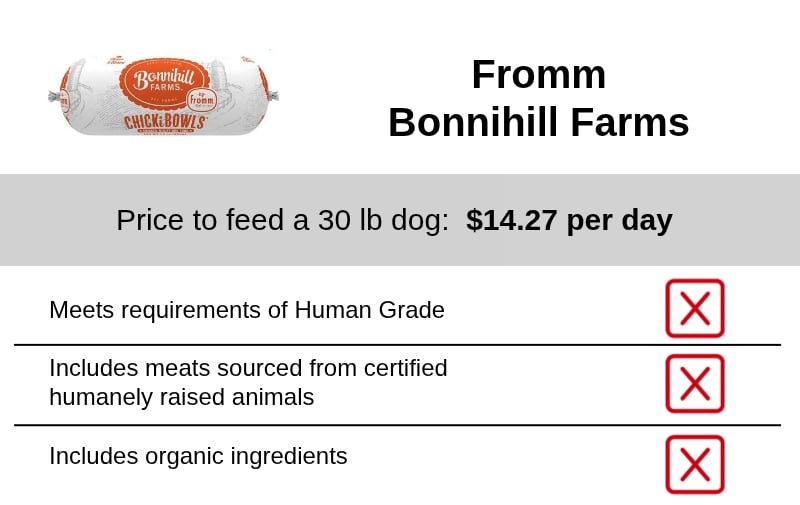
5. Fromm Pet Foods
Wisconsin-based Fromm Pet Foods introduced its fresh lineup under the Bonnihill Farms sub-brand, featuring "Chickibowls", which are distributed in both bagged fresh and roll formats:
Human-Grade Claim: None
Certified Organic Ingredients: None
Humanely Raised Meat Sourcing: None
Notable Sector Absence: Despite launching extensive lines for canine companions, not a single legacy manufacturer has produced a fresh food line for cats. Feline nutrition in the fresh food aisle remains completely unserviced by these major corporations, leaving cat owners entirely reliant on conventional canned, kibble, or specialized niche brands.
Supporting Context & Metrics
To evaluate the economic impact on pet owners, daily feeding costs were calculated based on standard manufacturer and retailer feeding guidelines for a mid-sized 30-pound adult dog.
The Regulatory Landscape: A Definition Vacuum
Understanding the mechanics of fresh pet food requires analyzing the regulatory environment overseen by the FDA and AAFCO. Currently:
No Legal Definition: Neither FDA nor AAFCO provides a legal, enforceable definition for the word "fresh" on pet food packaging.
Manufacturing Realities: Because no standard exists, products labeled as "fresh" can encompass frozen raw meat, gently cooked pasteurized meals, heavily processed refrigerated rolls, or even shelf-stable formulations that rely on synthetic preservatives or high-heat processing.
Feed-Grade vs. Human-Grade: Except for Orijen, every brand listed operates under standard feed-grade regulations. Feed-grade products are allowed under FDA compliance policies to utilize ingredients that would be legally rejected from the human food supply chain, including slaughterhouse byproducts and ingredients processed in facilities not meeting human food safety requirements.
+---------------------------------------------------------------------------------------------+
|                                FRESH DOG FOOD COMPARISON                                    |
+-------------------+--------------------+--------------+--------------+----------------------+
| Brand             | Product Line       | Quality      | Format       | Estimated Daily Cost |
|                   |                    | Designation  |              | (30 lb Dog)          |
+-------------------+--------------------+--------------+--------------+----------------------+
| Hill's            | Fresh Roll         | Feed Grade   | Roll         | $6.50                |
| Blue Buffalo      | Love Made Fresh    | Feed Grade   | Meal/Tray    | $8.40                |
| Fromm             | Chickibowls        | Feed Grade   | Roll/Bag     | $14.27               |
| Orijen            | Fresh Prey         | Human Grade  | Pouch/Meal   | Variable (Mid-High)  |
| Royal Canin       | Fresh Health Nutr. | Feed Grade   | Meal/Tray    | $17.28               |
| NomNom            | Fresh Meals        | Feed Grade   | Meal/Tray    | Mid-High Range       |
| Wellness          | Protein Bowls      | Feed Grade   | Bowl/Tray    | Mid Range            |
+-------------------+--------------------+--------------+--------------+----------------------+
Comprehensive Cost Metrics for a 30-Pound Dog
Across all five legacy kibble manufacturers, the daily cost to feed a standard 30-pound dog ranges from $6.50 to $17.28 per day.
Category 1: Traditional Fresh Meals (Pouches, Trays, and Bowls)
Price Range: $8.40 to $17.28 per day.
The Anomaly:Royal Canin tops the price chart at $17.28/day, despite being a feed-grade product processed similarly to its market competitors. Conversely, Blue Buffalo provides a feed-grade tray product at $8.40/day.
The Human-Grade Comparison:Orijen’s "Fresh Prey"—the only food in this study manufactured in a licensed human food facility with human-grade ingredients—is significantly less expensive than Royal Canin’s feed-grade alternative, defying traditional manufacturing economics where human-edible supply chains carry higher input costs.
Category 2: Fresh Pet Food Rolls (Refrigerated Chubs)
Price Range: $6.50 to $14.27 per day.
The Anomaly: Both Hill’s Science Diet ("Fresh Roll") and Fromm ("Chickibowls Roll") utilize similar industrial chub-packing technology and feed-grade raw materials. Yet, feeding a 30-pound dog Fromm costs $14.27 a day—more than double the $6.50 daily cost of Hill’s Science Diet.
Official Advocacy & Industry Commentary
The dramatic price swings and questionable quality designations have drawn intense scrutiny from consumer advocates. Susan Thixton, prominent pet food consumer advocate, founder of TruthAboutPetFood.com, and representative at the Association for Truth in Pet Food (ATPF), has questioned the commercial strategies driving Big Pet Food’s move into fresh options.
"We have to wonder what games these traditional pet food manufacturers are playing with their prices. Are they experimenting with price to see what pet owners will pay for their fresh options?"
— Susan Thixton, Pet Food Consumer Advocate
Pricing Arbitrage and Market Manipulation Concerns
Industry analysts and advocates point out several troubling hypotheses regarding corporate pricing models in the fresh dog food sector:
Price Testing and Volatility: Corporate conglomerates appear to be conducting real-time price discovery on consumers. For example, when Mars Petcare launched Orijen’s "Fresh Prey" in early 2026, it carried a significantly higher price tag. By March 2026, major retailers like Petco had already slashed the cost by $2.00 per pouch, demonstrating erratic baseline pricing strategies.
Margin Protection for Kibble: By inflating the retail price of feed-grade fresh foods—sometimes charging upwards of $500 a month for a single 30-pound dog—manufacturers may inadvertently or deliberately create "sticker shock." This extreme pricing signals to pet owners that fresh, fresh-cooked, or raw feeding is economically unfeasible, ultimately driving budget-conscious consumers back to high-margin, highly processed traditional kibble.
Feed-Grade Inflation: The fact that a feed-grade product like Royal Canin "Fresh Health Nutrition" can command $17.28 per day—outpricing true human-grade products—highlights a severe disconnect between consumer cost and raw ingredient quality.
The Association for Truth in Pet Food—which acts as a consumer stakeholder organization representing pet owners during AAFCO and FDA proceedings—continues to push regulatory bodies for legal definitions that would prohibit low-grade feed ingredients from using premium marketing terms like "fresh" without strict baseline standards.
Future Outlook
As traditional kibble giants deepen their footprint in the fresh dog food aisle, pet owners can expect significant market evolution, heightened regulatory scrutiny, and shifting retail dynamics in the coming years.
What to Watch Next
Regulatory Pressures on "Fresh" Terminology: With advocacy groups raising awareness regarding the lack of legal standards, pressure will increase on AAFCO and the FDA to establish a strict definition for "fresh" pet food, similar to rules governing human food labeling.
Expansion or Retrenchment of Product Lines: As price discovery normalizes, manufacturers will be forced to adjust extreme retail prices (as seen with Orijen’s price drop) or risk losing market share to independent, dedicated human-grade fresh pet food brands.
Potential Entry into Feline Fresh Meals: The current total absence of fresh cat food from major kibble manufacturers represents an untapped market segment. Whether manufacturers resolve formulation, packaging, and palatability challenges for obligate carnivores will be a critical indicator of the fresh category’s maturity.
Increased Scrutiny over Supply Chain Transparency: As pet parents become increasingly educated on the distinction between feed-grade and human-grade, corporate transparency regarding facility licensing, humane meat sourcing, and organic certification will become a key battleground for brand loyalty.
While Big Pet Food has undeniably embraced the fresh dog food format, consumers must look beyond glossy packaging and premium price tags. Without regulatory definitions or human-grade manufacturing credentials, high costs do not automatically translate to superior nutrition.