
Executive Overview
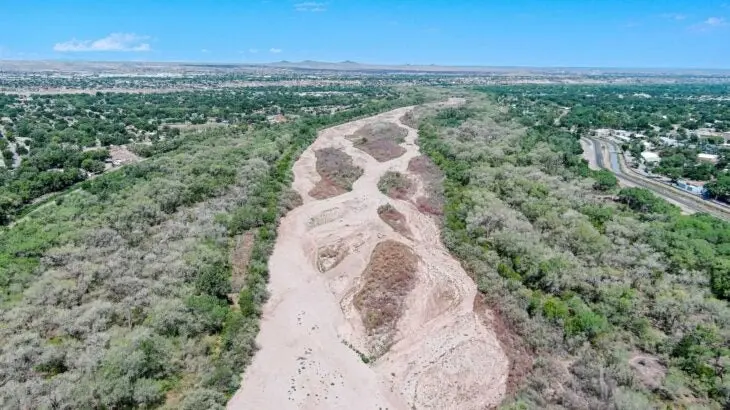
The American Southwest is confronting an ecological crisis of unprecedented proportions along one of its most vital desert lifelines. Driven by compounding climate pressures, severe aridification, and prolonged snowpack deficits, the Middle Rio Grande in New Mexico has experienced catastrophic summer drying. For decades, conservationists, water managers, and local stakeholders have braced for the ecological tolls of prolonged drought, but the summer of 2024 has shattered previous benchmarks of severity.
Unlike previous years, when drying events primarily devastated native fish populations—such as the endangered Rio Grande silvery minnow—the modern iteration of the drought has set its sights on the terrestrial crown jewel of the region: the bosque. This expansive cottonwood-willow riparian forest, stretching along the river corridor through Albuquerque and Los Lunas, is facing a large-scale die-back event. Without immediate intervention, experts project up to a 50 percent mortality rate among the forest’s iconic canopy trees by next year—an ecological collapse equivalent in scale and severity to a massive wildfire.
In response to this unfolding catastrophe, a coalition of environmental organizations, municipal utilities, and water management agencies has mobilized. Led by the National Audubon Society in close coordination with the Albuquerque Bernalillo County Water Utility Authority (ABCWUA), the Middle Rio Grande Conservancy District (MRGCD), and the U.S. Bureau of Reclamation, a strategic emergency water release has been initiated. By pooling leased environmental water assets and municipal resources, partners are orchestrating a multi-day pulse through the parched riverbed.
Beyond offering an immediate, life-saving drink to parched trees and recharging local aquifers, this emergency operation serves as a living laboratory. A rigorous, multi-agency monitoring program has been deployed concurrently to track groundwater dynamics, seepage rates, and the physiological recovery of the stressed ecosystem. This article provides an in-depth examination of the crisis, chronicling the sequence of events from initial discovery to emergency response, contextualizing the broader socio-ecological impacts, and exploring what this means for the future of water management in the American Southwest.
Detailed Chronology: From Field Discovery to Emergency Intervention
The Routine Monitoring That Raised the Alarm
The unfolding tragedy began not with satellite telemetry or high-level policy briefings, but with the boots-on-the-ground observations of field biologists. Approximately one month prior to the emergency release, Audubon staff members Tucker and a colleague set out to conduct routine habitat monitoring at a restoration and conservation site in Corrales, New Mexico, situated just north of Albuquerque.
Since early June, this specific location had been the beneficiary of environmental water leasing efforts managed by Audubon, designed specifically to deliver targeted flows to the Rio Grande and maintain localized wetland resilience. As the researchers walked into the river corridor, the visual contrast was jarring. The immediate outfall area associated with Audubon’s water delivery channel was a vibrant, verdant oasis. However, just beyond that hyper-local zone of influence, the landscape presented a grim picture of stress and decay.
Large swaths of the surrounding forest, which had appeared healthy and green just two weeks prior, were now rapidly browning, leaves curling and brittle under the merciless desert sun. The visceral shock of the scene triggered memories for the field team of the early 2000s drought in southeastern Arizona, where a rapid, irreversible loss of a cottonwood-willow riparian forest occurred at the Leslie Canyon National Wildlife Refuge. The alarm bells were ringing: the river corridor was not merely dry; it was experiencing a systemic collapse.
Aerial Surveys and the Revelation of Widespread Canopy Stress
Recognizing that the localized damage in Corrales might be symptomatic of a broader regional phenomenon, the team deployed drone technology over the following days to survey the Middle Rio Grande corridor comprehensively. Aerial mapping revealed a sobering reality. While isolated pockets of stress appeared near Los Lunas, the epicenter of the destruction was concentrated within the dense urban and peri-urban reaches of the riparian forest cutting straight through Albuquerque.
For years, water managers and ecologists took solace in the resilience of the bosque. During previous dry spells over the preceding decade, mature cottonwood and willow trees managed to survive surface drying events by tapping into shallow, subsurface alluvial groundwater reserves. Consequently, historical dry-ups exacted their heaviest toll on aquatic life—aquatic macroinvertebrates and native fish species like the silvery minnow—while leaving the arboreal canopy largely intact.
This year, however, the depth and geographic extent of the drying shattered historical norms. When the initial drone imagery was reviewed, the sheer scale of the damage became undeniable. The youngest cohorts of trees appeared entirely brown or grey, stripped of functional foliage. The older, deeply rooted canopy trees—venerable specimens that have stood for decades—were rendered a sickly, thin ghost-green transitioning into lifeless grey. Because Fremont cottonwoods and Goodding’s willows lack the physiological adaptations to bounce back from prolonged, severe soil desiccation, the biological countdown had begun.
Mobilizing the Network: A Plea for Urgent Action
Armed with high-resolution photographic evidence of widespread canopy failure, Audubon staff compiled the drone imagery into an urgent briefing deck. This digital dossier was dispatched across a multi-agency network of regional stakeholders, including municipal leaders, agricultural districts, and federal conservation partners, carrying an explicit plea for immediate, collaborative intervention.
The response from the regional water community was immediate and unified. Recognizing that traditional management frameworks were inadequate for the velocity of the climate crisis, stakeholders broke down institutional silos. Urgent discussions culminated in a historic pooling of resources between the Albuquerque-Bernalillo County Water Utility Authority, the Middle Rio Grande Conservancy District, and Audubon.
Rather than waiting for the seasonal monsoons or the end of the irrigation season, the coalition engineered a coordinated water release designed to rewater the desiccated riverbed through the heart of Albuquerque for a sustained four-day window. The primary objectives were twofold: to thoroughly soak the alluvial aquifer and to deliver a vital, life-sustaining irrigation pulse directly to the struggling roots of the dying bosque. Concurrently, a robust scientific monitoring initiative was established to evaluate groundwater recharge rates, infiltration dynamics, and the biological uptake and recovery of the targeted forest stands.
Supporting Context & Metrics: The Aridification of the Middle Rio Grande
The Ecological Architecture of the Bosque
To understand the gravity of the 2024 drying event, one must comprehend the unique ecological architecture of the Rio Grande bosque. As the largest remaining continuous cottonwood gallery forest in the American Southwest, the bosque functions as a biological hotspot. It provides critical migratory bird stopovers along the Central Flyway, serves as a sanctuary for diverse mammalian and amphibian populations, and acts as a natural cooling corridor for the metropolitan sprawl of Albuquerque.
However, this ecosystem is fundamentally dependent on the hydrological rhythm of the river. Cottonwood trees (Populus fremontii) are hydro-obligate species; their survival is inextricably tied to shallow water tables and periodic overbank flooding that deposits nutrient-rich alluvial soils and scours channels for seed germination. Unlike drought-hardy desert flora such as creosote or mesquite, cottonwoods cannot simply shut down metabolic processes and wait out a multi-year dry spell. When the river stops flowing and the shallow water table drops beneath the root zone faster than the trees can adapt, systemic hydraulic failure occurs. The water columns within the xylem cavitate, breaking the transport of water from roots to leaves, leading to rapid desiccation and tree death.
The Human Toll: Agriculture and Pueblos Under Siege
The ecological crisis unfolding within the riverbed does not exist in a vacuum; it is mirrored by profound socioeconomic and cultural suffering across the Middle Rio Grande Valley. The compounding failures of surface water hydrology have stretched human communities to their breaking points:
- Agricultural Strains: Valley farmers who rely on the river’s surface water rights have faced unprecedented hardship. During this water year, many agriculturalists went more than 120 days without receiving surface water irrigation, forcing them to either fallow valuable crops or draw unsustainably upon deeper groundwater wells.
- Rio Grande Pueblos: Indigenous communities along the river, whose cultures, traditions, and agrarian livelihoods are foundational to the identity of the Southwest, have been forced to scrape by on meager, unreliable irrigation releases.
- The Scale of Forest Mortality: Experts estimate that if the current trajectory of aridification holds without active mitigation, the bosque through Albuquerque could suffer up to a 50 percent die-back. To contextualize this metric, foresters note that losing half of this urban canopy is structurally and ecologically equivalent to a catastrophic, high-severity wildfire. Managing the aftermath of such a die-back—clearing massive fuel loads of dead timber, mitigating extreme wildfire risks adjacent to urban neighborhoods, and attempting ecological restoration—will require tens of millions of dollars and decades of intensive labor.
Official Statements and Institutional Perspectives
The emergency response on the Rio Grande highlights a growing paradigm shift in Western water management. No longer can environmental flows be treated as an afterthought or a luxury item secondary to municipal and agricultural allocations; they are increasingly recognized as structural components of regional sustainability.
Representatives from the Albuquerque Bernalillo County Water Utility Authority (ABCWUA) emphasized the necessity of cross-sector collaboration in the face of escalating climate volatility. By stepping up to integrate municipal water assets into the environmental release, ABCWUA demonstrated a commitment to urban-environmental co-survival. City water managers acknowledge that a dead, desiccated forest running through the center of Albuquerque not only destroys irreplaceable wildlife habitat but also degrades the quality of life, increases urban heat island effects, and elevates catastrophic wildfire risks directly adjacent to densely populated neighborhoods.
The Middle Rio Grande Conservancy District (MRGCD), which manages the intricate network of canals, drains, and diversions that distribute the river’s water across farms and wildlife refuges, played an indispensable role in operationalizing the pulse flow. MRGCD leadership noted that balancing the competing demands of agricultural water users experiencing historic shortages with the acute ecological needs of the bosque represents one of the most complex governance challenges in the district’s history.
Meanwhile, conservation scientists from the National Audubon Society framed the emergency operation as a masterclass in adaptive management. While the initial discovery of the dying trees was described as a moment of profound "climate despair," the rapid, galvanized response of the partner network transformed the narrative into one of resilience and hope. The integration of real-time drone mapping, inter-agency resource sharing, and post-release ecological monitoring establishes a new operational blueprint for how Western stakeholders can confront the compounding realities of an aridifying future.
Future Outlook: Lessons Learned and the Path Forward
As the four-day water pulse recedes into the sands of the Middle Rio Grande and scientists begin harvesting data from the newly established monitoring networks, the long-term outlook for the basin remains sobering yet resolute. The 2024 summer crisis is not an isolated anomaly; rather, it is a clear preview of the arid conditions structural climate change will continue to deliver to the American Southwest.
Key Takeaways for Future Water Management
- Proactive Environmental Leasing: The ability of Audubon and its partners to deploy leased water assets saved pockets of the bosque from immediate collapse. Expanding environmental water leasing programs and establishing dedicated "water banks" for nature will be critical policy mechanisms for the future.
- Integrated Monitoring and Science-Driven Operations: The comprehensive monitoring framework tracking groundwater response, soil saturation gradients, and tree physiological recovery will provide invaluable empirical data. Water managers will utilize these metrics to optimize future emergency flows, ensuring every cubic foot of water achieves maximum ecological benefit.
- Institutional Agility: The speed at which municipal utilities, agricultural districts, and conservation NGOs mobilized proves that traditional institutional boundaries can be crossed in times of crisis. Fostering permanent, collaborative governance structures will be essential to navigate future droughts proactively rather than reactively.
Conclusion: A Shared Destiny
The Rio Grande is more than just a drainage channel or a resource to be divided; it is the ecological and cultural heartbeat of New Mexico. The plight of the bosque this summer serves as an urgent wake-up call to policymakers, water users, and citizens alike. While the challenges of climate change, shrinking snowpacks, and over-allocated river basins are formidable, the coordinated rescue effort on the Middle Rio Grande proves that human ingenuity, cross-sector partnership, and a shared dedication to the land can alter the trajectory of decline. By fighting for the trees on the brink today, New Mexico is laying the groundwork for a resilient, living river tomorrow.