
Executive Overview
Nearly 45 million acres of the United States’ most ecologically intact, pristine forests—an expansive landscape larger than the state of Oklahoma—could soon be carved open to commercial logging, industrial development, and road construction. Under a sweeping and highly controversial proposal announced by the U.S. Forest Service, the federal government is moving to rescind the landmark Roadless Area Conservation Rule.
Established a quarter-century ago in 2001, the Roadless Rule has long served as a cornerstone of American conservation. It prohibits commercial logging and the construction of new roads across roughly one-third of all National Forest System lands. For 25 years, the rule has functioned as an environmental shield, preserving critical watersheds, locking away immense stores of atmospheric carbon, and safeguarding irreplaceable strongholds for hundreds of species of wildlife, including threatened and endangered animals.
The current push to dismantle the regulation has ignited a fierce national debate, pitting the federal government and timber industry advocates against a formidable coalition of conservation organizations, former Forest Service chiefs, fiscal watchdogs, and outdoor recreation groups. While proponents of the repeal argue that removing federal restrictions is a necessary modernization to combat catastrophic wildfires and improve forest health, critics warn of a looming ecological and financial disaster. Opponents assert that scrapping the rule will trigger a wave of taxpayer-subsidized road building, bankrupt the agency’s already strained infrastructure budget, accelerate climate change, and irrevocably fracture some of the last remaining wild landscapes in North America.
With a public comment period open through September 21, the future of the nation’s backcountry hangs in the balance. The outcome of this regulatory battle will determine whether America’s most treasured wild expanses remain wild sanctuaries or become industrial working forests.
Detailed Chronology: The Rise, Defense, and Threat to the Roadless Rule
To understand the gravity of the current proposal, it is necessary to examine the history of the Roadless Area Conservation Rule and the decades of legal and political maneuvering that have defined its existence.
2001: The Birth of a Landmark Conservation Policy
Following years of intensive public debate, scientific study, and millions of public comments, the U.S. Forest Service officially promulgated the Roadless Area Conservation Rule in the final days of the Clinton administration in January 2001. The rule was designed with a dual purpose: to protect the profound ecological values of unfragmented backcountry forests and to stem the tide of runaway financial liabilities associated with maintaining national forest roads. At the time, the Forest Service faced an estimated $8.4 billion backlog in road maintenance—a figure that has since evolved but remains stubbornly high at approximately $6.9 billion. By placing a moratorium on new road construction and commercial timber harvesting in inventoried roadless areas, the agency sought to freeze its expanding infrastructure footprint and protect pristine ecosystems from the cumulative impacts of habitat fragmentation.
The Intervening Decades: Legal Battles and State-Specific Exemptions
Almost since its inception, the Roadless Rule has been a political football, subjected to shifting political winds across successive presidential administrations. It has weathered numerous legal challenges, lawsuits, and administrative revisions. Notably, states like Colorado and Idaho pursued and secured their own tailored state-level roadless management plans, insulating them from blanket federal changes. However, the core federal framework remained the bedrock protection for roadless tracts in states across the West and pockets of the East.
2025–2026: The Path to Total Repeal
The current existential threat to the rule began to take shape a year ago when the U.S. Department of Agriculture (USDA)—the parent agency of the Forest Service—announced its formal intent to rescind the 2001 regulation entirely. That initial warning shot drew immediate, sharp rebukes from a bipartisan group of former Forest Service chiefs who had served across both Democratic and Republican administrations.
Despite warnings from veteran land managers that a total repeal would generate far more problems than it could possibly solve, the USDA pressed forward. Last month, the Forest Service officially announced the text of its proposal to scrap the Roadless Rule, setting off a high-stakes public comment window slated to close on September 21. This move sets the stage for a momentous policy showdown over the management of public lands.
Supporting Context & Metrics: Ecological Value and Financial Realities
The debate over the Roadless Rule is ultimately anchored in hard data, ecological metrics, and economic realities. Proponents and opponents alike point to figures concerning wildlife, wildfire behavior, carbon sequestration, and fiscal stewardship to bolster their arguments.
A Sanctuary for Biodiversity
Roadless areas comprise a mere 2 percent of the total landmass of the continental United States, yet their disproportionate ecological value cannot be overstated. According to conservation analyses, these undisturbed landscapes provide vital habitat for 25 percent of all animal species currently listed or proposed for listing under the Endangered Species Act.
The overlap between roadless areas and critical aquatic habitat is nearly absolute. Chris Wood, president and CEO of Trout Unlimited—who previously worked for the Forest Service and helped draft the original 2001 rule—notes that if one overlays a map of native trout and salmon habitat across a map of inventoried roadless areas, there is an almost one-to-one correspondence. In western states, the statistics are similarly striking: in Utah, 99 percent of roadless areas are designated as crucial habitat for mule deer, while 93 percent of Montana’s roadless areas provide indispensable summer range for elk.
Regional Jewels: From the Tongass to the Appalachians
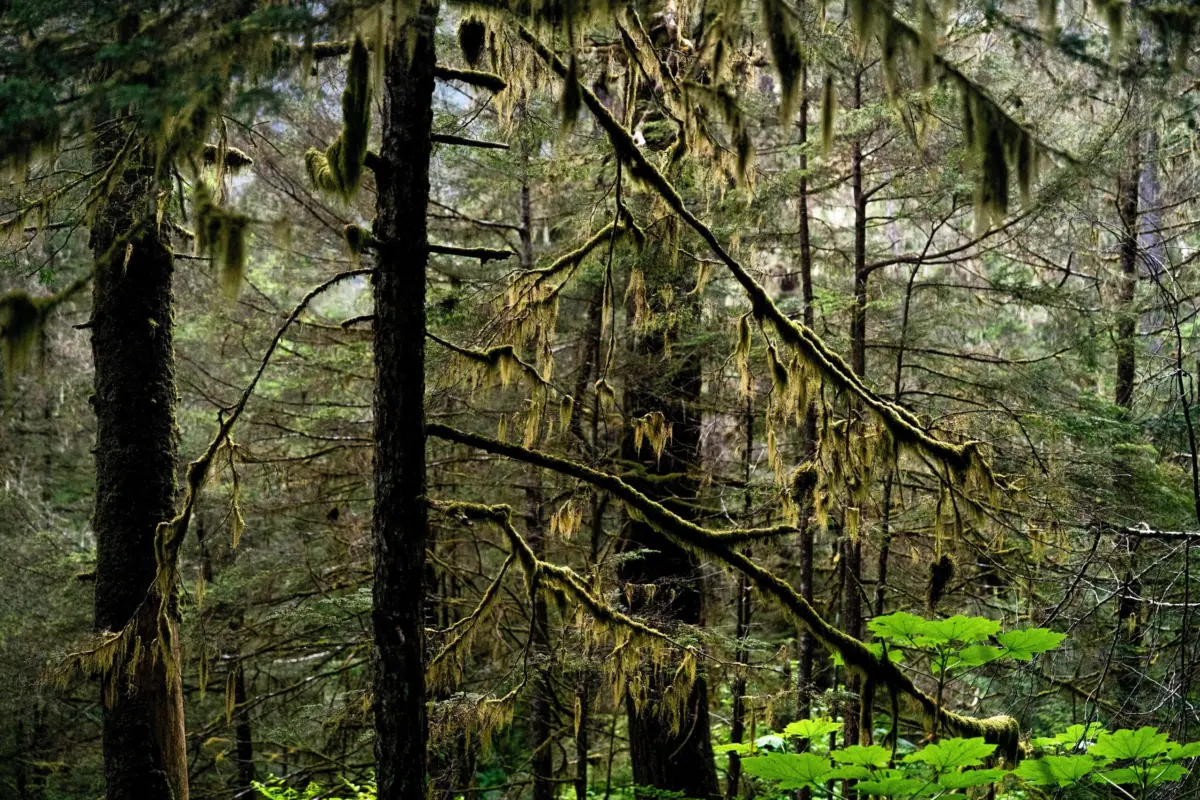
Nowhere are the stakes higher than in Southeast Alaska’s Tongass National Forest. Spanning roughly 17 million acres—more than half of which are roadless—the Tongass is the largest national forest in the United States and forms a core component of the largest intact temperate rainforest on Earth.
The Tongass supports all five species of Pacific salmon and serves as a critical nesting ground for Bald Eagles and Marbled Murrelets at densities found nowhere else on the planet. Unique, localized subspecies—such as the Queen Charlotte Goshawk and the Prince of Wales Spruce Grouse—depend entirely on the forest’s ancient old-growth structure.
Beyond Alaska, the rule protects essential ecosystems across the country. In California, towering old-growth groves in the Sequoia National Forest provide refuge for Western Tanagers. In North Carolina, 144,000 roadless acres shelter Cerulean Warblers and federally threatened Red-cockaded Woodpeckers. And while the rule is most frequently associated with sprawling western backcountry, it has successfully shielded large tracts of eastern forests in states such as Florida, Virginia, and New Hampshire.
Clean Water and Carbon Sequestration
Beyond wildlife, roadless areas deliver vital ecosystem services to human populations. A landmark scientific study published in July underscored that the Roadless Rule helps safeguard clean drinking water for approximately 25 million Americans.
Furthermore, old-growth and mature backcountry forests act as earth’s premier carbon vaults. Research indicates that inventoried roadless areas alone sequester roughly 445 million tons of carbon. The Tongass National Forest alone holds approximately one-fifth of all the carbon stored across the entire National Forest System, making the preservation of these lands an indispensable component of national climate mitigation strategies.
The Economics of Roads: A Fiscal Liability
From a fiscal perspective, taxpayer advocacy groups warn that repealing the rule is an economic miscalculation. The Forest Service currently manages roughly 370,000 miles of existing roads—an infrastructure network so vast it could circle the globe nearly 15 times. Maintaining this network represents a multibillion-dollar backlog.
Autumn Hanna, vice president of the nonpartisan fiscal watchdog Taxpayers for Common Sense, sharply criticized the proposal. "Repealing the 2001 Roadless Area Conservation Rule in its entirety would recklessly expose taxpayers to billions in new liabilities from subsidized roads and money-losing timber sales," Hanna stated.
Official Statements and Competing Perspectives
The chasm between the policy’s defenders and its architects reveals a fundamental disagreement over what constitutes modern forest health and wildfire management.
The Administration and Timber Industry Case for Repeal
The USDA and forestry trade associations frame the repeal as a long-overdue modernization designed to protect communities from catastrophic wildfires fueled by climate change, drought, and disease.
In a public statement announcing the plan, Agriculture Secretary Brooke Rollins argued that the existing rule has handcuffed land managers. "For too long, outdated restrictions have kept tens of millions of forested acres off-limits to the very treatments that improve forest health and reduce wildfire risk to our communities," Rollins said.
This sentiment is echoed by commercial timber interests. Travis Joseph, president of the American Forest Resource Council—a trade association representing forest products companies in the West—argued that adherence to the 2001 rule represents an unwillingness to adapt to modern ecological challenges. "We should continue to adapt and learn from failed policies to meet the moment, not continue to cling to positions and ideas that don’t serve the public’s interest," Joseph noted in a statement supporting the rescission.
The Conservation and Scientific Pushback
Forest management experts, independent scientists, and conservation leaders strongly reject the premise that the Roadless Rule prevents wildfire mitigation. They point out that the current rule already contains explicit provisions allowing forestry crews to thin or conduct prescribed burns in overgrown woods to mitigate wildfire hazards. Moreover, the rule permits emergency road construction when public safety is immediately threatened by fire.
An internal 2001-era and subsequent 2020 analysis by the Forest Service itself undermined the administration’s current rationale, concluding that "a lack of roads has not stopped fire prevention measures; fuel management activities in roadless areas have actually been more numerous on a per-square kilometer basis than elsewhere in the National Forest System."
Chris Wood of Trout Unlimited argues that building more roads will paradoxically increase wildfire risks rather than mitigate them. Citing data showing that most national forest blazes ignite within half a mile of an existing road—often sparked by discarded cigarette butts or hot vehicle exhaust systems passing over dry grass—Wood summarizes the dynamic bluntly: "Roads actually equal fires."
Veterans of the agency agree. In a joint letter submitted to the USDA, four former chiefs of the Forest Service—who served under both Democratic and Republican administrations—warned against abandoning the regulation. Drawing on decades of collective experience, they wrote, "We believe a total repeal of the Rule will result in many more problems than it fixes and be more costly in the long run."
Sara Brodnax, Audubon’s director of public lands policy, emphasized the irreplaceable nature of these habitats for migratory birds facing mounting pressures from habitat fragmentation, development, and prolonged drought. "We strongly believe that roadless areas are important, intact wildlife habitat and that the rule should not be repealed," Brodnax said.
Future Outlook: What Lies Ahead for America’s Backcountry
As the September 21 deadline for public comments approaches, the debate over the Roadless Rule stands as a defining environmental battleground of the decade.
While proponents of the repeal envision a future where expanded access allows for aggressive mechanical timber harvesting and enhanced logistical capabilities for wildfire suppression, critics foresee a fractured wilderness. They warn of a cascade of negative consequences: degraded watersheds feeding millions of households, diminished populations of native salmon and big game, billions of dollars in unfunded road maintenance liabilities shifted onto taxpayers, and millions of tons of carbon released back into the atmosphere.
Even critics of a wholesale repeal acknowledge that governance of public lands is complex. Chris Wood suggests that if the Forest Service possesses novel scientific data indicating that specific, targeted adjustments are necessary, a measured public debate about tweaking the rule could be warranted. However, he maintains that discarding the framework entirely is fundamentally counterproductive: "To throw it out wholesale, as is being proposed, doesn’t make sense… permitting new roads in roadless areas just seems like folly."
Ultimately, the decision made by the federal government regarding the 45 million acres of roadless forest will cast a long shadow over the American landscape. It will test the nation’s commitment to balancing resource extraction with the preservation of its ecological heritage, leaving a lasting legacy on the wild places that define the American frontier.