
Executive Overview
In the shimmering coastal waters of Ocean City, Maryland, a quiet ecological renaissance is taking flight. Once teetering on the precipice of local extinction, the state’s population of Common Terns (Sterna hirundo) has staged a remarkable, highly improbable recovery. During the recent breeding season, biologists documented an astounding 460 nests across two localized colonies within Maryland’s Coastal Bays—a dramatic leap from the desperate nadir of just 30 nesting pairs recorded mere years ago.
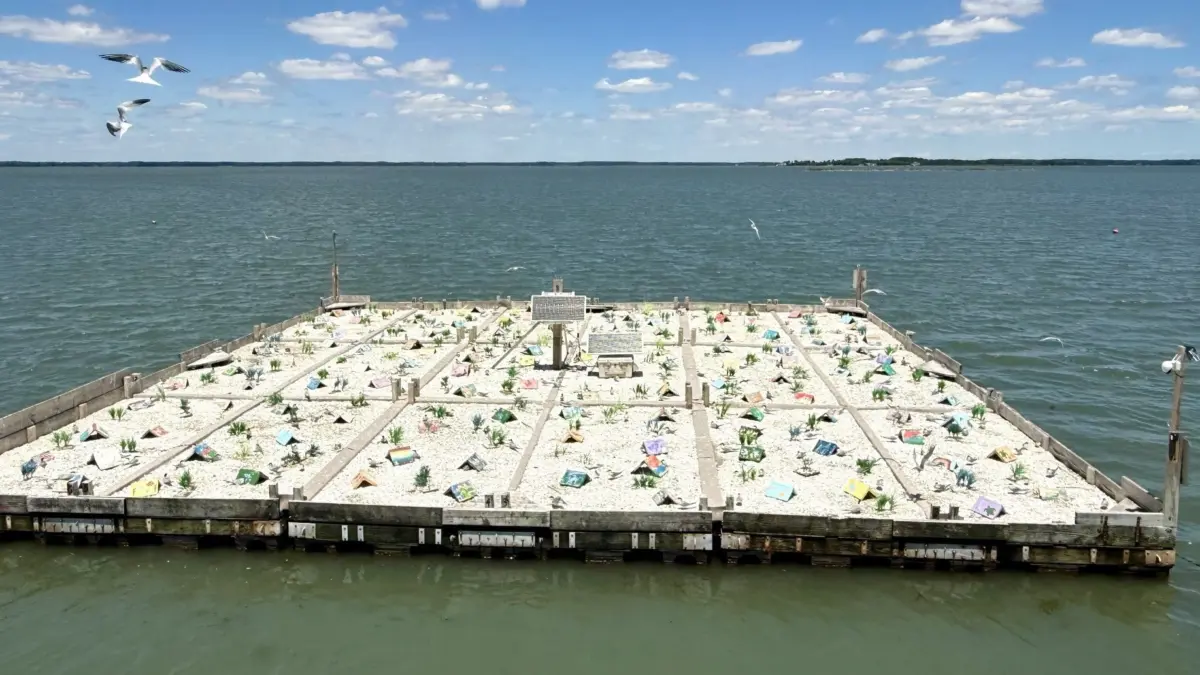
This modern conservation triumph is anchored by an ingenious, low-tech yet highly effective intervention: a floating wooden raft designed to mimic natural nesting habitats while shielding vulnerable seabirds from surging tides and mammalian predators. Bolstered by targeted island restoration projects, this collaborative initiative—spearheaded by the Maryland Department of Natural Resources (DNR) Wildlife and Heritage Service, the Maryland Coastal Bays Program, and Audubon Mid-Altantic—has effectively restored nearly one-third of the region’s historic Common Tern population.
What began as a desperate, last-ditch experiment in 2020 has blossomed into a thriving avian metropolis. Not only are hundreds of sleek, silver-grey terns successfully raising their chicks, but the floating platform has also transformed into a vital biodiversity hotspot, attracting rare and visiting shorebird species. Yet, while the timber raft serves as an inspiring symbol of human ingenuity, conservationists emphasize that it is merely a stopgap. The ultimate victory will require healing the fragile, rapidly eroding sand islands that these migratory seabirds have called home for millennia.
Detailed Chronology: From Near-Extinction to Structural Innovation
To understand the magnitude of the current Common Tern population surge, one must look back at the steady, alarming erosion of their historical strongholds. For generations, the low-lying sand islands scattered throughout Maryland’s Coastal Bays provided ideal, undisturbed terrain for ground-nesting seabirds. However, a compounding cocktail of ecological pressures—ranging from relentless coastal erosion and intensifying storm surges driven by climate change to escalating human disturbance from recreational boaters and shoreline development—systematically degraded these fragile habitats.
The historical trajectory of the Common Tern in Maryland mirrors this landscape degradation. During the late 1980s and early 1990s, ecological surveys routinely counted more than 1,200 active Common Tern nests across the Coastal Bays. By the turn of the century, however, a slow and debilitating decline had set in. Over subsequent decades, the state’s breeding population plummeted by a staggering 95%. By 2020, the situation had grown critical: field biologists could locate fewer than 30 remaining nesting pairs. The species was hurtling toward functional extirpation along the Maryland coastline.
Faced with the imminent loss of a cornerstone coastal species, a coalition of state agencies and conservation non-profits mobilized. Recognizing that natural island habitats were disappearing faster than they could be naturally replenished, the team pivoted to artificial intervention. In 2020, the Maryland DNR Wildlife and Heritage Service, the Maryland Coastal Bays Program, and Audubon Mid-Atlantic constructed and deployed a specialized floating wooden raft in the coastal bays of Ocean City.
Engineered specifically to float with the tides and evade land-based predators like raccoons, rats, and foxes, the raft offered a secure sanctuary. The results were immediate and heartening. In its inaugural season, the platform hosted 23 nests, which successfully fledged 22 chicks. More importantly, the project capitalized on the species’ strong "site fidelity"—the natural biological imperative for migratory birds to return to the exact geographic locations where they successfully bred in previous years.
As the years progressed, returning adults brought new recruits. By the 2026 breeding season, the artificial platform alone supported an astonishing 376 nests. Simultaneously, parallel habitat restoration efforts at Reedy Beach and West Reedy Island in Isle of Wight Bay bore fruit, establishing a second natural colony of 84 nests. Together, these sites yielded 460 nests—a population density not seen in Maryland since the early 2000s, successfully reversing a decades-long downward spiral.
Supporting Context & Metrics: The Science of Seabird Recovery
The numerical rebound of Maryland’s Common Terns is supported by a wealth of empirical data and ecological dynamics. The transformation from 30 precarious pairs to 460 robust nests represents an exponential growth curve that defies typical conservation timelines for imperiled seabirds.
At the microscopic and behavioral levels, several key factors have driven this success:
- Site Fidelity and Social Attraction: Common Terns are intensely colonial and social birds. As Kim Abplanalp, Bird Habitat Coordinator at the Maryland Coastal Bays Program, notes: "Give them a plot of land and they’ll use it. Terns are highly social, they want to be where the numbers are. On the raft they’re offered protection in large groups and more resources to raise their young." Once the initial vanguard of 23 pairs established the raft in 2020, their presence signaled safety to passing migrants, drawing in hundreds of subsequent nesters through social attraction.
- Geographic Connectivity and Hemispheric Migrations: The conservation impact of the Maryland tern raft extends far beyond the mid-Atlantic seaboard. Through rigorous banding programs managed by Abplanalp and her field teams, researchers have tracked individual birds far beyond state lines. Remarkably, terns hatched or banded on the Ocean City raft have been resighted thousands of miles away during the austral winter, frequenting coastal wetlands in places like Punta Rasa, Argentina.
- Spillover Biodiversity: While engineered primarily for Common Terns, the floating platform has inadvertently become an ecological anchor for a broader suite of coastal avifauna. Small numbers of Royal Terns have successfully nested on the structure. Furthermore, during recent field seasons, biologists have documented rare and transient visitors—including Roseate Terns, Gull-billed Terns, and Sandwich Terns—utilizing the raft as a secure communal roosting site.
- The Scale of Restoration: The combined tally of 460 nests for the 2026 season accounts for the recovery of nearly one-third of the entire region’s historic, pre-decline population baseline, proving that targeted micro-habitats can yield macro-scale ecological dividends.
Official Statements: Perspectives from the Front Lines of Conservation
The triumph in the Coastal Bays is a testament to cross-agency collaboration and decades of institutional dedication to avian conservation. Wildlife professionals who have tracked the agonizing decline of the species now express cautious optimism as they witness its resurgence.
Dave Brinker, Avian Conservation Ecologist at the Maryland DNR’s Natural Heritage Program, contextualized the milestone within a broader historical timeline:
"We have recovered the coastal Common Tern breeding population in Maryland to where we were back in the early 2000s. The problem has been a lack of nesting habitat, and we are restoring that for the birds."
Brinker’s assessment underscores a fundamental truth of modern wildlife management: many species are not failing due to genetic weakness or intrinsic reproductive failure, but rather because anthropogenic pressures have systematically dismantled the physical landscapes required for their survival. By diagnosing this habitat deficit and engineering a physical remedy, conservationists bypassed the bottleneck.
Kim Abplanalp emphasized the behavioral readiness of the birds to embrace human-provided solutions, provided those solutions accurately mirror evolutionary needs:
"Terns are highly social, they want to be where the numbers are. On the raft they’re offered protection in large groups and more resources to raise their young."
This sentiment highlights the adaptive resilience of wildlife when afforded even a modest margin of safety. When protected from the dual scourges of terrestrial predation and tidal inundation, Common Terns demonstrated an immediate capacity to bounce back, utilizing both the artificial wooden structure and adjacent restored island plots with equal vigor.
Future Outlook: Beyond the Raft
While the wooden floating platform in Ocean City remains an undisputed conservation masterclass, scientists and project managers are unified in a singular perspective: the raft is a brilliant emergency room, not a permanent home.
The long-term survival of Common Terns in Maryland cannot—and should not—rely permanently on artificial timber platforms bobbing in the bays. Maintenance costs, material degradation, and the sheer scale of regional ecological needs dictate that natural systems must eventually resume their role. The ultimate, overarching goal of the Maryland DNR, the Maryland Coastal Bays Program, and Audubon Mid-Atlantic is the large-scale restoration and fortification of the sand islands that historically supported these populations.
Fortunately, there are deeply encouraging signs that the raft project is acting as a natural stepping stone toward this larger goal. Recent habitat rehabilitation efforts at Reedy Beach and West Reedy Island have already proven that young terns hatched safely on the artificial raft will readily transition to nesting on restored natural islands as adults. This biological bridge—from artificial float to natural sand—validates the strategy of using human intervention to kickstart natural recolonization.
As researchers look toward the horizon, the Ocean City tern raft stands as a powerful metaphor for environmental stewardship in the 21st century. It proves that aggressive, creative conservation can pull species back from the brink of regional extinction. More importantly, it offers a tangible glimpse of hope: a demonstration that with sustained political will, scientific rigor, and inter-agency cooperation, Maryland’s fragile coastal ecosystems can once again be shaped into resilient landscapes where Common Terns—and the rich biodiversity they represent—can thrive for generations to come.