
For pet owners navigating the increasingly complex labyrinth of commercial airline regulations, traveling with a larger-than-average dog in the aircraft cabin has long presented a formidable logistical challenge. While carriers routinely permit small pets to fly beneath the seat in front of passengers, strict height and width limitations effectively penalize taller breeds with long legs and voluminous coats.
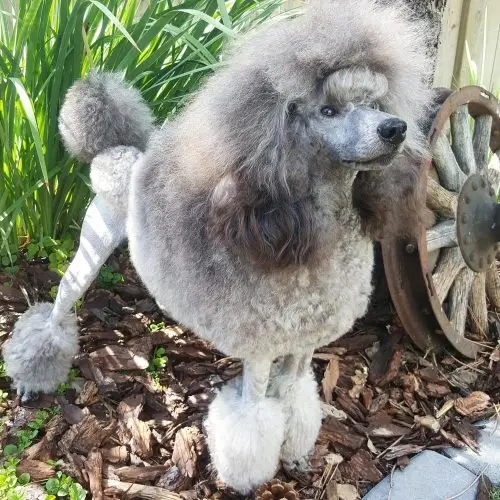
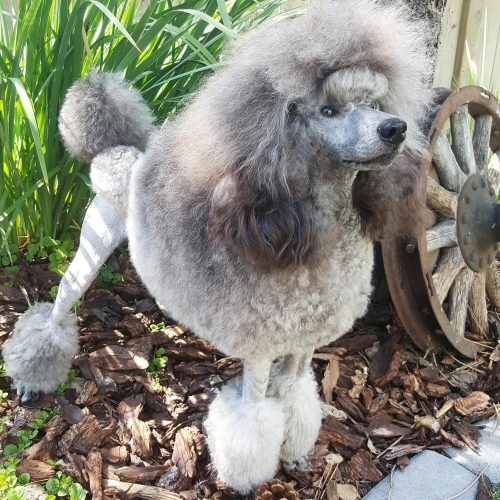
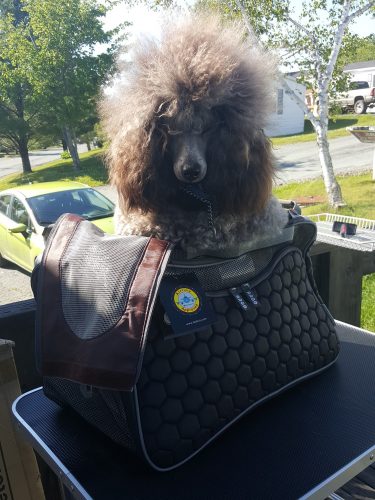
When pet stylist Keri prepared for a multi-leg journey across Canada with Flint—a tall, full-coated Miniature Poodle featuring long legs and a notoriously generous silhouette—she faced widespread skepticism from fellow travelers who insisted the dog would never fit in-cabin. Refusing to resort to cargo hold transportation, Keri embarked on a rigorous, highly inventive mission to engineer a viable in-cabin travel solution.
Rather than accepting standard industry limitations, Keri evaluated high-end commercial pet carriers before settling on an affordable, expandable model—the large Pettom Expandable Foldable Travel Carrier. Demonstrating extraordinary ingenuity and a calculated disregard for conventional manufacturing guidelines, she executed a radical structural modification using bolt cutters to physically alter the carrier’s internal wire frame.
This daring modification allowed the bag to compress beneath low-clearance aircraft seats while preserving an expandable mesh "pup tent" for in-flight deployment. Over a series of four distinct Air Canada flights—spanning the Embraer 175 and 190, the Airbus A320-200, and the Bombardier Q400—this DIY aviation hack proved astonishingly successful.
This report provides a comprehensive examination of Keri’s methodology, an exhaustive analysis of the structural modifications required, comparative metrics of top-tier pet carriers, and critical strategic takeaways for pet owners planning long-haul commercial flights with high-clearance animals.
Detailed Chronology: From Concept to Cabin
Phase One: The Carrier Selection Process
The journey began roughly a month prior to departure. Recognizing that standard-issue soft-sided carriers would constrict Flint’s long frame, Keri initiated a comprehensive market analysis. Initial evaluations of industry staples—including the large Sherpa carrier (measuring 19” long by 11.75” wide by 11.5” high) and the large Bergan carrier (19” long by 10” wide by 13” high)—revealed critical spatial deficits. Although the Bergan offered adequate vertical clearance, its narrow base was insufficiently accommodating for a substantial Poodle.
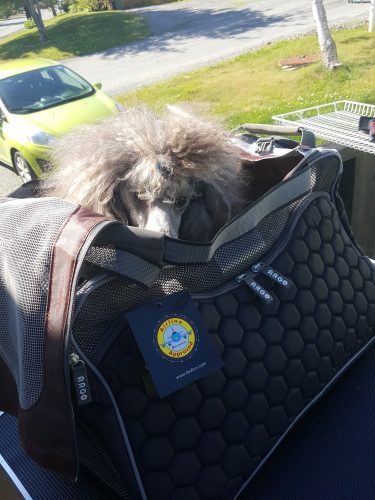
Turning her attention to premium alternatives, Keri ordered the upscale Argo Petagon Carrier by Teafco (dimensions: 21” long by 12” wide by 13” high) alongside the budget-friendly Pettom Expandable Foldable Carrier (dimensions: 19” long by 12” wide by 12” high).
Upon arrival, the Teafco Argo emerged as an exceptionally manufactured product. It boasted superior material integrity, multiple functional utility pockets, a rugged shoulder strap system, and reflective tape designed to offer privacy and reduce environmental stimuli for the animal. However, two structural factors disqualified it:
- The Cooling Tray Bottom: The integrated cooling insert consumed crucial vertical headroom.
- The Zipper Mechanism: The tight clearance made it difficult to zip the enclosure closed without catching Flint’s abundant hair.
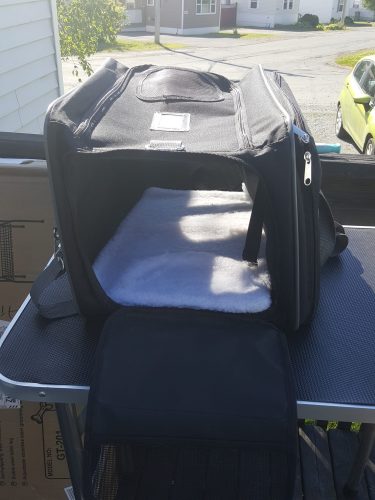
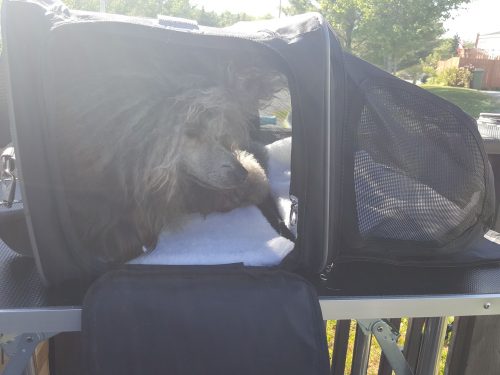
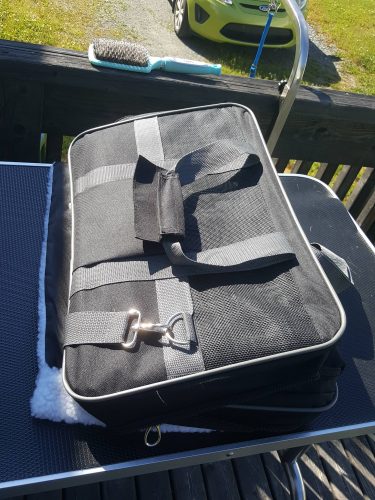
Conversely, the economically priced Pettom carrier won immediate approval from Flint himself. Featuring dual zippered end-panels, the Pettom allowed the dog to walk directly into the kennel of his own volition. Its defining asset was a fold-out, mesh-walled expansion panel that increased the carrier’s width to an expansive 22.5 inches, granting essential lateral space for long canine limbs. While the material quality and hardware felt decidedly cheaper than the Teafco model—prompting Keri to reinforce the strap attachments with heavy-duty metal carabiners—the structural flexibility made it the clear frontrunner.
Phase Two: The Radical Modification
Standard commercial pet carriers are engineered with rigid internal wire frames to maintain a strict rectangular geometry. While this satisfies aesthetic and structural durability standards, it presents a major operational hazard in commercial aviation, where under-seat clearance varies drastically and frequently features intrusive metal support bars.
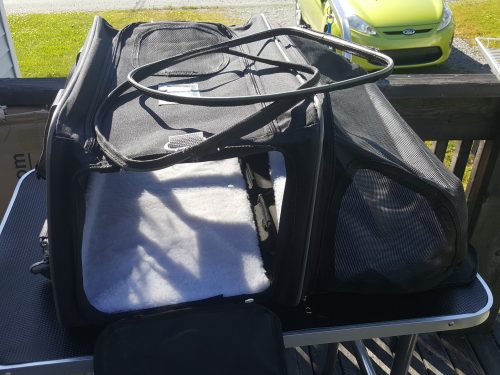
Anticipating that an unmodified Pettom carrier would be rejected by gate agents or jammed beneath restrictive seat frames, Keri executed a high-stakes modification:
- Removal of Expandable Supports: The zippered-in internal rods intended to hold the expandable section rigid were removed immediately to prevent Flint from catching a leg during movement.
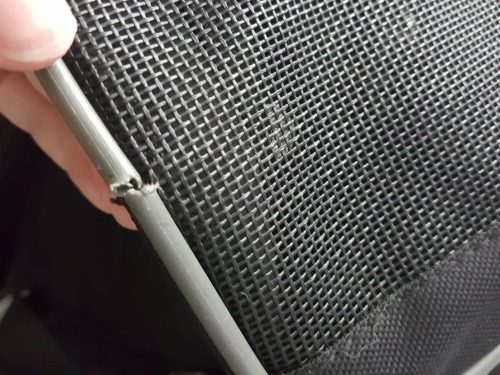
- Structural Amputation: Exercising extreme caution to preserve the surrounding mesh fabric and load-bearing seams, Keri utilized heavy-duty bolt cutters to slice through the four primary wire-frame supports encircling the kennel perimeter.
- Precision Sizing: The cuts were executed at precisely the 9-inch mark, ensuring the profile could compress safely under low-clearance seats.
While the modification yielded an agile, flexible carrier that sloped inward when empty, it introduced a sharp-edged hazard. Keri later noted that exposed wire ends required careful filing, taping, or capping to prevent lacerations during transit.
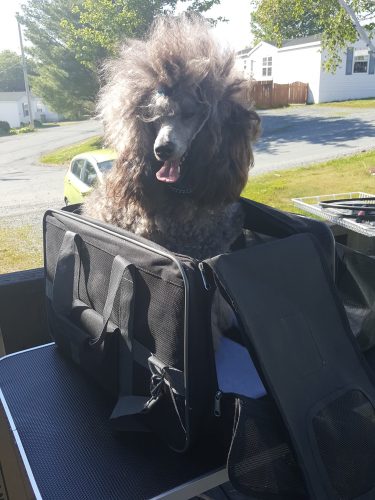
Phase Three: Conditioning and Behavioral Desensitization
Recognizing that mechanical preparation represents only half the battle, Keri instituted a rigorous, multi-week desensitization protocol to acclimate Flint to the modified environment:
- Week One: The carrier was left open in the living environment with treats tossed inside, encouraging voluntary, stress-free entries.
- Week Two: Short, incremental sessions were introduced with the enclosure zipped shut for brief durations.
- Week Three: Flint was integrated into afternoon nap routines, placed in the closed carrier at his owner’s feet for hour-long intervals, consistently rewarded for calm behavior.
To bridge the gap between home and the skies, Keri utilized the carrier during professional shifts at her dog-grooming salon, acclimating Flint to extended confinement amidst ambient noise. Finally, she secured official written endorsement from her veterinarian, certifying that the customized carrier was appropriate for Flint’s specific anatomical dimensions—a crucial precaution should airline personnel request professional verification.
Supporting Context & Metrics
Comparative Analysis of In-Cabin Pet Carriers
| Carrier Model | Advertised Dimensions (L x W x H) | Material Quality | Key Advantages | Key Limitations |
|---|---|---|---|---|
| Large Sherpa | 19” x 11.75” x 11.5” | Premium | Highly recognized by airline personnel; durable zippers. | Too short and restrictive for tall-framed breeds. |
| Large Bergan | 19” x 10” x 13” | Moderate-High | Excellent vertical clearance. | Narrow base restricts natural repositioning. |
| Teafco Argo Petagon | 21” x 12” x 13” | Superior | Outstanding build quality, privacy tape, multiple storage pockets. | Cooling tray consumes headroom; tight zipper clearance catches hair. |
| Large Pettom Expandable | 19” x 12” x 12” (Expands to 22.5” width) | Budget / Moderate | Expands laterally into a "pup tent"; dual end-zippers for easy entry. | Weaker factory straps; rigid frame requires manual modification for tight spaces. |
Aircraft Fleet Spatial Breakdown
Keri’s multi-leg itinerary with Air Canada provided a comprehensive testing ground across four distinct regional and mainline aircraft configurations:
- Embraer 175 (Economy Window Seat)
- Seat Pitch / Width: 32–34 inches / 18 inches.
- In-Flight Performance: Flint vocalized pre-flight but settled instantly upon takeoff. Benefiting from an empty adjacent seat, Keri pulled the carrier out post-takeoff and fully deployed the lateral mesh expansion into the adjoining footwell.
- Airbus A320-200 (Preferred Seating Window Seat)
- Seat Pitch / Width: 35 inches / 17.8 inches.
- In-Flight Performance: Operating on a nearly five-hour flight, Keri utilized a Preferred Seating upgrade to secure additional legroom. The carrier was pushed fully forward and tilted slightly to accommodate the aircraft’s lateral hull curvature while deploying a half-expansion of the mesh tent.
- Embraer 190 (Economy Seat)
- Seat Pitch / Width: 31–33 inches / 18 inches.
- In-Flight Performance: Loaded horizontally to accommodate a neighbor’s overhead baggage allowance, the carrier rested partially in under-seat space without obstruction. Post-takeoff, the mesh expansion was unzipped to occupy active foot space.
- Bombardier Q400 (Economy Window Seat)
- Seat Pitch / Width: 31 inches / 17 inches.
- In-Flight Performance: Representing the most restrictive spatial environment encountered, this turboprop left zero room for lateral expansion. The carrier remained fully zipped and confined beneath the seat for the duration of the flight.
Official Industry Standards & Operational Realities
Commercial airlines maintain stringent, non-negotiable parameters regarding in-cabin animal transportation. Most legacy carriers mandate that soft-sided containers must not exceed aggregate dimensions that allow compression beneath the seat ahead—typically averaging 18 x 11 x 11 inches. However, actual under-seat clearances vary wildly depending on structural elements such as life vest housings, entertainment system hardware boxes, and seat-support legs.
Aviation authorities and major carriers emphasize the following foundational compliance mandates:
- Uninterrupted Under-Seat Stowing: During critical phases of flight—specifically taxi, takeoff, and landing—the pet carrier must remain completely stowed beneath the seat forward of the passenger, with zero structural protrusion into shared aisle spaces.
- Animal Posture Requirements: Regulations universally dictate that the animal must be able to stand up, turn around, and lie down comfortably within the enclosure. For taller breeds like Miniature Poodles, this creates an inherent regulatory paradox, as rigid-frame carriers cannot simultaneously satisfy vertical clearance and under-seat height limits.
- Carrier Certification: While airlines do not officially endorse third-party modifications, they explicitly require that carriers remain leak-proof, well-ventilated, and structurally sound. Keri’s deployment of bolt cutters to modify the internal frame highlights a growing grey area where resourceful pet owners must adapt consumer products to bridge the gap between rigid airline rules and animal welfare needs.
Future Outlook & Strategic Takeaways
The success of Keri’s modified Pettom carrier experiment opens a vital dialogue for the future of pet travel. As commercial cabin spaces grow increasingly optimized and restrictive, rigid adherence to off-the-shelf pet accessories often fails owners of non-standard pets.
Key takeaways for long-legged pet travel include:
- Embrace Calculated Customization: When factory options fail to reconcile animal anatomy with corporate seating constraints, structural modifications—executed with careful precision—can mean the difference between a successful cabin flight and a denied boarding pass.
- Prioritize Gradual Acclimatization: Systematic desensitization is paramount. Training an animal to view a confined, moving carrier as a safe resting place eliminates panic-induced vocalization during airport processing and taxi procedures.
- Invest in Strategic Seat Selection: Upgrading to preferred seating rows or selecting window seats where adjacent spatial clearances can be utilized post-takeoff provides essential operational flexibility on longer journeys.
Ultimately, Keri’s pioneering work demonstrates that with meticulous preparation, creative engineering, and steadfast dedication to animal comfort, long-legged companions can safely and successfully traverse the skies.