
Executive Overview
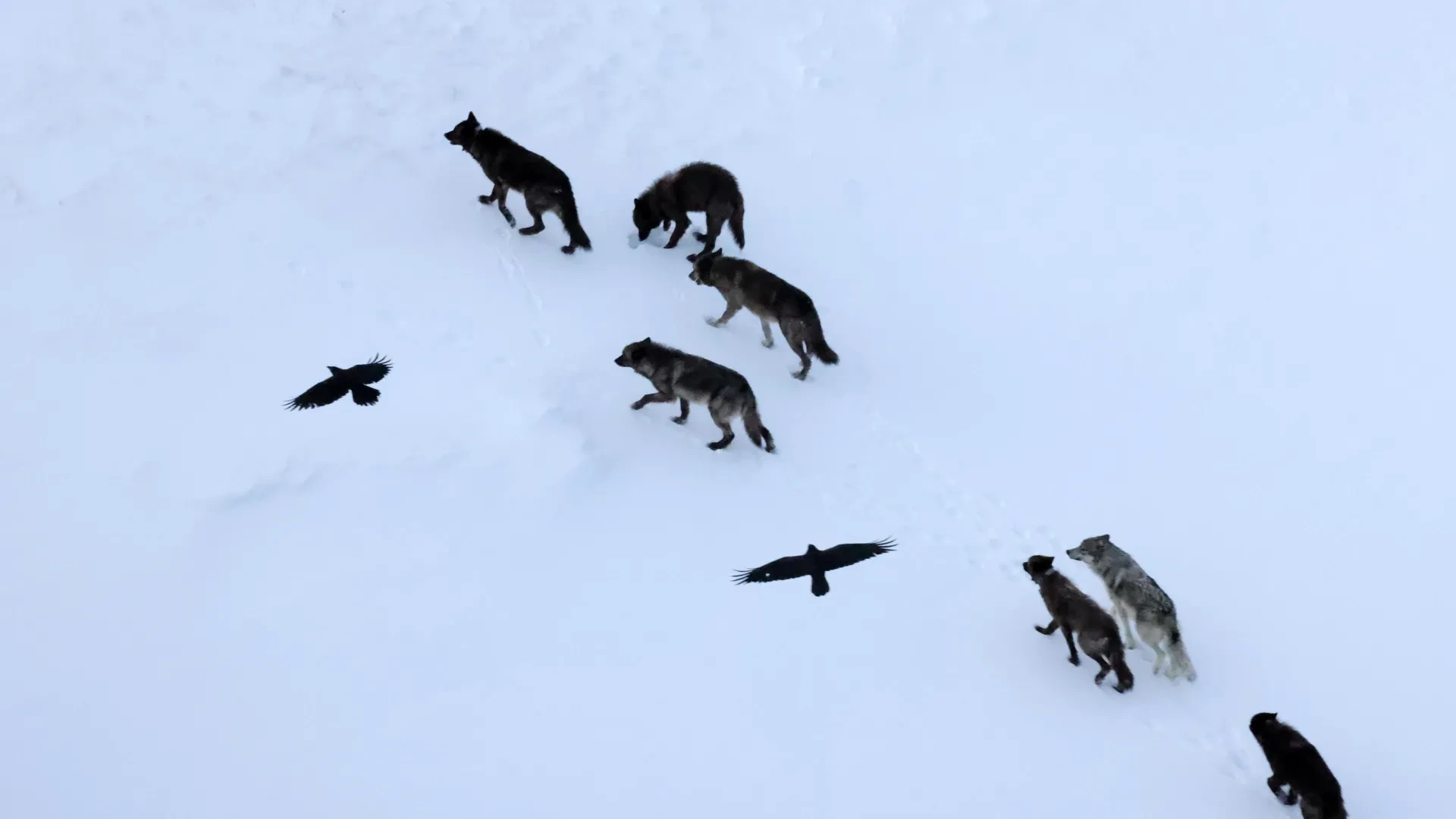
For centuries, naturalists, wildlife biologists, and casual observers of the wilderness have operated under a tidy, intuitive assumption: when the apex predator strikes, the scavenger follows. In the snow-swept valleys of Yellowstone National Park, the classic ecological tableau features a wolf pack bringing down an elk, swiftly encircled by an expectant parliament of ravens. The birds loiter in the skeletal branches of nearby pines, hopping impatiently on the crusty snow, waiting for the carnivores to carve open a meal and leave behind precious scraps.
For generations, humanity’s explanation for this uncanny synchronization was remarkably simple—some might say simplistic. Ravens were thought to be the perpetual shadows of wolves, tethered to the heels of packs across the sprawling wilderness, relying on the canine predators as ambulatory lunchboxes.
A groundbreaking, multi-year empirical study published in the prestigious journal Science has fundamentally dismantled this long-held ecological dogma. Researchers tracking both ravens and wolves in Yellowstone over a grueling two-and-a-half-year window have revealed a far more sophisticated survival strategy at play. Ravens, it turns out, do not need to tail wolves across the rugged topography of the American West. Instead, these corvids possess an extraordinary cognitive toolkit driven by spatial memory, geographic mapping, and long-range navigation. They remember where the blood has been spilled in the past, and they fly directly to those high-probability zones from distances spanning tens or even hundreds of kilometers.
Led by an international coalition of institutions—including the Research Institute of Wildlife Ecology at the University of Veterinary Medicine Vienna, the Max Planck Institute of Animal Behavior in Germany, the Senckenberg Biodiversity and Climate Research Centre, the University of Washington, and Yellowstone National Park itself—this research shifts the scavenger’s point of view to the center of the ecological lens. The findings do not merely rewrite the behavioral ecology of Corvus corax; they elevate our understanding of avian intelligence, demonstrating that these birds operate with a sophisticated mental map of a shifting resource landscape, unbound by the physical presence of their predatory partners.
Detailed Chronology: Unraveling the Myth of the Shadowed Predator
To understand how this ecological revelation came to light, one must examine the timeline of modern field research in Yellowstone National Park—a landscape uniquely suited for such an investigation.
The Return of the Apex Predator
The modern baseline for Yellowstone’s predator-prey dynamics was established in the mid-1990s, when gray wolves (Canis lupus) were triumphantly reintroduced to the park after a 70-year absence. This bold conservation maneuver instantly reconfigured the ecosystem’s trophic cascades. Predictably, wolves began regulating ungulate populations—primarily elk (Cervus canadensis), bison (Bison bison), and mule deer (Odocoileus hemionus)—while simultaneously generating a steady, reliable bonanza of scavengeable carrion.
For decades, biologists working within the park noted the ubiquitous presence of ravens alongside wolf packs. Dr. Dan Stahler, a senior Yellowstone wildlife biologist who has dedicated his career to studying the park’s wolves since their initial reintroduction, watched this relationship play out for decades.
"You see them flying directly above traveling packs or hopping close behind wolves as they take down prey," Dr. Stahler notes. Because this visual pairing was so frequent, it birthed an unchallenged scientific assumption. "We all assumed that the birds had a very simple rule: just stick close to the wolves," Stahler admits. Yet, despite the ubiquity of the observation, no one had ever subjected the hypothesis to rigorous empirical testing. The scavenger’s actual mechanics remained an ecological blind spot.
The Trapping and Tracking Campaign
To bridge this knowledge gap, an international team of researchers devised a tracking campaign of unprecedented scale within the park. The central challenge, however, lay in the very subject of their study: Corvus corax is famously, notoriously intelligent.
"Ravens are so observant of the landscape that they don’t step into traps easily," explains Dr. Matthias Loretto, the study’s first author. Capturing dozens of wild ravens required a level of ecological espionage. The research team had to meticulously camouflage their capture apparatus to blend seamlessly with human-altered or natural surroundings. In areas near park campsites, for instance, traps were cunningly disguised with discarded fast-food wrappers and trash. "Or else the ravens would suspect that something was off and wouldn’t come near it," Loretto recalls.
Ultimately, the team successfully fitted 69 wild ravens with advanced, miniaturized GPS tracking units—an extraordinarily large sample size for avian behavioral telemetry of this caliber. Simultaneously, researchers pooled movement data from 20 collared wolves that were already being monitored as part of Yellowstone’s ongoing wildlife management programs.
The Winter Surveillance Matrix
The study narrowed its operational window to the brutal Yellowstone winter. This was a deliberate methodological choice; winter is the season when metabolic stress peaks for scavengers, and the interaction between wolves and ravens reaches its absolute zenith due to deep snowpacks, harsh weather, and concentrated ungulate herds.
During these freezing months, the technological apparatus hummed continuously. The GPS units recorded raven locations with hyper-precise intervals every 30 minutes, while wolf movements were logged hourly. Concurrently, field biologists tracked and documented the precise geographic coordinates, timestamps, and species details of every kill made by the monitored wolf packs.
When the raw tracking data began flowing into the database, the research team anticipated confirming the traditional narrative: a dense, overlapping trail of birds shadowing canines across the snowy backcountry. Instead, the data told a radically different story.
Supporting Context & Metrics: The Anatomy of Avian Navigation
When the researchers crunched the numbers from the two-and-a-half-year surveillance window, the results were initially baffling.
The Disproof of Direct Tracking
For a study tracking scores of birds and packs over multiple winters, researchers identified only one single, unambiguous instance of a raven actively following a wolf for a distance exceeding one kilometer or lasting longer than one hour.
"At first, we were puzzled," Dr. Loretto reflects. "Once we realized that ravens are not following wolves over long distances, we couldn’t explain why the birds still arrive so quickly at wolf kills."
If ravens were not shadowing wolves, how were they managing to materialize at carcasses minutes after a hunt concluded? The answer required shifting focus from real-time tracking to spatial memory and landscape-level statistics.
The Geography of the Kill
A deeper spatial analysis of the telemetry data revealed that ravens were not reacting to the movement of wolves, but rather to the geography of the park itself.
- High-Yield Corridors: Wolf kills in Yellowstone are not distributed randomly across the topography. They heavily cluster in specific, predictable zones—most notably flat valley bottoms, riparian corridors, and transitional slopes where ungulates concentrate and maneuverability gives the canine pack a distinct hunting advantage.
- Targeted Journeys: Rather than wandering aimlessly or tailing predators, ravens exhibited purposeful, linear flight paths. Some individual birds traveled up to 155 kilometers (approx. 96 miles) in a single day, flying in direct, unwavering trajectories toward known high-yield zones.
- The Long-Term Resource Landscape: While an individual kill is an unpredictable, stochastic event in time, the spatial distribution of kills over seasons and years is remarkably stable. Ravens have learned to read this resource landscape. They visit high-yield areas far more frequently than low-yield regions, effectively utilizing a mental map built on cumulative historical experience.
"We already knew that ravens can remember stable food sources, like landfills," Dr. Loretto explains, highlighting the cognitive baseline of the corvid family. "What surprised us is that they also seem to learn in which areas wolf kills are more common. A single kill is unpredictable, but over time some parts of the landscape are more productive than others—and ravens appear to use that pattern to their advantage."
The Dual-Layer Strategy
Does this mean ravens completely ignore wolves? Not quite. The researchers propose a hierarchical, dual-layer foraging strategy:
- Macro-Scale (Spatial Memory): Over vast distances (tens to hundreds of kilometers), ravens rely entirely on memory and navigation. They fly directly to productive valleys because their past experience tells them carcasses are statistically likely to materialize there.
- Micro-Scale (Local Cues): Once a raven arrives in a general high-yield area, it switches tactics. "To find wolf kills locally, ravens likely use short-range cues, like monitoring wolf behavior or listening to wolf howling," Loretto notes.
This hybrid model explains both the uncanny speed of their arrival and their freedom from constant, energy-draining physical pursuit.
Official Statements & Expert Analysis
The publication of these findings in Science has sent ripples through the ornithological and ecological communities, prompting a re-evaluation of cognitive ecology in non-primate species.
Dr. Matthias Loretto, emphasizing the sheer energetic efficiency of the birds’ behavior, points out the physiological marvel of their movement patterns: "They can fly six hours non-stop, straight to a kill site. Ravens can cover large distances by flying, and they seem to have a good memory, so they don’t need to constantly follow wolves in order to profit from the predators."
Dr. Dan Stahler, reflecting on his decades-long immersion in Yellowstone’s wolf restoration project, acknowledges how easily scientific intuition can lead researchers astray. "We didn’t know what ravens were capable of because nobody had ever put them at the center; nobody had taken the scavenger’s point of view," Stahler states. The study bridges a historical divide between carnivore ecology and avian behavior, proving that scavengers are active, cognitively empowered agents rather than passive camp-followers.
Senior author Professor John M. Marzluff of the University of Washington—a globally recognized authority on corvid intelligence—summarizes the broader philosophical and ecological implications of the research:
"What our study clearly shows is that ravens are flexible in where they decide to feed. They don’t stay tied to a particular wolf pack. With their sharp senses and memory of past feeding locations, they can choose among many foraging opportunities far and wide. This changes how we think about how scavengers find food—and suggests we may have underestimated some species for a long time."
Future Outlook: Redefining Wildlife Conservation and Animal Cognition
The revelation that ravens navigate Yellowstone through complex mental mapping rather than simple reactive tracking opens vast new horizons for ecological research and wildlife management.
Implications for Behavioral Ecology
For decades, studies of food-web dynamics have tended to view scavengers as downstream, secondary beneficiaries of predatory success. By demonstrating that corvids possess sophisticated spatial economies—mapping landscape productivity over multi-year periods—this study urges researchers to elevate scavengers to primary architects of nutrient redistribution. Ravens are not merely waiting for scraps; they are processing environmental data at a regional scale, utilizing cognitive maps that rival those of large mammalian carnivores.
Technological Frontiers in Telemetry
The success of this project—combining the simultaneous, high-resolution tracking of 69 intelligent avian subjects and 20 apex predators across rugged alpine terrain—serves as a methodological blueprint for future multi-trophic studies. As GPS and telemetry hardware continues to shrink in weight while expanding in battery life and data-logging capacity, researchers will increasingly be able to examine ecosystems from multiple species’ perspectives simultaneously, dissolving the historical boundaries between specialized academic silos.
Conservation and Park Management
As global ecosystems experience unprecedented pressures from habitat fragmentation and climate change, understanding how adaptable species like the common raven navigate and exploit human- and predator-altered landscapes becomes critical. Ravens are consummate generalists; their capacity to learn resource landscapes—whether defined by wolf kills in Yellowstone or human refuse dumps worldwide—underpins their ecological success. Recognizing the cognitive depth of these birds reminds conservationists that protecting resilient species requires preserving the ecological integrity of vast landscape networks, ensuring that animals capable of flying 155 kilometers a day still find a world worth navigating.
In the final analysis, the raven over the Yellowstone ridge is no mere sycophant to the wolf. It is an independent cartographer of life and death, reading the contours of the valley floor not with the frantic desperation of a follower, but with the quiet, calculating confidence of a master mind.