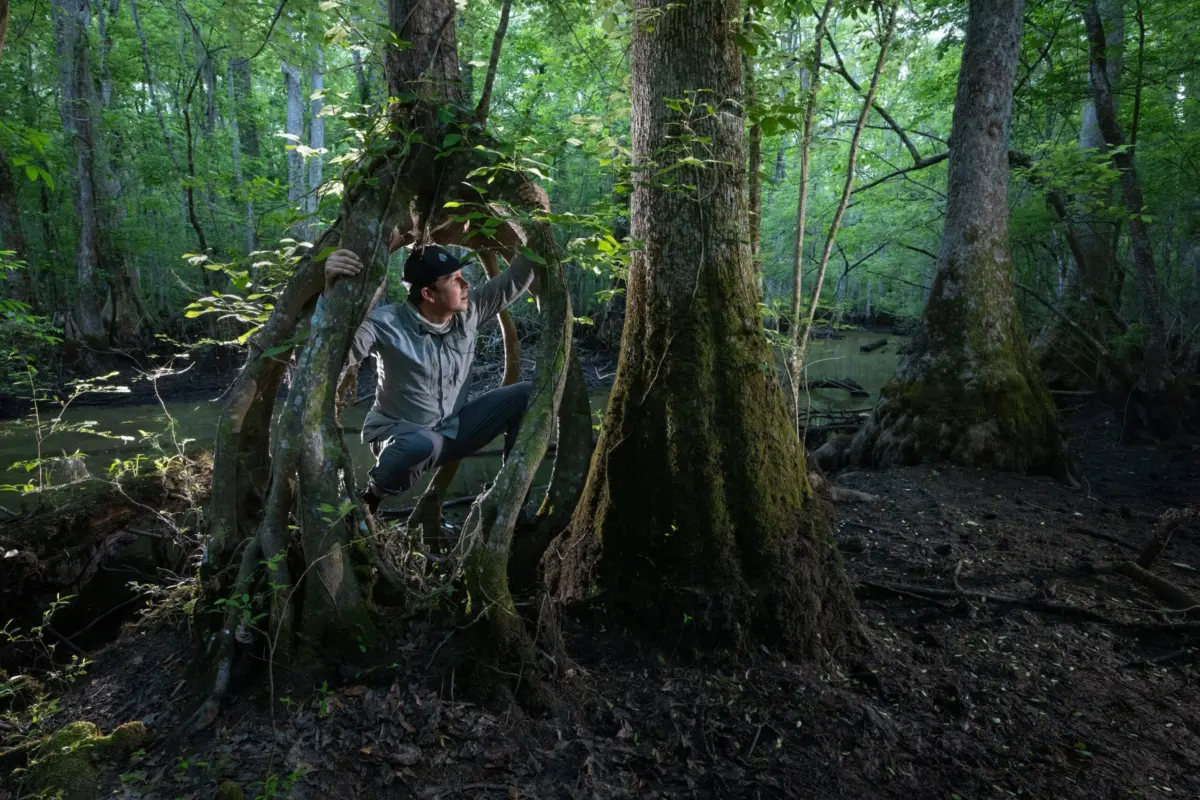

In the heart of the American South, an enduring cultural axiom dictates an absolute avoidance of serpents—particularly the venomous, semi-aquatic cottonmouth. Armed with hemotoxic venom engineered by millions of years of evolution to lyse tissue, rupture red blood cells, and induce unchecked hemorrhaging, the pit viper commands a wide berth from casual passersby. Yet conservation photographer Mac Stone is anything but casual.
Leaping over elevated boardwalks into primordial muck with thousands of dollars of camera gear cradled in his arms, Stone embodies a rare breed of visual artist and land protector. Operating across the imperiled wetlands of the U.S. Southeast, the 42-year-old National Geographic Explorer and executive director of the nonprofit Naturaland Trust merges rigorous scientific training with relentless field persistence. His mission is as urgent as it is artistic: to rescue America’s overlooked, waterlogged ecosystems from the relentless march of development, pollution, and climate change. Through award-winning books, upcoming IMAX features, and active land acquisition, Stone deploys his camera not merely as an instrument of capture, but as a definitive tool for survival.
Detailed Chronology: From Gainesville Creeks to the Swamps of the Carolinas
Childhood Explorations and Early Obsessions
Growing up in Gainesville, Florida, Stone’s upbringing was characterized by a profound curiosity for the wild rather than a fear of it. Frequently reprimanded by his parents for an "unhealthy relationship with gators," he spent his formative afternoons scouring the white sands of a backyard blackwater creek for fossilized shark teeth and climbing the gnarly boughs of southern live oaks. Bicycling through nearby marshes and forests, Stone viewed reptiles and invertebrates not as hazards to be evaded, but as prizes in a continuous, open-air treasure hunt.
In the ninth grade, the discovery of his father’s vintage Minolta SR-T 101 camera fundamentally shifted his engagement with the natural world. Photography became an immediate, physical extension of his exploratory impulse. Equipping himself with a local atlas, a young Stone systematically identified every wetland symbol on the map, driving out before dawn to document landscapes largely untouched by modern eyes. He would frequently arrive at school covered in drying mud, his technical skills rapidly sharpening through clandestine readings of nature photography field guides hidden inside classroom textbooks.
Field Biology and the Genesis of a Visual Voice
By his college years, Stone possessed an unyielding desire to pursue nature photography professionally, though traditional academic pathways for such a career were virtually non-existent. He instead pursued a multidisciplinary education—studying biology, environmental science, international politics, and Spanish—while quietly building his portfolio.
Upon graduation, Stone secured a position as a field biologist for Audubon Florida, working under ecologist Jerry Lorenz at the Everglades Science Center. While Lorenz initially hired him for his ecological expertise rather than his artistic ambitions, Stone’s pre-dawn helicopter and boat excursions deep into restricted Everglades watersheds soon yielded undeniable results. "When he showed me his pictures, I was gobsmacked," Lorenz recalls.
This immersion culminated in Stone’s 2014 debut book on the Everglades, a five-year visual project that challenged prevailing public perceptions of the wetland. Blending breathtaking imagery with harrowing documents of ecological collapse—such as dead Roseate Spoonbill chicks left stranded by artificially dried waterways—the publication established Stone as a formidable voice in conservation media. Subsequent assignments for Audubon and National Geographic yielded historic milestones, including the first-ever photographs of a ghost orchid being pollinated by a giant sphinx moth and the documentation of an 18-year-old banded Roseate Spoonbill, the oldest known living individual of its kind.
Supporting Context & Metrics: The Crisis of Southeastern Wetlands
While Stone’s imagery often isolates wildlife and pristine landscapes away from the heavy footprint of human industry, the specter of anthropogenic threat looms large over his frames. The ecological stakes in the American Southeast are historically unprecedented:
- Habitat Loss: According to U.S. Fish and Wildlife Service data, more than 50% of wetlands across the lower 48 states have vanished over the past 70 years.
- Accelerating Decline: The rate of wetland loss has steadily escalated since 2009, with the U.S. Southeast experiencing some of the most aggressive degradation driven by urban sprawl and agricultural conversion.
- Cypress Erasure: Decades of a pervasive "drain the swamp" mentality have decimated nearly all of the nation’s old-growth cypress forests. From an original expanse spanning approximately 40 million acres, only an estimated 10,000 to 12,000 acres of old-growth cypress remain intact today.
- Landscape Connectivity: Scientists and conservationists increasingly view the Southeast as a unified eco-region linked by complex river networks, mountain ranges, and coastal corridors. Species such as migratory songbirds and wading birds rely on this unbroken web, rendering state-by-state management frameworks obsolete.
Official Statements and Industry Perspectives
The convergence of art, science, and advocacy in Stone’s career has drawn high praise from prominent figures within the conservation and publishing sectors:
Anne Farrar, Senior Photography Manager at National Geographic:
"If he’s after a specific image or animal behavior, he simply doesn’t give up until he captures and documents it not just accurately but beautifully. He’s made me fall in love with swamps and I’m not a swamp girl—I don’t do mosquitoes."Jerry Lorenz, Ecologist and Former Director of Audubon Florida’s Everglades Science Center:
"This is where Mac’s work is so vital. He shows people the beauty of these places and you go with him on these journeys… These ecosystems host an astounding array of biodiversity, buffer the land from storms and floods, and stabilize shores—increasingly important roles amid the worsening effects of climate change."Frank Holleman, President of Naturaland Trust:
"Hiring Mac was one of the best decisions we ever made. His people skills and compelling presentations make him extremely successful at the job, but perhaps most important is his unwavering dedication to the cause."Mac Stone, Conservationist and Photographer:
"As a conservationist, I want to use my art to make a tangible impact. All the photos need to go to work… People have to understand what it is you’re asking them for."
Future Outlook: Multimedia Reach and Active Land Acquisition
Stone’s strategic approach to conservation has expanded far beyond static print photography into multimedia advocacy and direct real estate acquisition. As executive director of the South Carolina-based nonprofit Naturaland Trust—an organization founded in 1973 by legendary conservation attorney Tommy Wyche—Stone actively identifies, evaluates, and secures biologically sensitive parcels before developers can convert them.
Operating in a region where granite-faced mountain formations and rare ecosystems are continuously threatened by high-density housing projects, Stone recently spearheaded the acquisition of a 182-acre mountainous plot in Pickens County, South Carolina. Originally slated for a 240-home subdivision, the property was brought under contract sight unseen by Stone the moment it hit the market. Leveraging his striking aerial drone photography and field imagery for state grant applications, Stone successfully secured the necessary $899,000 to permanently preserve the land.
Simultaneously, Stone’s media footprint is set to reach unprecedented audiences. His latest book, Cypress: The Last Old-Growth Swamps, brings focused attention to vanishing arboreal sanctuaries. Furthermore, his upcoming co-production of American Amazon—an IMAX film and companion PBS series accompanied by a photo book published by Gestalten—aims to reframe the southeastern United States in the public consciousness as a single, interconnected living organism that transcends political boundaries.
Whether wading through knee-deep blackwater to illuminate a walking maple with off-camera strobes or negotiating multi-million-dollar land preservation deals, Mac Stone remains steadfast in his methodology. By translating the esoteric complexities of wetland ecology into undeniable visual poetry, he continues to forge a path where art directly commands the survival of the wild.