
Executive Overview
Amid the gleaming canyons of glass and steel that define the Manhattan skyline, a silent crisis unfolds with every seasonal shift. Millions of migratory birds traverse the Atlantic Flyway each year, only to find themselves disoriented by the dazzling artificial lights and reflective architecture of the nation’s densest urban center. The resulting collisions claim the lives of tens of thousands of songbirds annually.
Enter Miles Wu. At just 14 years old, Wu occupies a unique and somber intersection of art, ornithology, and conservation. As a volunteer collision monitor for Project Safe Flight—a vital initiative spearheaded by the NYC Bird Alliance—Wu spends his Sunday mornings patrolling the perimeter of Bryant Park. Armed with observation logs and a deep reverence for wildlife, he documents the casualties of urban development.
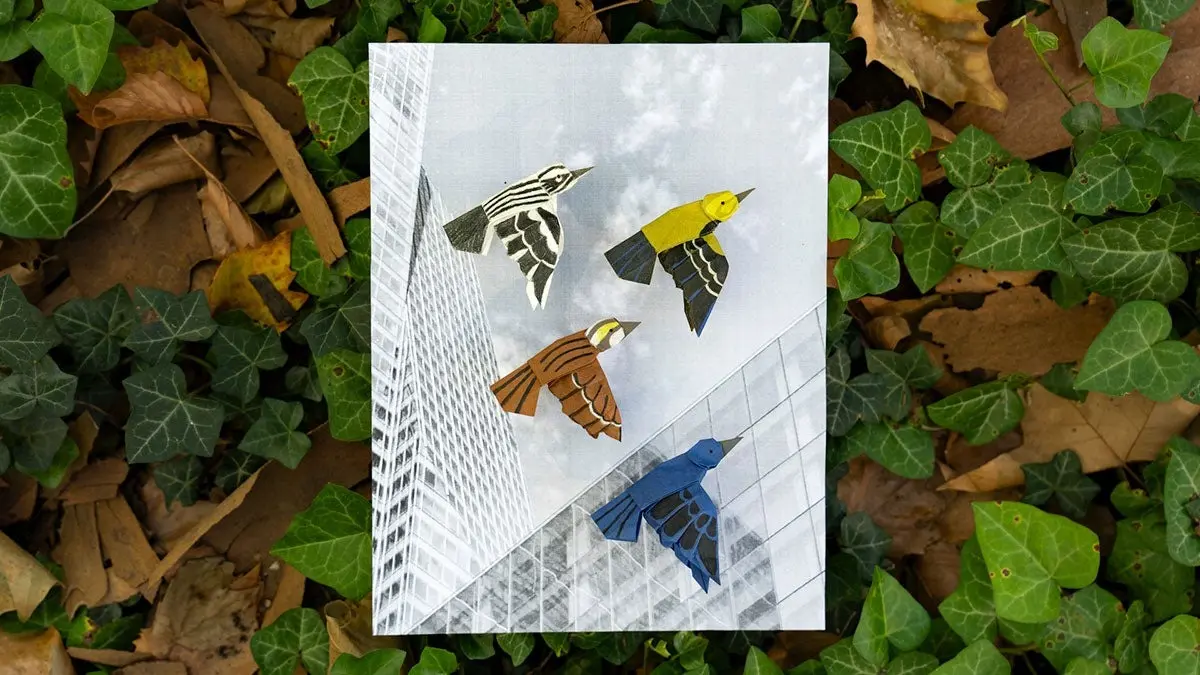
However, Wu’s response to this grim duty transcends standard advocacy. A passionate practitioner of origami for more than half his life, the teenage artist has channeled the heartbreak of his volunteer work into an intricate, tactile memorial series. By folding complex paper replicas of the very birds he has mourned—such as the Indigo Bunting, the Black-and-white Warbler, the Black-throated Green Warbler, and the White-throated Sparrow—Wu honors their fleeting lives. Mounted against photographic backdrops of the very Manhattan skyscrapers that pose such lethal threats, Wu’s origami creations serve as both a heartbreaking tribute and an urgent call to action. This comprehensive report explores Wu’s artistic journey, the mechanics of urban bird strikes, the rigorous science of collision monitoring, and the broader push for bird-safe architecture in New York City.
Detailed Chronology: From First Sightings to Paper Tributes
The Catalyst: A Fatal Encounter in Manhattan
The genesis of Wu’s latest artistic tribute occurred this past May. As the teenager concluded his early morning shift as a Project Safe Flight collision monitor, a sudden, sharp impact shattered the morning air. An Indigo Bunting—a songbird renowned for its incandescent, jewel-toned blue plumage—had collided with a glassy Manhattan office building, plummeting to the pavement just feet from where Wu stood.
"It was shocking and sad," Wu recalls, reflecting on the immediate aftermath of the impact. "But it was also really beautiful."
That dichotomy—between the breathtaking evolutionary marvel of migratory wildlife and the brutal, unnatural reality of architectural glass—fundamentally shifted Wu’s perspective. Rather than letting the memory fade, the young artist resolved to immortalize the encounter through his lifelong medium: origami. The resulting sculpture features not only the Indigo Bunting but also three other victims recovered during the spring migration window: a Black-and-white Warbler, a Black-throated Green Warbler, and a White-throated Sparrow.
A Seven-Year Evolution in Origami
Wu’s mastery of paper-folding is no overnight phenomenon. Having practiced the art form for over seven years—accounting for roughly half of his young life—he began in elementary school by folding simple ninja stars and decorative objects with schoolmates. His dedication deepened when his aunt and cousins gifted him an authoritative book on origami, steering him toward precision-based folding.
Two years ago, Wu crossed the threshold from interpretive folding to original design, launching his own patterns. By then, he had already spent years as an avid young birder exploring the rich avian habitats of Central Park. Naturally, his artistic pursuits converged with his ornithological passions. He began focusing heavily on birds and insects.
"They’re just really interesting subjects for folding because they have all these long appendages," Wu explains, noting the intricate challenges of translating biological structures into geometric folds.
The Anatomy of an Origami Bird
Crafting a hyper-realistic songbird from a single, uncut square of paper demands exceptional technical skill. Wu’s avian designs uniformly originate from a classic structural foundation known among origami practitioners as the "bird base." This configuration yields five distinct flaps: a shorter, central flap for the body, alongside four elongated appendages designated for the head, the tail, and the two wings.
"After that, I can alter it and tweak it in different ways to match the specific type of bird," Wu notes. For his dedicated memorial piece, Wu elevated his technique by selecting a heavier, textured paper stock. He meticulously adjusted the mountain and valley folds to manipulate how the paper feathers layered across the wings. To achieve biological fidelity, he finished the pieces by hand-coloring the plumage details with colored pencils. Finally, he mounted the completed songbirds onto paper-covered foam board, positioning them directly against a photographic backdrop of the Bryant Park skyscrapers he routinely monitors.
Supporting Context & Metrics: The Perils of the Urban Flyway
The Scale of the Crisis in New York City
New York City sits squarely within the Atlantic Flyway, a primary aerial migration superhighway utilized by millions of birds each spring and fall. However, this urban oasis presents a gauntlet of lethal architectural hazards.
According to comprehensive data compiled by the NYC Bird Alliance through decades of monitoring, between 90,000 and 230,000 birds perish annually from window collisions in New York City alone. The mechanics of these tragedies are twofold:
- Reflective Glass: Modern skyscrapers utilize large, seamless panes of glass that reflect surrounding sky, clouds, and urban park foliage. To a migrating bird, these reflections do not signal a solid barrier; instead, they appear as open pathways or continuous forest canopies.
- Light Pollution: Migratory birds—many of which navigate primarily by the stars during nocturnal flights—frequently become disoriented by intense artificial lighting emanating from high-rise office towers. Drawn toward the illumination, they are trapped in urban centers where daytime glare seals their fate.
Furthermore, migratory species face compounding biological vulnerabilities. Having flown hundreds or thousands of miles without rest or sustenance, these exhausted animals are operating at peak physical deficits, leaving them uniquely unequipped to navigate complex urban obstacles.
Project Safe Flight: On the Front Lines of Conservation
Miles Wu’s boots-on-the-ground contribution occurs through Project Safe Flight, an intensive community science initiative managed by the NYC Bird Alliance. Every Sunday throughout the spring and fall migration seasons, Wu’s alarm clock sounds well before 7:00 a.m. He reports to Bryant Park to conduct systematic patrols along designated architectural sectors.
The protocol for collision monitors requires immense dedication and emotional resilience. When monitors discover injured birds still clinging to life, the protocol is swift: rescue and transport. Live victims are carefully secured and rushed to the Wild Bird Fund, Manhattan’s premier wildlife rehabilitation center, where veterinary professionals administer emergency trauma care. (Reflecting the bittersweet realities of his work, Wu successfully rescued one live Brown Creeper during the spring season.)
For birds that succumb to their impacts, the mission shifts from rescue to scientific documentation. Deceased specimens are carefully gathered, cataloged, and donated to the American Museum of Natural History’s ornithology collection, providing researchers with invaluable biological data regarding avian morphology, health, and mortality distributions.
For a young birder, this volunteer work exposes a poignant paradox. Wu notes that many bird species enter his life list—or "lifer" count, a cherished milestone among birders—not through joyful sightings in the treetops, but through tragedy.
"A lot of them were lifers, even though they were dead," Wu reflects, capturing the melancholic duality of his conservation fieldwork.
Official Statements & Expert Perspectives
The intersection of urban development, avian mortality, and youth-led artistic intervention has drawn praise from conservation leaders and ornithologists across the metropolitan area.
Dr. Caitlin Robinson, an urban ecologist specializing in avian infrastructure, emphasizes the critical role that volunteer monitors play in shaping policy:
"The data collected by citizen scientists through programs like Project Safe Flight provide the empirical backbone required to enact legislative change. Without systematic monitoring at the base of skyscrapers, the true scale of window-strike mortality would remain invisible to city planners and building owners."
Representatives from the NYC Bird Alliance have similarly lauded Wu’s ability to bridge hard science and emotive storytelling. In a statement regarding youth engagement in conservation, the organization noted:
"When a young artist like Miles Wu utilizes his talents to memorialize collision victims, he humanizes—and avianizes—a statistic that many prefer to ignore. Art has the unique capacity to penetrate cultural indifference, translating ecological data into a visceral emotional experience that compels people to care."
Audubon conservation advocates echo this sentiment, pointing out that public awareness campaigns grounded in creative expression help build public momentum for systemic building retrofits.
Future Outlook: Building a Safer Skyline
While memorializing victims through origami offers a powerful tribute, the ultimate goal of Project Safe Flight monitors, advocates, and artists alike is to render such memorials obsolete. The momentum toward bird-safe architecture in New York City and across the United States is gaining traction, driven by a combination of rigorous data, legislative action, and public advocacy.
Architectural Innovations and Policy Shifts
Making cities safe for migratory birds does not require demolishing skyscrapers; rather, it demands thoughtful, cost-effective structural modifications:
- Window Treatments: Applying exterior films, UV-patterned decals, fritted glass, or external screens breaks up reflections, signaling a physical barrier to approaching birds.
- Lighting Management: Programs such as "Lights Out New York" encourage commercial building managers and residential co-ops to dim or extinguish non-essential decorative and interior lighting during peak migration hours, dramatically reducing nocturnal disorientation.
- Legislative Mandates: Municipal policies are increasingly shifting from voluntary guidelines to binding legal requirements. New York City has implemented ordinances requiring bird-friendly materials on new municipal construction and major alterations, setting a national benchmark for urban conservation.
The Role of Youth and Art in the Path Forward
Miles Wu remains steadfast in his commitment to both birding and artistic expression. By using his intricate paper sculptures to tell the stories of the Indigo Bunting, warblers, and sparrows that cross his path, he hopes to inspire a broader cultural reckoning regarding how humans share urban spaces with wildlife.
"I thought this piece would be like a tribute to all the birds from Project Safe Flight," Wu says simply.
As cities continue to expand vertically, the voices of young conservationists and artists will be instrumental in reshaping our built environment. Through precise folds of paper and unwavering dedication in the early morning light at Bryant Park, Miles Wu demonstrates that even the smallest hands can help construct a more compassionate, bird-safe future.