
Executive Overview
In a major operational shift that highlights the complex intersection of federal food safety mandates and pet nutrition, leading pet food manufacturer Vital Essentials has quietly implemented Electron-Beam (E-Beam) irradiation technology across its product lines. According to official disclosures published on the company’s consumer FAQ platform, the manufacturer adopted this technology as a cold-sterilization method to eliminate harmful pathogenic bacteria using targeted electrical streams.
While the primary objective of this intervention is to mitigate microbial risks—specifically targeted by federal regulatory agencies—it has reignited a contentious debate among veterinary toxicologists, regulatory advocates, and pet owners. Federal authorities, including the U.S. Food and Drug Administration (FDA), alongside industrial trade groups such as NextBeam, maintain that food irradiation is a scientifically validated, safe intervention. However, consumer advocacy groups and pet nutrition researchers urge caution, pointing to historical precedents where irradiated pet diets led to severe neurological disorders and fatalities in animals.
Under current federal labeling statutes, any packaged food—whether formulated for human or animal consumption—that undergoes ionizing radiation must explicitly display the international Radura symbol alongside standard warning declarations, such as "Treated with radiation" or "Treated by irradiation."
        mandatory RADURA SYMBOL
               /
             (  •  )
              ___/
     "Treated with Radiation"
Yet behind these labeling requirements lies a fundamental regulatory dilemma: Does relying on advanced post-processing sterilization techniques resolve the underlying issues of raw material contamination, or does it merely obscure systemic vulnerabilities within the agricultural supply chain?
This investigative report examines the technological mechanics, historical precedents, regulatory framework, and lingering toxicological risks—such as lingering bacterial endotoxins—associated with irradiated pet foods.

Detailed Chronology: The Evolution of Irradiation and Regulatory Milestones
To understand why pet food manufacturers are turning to high-energy radiation, one must trace the convergence of catastrophic health incidents, regulatory shifts, and technological pivots over the past two decades.
+-----------------------------------------------------------------------------------+
| CHRONOLOGY OF PET FOOD STERILIZATION & REGULATION                                 |
+-----------------------------------------------------------------------------------+
| 2008: Australia Orijen Cat Food Catastrophe (Gamma Irradiation / Vitamin A loss)  |
| 2012-2014: Chinese Jerky Treat Crisis (FDA investigates radiation dosage gaps)   |
| 2013: FDA Enforces Strict "Zero-Tolerance" Pathogen Mandate for Pet Foods          |
| Present: Industry Shifts to E-Beam Sterilization (Vital Essentials adoption)      |
+-----------------------------------------------------------------------------------+
The 2008 Australia Catastrophe: Gamma Radiation and Feline Paralysis
The debate surrounding pet food irradiation is rooted in a well-documented veterinary crisis in Australia. In 2008, Canadian pet food brand Orijen began importing premium cat food into the Australian market. To comply with strict national quarantine regulations designed to prevent foreign animal diseases from entering the country, the Australian government subjected imported pet foods to high-dose gamma irradiation.
Shortly after the commercial release of these imported batches, veterinarians across Australia observed a sudden wave of severe neurological impairment in domestic cats. Affected felines exhibited progressive weakness, hind-limb paralysis, loss of motor control, and in numerous instances, fatal systemic collapse. Subsequent investigations conducted by Australian academic institutions and formally recorded by the Australian Parliament identified a direct link between gamma-irradiated foods and severe nutrient degradation.
The Australian Senate Rural and Regional Affairs and Transport Committee concluded that high-dose gamma irradiation applied to the pet food caused severe depletion of crucial vitamins—most notably Vitamin A—while simultaneously generating high concentrations of damaging free radicals and peroxides through lipid oxidation. The combination of nutrient destruction and toxic byproduct formation induced severe leukoencephalomyelopathy (degeneration of the white matter in the brain and spinal cord) in cats, forcing Australia to ultimately abandon mandatory quarantine irradiation for cat foods.
The Chinese Jerky Treat Crisis and Testing Deficits
Between 2007 and 2015, thousands of dogs across North America suffered severe illnesses, including Fanconi-like syndrome and acute renal failure, linked to the consumption of imported jerky treats manufactured in China. As part of its extensive investigation into these unexplained pet deaths, the FDA tested affected products for various contaminants, heavy metals, chemical adulterants, and markers of food irradiation, such as 2-alkylcyclobutanones (unique radiolytic compounds formed when fats are exposed to ionizing radiation).

While many of these imported treats had been subjected to radiation prior to export, the FDA acknowledged a major oversight in its consumer advisory updates during the height of the crisis: the agency lacked standardized, validated scientific methods to determine the precise dose of radiation applied to the finished products. Without a reliable dosimetric verification protocol, regulatory authorities could neither confirm whether products received excessive radiation exposure nor determine if improper processing caused chemical shifts within the treats. This raised a critical question: Should commercial manufacturers deploy radiation technologies at scale when regulatory bodies lack the tools to measure real-world dosage exposure?
The 2013 FDA Zero-Tolerance Mandate
The commercial catalyst for today’s adoption of irradiation occurred in 2013, when the FDA enforced an unyielding Zero-Tolerance Policy for pathogenic bacteria in pet food under the authority of the Food Safety Modernization Act (FSMA). Under this mandate, the presence of even trace amounts of Salmonella, Listeria monocytogenes, or Escherichia coli in pet food products renders the food legally "adulterated," triggering immediate public warnings and mandatory product recalls.
Faced with severe financial and reputational risks from potential recalls, manufacturers seeking to market raw, fresh, or freeze-dried pet foods were forced to adopt post-processing antimicrobial steps—leading directly to the adoption of High-Pressure Processing (HPP) and, more recently, Electron-Beam irradiation.
Supporting Context & Metrics: Evaluating the Efficacy of "Kill Steps"
To evaluate whether aggressive end-stage sterilization methods have improved safety, it is helpful to analyze recall trends across different sectors of the food industry.
+-----------------------------------------------------------------------------------+
| COMPARATIVE PATHOGEN REGULATORY STANDARDS & INTERVENTIONS                         |
+-----------------------------------------------------------------------------------+
| CATEGORY          | GOVERNING BODY | REGULATORY THRESHOLD    | PRIMARY KILL STEP  |
+-------------------+----------------+-------------------------+--------------------+
| Human Meat       | USDA-FSIS      | Zero-Tolerance for E.   | Thermal / Cooking  |
|                   |                | coli O157:H7; Tolerance |                    |
|                   |                | thresholds for others   |                    |
+-------------------+----------------+-------------------------+--------------------+
| Pet Food (Kibble) | FDA-CVM        | Zero-Tolerance for all  | Extrusion Heat     |
|                   |                | pathogens               | (High Temp/Press.) |
+-------------------+----------------+-------------------------+--------------------+
| Pet Food (Raw/Alt)| FDA-CVM        | Zero-Tolerance for all  | HPP or E-Beam      |
|                   |                | pathogens               | Irradiation        |
+-----------------------------------------------------------------------------------+
A core argument raised by pet food consumer advocates, including Susan Thixton of TruthaboutPetFood.com, is that end-stage intervention policies fail to produce a measurable reduction in systemic food contamination.
The Persistent Recall Cycle
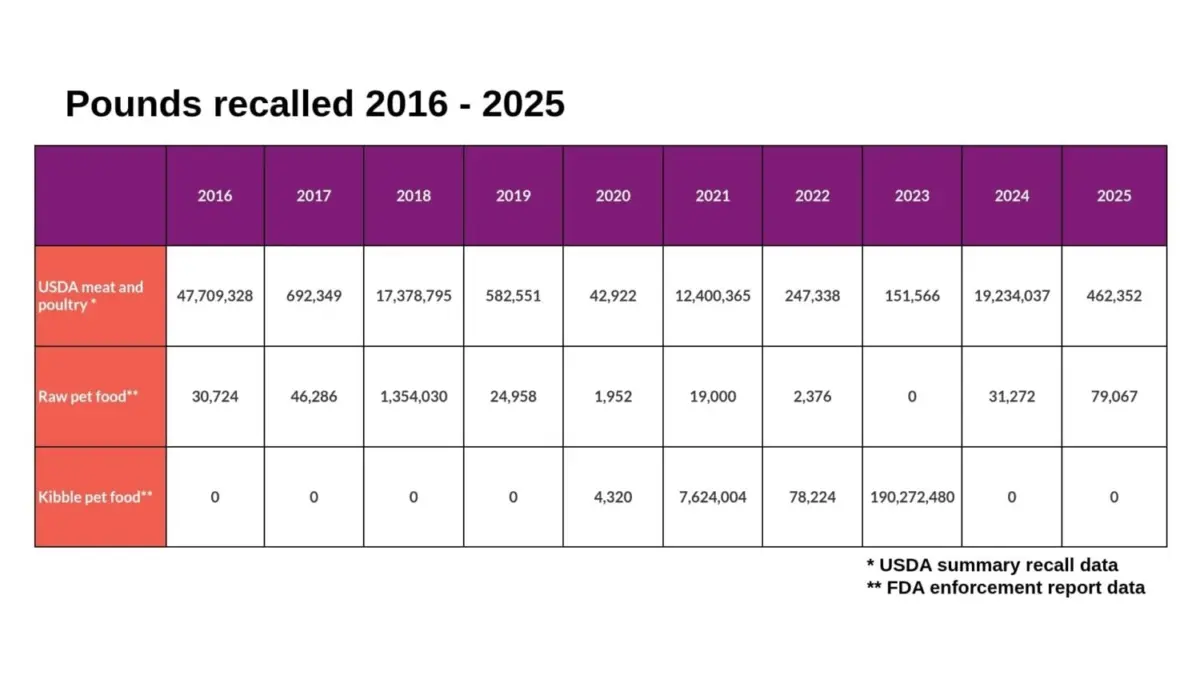
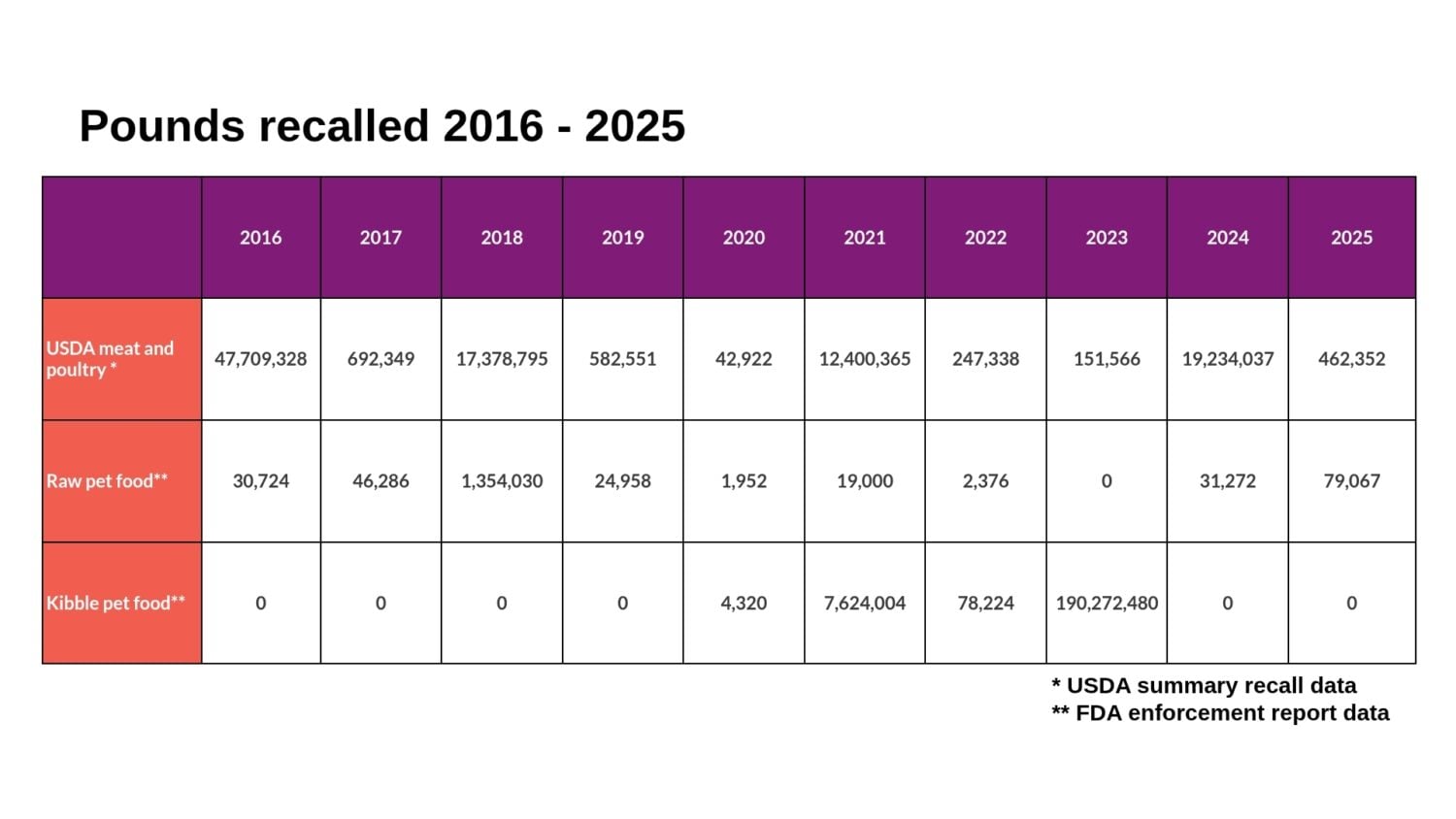
Despite widespread implementation of post-processing kill steps across the pet food industry, millions of pounds of pet food continue to be recalled annually due to bacterial contamination.
RECALL TREND ANALYSIS: MILLIONS OF LBS RECALLED OVER 10 YEARS
[High Volatility Across All Sectors - No Consistent Downward Trend]

Kibble (Extruded) : ████████████████████████████ (Thermal Kill Step)
Raw / Fresh Pet   : ██████████                      (HPP / Radiation)
Human Meat (USDA) : ██████████████████████████████████████ (Industrial Scale)
Data from federal recall logs reveals several critical insights:
- Extrusion Heat Fails as a Catch-All: Commercial kibble is subjected to extreme heat and pressure during extrusion—a process the FDA considers an official thermal "kill step." Yet, kibble accounts for millions of pounds of recalled product over the last decade, primarily due to post-cook re-contamination during fat spraying, cooling, and packaging.
- Regulatory Asymmetry: The USDA permits baseline tolerance levels for Salmonella on raw human-grade poultry, operating under the assumption that consumers will cook the meat properly. Conversely, the FDA enforces strict zero tolerance for Salmonella on raw pet food. This forces pet food manufacturers to take raw meat that is legally permissible for human retail and subject it to aggressive chemical or radiological processing to pass pet food compliance tests.
- No Downward Trend: Historical recall volume charts over a 10-year period show no sustained downward trend in pathogen-related recalls. End-of-line interventions appear to act as a reactive band-aid rather than a proactive cure for contamination in the supply chain.
Official Statements, Industry Positions, and Biochemical Analysis
Industry & Regulatory Position: The Science of E-Beam Technology
Both the FDA and industrial processors maintain that food irradiation is safe, effective, and chemically sound. Proponents emphasize that modern Electron-Beam (E-Beam) processing differs significantly from the gamma irradiation technologies implicated in historic incidents.
+-----------------------------------------------------------------------------------+
| IRRADIATION METHODOLOGY COMPARISON                                                |
+-----------------------------------------------------------------------------------+
| PROPERTY           | GAMMA IRRADIATION               | E-BEAM IRRADIATION         |
+--------------------+---------------------------------+----------------------------+
| Energy Source      | Radioactive Isotopes            | Commercial Electricity     |
|                    | (Cobalt-60 or Cesium-137)       | (Linear Accelerator)       |
+--------------------+---------------------------------+----------------------------+
| Exposure Profile   | Deep penetration, long exposure | High-energy electron flux, |
|                    | time (Minutes to hours)         | rapid exposure (Seconds)   |
+--------------------+---------------------------------+----------------------------+
| Free Radical Risk  | High potential for lipid        | Minimal thermal impact;    |
|                    | oxidation & nutrient loss       | targeted molecular damage  |
+-----------------------------------------------------------------------------------+
In official press communications and white papers published by facilities such as NextBeam, the industry highlights key technological distinctions:
- No Radioactive Isotopes: E-Beam equipment relies purely on commercial electricity to power linear accelerators, producing a targeted stream of high-energy electrons without using radioactive materials like Cobalt-60.
- Targeted DNA Disruption: The electron beam directly damages the nucleic acid chains of microbial pathogens (Salmonella, Listeria, E. coli), rendering them incapable of replication without signficantly heating the food product.
- Nutritional Integrity Preservation: Vital Essentials explicitly addresses nutritional stability on its FAQ platform, asserting: "Our validation work shows the food maintains nutritional integrity after treatment."
The Unaddressed Hazard: Endotoxins and Hepatic Risk
While irradiation effectively neutralizes live, replicating bacteria, biomedical experts emphasize that killing a pathogen does not necessarily remove its biochemical hazards.

Bacterial Cell Wall (Gram-Negative: Salmonella / E. coli)
       │
       ├──> [ E-Beam / Heat / HPP Kill Step ]
       │
       ▼
Cell Lysis (Bacterial Death)
       │
       ▼
Release of Free Endotoxins (Lipopolysaccharides - LPS)
       │
       ▼
Ingestion by Pet ──> Enters Portal Circulation ──> Hepatic Strain / Liver Stress
Gram-negative bacteria such as Salmonella and E. coli possess outer membranes built from complex Lipopolysaccharides (LPS), commonly known as endotoxins. When these bacteria are destroyed by irradiation, thermal heat, or high pressure, their cell walls break apart, releasing free endotoxins directly into the food matrix. These endotoxins are extremely stable; they are unaffected by thermal processing, pressure, or ionizing radiation.
The late Dr. Donald R. Strombeck, Professor Emeritus of Veterinary Medicine at the University of California, Davis, documented the systemic dangers of dietary endotoxins in veterinary gastroenterology:
"Endotoxin entering the body is carried to the liver where it is inactivated. Increased endotoxin levels can damage the liver. Moreover, when the amount of endotoxin reaching the liver is normal, the presence of another potential toxin can interact with endotoxin to damage the liver. The other substances are not necessarily toxins. They include vitamin A, copper and iron, and many drugs. Thus, any level of endotoxin can damage the liver. Exposure to endotoxin should be minimized as much as possible."
When pet food manufacturers process raw ingredients that carry heavy baseline bacterial counts, using an e-beam "kill step" leaves behind high concentrations of cell wall debris. The pet ingests dead bacteria alongside concentrated endotoxins, placing chronic metabolic stress on the liver—a chemical risk that current FDA Center for Veterinary Medicine (CVM) regulations do not monitor or restrict.
Future Outlook & Strategic Consumer Guidance
Shifting Focus: From Post-Processing Sterilization to Source Sanitation
The widespread adoption of E-Beam technology highlights a fundamental debate in modern food safety philosophy:

CURRENT INDUSTRY PARADIGM:
High Pathogen Load Raw Material ──> Post-Processing Sterilization (E-Beam/HPP) ──> Toxic Endotoxins Remain

PROPOSED ADVOCACY PARADIGM:
Sanitary Farm & Slaughter Source ──> Cold-Chain Hygiene & Sanitation ──> Safe Food, Low Endotoxin Profile
Industry analysts and pet food advocates argue that federal regulators should focus on clean farming practices, humane and sanitary slaughterhouse conditions, and strict cold-chain management, rather than relying heavily on chemical or physical sterilizations at the end of production. Eliminating pathogens at the agricultural source prevents high initial bacterial loads, keeping both live pathogens and residual endotoxins out of the finished product.
Actionable Steps for Pet Owners
As E-Beam irradiation becomes more widespread across commercial pet food processing, pet owners should take the following steps to evaluate their choices:
- Inspect Packaging Labels carefully: Look for the mandatory Radura symbol and statement declarations ("Treated with radiation" or "Treated by irradiation") on freeze-dried, raw, and fresh treat packages.
- Engage Directly with Manufacturers: If a brand utilizes irradiation or HPP technology, contact their customer support team and request:
- The specific type of irradiation used (Gamma vs. Electron-Beam).
- Third-party laboratory validation assays confirming post-treatment nutrient levels (specifically Thiamine, Vitamin A, and essential fatty acid profiles).
- Quantitative testing protocols for residual endotoxin (LPS) levels in finished products.
- Report Adverse Events Promptly: If a pet exhibits sudden lethargy, digestive issues, or neurological symptoms after switching to a new or reformulated diet, report the issue immediately to a primary veterinarian and submit a formal report to the FDA CVM Safety Reporting Portal.
Conclusion
As pet food manufacturers continue adopting technologies like E-Beam irradiation to meet strict federal requirements, pet owners must balance the benefits of microbial safety against potential long-term nutritional and toxicological impacts. While modern E-Beam processing offers distinct operational advantages over older gamma radiation methods, relying on post-processing sterilization underscores the ongoing need for systemic reform in pet food safety—shifting the focus from masking baseline contamination to raising standards across the entire supply chain.