
Executive Overview
The fundamental architecture of American clean water law stands at a historic crossroads. Under a newly advanced supplemental notice of proposed rulemaking published jointly by the U.S. Army Corps of Engineers and the Environmental Protection Agency (EPA), the federal government is moving to dramatically narrow the scope of the 1972 Clean Water Act (CWA). According to legal scholars, environmental scientists, and conservation advocates, the proposed definition of "Waters of the United States" (WOTUS) is so restrictive that it would legalize the unregulated draining of nearly all wetlands and strip pollution protections from the vast majority of the nation’s streams.
At the heart of the debate is the federal government’s statutory authority to regulate water bodies that cross state lines, filter contaminants, and safeguard drinking water supplies. For decades, developers, agricultural associations, and industry groups have argued that federal agencies have historically overreached their jurisdiction, imposing burdensome permitting processes on ordinary land use. Conversely, scientists and environmental organizations maintain that isolated wetlands, headwater streams, and seasonal waterways are indispensable cogs in a larger hydrological machine.
If finalized in its current form, this sweeping regulatory rollback would dismantle federal oversight across vast swaths of the American landscape. Projections from conservation analyses indicate that an astounding 94 percent of continental U.S. wetlands and 79 percent of its streams could lose federal protection. From the "duck factories" of the upper Great Plains to the intermittent desert ribbons of the American West, this policy shift threatens to permanently alter regional ecosystems, endanger drinking water sources for millions, and imperil iconic bird species that depend on these fragile aquatic networks for survival.
Detailed Chronology: The Decades-Long Battle Over WOTUS
To understand the gravity of the current regulatory pivot, one must examine the legal evolutionary arc of the Clean Water Act and the protracted, bipartisan struggle to define its jurisdictional boundaries.
The Legislative Genesis and Judicial Interventions
Enacted in 1972, the Clean Water Act fundamentally transformed how the United States manages its liquid resources. The core mechanism of the statute is straightforward yet powerful: it requires individuals, corporations, and municipalities planning to dredge, drain, fill, or otherwise disturb "waters of the United States" to first secure a permit from the EPA or the Army Corps of Engineers.
However, Congress left the definition of WOTUS remarkably concise, setting the stage for half a century of bureaucratic confusion, intense lobbying, and high-stakes litigation. Because the statute does not explicitly detail how far federal jurisdiction extends into seasonal wetlands or minor streams, the courts have repeatedly stepped in to draw the lines:
- The Solid Waste Agency of Northern Cook County v. U.S. Army Corps of Engineers (SWANCC) Decision (2001): The Supreme Court ruled that the Corps could not use the presence of migratory birds alone to assert jurisdiction over isolated, non-navigable, intrastate waters.
- The Rapanos v. United States Decision (2006): In a fractured ruling, the high court attempted to clarify the scope of WOTUS. Justice Antonin Scalia argued that the law covered only relatively permanent, standing, or continuously flowing bodies of water, alongside wetlands with a "continuous surface connection" to them. Justice Anthony Kennedy offered a separate concurring opinion, introducing the "significant nexus" test, which asserted that waters should be protected if they significantly affect the chemical, physical, and biological integrity of downstream traditional navigable waters.
The Modern Executive Pendulum
Frustrated by legislative inaction, every successive presidential administration since Barack Obama has attempted to codify a definitive WOTUS rule, only to see each iteration entangled in multi-state lawsuits and overturned by shifting political winds:
- The Obama-Era Clean Water Rule (2015): This regulation leaned heavily into Justice Kennedy’s "significant nexus" test, expanding federal protections to many tributaries and adjacent wetlands. It was immediately challenged and stayed in numerous federal courts.
- The Trump-Era Navigable Waters Protection Rule (2020): Reversing course, the Trump administration adopted a narrow interpretation closely aligned with Justice Scalia’s Rapanos opinion, stripping protections from millions of miles of ephemeral streams and wetlands. This rule was ultimately vacated by a federal judge in 2021.
- The Biden-Era Redefinition (2023): Seeking stability, the Biden administration codified a compromise rule that embraced both the "relatively permanent" and "significant nexus" standards.
- The Sackett v. EPA Ruling (May 2023): The Supreme Court dealt a massive blow to federal environmental oversight. In a unanimous judgment on the outcome but a divided rationale, the conservative majority decisively rejected the "significant nexus" test. The court ruled that wetlands are protected under the CWA only if they share a "continuous surface connection" with larger, conventionally covered water bodies, effectively restricting the law to streams that are "relatively permanent."
The Current Rulemaking Process
Rather than resting on the parameters established by Sackett, the current administration has aggressively pressed forward to narrow the statutory boundaries even further.
- November 2025: Federal agencies issued an initial proposed rule stipulating that to meet the "relatively permanent" standard, streams must flow "year-round or at least during the wet season." It also decreed that a wetland must have "surface water at least during the wet season" and physically touch a regulated water body to possess a continuous surface connection.
- December 2025 – January 2026: The public comment period on the initial draft drew an overwhelming response, accumulating over 220,000 public submissions from scientists, developers, and conservationists.
- September 9, 2026: Ignoring widespread warnings from the scientific community, the U.S. Army Corps of Engineers and the EPA published a supplemental notice of proposed rulemaking in the Federal Register, taking the deregulation process a significant step further.
- October 9, 2026: The compressed public comment window officially closed, setting the stage for a final rule that legal experts predict will face immediate and fierce courtroom challenges.
Supporting Context & Metrics: The Scale of Vulnerability
The quantitative fallout of the proposed supplemental rule is staggering. To fully grasp what is at stake, one must examine both the historical trajectory of American wetland loss and the precise ecological math of the new regulatory thresholds.
Accelerated Wetland Degradation
According to baseline data compiled by the U.S. Fish and Wildlife Service, the contiguous United States has already lost more than 50 percent of its original wetland acreage since European settlement, largely driven by systematic agricultural conversion and urban development.
More alarming is the acceleration of this loss. Federal data shows that the rate of wetland destruction surged by 50 percent between 2009 and 2024. This rapid degradation has been compounded by climate change, which has intensified droughts, floods, and severe weather events, making remaining natural filters more vital than ever.
The Math of Deregulation
Under the newly proposed supplemental framework, the agencies plan to replace the flexible "wet season" standard with a strict "perennial" requirement. Under this interpretation:
- A wetland is protected only if it maintains standing water year-round.
- A stream is protected only if it flows every single day of the year, with extremely narrow exemptions for temporary drought anomalies.
Because a massive proportion of American waterways are intermittent or ephemeral—flowing in response to snowmelt, rainstorms, or seasonal groundwater tables—this single definitional shift pulls the rug out from under the nation’s hydrological safety net.
An exhaustive analysis conducted by the Natural Resources Defense Council (NRDC) projects the catastrophic geographic impact of this policy: 94 percent of all continental U.S. wetlands and 79 percent of all continental U.S. streams will lose federal protection.
Projected Loss of Federal Clean Water Protection:
[████████████████████████████████████████] 94% of Continental Wetlands
[█████████████████████████████████.......] 79% of Continental Streams
Regional Ecological Flashpoints
The repeal of protections will not impact all regions equally. Several iconic American ecosystems face near-total exposure to unmitigated development and industrial pollution:
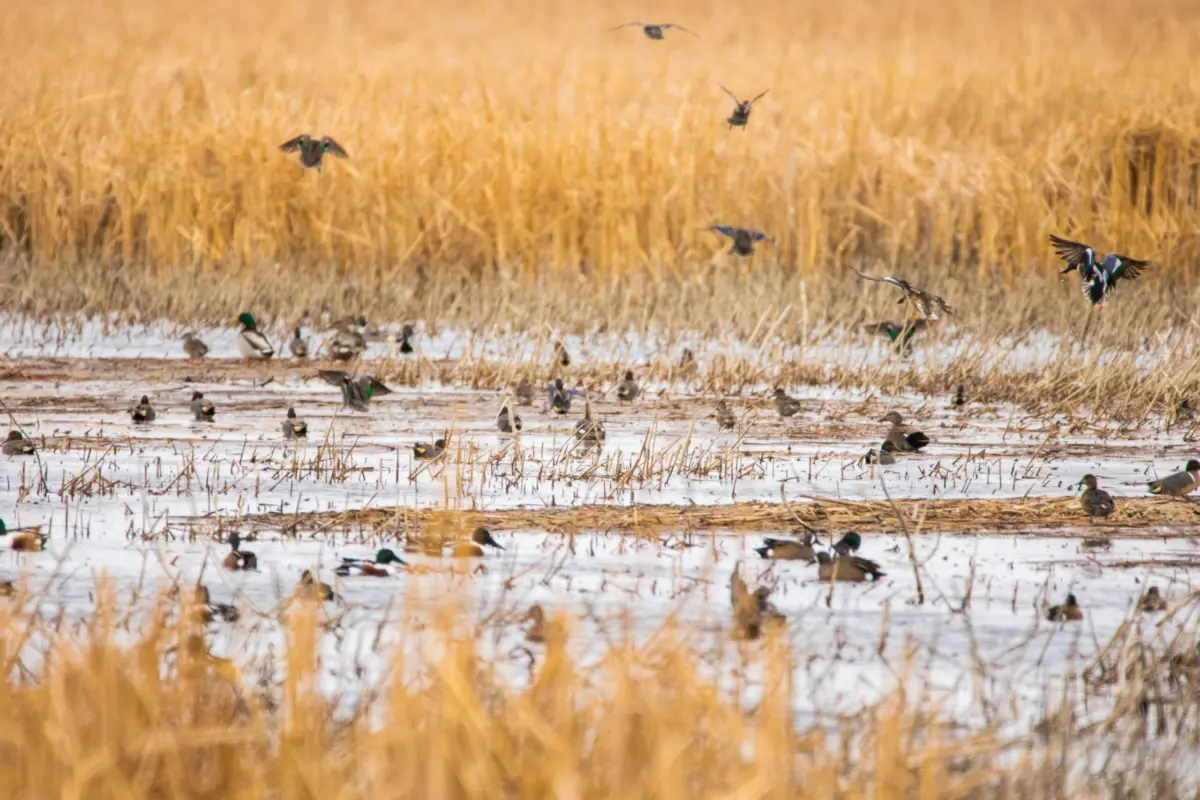
- The Prairie Pothole Region ("America’s Duck Factory"): Spanning the upper Great Plains, this landscape is dotted with millions of small, often seasonal prairie potholes and glacial ponds. Though many dry up periodically, they serve as the premier breeding ground for North American waterfowl. More than 50 percent of the continent’s American Bittern population breeds here, alongside roughly 10 million ducks. Beyond its ecological significance, this avian abundance underpins an outdoor recreation economy that supports 10,000 jobs and generates $760 million in annual labor income, according to U.S. Geological Survey data.
- Eastern Vernal Pools: These temporary woodland pools burst into life each spring, echoing with frog-song and providing crucial breeding and foraging habitat for species like Wood Ducks and Barred Owls. Under the new rule, these isolated forest incubators will be stripped of federal oversight.
- Arid Western Streams: Across the dry American West, ephemeral and intermittent streams flow only during specific windows—such as spring mountain snowmelt or violent summer monsoons. Despite their fleeting nature, these waterways carve verdant green ribbons of riparian life through desert landscapes, providing indispensable migratory stopovers and breeding grounds for threatened species like the Yellow-billed Cuckoo and the endangered Southwestern Willow Flycatcher.
Official Statements and Stakeholder Perspectives
The ideological chasm separating industry advocates from environmental scientists and conservation organizations has rarely been wider.
The Federal Administration’s Rationale
Proponents of the rule maintain that the overhaul is desperately needed to end decades of regulatory overreach, clarify property rights, and restore economic certainty to American farmers, builders, and infrastructure planners.
Announcing the supplemental proposal, EPA Administrator Lee Zeldin framed the initiative as a necessary step toward legal coherence:
"The EPA’s goal is a durable WOTUS definition that follows the law and ends burdensome regulatory uncertainty."
From the perspective of the agency and its business allies, federal bureaucrats should not have veto power over drainage ditches, farm ponds, or dry arroyos that bear little resemblance to traditional navigable rivers.
Environmental Law and Conservation Pushback
Conversely, legal experts and conservation leaders argue that the administration is weaponizing the Supreme Court’s Sackett ruling to systematically dismantle half a century of environmental progress.
Mark Sabath, a senior attorney for the Southern Environmental Law Center, did not mince words regarding the severity of the text:
"The last rule was the most extreme interpretation of which waters are federally protected that we had ever seen, and this goes even beyond that. It reflects a deliberate choice to protect as few wetlands and streams as possible."
Caitlin Wall, policy director for water conservation at Audubon, underscored the direct threat this poses to both wildlife and human communities:
"A lot of different species rely on these types of ecosystems throughout the year. As these streams and wetlands are put at greater risk, we know that threatens birds and people."
Scientific Consensus vs. Political Expediency
Perhaps the most damning critique of the administration’s proposal comes from the scientific community, which argues that the rule is fundamentally detached from basic hydrology.
Dr. David Kaplan, a professor of environmental engineering sciences and director of the Howard T. Odum Center for Wetlands at the University of Florida, rejects the premise that physical permanence dictates ecological importance:
"Having a permanent connection to a downstream water is not the thing that makes a wetland or a headwater stream important ecologically. There are literally millions of wetlands that lack a perennial surface connection and are still tremendously important for both their own intrinsic ecological value, but also for supporting the water quality in the streams and the rivers downstream."
This perspective is explicitly backed by the federal government’s own historical research. A comprehensive 2015 scientific synthesis published by the EPA concluded:
"There is ample evidence that many wetlands and open waters located outside of riparian areas and floodplains, even when lacking surface water connections, provide physical, chemical, and biological functions that could affect the integrity of downstream waters."
The agency explicitly added at the time that "streams, regardless of their size or frequency of flow, are connected to downstream waters and strongly influence their function."
To circumvent this scientific reality, critics argue, is to ignore how water actually moves through the biosphere. When pollution is dumped into an unprotected seasonal stream or a drained prairie pothole, those contaminants inevitably leach into regional aquifers or travel downstream during heavy rains, ultimately fouling municipal drinking water supplies and major commercial river arteries.
While proponents of the rule often suggest that state-level environmental laws can step in to fill the void, Dr. Kaplan warns that this "patchwork of state laws" is an illusion:
"The places with the most intermittent streams and isolated wetlands—non-perennial connections that are most vulnerable to losing protection—are those places where the state laws are not a safety net."
Future Outlook: What Lies Ahead for Clean Water
With the public comment period officially closed as of October 9, 2026, the EPA and the Army Corps of Engineers face the monumental task of reviewing public feedback and drafting a final rule. However, the publication of the final text will mark only the beginning of a new chapter of conflict.
Imminent Legal Challenges
Environmental coalitions, led by organizations such as the Southern Environmental Law Center, the Natural Resources Defense Council, and Earthjustice, are already preparing multi-state lawsuits. They argue that a rule excluding 94 percent of wetlands and 79 percent of streams violates the explicit text and historic intent of the Clean Water Act, which mandates the restoration and maintenance of the "chemical, physical, and biological integrity of the Nation’s waters."
Legal scholars note that while the Supreme Court’s Sackett ruling constrained federal power, it did not explicitly command agencies to adopt a purely "perennial-only" standard. Consequently, challengers will argue that the agencies’ ultra-narrow interpretation is "arbitrary and capricious" under the Administrative Procedure Act (APA), failing to account for overwhelming peer-reviewed science.
State-Level Policy Fragmentation
As federal protections recede, the burden of water governance will shift unevenly to state legislatures and regulatory agencies. States with robust environmental frameworks—such as California, Washington, and parts of the Northeast—may move to codify state-level protections for ephemeral streams and seasonal wetlands. Conversely, states across the Intermountain West, the Great Plains, and the industrial South may actively capitalize on the federal rollback, leaving millions of acres of sensitive habitat entirely vulnerable to industrial dumping, agricultural runoff, and unmitigated real estate development.
The Long-Term Stakes for Public Health and Ecology
Ultimately, the battle over WOTUS is not merely an esoteric legal dispute over bureaucratic definitions. It is a fundamental contest over the future of America’s natural resources. By willfully narrowing the perimeter of federal law to exclude the capillaries of the nation’s hydrological system, the government risks degrading the very sources that feed its major rivers.
As wetlands vanish and seasonal streams are paved over or polluted, the cascading effects will be felt across municipal water treatment plants, rural farming communities, and migratory flyways alike. Whether the courts or future administrations will ultimately intervene to halt this unprecedented rollback remains to be seen, but the ecological cost of this regulatory retreat will echo for generations to come.