
Executive Overview
Few agricultural commodities are as notoriously delicate or economically volatile to handle as the potato. Highly susceptible to bruising, impact damage, and pressure marking during the harvesting and transport stages, potatoes account for millions of dollars in annual losses across the global supply chain. For multinational consumer packaged goods (CPG) giants like PepsiCo—which relies on a massive, unbroken stream of unblemished tubers to feed its multi-billion-dollar snack empire—every bruised potato represents both wasted agricultural yield and lost revenue.
Traditionally, the agricultural sector has attempted to solve supply chain and quality issues by refining machinery, improving logistics, or introducing chemical treatments. However, PepsiCo, in a strategic collaboration with agricultural machinery titan Grimme and immersive learning technology provider Altoura, has taken a fundamentally different approach. By targeting an often-neglected pillar of agricultural efficiency—operator training and workforce upskill—the companies have pioneered an industrial-scale virtual reality (VR) and digital twin training ecosystem.
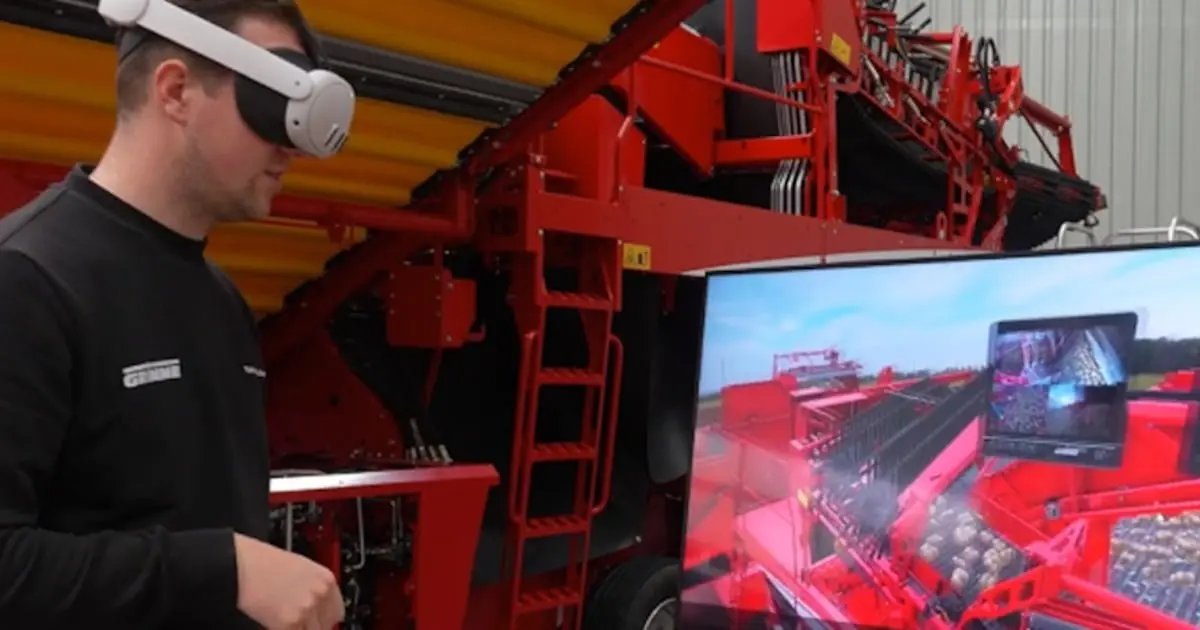
Launched via intensive pilot programs across emerging and established agricultural markets including Brazil, Mexico, Poland, and Romania, this initiative centers on hyper-realistic digital replicas of Grimme’s EVO and SE series potato harvesters. These virtual training platforms allow seasonal workers, farm managers, and heavy machinery operators to inspect complex internal components, remove panels, troubleshoot mechanical issues, and master harvesting techniques in a risk-free virtual environment before ever setting foot in a muddy field.
The early results of this cross-industry marriage of agriculture and immersive technology are nothing short of astounding. Pilot data shared by PepsiCo reveals an 87% increase in bruise-free potato yields, alongside a critical 1.7-fold reduction in severe bruising incidents. As agriculture grapples with severe labor shortages, high turnover, and the complexities of training a geographically dispersed workforce, this case study explores how immersive learning, edge-ready software, and digital twins are laying the groundwork for a more resilient, efficient, and technologically advanced agricultural future.
Detailed Chronology: From Manufacturing Simulation to AgTech Innovation
To understand how a CPG powerhouse like PepsiCo became deeply involved in agricultural machinery training, one must trace the technological evolution of the company’s broader operational strategy. The journey from industrial artificial intelligence to the potato patch is a masterclass in cross-sector technology transfer.
The Industrial Foundation (Early 2025)
Long before farmhands in Latin America and Eastern Europe strapped on virtual reality headsets to inspect potato sorters, PepsiCo’s corporate leadership had been heavily investing in industrial simulation and artificial intelligence. Earlier in 2025, the CPG titan made headlines across the technology and manufacturing sectors by announcing an industry-first collaboration with tech behemoths NVIDIA and Siemens.
This partnership aimed to deploy cutting-edge AI and digital twin simulations across PepsiCo’s vast global manufacturing and supply chain network. By creating virtual replicas of factories, assembly lines, and processing plants, engineers could test operational modifications, optimize throughput, and train manufacturing personnel in simulated digital environments without halting physical production lines.
According to Rob Meyers, PepsiCo’s Vice President of Global Agriculture, the profound success and operational resilience observed in the manufacturing division served as a lightbulb moment for the agricultural division.
"We had seen some of the work that our wider PepsiCo business was doing around using digital twins to improve operator training in the manufacturing space and felt there was a lot of applicability that could help us on the farming side," Meyers explained in discussions with agricultural technology analysts.
Engineering the Virtual Harvester (Late 2025)
Recognizing that agricultural operations faced similar human-factor bottlenecks—where operator error directly impacted product quality—PepsiCo approached Grimme, a premier global manufacturer of specialized potato harvesting and handling technology. Together, the two entities enlisted Altoura, a leader in immersive learning and spatial computing solutions, to build fully interactive, physics-accurate digital twins of Grimme’s flagship EVO and SE series potato harvesters.
Unlike standard 2D video tutorials or static user manuals, these digital twins function as fully realized 3D environments. Operators can walk around the virtual machine, open access panels, examine intricate web chains and separation units, and understand how adjustments to speed, depth, and angle directly affect the tubers passing through the machine.
Global Rollout and Field Testing (2025–2026)
Following initial internal testing, the partners deployed the digital twin platform into real-world operational environments. Recognizing that agricultural practices, language barriers, and technology infrastructure vary wildly across the globe, the rollout was executed deliberately.
The platform underwent rigorous pilot testing in Brazil and Mexico, two vital agricultural hubs for PepsiCo’s supply chain. Buoyed by overwhelmingly positive feedback and immediate improvements in crop quality, the program expanded into Eastern Europe, seeing deployments in Poland and Romania. Furthermore, the technology was prominently showcased at PepsiCo’s prestigious Global Agro University in Germany, signaling to international agricultural stakeholders that immersive training is no longer a futuristic novelty, but a core component of modern farm management.
Supporting Context & Metrics: Solving the Potato Bruising Crisis
To fully appreciate the commercial and operational impact of the PepsiCo-Grimme collaboration, one must examine the profound economic stakes involved in potato harvesting and the severe labor dynamics currently plaguing the global agricultural sector.
The Physics and Economics of Potato Bruising
Potatoes are roughly 80% water and possess fragile skin structures during harvest periods. When harvested by massive, heavy-duty mechanical harvesters like the Grimme EVO and SE series, tubers are subjected to immense mechanical forces. If an operator sets the digger web speeds too aggressively, fails to cushion drop zones, or allows soil separation chains to run too dry, potatoes suffer from internal and external bruising.
External bruising results in unsightly blemishes that lead to immediate rejection by quality control inspectors. Internal bruising—often invisible until the potato is cut or processed—causes enzymatic discoloration, rendering the tuber entirely unusable for high-grade chip production or commercial culinary markets. Across the global supply chain, this translates into millions of dollars in discarded crops, wasted water, fertilizer, and fossil fuels.
The Power of the Pilot: By the Numbers
Prior to the implementation of the Altoura-powered VR training program, onboarding seasonal operators relied heavily on traditional, trial-and-error field mentoring. This method was not only time-consuming and inconsistent, but it also meant that operators frequently learned on the job—at the direct expense of the harvest.
The results of the PepsiCo-Grimme pilot programs upended traditional metrics:
- 87% Increase in Bruise-Free Potatoes: Farms utilizing operators trained on the digital twin platform saw a massive surge in top-tier, unblemished yields.
- 1.7x Reduction in Severe Bruising: Catastrophic impact damage, which ruins entire batches of tubers, was nearly cut in half.
- Fractional Cost vs. Risk Ratio: As leadership noted, while implementing VR infrastructure involves initial hardware and software licensing costs, these expenditures represent a microscopic fraction of the massive financial losses a farmer faces from a single compromised harvest.
Bridging the Ag Workforce Gap
Beyond yield quality, the agricultural sector faces an existential human resources crisis. Farming operations around the world are increasingly crippled by acute labor shortages, an aging rural workforce, and heavy reliance on transient, seasonal workers.
Training these workers efficiently is an immense logistical nightmare. Operators are geographically dispersed, often speak a multitude of different languages, and arrive on farm sites with varying levels of technical literacy. Delivering standardized, high-quality, hands-on training on multi-million-dollar agricultural machinery has historically been nearly impossible at scale.
The digital twin platform directly dismantles these barriers. Designed primarily with virtual reality headsets in mind—such as Meta Quest or enterprise-grade spatial headsets—the application is also fully accessible via everyday consumer hardware, including tablets, smartphones, and desktop computers. Crucially, once the training modules are downloaded via the Altoura application, the software operates entirely offline, eliminating the need for reliable Wi-Fi or active mobile cellular service in remote agricultural fields.
Official Statements and Industry Insights
The strategic vision behind this initiative highlights a profound shift in how agtech and CPG giants view their relationships with primary producers. Rather than simply imposing strict quality mandates downstream, leading corporations are investing upstream in the human capital of the farmer.
Rob Meyers, PepsiCo’s VP of Global Agriculture, emphasized the critical importance of localized adaptation when deploying advanced enterprise software to diverse farming communities:
"Adapting to local realities is often more important to driving adoption at scale. As we expand into new markets, we’re continuing to refine the experience, including language support and training content. The goal isn’t to introduce complexity. It’s to make proven expertise available to more operators, in more places, before they enter the field."
Meyers also touched on the scalability and accessibility of immersive training tools in overcoming systemic agricultural labor deficits:
"One of agriculture’s biggest challenges is delivering consistent, high-quality training to operators who may be seasonal, geographically dispersed or working in different languages and markets. The opportunity with digital tools is their ability to make expert training more accessible and scalable. Of course, cost is always an important consideration for the adoption of any technology. The loss of revenue for a farmer due to bruising can be very high, and the VR technology costs are only a fraction of this risk."
Industry analysts note that PepsiCo’s willingness to co-develop and co-finance training ecosystems alongside equipment manufacturers like Grimme represents a new paradigm in supply chain resilience. By treating the farm operator not as an end-user, but as a vital partner in quality assurance, companies can secure their raw material pipelines against climate volatility, labor crunches, and economic pressures.
Future Outlook: The Horizon of Immersive Agriculture
As the PepsiCo, Grimme, and Altoura partnership moves past its successful initial pilot phases, the broader agricultural technology landscape is taking notice. The success of potato harvester digital twins opens the door to a sweeping transformation across nearly every facet of modern farming.
1. Expansion to Other Fragile Crops
The methodology perfected with potato harvesters is inherently modular. Other delicate, high-value specialty crops—such as apples, citrus fruits, wine grapes, and delicate root vegetables—suffer from similar mechanical harvesting damage and workforce training deficits. In the coming years, we can expect to see agricultural equipment manufacturers across diverse sectors partnering with spatial computing firms to build virtual replicas of combines, sorting lines, and specialized pickers.
2. Integration with Generative AI and Real-Time Telemetry
The next frontier for agricultural digital twins lies in real-time data integration. While current digital twins serve as exceptional pre-field training environments, future iterations could integrate live telemetry from operating harvesters in the field. Using edge AI and 5G/satellite connectivity, a digital twin could analyze an operator’s real-time machine settings, compare them against optimal parameters, and provide instant visual or auditory feedback inside a VR headset or smart glasses display, effectively serving as an intelligent co-pilot during harvest season.
3. Democratization of Enterprise Spatial Computing
As hardware costs for VR and augmented reality (AR) continue to plummet, and as software development platforms become increasingly democratized, advanced immersive training will no longer be the exclusive domain of Fortune 500 multinationals. Independent family farms, agricultural co-ops, and regional agricultural colleges will likely adopt these tools to train the next generation of ag-tech-literate operators.
Conclusion
The collaboration between PepsiCo, Grimme, and Altoura proves that solving some of agriculture’s oldest and most stubborn problems—such as crop bruising and workforce turnover—does not always require a heavier tractor, a harsher chemical, or a more expensive fertilizer. Sometimes, the most powerful tool a farmer can have is a digital window into their machinery, unlocking knowledge, precision, and care long before the first blade cuts into the soil.