
Executive Overview
Few agricultural commodities are as notoriously delicate—or as economically punishing when mishandled—as the potato. Prone to bruising from the moment they are unearthed to the second they reach processing facilities, potatoes incur millions of dollars in lost revenue annually. This persistent supply chain vulnerability has long plagued growers, processors, and consumer packaged goods (CPG) giants alike.
In response, an unexpected yet powerful cross-industry alliance has emerged. CPG heavyweight PepsiCo has partnered with agricultural machinery titan Grimme, alongside immersive learning technology provider Altoura, to tackle this challenge at its root: operator training and upskilling.
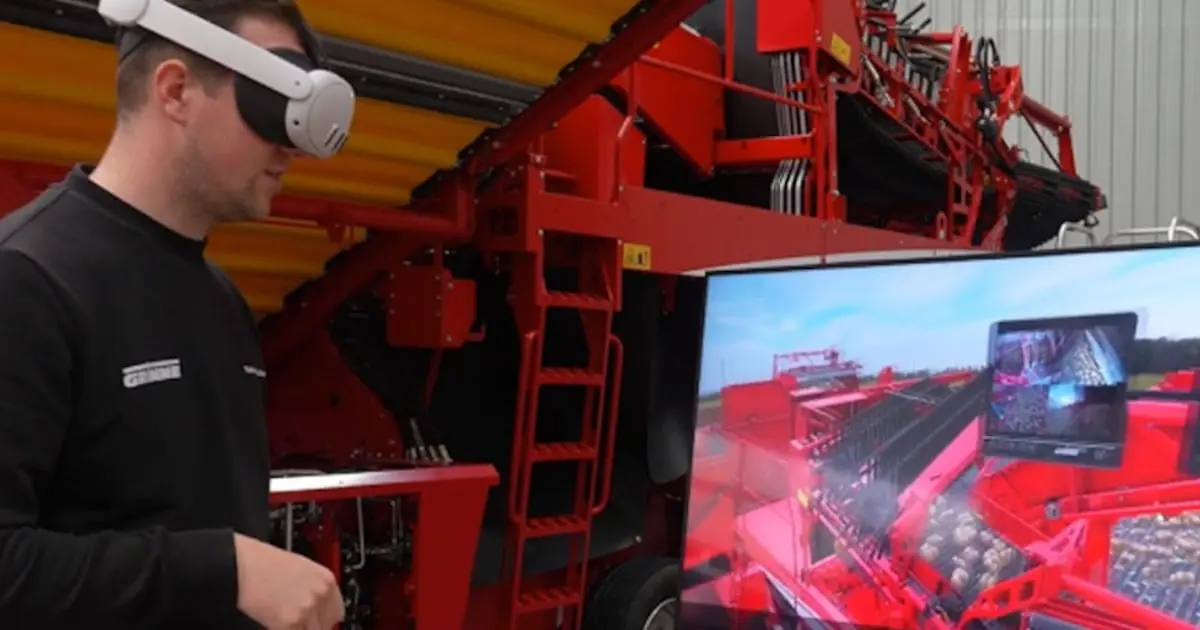
By leveraging cutting-edge digital twin technology, the companies have designed virtual, highly accurate replicas of Grimme’s EVO and SE series potato harvesters. This immersive training platform allows machine operators to interact with complex agricultural machinery in a virtual environment. Users can inspect internal components, remove panels, practice maintenance routines, and simulate harvest conditions without stepping foot in a muddy field.
The initiative addresses a blind spot in modern agriculture: the severe shortage of skilled, experienced farm labor. Agriculture has historically struggled to deliver consistent, high-impact training to a workforce that is often seasonal, geographically fragmented, and multi-lingual. By translating industrial-grade simulation technology from the factory floor to the agricultural field, PepsiCo and Grimme are demonstrating how virtual reality (VR) and digital replicas can bridge the skills gap, protect crop quality, and drastically reduce waste.
Following successful international pilot programs that yielded an astonishing 87% increase in bruise-free potatoes, this initiative marks a watershed moment for ag-tech adoption, signaling a future where immersive technology is just as vital to a harvest as tractors and tillers.
Detailed Chronology: From Concept to Global Field Rollout
The genesis of this virtual reality agricultural initiative did not begin in a quiet country farmhouse, but rather within the high-tech corridors of corporate industrial manufacturing.
The Industrial Blueprint
Earlier in the development cycle, PepsiCo leadership began exploring advanced digital simulation tools across its broader manufacturing and supply chain operations. The company sought ways to leverage artificial intelligence and digital twins to streamline factory operations, partnering with industrial heavyweights like Siemens and Nvidia.
Rob Meyers, Vice President of Global Agriculture at PepsiCo, recognized that these sophisticated industrial training simulations held untapped potential for the upstream agricultural sector. If virtual replicas could train factory operators on complex manufacturing machinery with zero physical risk, why couldn’t the same logic apply to multi-million-dollar agricultural harvesting equipment?
The Alliance Formed
PepsiCo approached Grimme, a globally recognized leader in potato harvesting technology, with a vision: to co-create a training apparatus that would make harvesting machinery more intuitive while minimizing crop damage. To bring this vision to life, the partnership enlisted Altoura, a recognized specialist in immersive learning software.
The task was to build faithful, interactive digital twins of Grimme’s flagship EVO and SE series potato harvesters. Unlike passive video tutorials or standard manuals, Altoura’s platform enables deep physical interaction. Operators can virtually walk around the machine, peel back panels, examine internal mechanisms, and understand how adjustments to speed, depth, and agitation affect the delicate tubers moving through the machinery.
International Pilots and Regional Refinement
With the technology developed, PepsiCo and Grimme initiated a meticulous global rollout. Recognizing that farming practices, languages, and machinery configurations vary wildly across continents, the companies avoided a one-size-fits-all approach.
- Phase 1 (Latin America): Initial pilot testing launched last year in Brazil and Mexico. These regions served as testing grounds to evaluate user engagement, technological friction, and the direct impact on crop quality.
- Phase 2 (Eastern Europe): Encouraged by initial results, the partnership expanded the program to Poland and Romania, testing the platform across different soil types, operational scales, and linguistic demographics.
- Phase 3 (Global Showcase): The companies showcased the digital twin ecosystem at PepsiCo’s Global Agro University in Germany, presenting the framework to agricultural leaders, agronomists, and supply chain partners from around the world.
Through this phased, intentional rollout, the partners gathered critical feedback to refine the software, ensuring that the digital tools would seamlessly integrate into local farming realities without introducing unnecessary technical complexity.
Supporting Context & Metrics: Quantifying the Impact of Immersive Ag-Tech
To understand the profound significance of the PepsiCo-Grimme collaboration, one must examine the staggering economic and physical realities of potato farming.
The High Cost of Potato Bruising
Potatoes are roughly 80% water, making them remarkably susceptible to mechanical shock. When a harvester digs tubers out of the earth, separates them from dirt and vines, and deposits them into a transport vehicle, every impact point represents a potential bruising hazard.
Internal and external bruising does not just ruin the aesthetic appeal of the potato; it compromises its shelf life and processing viability. Bruised potatoes are prone to rot, disease, and discoloration, leading to massive post-harvest rejection rates. On a global scale, these imperfections translate to millions of dollars in discarded crops and lost revenues every single year.
Hard Data from the Pilot Programs
While the novelty of virtual reality in farming generates significant headlines, the economic metrics driving the initiative are what truly command attention. According to impact data released by PepsiCo following the international pilot programs, the digital twin training initiative achieved remarkable results:
- 87% Increase in Bruise-Free Potatoes: Operators trained via the digital twin platform significantly optimized their harvesting techniques, resulting in a dramatic reduction of damaged crops.
- 1.7x Reduction in Severe Bruising: The most catastrophic category of damage—severe bruising that renders tubers completely unusable for high-end consumer products like potato chips—was cut by nearly half.
Overcoming Infrastructure Barriers in Rural Agriculture
A common critique of advanced agricultural technology is that it requires high-speed internet, expensive hardware, and constant connectivity—luxuries that are frequently unavailable in remote farming regions.
PepsiCo, Grimme, and Altoura deliberately engineered the digital twin platform to circumvent these infrastructure limitations:
- Hardware Flexibility: While the training experience is optimized for immersive VR headsets (offering maximum spatial awareness and tactile simulation), it is fully accessible across conventional consumer hardware, including tablets, smartphones, and desktop computers.
- Offline Functionality: Once the training application is downloaded via the Altoura app, users do not require Wi-Fi or active mobile service. Farmers and seasonal workers can download the training modules in an urban center or headquarters with stable internet, then take the platform directly into remote fields without worrying about cellular connectivity.
Official Statements and Industry Insights
The intersection of immersive technology and traditional agriculture yields profound insights regarding the future of the food supply chain. Industry leaders have been vocal about the strategic imperative behind this collaboration.
Rob Meyers, Vice President of Global Agriculture at PepsiCo, offered deep perspective on the philosophy guiding the initiative during an interview with AgNavigator.
"Adapting to local realities is often more important to driving adoption at scale," Meyers explained. "As we expand into new markets, we’re continuing to refine the experience, including language support and training content. The goal isn’t to introduce complexity. It’s to make proven expertise available to more operators, in more places, before they enter the field."
Addressing the labor dynamics that challenge modern agriculture, Meyers highlighted the unique versatility digital tools provide:
"One of agriculture’s biggest challenges is delivering consistent, high-quality training to operators who may be seasonal, geographically dispersed, or working in different languages and markets. The opportunity with digital tools is their ability to make expert training more accessible and scalable."
Furthermore, Meyers addressed the pragmatic financial considerations that govern agricultural investments. Equipment upgrades and new technology must justify their costs through tangible return on investment (ROI):
"Of course, cost is always an important consideration for the adoption of any technology. The loss of revenue for a farmer due to bruising can be very high, and the VR technology costs are only a fraction of this risk."
Grimme representatives and Altoura engineers have similarly echoed these sentiments, emphasizing that empowering the person in the driver’s seat of the harvester is the single most effective leverage point for improving farm-level sustainability and profitability.
Future Outlook: Can VR Solve Agriculture’s Labor Crisis?
As the agricultural sector confronts a deepening demographic squeeze—characterized by an aging workforce, acute labor shortages, and high turnover rates among seasonal workers—the imperative to innovate training methods has never been greater.
The successful deployment of the PepsiCo-Grimme digital twin initiative opens up a expansive horizon for the future of farming. Several key trends and future trajectories are likely to emerge from this foundational milestone:
1. Expansion Beyond Potatoes
While the immediate application focuses on Grimme EVO and SE series potato harvesters, the underlying architecture of digital twin training can be scaled to virtually any complex agricultural machinery. Grain combines, sugar beet harvesters, precision seeders, and autonomous tractors could all benefit from similar virtual immersion programs. Manufacturers seeking to differentiate their equipment may soon bundle digital twin training suites standard with heavy machinery sales.
2. The Rise of Gamified and Multilingual Upskilling
Agricultural labor forces are increasingly international, requiring training programs that transcend language barriers. Immersive VR and digital replicas rely heavily on visual, spatial, and tactile learning rather than dense textual manuals. By gamifying the training experience—allowing operators to practice emergency troubleshooting, speed adjustments, and maintenance routines in a risk-free digital sandbox—farms can onboard seasonal workers in a fraction of the traditional time while achieving higher competency levels.
3. Convergence of AI, IoT, and Digital Twins
Looking further ahead, the integration of digital twins with real-time Internet of Things (IoT) sensors and artificial intelligence promises even greater efficiencies. Imagine a future where an actual Grimme harvester operating in a Romanian or Brazilian field feeds real-time telemetry data back into its digital twin. If an operator encounters an unusual soil density or operating resistance, the digital twin can instantly simulate the optimal harvester adjustments and beam those recommendations directly to the operator’s interface.
Conclusion
The collaboration between PepsiCo, Grimme, and Altoura represents a profound shift in how the agricultural supply chain approaches sustainability and efficiency. By looking past traditional agronomy and investing in the cognitive infrastructure of farm operators, these companies are proving that some of the most impactful agricultural innovations do not happen in the soil, but in the mind. As virtual reality transitions from entertainment and industrial design into the daily toolkit of farmers worldwide, the humble potato harvest is charting a high-tech course toward a more resilient, waste-free future.