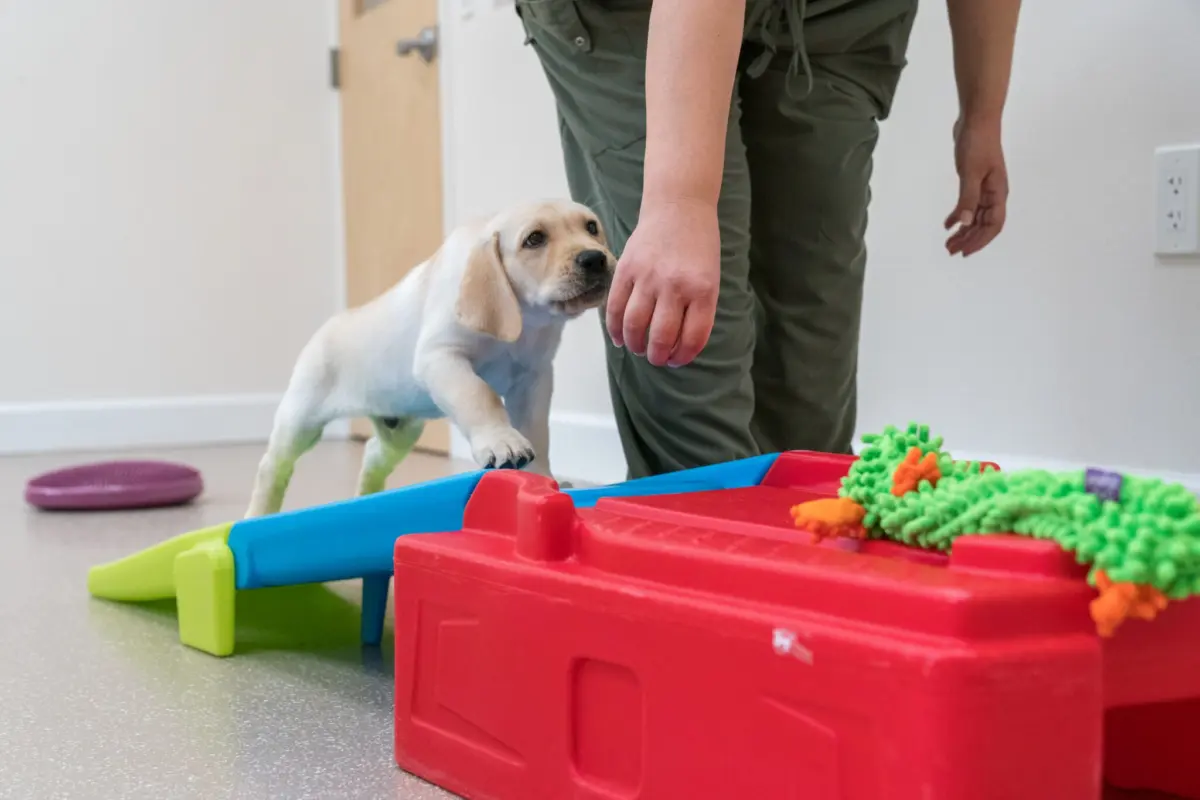
Long before a puppy takes its first clumsy steps, learns to walk in step beside a handler on a leash, or ultimately navigates a complex urban landscape as a guide or service dog, an intricate world of biological development is unfolding behind the scenes.
During the fragile first few weeks of life, when a newborn puppy is still blind, deaf, and entirely dependent on its mother, its brain and central nervous system are working at a furious pace. The sensory impressions, handling, and neurological conditioning experienced during this neonatal window lay the biological groundwork for how the animal will learn, process stress, and interact with the world for the rest of its life.
At organizations like Dogs Inc, preparing future guide and service dogs is treated as a science-driven continuum that starts long before formal obedience training ever begins. Central to this foundational phase is a specialized, science-backed practice known as Early Neurological Stimulation (ENS). Though ENS is only one piece of a much larger, multi-stage developmental mosaic, it exemplifies the deep intentionality required to cultivate the resilient, unflappable temperament demanded of a world-class working dog.
Executive Overview
The journey of a service dog begins at birth, governed by biological milestones that dictate how an animal perceives and reacts to its environment. Early Neurological Stimulation—a protocol originally adapted from canine military and working dog programs—introduces mild, highly controlled physical stressors during a puppy’s neonatal stage (birth through approximately two weeks of age). Far from being a form of training, ENS is a physiological priming method designed to stimulate the neurological system, enhance cardiovascular performance, improve stress tolerance, and strengthen the adrenal glands.
However, experts at Dogs Inc emphasize that ENS is merely the opening chapter in a lifelong developmental story. It operates in tandem with subsequent milestones, including the transitional period, the critical socialization window, adolescent boundary-testing, and formal advanced training.
By understanding the physiological and psychological markers of each stage—from neonatal dependency to the introduction of short-session cue training at three months and formal puppy classes by four months—organizations can better prepare dogs for the profound responsibilities they will shoulder. Ultimately, the meticulous care invested during these early developmental epochs ensures that future guide and service dogs possess the emotional maturity, adaptability, and unwavering focus required to change lives.
Detailed Chronology: A Puppy’s Developmental Milestones
To appreciate the role of Early Neurological Stimulation, one must examine the precise chronological stages a puppy traverses during its first months of life. Each developmental window presents unique vulnerabilities and unprecedented opportunities for growth.
1. The Neonatal Stage (Birth to 2 Weeks)
During the first week of life and extending into the second, newborn puppies exist in a state of absolute dependency. Blind, deaf, and incapable of regulating their own body temperature, they spend the vast majority of their time alternating between nursing and sleeping, safely tucked against their mother and littermates.
Despite their apparent fragility, monumental neurological developments are occurring. The brain is forming neural pathways at an astonishing rate. It is precisely during this neonatal window—typically spanning from days 3 through 16—that Early Neurological Stimulation is deployed. Because puppies at this stage can feel tactile changes and temperature shifts even though they cannot yet see or hear, brief, gentle handling exercises trigger neurological responses that permanently wire the brain for greater adaptability.
2. The Transitional Stage (2 to 4 Weeks)
As puppies cross the threshold into the transitional stage, their sensory world explodes into clarity. Their eyes and ears open, allowing them to process sights and sounds for the very first time.
By the time they reach four weeks of age, physical milestones arrive rapidly: puppies begin to walk, explore their whelping box, and even emit their first playful barks. Their baby teeth begin to erupt, signaling the gradual biological shift from an exclusive diet of maternal milk toward soft food and, eventually, solid nutrition. Interaction with littermates increases dramatically, laying the groundwork for essential canine communication and early bite inhibition.
3. The Socialization Period (3 to 12 Weeks)
Often considered the most critical psychological window in a dog’s life, the socialization period overlaps with the latter half of the transitional phase and extends through the third month. During this period, puppies transition from passive observers to active participants in their environment.
3 Weeks and Beyond: Puppies begin recognizing human handlers, reacting to distinct sounds, and exploring varied physical surfaces. Short, positive learning sessions can begin, introducing basic cues through positive reinforcement.
8 Weeks: At this juncture, many puppies transition to their designated puppy raiser homes. Experiences accrued up to this point lay the vital groundwork for a friendly, confident, and well-adjusted adult dog.
12 Weeks: By the three-month mark, structured exposure to novel stimuli is paramount. Meeting diverse people, exploring unfamiliar environments, navigating different floor textures, and encountering safe animals all help build robust psychological resilience, directly mitigating the risk of adult anxiety, fearfulness, or defensive aggression.
4. The Adolescent Stage (6 Months and Beyond)
As dogs mature past puppyhood, they enter adolescence—a phase that can begin as early as six months of age. Much like human teenagers, adolescent dogs frequently test boundaries, challenge established routines, and navigate shifting hormonal landscapes.
Female dogs typically experience their first heat cycle and the broader dynamics of the reproductive cycle between 6 and 12 months, while males undergo hormone-driven behavioral shifts. Concurrently, veterinary and behavioral science notes that most puppies navigate an average of four distinct "fear periods" as they grow. During these sensitive phases, negative experiences can leave deep psychological scars, making thoughtful, positive-reinforcement-based management essential.
Supporting Context & Metrics: Decoding Early Neurological Stimulation (ENS)
What does Early Neurological Stimulation actually entail, and how does it alter a puppy’s biological trajectory?
Developed originally as part of the "Bio Sensor" program (popularized by military canine research), ENS involves a series of five distinct, highly specific handling exercises performed once daily between the third and sixteenth days of life. Each exercise lasts precisely three to five seconds. Because the puppy is so young, the handling is designed to introduce mild, short-term physiological stress—enough to stimulate the neurological system without causing psychological distress or overwhelming the animal.
The Five ENS Exercises:
Tactile Stimulation: Holding the puppy in one hand, the handler uses a cotton-tip applicator to tickle the pad of each foot gently between the toes. This stimulates neurological pathways in the extremities.
Head Held Erect: The puppy is held perpendicularly, pointing straight up with both hands, allowing the head to be supported while mildly altering its spatial orientation.
Head Inverted: The puppy is held firmly with its head pointed downward toward the ground, safely challenging its vestibular system and balance receptors.
Supine Position: The puppy is placed flat on its back in the palm of the handler’s hand, allowing it to relax and experience a vulnerable, horizontal orientation.
Thermal Stimulation: A damp towel that has been cooled in a refrigerator is placed inside a small container, and the puppy is placed upon it (without restraint) for a few seconds, introducing a mild, safe thermal shift.
Documented Physiological Benefits
Decades of utilization by elite working dog organizations, breeders, and service dog institutions indicate that ENS yields tangible biological improvements. While not a replacement for training, genetics, or environmental socialization, research and operational experience suggest that ENS-conditioned dogs demonstrate:
Improved Cardiovascular Performance: Enhanced heart rates and stronger cardiovascular functioning.
Stronger Adrenal Glands: Improved hormonal response systems that better manage acute stress.
Greater Tolerance to Stress: An enhanced ability to recover quickly from startling or novel stimuli.
Greater Disease Resistance: Anecdotal and observational metrics suggest strengthened immune system responses in dogs that received early neurological conditioning.
It is vital to note that ENS is distinct from socialization. While ENS rewires the underlying physiological hardware during the neonatal phase, socialization software is written later (weeks 3 through 12) through environmental exposure, human interaction, and positive reinforcement. Both are necessary, but they operate across entirely different timelines.
Official Perspectives: The Philosophy of Dogs Inc
To fully grasp the magnitude of early puppy development, one must examine the institutional philosophy guiding organizations dedicated to producing elite working animals. At Dogs Inc, the philosophy is clear: a world-class guide or service dog is not manufactured overnight through rigid discipline; rather, they are systematically nurtured from day one.
"Guide dogs and service dogs need far more than advanced technical skills. They must possess the emotional fortitude to navigate chaotic urban environments, adapt instantly to shifting situations, and remain preternaturally calm and focused alongside individuals who rely on them for their independence," notes an organizational spokesperson for Dogs Inc. "Those extraordinary qualities do not appear by chance. They are the direct result of a deliberate, multi-year developmental journey that begins the moment a puppy is born."
According to leadership at Dogs Inc, early puppy development is never about attempting to create a "perfect" or robotic dog. Instead, the focus is squarely on providing structured, thoughtful, and age-appropriate challenges that build emotional maturity, curiosity, and adaptability.
By integrating scientific protocols like ENS with expert puppy raising, comprehensive socialization regimens, and science-based positive reinforcement, Dogs Inc ensures that every puppy is afforded the absolute best possible start in life. Whether a dog goes on to guide a visually impaired person across a bustling metropolitan street or assist an individual with mobility challenges, its success is deeply rooted in the careful stewardship it received during its earliest, most vulnerable weeks.
Future Outlook: A Lifetime of Learning and Partnership
As the science of canine development continues to evolve, organizations like Dogs Inc remain at the forefront of refining how puppies are raised, evaluated, and trained. The recognition that neonatal experiences, transitional milestones, and structured socialization periods form an unbroken continuum has transformed modern breeding and puppy-raising standards.
Looking forward, the integration of early neurological conditioning with advanced behavioral tracking promises even higher success rates for working dog pipelines. As puppies graduate from neonatal boxes to puppy-raiser homes, and eventually into formal professional training around 16 weeks and beyond, the investments made during their first two weeks of life continue to pay dividends.
Ultimately, a puppy’s first weeks pass in the blink of an eye, but they ignite a lifelong trajectory of learning, courage, and partnership. Through meticulous breeding, science-based early intervention like ENS, and a lifelong commitment to positive reinforcement, organizations like Dogs Inc are not just training dogs—they are engineering independence, mobility, and unconditional companionship for the future.