
Executive Overview
Deep within the hyper-arid coastal desert of northern Peru, archaeologists have unearthed a biological and cultural treasure trove that rewrites our understanding of the ancient Andean relationship with animals. At Castillo de Huarmey—a sprawling 110-acre administrative and burial complex built by the pre-Inca Wari Empire—researchers have uncovered the oldest scientifically verified physical evidence of Peruvian hairless dogs in the region, dating back more than 1,200 years.
Published in the Journal of Anthropological Archaeology, a new study details the recovery of naturally mummified remains, unusual skeletal morphologies, and revealing chemical signatures preserved in dog bones and teeth. These findings provide unprecedented insights into how these distinctive, slender-bodied, and largely furless canines lived, what they ate, and how they were integrated into the stratified society of the Wari Empire, which ruled centuries before the rise of the Incas.
The discovery highlights a complex coexistence between humans and animals in the ancient Andes. By combining traditional zooarchaeological analysis with cutting-edge isotopic chemistry and radiocarbon dating, researchers have opened a window into a millennium-old world where dogs could simultaneously serve as pampered companions, sacrificial offerings, or urban scavengers. The research not only validates historical representations of these animals in ancient Andean pottery but also deepens our comprehension of the social, dietary, and ritualistic dimensions of the Wari civilization.
Detailed Chronology
The unfolding of this archaeological breakthrough spans decades of meticulous excavation, modern scientific testing, and historical detective work. The chronology of the Castillo de Huarmey site and the recent breakthroughs regarding its canine inhabitants underscores the progressive nature of modern archaeological research.
1. The Rise of the Wari Empire (600 – 1050 CE)
Occupied long before the rise of the Inca Empire, Castillo de Huarmey served as a major political, administrative, and religious center for the Wari Empire. Located approximately 190 miles north of Lima, the expansive 110-acre complex featured monumental architecture, elite residences, and extensive burial grounds. During this era, the Wari exerted profound cultural and political influence across the Andean coast and highlands, leaving behind a rich material culture characterized by fine ceramics, textiles, and metallurgy.
2. Modern Excavations and Landmark Discoveries (2010 – 2022)
Modern scientific excavations at the site began yielding extraordinary results in the early 21st century.
- 2012: Researchers uncovered the first completely undisturbed elite Wari tomb. Inside, they found the remains of 58 high-status women, six human sacrificial victims, and roughly 1,300 opulent artifacts crafted from gold, silver, bronze, and precious stones.
- 2022: Archaeologists identified nearby burials belonging to elite craftspeople, accompanied by specialized tools of precious metals, further illuminating the sophisticated economic and labor structure of the Wari state.
3. The 1970 Earthquake and Post-Deposition Disturbance
The integrity of the site’s archaeological stratigraphy has faced significant natural and human challenges. A massive earthquake in 1970 caused structural collapses across parts of Castillo de Huarmey, exposing ancient burial chambers and drawing illicit looters. While the upper stratigraphic layers became disturbed and mixed with more recent debris, the deeper archaeological contexts remained pristine, preserving the delicate organic remains that would later capture international attention.
4. Unearthing the Canine Remains (2010 – 2025)
Over years of systematic fieldwork in the northern section of the main ceremonial area, excavations yielded 341 individual dog bone specimens representing at least 19 animals, alongside exceptionally well-preserved mummified remains. Among these, three canine specimens stood out:
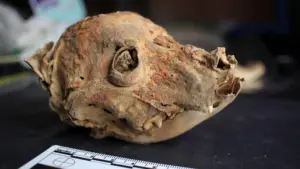
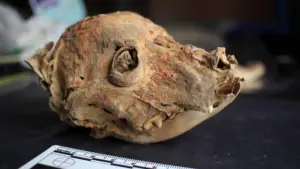
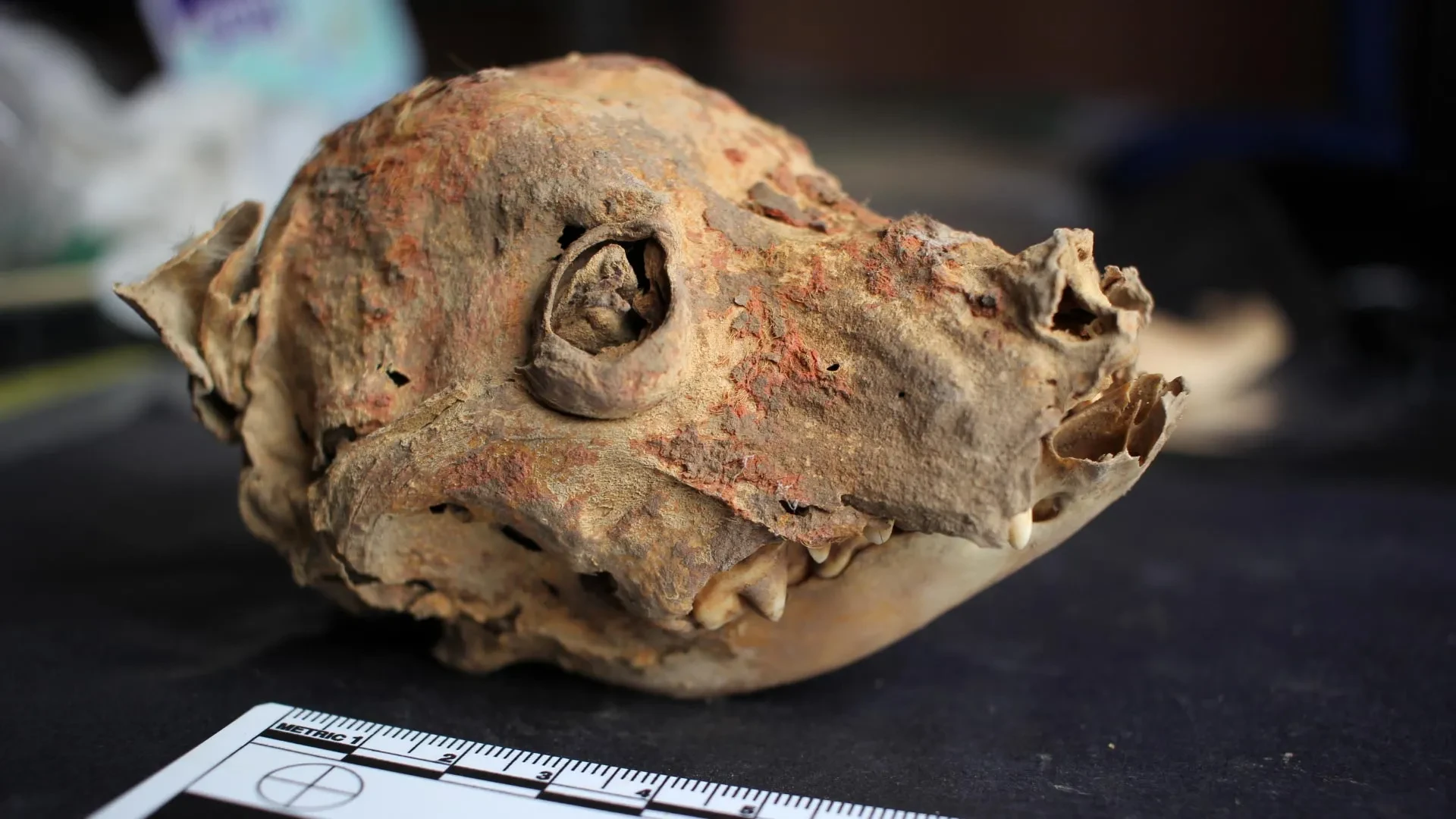
- A naturally mummified skull retaining visible hairless skin, attached ears, and traces of bright red cinnabar pigment—a mineral heavily utilized in ancient Peruvian mortuary rituals.
- A second, larger dog skull found alongside a nearly complete, naturally mummified male dog buried in a shallow pit, missing only the lower portions of its front limbs.
- Skeletal elements recovered from elite contexts, including the bones of a 6-to-8-week-old puppy buried next to an elite craftsperson known as the "Master Basketmaker," and puppy remains associated with a suspected human tomb guardian.
5. Genetic Identification via Dental Anomalies
Initial fears that the mummified remains might be recent intrusions were quickly dispelled through anatomical analysis. Researchers observed that several of the dog skulls lacked their first premolars and final molars, and that these teeth had never erupted during the animals’ lifespans rather than being lost to injury or old age. Consulting comparative genetic literature, the team confirmed that the precise genetic mutation responsible for hairlessness in dogs is intrinsically linked to oligodontia (a reduced number of teeth). This biological marker definitively identified the specimens as ancient Peruvian hairless dogs.
6. Laboratory Analyses and Radiocarbon Dating
With the identity of the dogs established, the research team employed zooarchaeological techniques, isotopic profiling (analyzing carbon, nitrogen, oxygen, and strontium isotopes in bone and tooth collagen), and radiocarbon dating. The complete mummified male dog was radiocarbon-dated to at least 1,200 years old, establishing it as the oldest verified radiocarbon-dated biological specimen recovered from Castillo de Huarmey to date.
Supporting Context & Metrics
The integration of advanced scientific methods with field archaeology has transformed our understanding of ancient fauna. The dataset compiled from Castillo de Huarmey provides concrete metrics regarding population size, dietary habits, and spatial distribution within the Wari settlement.
Quantifying the Find
- Site Dimensions: 110 acres of administrative, residential, and ritual architecture.
- Geographic Location: Approximately 190 miles north of Lima, situated in the arid coastal desert of Peru.
- Chronological Span: Occupied between 600 and 1050 CE.
- Specimen Count: 341 individual dog bone specimens representing a minimum number of 19 distinct dogs, supplemented by multiple naturally mummified specimens.
- Age Distribution: Remains ranged from neonatal puppies (6 to 8 weeks old) to mature adult dogs, reflecting varied mortality profiles across different social and spatial sectors of the site.
Environmental Preservation via Hyper-Aridity
The extreme dryness of the Peruvian Pacific coast creates a natural preservation chamber. Unlike temperate or tropical archaeological sites where organic materials rapidly decompose, Castillo de Huarmey’s desert environment desiccated soft tissues, skin, hair, and textiles. This environmental factor enabled the survival of mummified hairless skin, animal pelts, and delicate organic pigments such as cinnabar, providing researchers with direct physical evidence that is typically lost to time.
Isotopic Insights into Diet and Geography
By examining distinct chemical isotopes preserved in bone and dental tissues, scientists can reconstruct an animal’s life history:
- Tooth Enamel: Forms rapidly during puppyhood, capturing the chemical signature of early-life diet and local water consumption.
- Bone Collagen: Remodels slowly over time, reflecting the animal’s diet during the final year of its life.
- Strontium Isotopes: Trace geological signatures, offering clues about geographic provenance and whether an animal was raised locally or brought to the site from the Andean highlands or other coastal valleys.
- Dietary Staples: Isotopic ratios demonstrated that the dogs’ diets heavily overlapped with the human population, centered around the heavy consumption of maize (corn), a staple of pre-Hispanic Andean agriculture. Furthermore, distinct isotopic shifts observed in young hairless puppies suggest targeted feeding practices or controlled rearing environments.
Official Statements
The interdisciplinary research team emphasizes that interpreting the lives of ancient animals requires moving past modern biases regarding pets and pests.
Weronika Tomczyk, a research associate in Dartmouth’s Department of Anthropology, a postdoctoral fellow in its Ecology, Evolution, Environment and Society Program, and lead author of the study, reflected on the complexities of human-animal bonds across millennia:
"Our findings indicate that humans and dogs coexisted at this Wari site, but reconstructing their bond is challenging, as past emotions are difficult to capture through archaeological methods. The goal of our study was to not only present data on Castillo de Huarmey’s dog burials, but also emphasize that people in the past had often contradictory relationships with the animals, just as they do today: a pet for one group of people could at the same time be considered a pest by their closest neighbors."
Discussing the crucial breakthrough regarding the animals’ unique dental characteristics, Tomczyk noted:
"What I noticed is that some of তব the dog skeletons were missing teeth, and not that they lost them during their lifespan; some teeth, especially first premolars and sometimes last molars, had just never erupted. And then I found in the literature that the same gene which is responsible for hairlessness in dogs is responsible for a reduced number of teeth, indicating that these were Peruvian hairless dogs."
Addressing the dietary data extracted from the isotopic analyses, Tomczyk added:
"Isotopic analyses of a dog’s tooth give a signal of its life as a puppy because dog teeth erupt so fast, and the bone gives a signal of more or less the last year of its life. Such sampling strategy aimed to provide signals from distinct stages of a dog’s life. We do not know if the dogs were intentionally fed maize or if perhaps, they were just eating leftovers or trash. Yet, the distinct dietary patterns of hairless puppies provide insights into what may have been organized breeding."
Summarizing the multifaceted social status of the canines within the Wari community, Tomczyk concluded:
"While we will never know if any of the three dogs were pets or how people treated them, it is evident they received different treatment than other dogs."
Future Outlook
The recovery and analysis of the Castillo de Huarmey canine remains open exciting new avenues for Andean archaeology and bioarchaeological research. As analytical techniques continue to evolve, researchers anticipate several key developments in future investigations:
- Expanded Ancient DNA (aDNA) Profiling: While morphological and isotopic data have firmly established the identification of the Peruvian hairless dogs, ongoing and future genetic sequencing aims to map the broader genealogical lineages of these ancient populations, tracking how specific traits were bred, maintained, or lost across centuries of pre-Hispanic history.
- Comparative Regional Studies: Researchers plan to compare isotopic and osteological datasets from Castillo de Huarmey with contemporaneous Wari sites in the Andean highlands and other coastal valleys. This comparative approach will determine whether hairless dogs were traded across ecological zones or maintained within localized coastal breeding centers.
- Refining Mortuary Archaeology: The association of elite craftspeople and sacrificial guardians with canine companions underscores the ritual significance of animals in Wari state ideology. Future excavations will focus on identifying further domestic and ceremonial spaces to clarify whether specific canine morphotypes were systematically reserved for particular ritual functions.
- Conservation of Fragile Artifacts: Given the vulnerability of organic mummified remains to modern climate fluctuations and environmental degradation, ongoing conservation efforts will prioritize the climate-controlled curation and non-destructive digital scanning of these irreplaceable biological treasures.
Ultimately, the revelation of these 1,200-year-old hairless dogs bridges the gap between ancient artistic representations—such as ceramic vessels depicting slender, wrinkled canines—and the physical reality of everyday life in the Wari Empire. It serves as a powerful reminder that our deep-rooted companionship with animals is an ancient, intricate, and enduring part of human history.