
Executive Overview
Long before a puppy takes its first deliberate step on a leash, learns the foundational mechanics of a basic sit, or prepares to guide a visually impaired handler through a bustling metropolis, a sophisticated, highly calculated developmental process is already underway behind the scenes. At organizations like Dogs Inc, the journey toward becoming a world-class guide or service dog does not begin in formal training yards; it commences in the quiet, controlled environment of the neonatal nursery.
During the formative first few weeks of life, when puppies are entirely blind, deaf, and reliant on their mother, their central nervous systems are experiencing an unprecedented window of rapid neural growth. Modern canine science demonstrates that strategic, gentle environmental inputs during this delicate period can profoundly influence stress tolerance, cardiovascular performance, and problem-solving capacities later in life.
At the center of this early-intervention philosophy is Early Neurological Stimulation (ENS)—a science-based protocol designed to gently stress the neurological system in controlled, micro-doses. While ENS is only a single foundational chapter in a lifelong curriculum of socialization, puppy raising, and advanced instruction, it exemplifies the rigorous, intentional approach required to breed and raise elite working dogs. This report explores the physiological mechanics, chronological milestones, and overarching developmental philosophy that transform vulnerable newborns into life-changing canine partners.
Detailed Chronology: From Neonatal Roots to Adolescent Independence
The maturation of a future service dog is a delicate, multi-stage marathon governed by specific biological windows. Understanding how an animal adapts to the complexities of human society requires tracking its development across well-defined chronological phases.

1. The Neonatal Stage (Birth to Two Weeks)
In their earliest days of life, puppies exist in a state of absolute dependency. Blind, deaf, and incapable of regulating their own body temperature, neonatal puppies spend the vast majority of their time cycling between nursing and deep REM sleep, which is critical for brain development. Despite their outward vulnerability, monumental neuro-developmental shifts are occurring.
It is within this fragile window—specifically between days three and sixteen—that protocols like Early Neurological Stimulation (ENS) are introduced. Handled strictly by trained staff following precise protocols, the puppies are subjected to brief, mild tactile and postural stresses designed to stimulate the neurological system without inducing fear or distress.
2. The Transitional Stage (Two to Four Weeks)
As puppies cross the two-week threshold, a biological awakening occurs. Their eyes and ears unseal, introducing them to the sights and sounds of the world for the very first time. By week four, motor skills rapidly improve: puppies begin to wobble onto all four paws, explore outside the whelping box, and even experiment with soft vocalizations like barks and growls.
Concurrently, their deciduous baby teeth erupt, signaling the physiological shift away from exclusive nursing toward mushy and eventually solid food. This stage marks the bridge between internal neurological wiring and external sensory engagement.

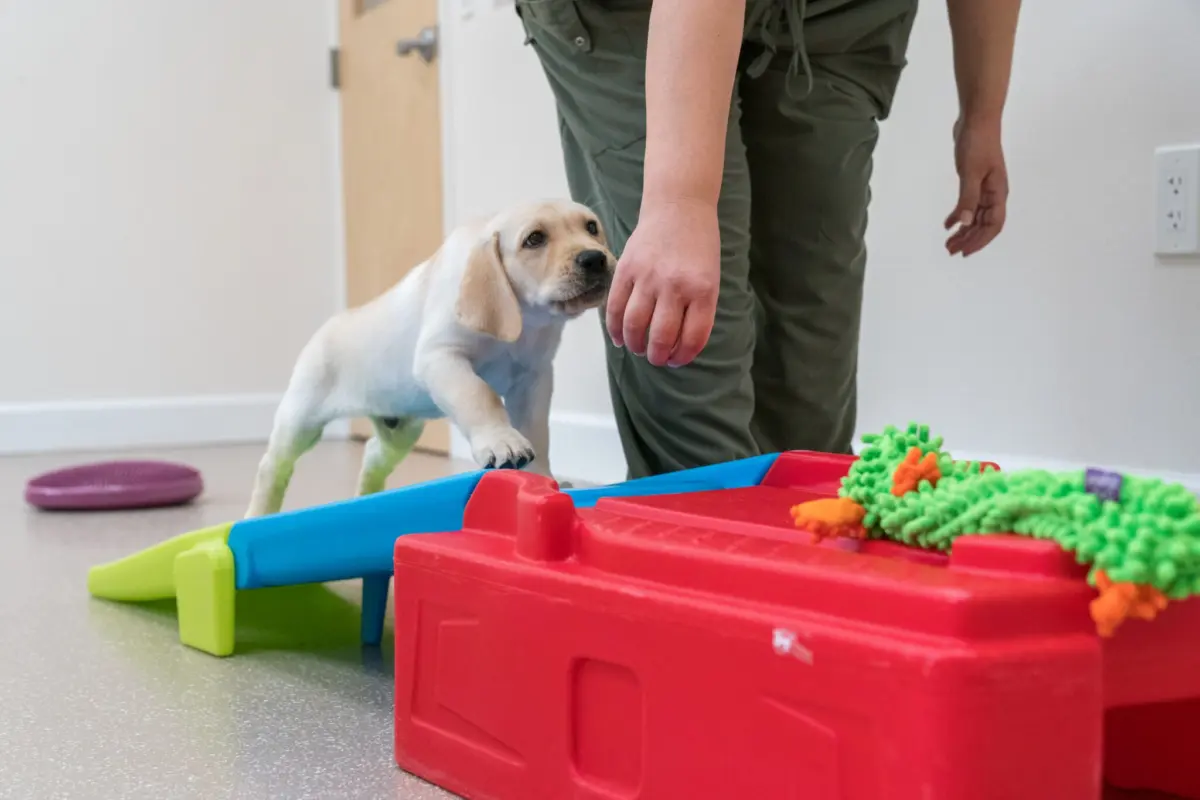
3. The Socialization Period (Three to Twelve Weeks)
Widely recognized by animal behaviorists as the most critical behavioral window in a dog’s life, the socialization period overlaps with the tail end of the transitional stage and extends through the third month. During this time, puppies are biologically primed to form impressions of their environment.
- Building Positive Associations: Between 3 and 12 weeks of age, well-managed exposure to diverse human demographics, novel textures, ambient noises, and varied environmental surfaces helps wire the brain for resilience.
- Bite Inhibition and Social Cues: Time spent interacting with littermates and the dam teaches critical social boundaries, including bite inhibition—the understanding of how to control jaw pressure during play.
- Preventing Behavioral Pathology: Proactive socialization by week twelve significantly mitigates the development of fear-based aggression, generalized anxiety, and noise phobias in adult dogs.
4. The Juvenile and Adolescent Phases (Six Months to One Year)
As puppies transition into young adulthood, they encounter new hormonal and psychological milestones. Around six months of age, many dogs enter an adolescent phase characterized by boundary-testing, closely mirroring human teenagers.
Simultaneously, biological maturity sets in: male dogs experience hormone-driven shifts in focus and territorial awareness, while female dogs undergo their first heat cycles. Furthermore, behavioral scientists note that puppies navigate an average of four distinct "fear periods" during their development, during which negative experiences can leave deep, lasting impressions. Thoughtful handling, positive reinforcement, and structured routines during these phases are vital to ensuring emotional stability.
Supporting Context & Metrics: The Science of Early Neurological Stimulation
Originally developed as the "Bio Sensor" program and popularized by the military to enhance the performance of working dogs, Early Neurological Stimulation introduces five distinct tactile and postural exercises designed to stimulate the neurological system. Each exercise lasts approximately three to five seconds per puppy, per day.

[Day 3-16 Neonatal Window]
       │
       ├── 1. Tactical Stimulation (Tickle between toes)
       ├── 2. Head Up (Vertical positioning)
       ├── 3. Head Down (Inverted positioning)
       ├── 4. Supine Position (Back resting in hand)
       └── 5. Thermal Stimulation (Cool damp towel placement)
       │
       ▼
[Measured Physiological Benefits]
       • Improved cardiovascular performance (heart rate)
       • Stronger adrenal glands & stress resilience
       • Enhanced brain wave activity & problem-solving tolerance
The Five Core ENS Exercises
- Tactile Stimulation: Using a cotton-tip applicator, the handler gently tickles the skin between the front toes on any one foot for 3–5 seconds.
- Head Up: The puppy is held vertically, supporting its body with both hands so that its head points directly up toward the ceiling.
- Head Down: The puppy is held securely while inverted, with its head pointed downward toward the floor.
- Supine Position: The puppy is placed on its back, resting comfortably in the palm of the handler’s hand, with its muzzle pointing upward.
- Thermal Stimulation: A cool, damp washcloth is placed inside a container, and the puppy is placed directly on top of the damp surface for the allotted duration without restraining its movement.
Quantifiable Physiological Responses
Clinical observations and historical data associated with ENS protocols point to several distinct physiological improvements in neonates:
- Improved Cardiovascular Performance: Heart rates demonstrate greater baseline adaptability following mild stressors.
- Stronger Endocrine Systems: Adrenal glands show heightened efficiency, allowing the animal to rebound rapidly from unexpected environmental shifts.
- Enhanced Brain Function: Electroencephalogram (EEG) readings often show greater brain wave activity and neural density compared to non-stimulated control groups.
- Greater Stress Tolerance: Dogs subjected to early neurological conditioning routinely display higher exploratory drive and improved problem-solving capabilities when confronted with novel, complex puzzles later in life.
Official Statements & Institutional Philosophy
The implementation of advanced protocols like ENS is not undertaken casually; it requires a deeply institutionalized commitment to animal welfare, behavioral science, and precision breeding.
Organizations operating at the vanguard of service animal production emphasize that early interventions must never be viewed as a substitute for genetics, veterinary health, or comprehensive socialization. Instead, they form a cohesive, continuum-based approach to rearing. Representatives from canine development centers frequently highlight that while ENS gives a puppy a head start on cellular and neurological resilience, it is merely the opening act of an extensive developmental journey.
"Early Neurological Stimulation provides a vital framework for resilience during the neonatal stage, but it is one small piece of a much larger puzzle," notes program literature from leading institutions. "True excellence in a working dog is the cumulative result of elite genetics, rigorous health screenings, targeted neonatal exercises, structured socialization windows, and lifelong positive reinforcement training."

This philosophy recognizes that no single intervention guarantees a dog’s future success. Rather, mitigating behavioral drop-out rates among service dogs requires eliminating weak links across every single developmental milestone—from the moment a puppy draws its first breath to the day it is matched with a handler in need.
Future Outlook: Raising the Standard for Working Canines
As veterinary medicine and canine behavioral science continue to evolve, the methodologies governing guide and service dog development are becoming increasingly sophisticated. The future of puppy rearing lies in personalized, data-informed enrichment programs that track neurological milestones, monitor stress recovery metrics, and tailor socialization schedules to individual behavioral profiles.
For organizations like Dogs Inc, the mission remains clear: bridge the gap between scientific discovery and practical application. By investing profound care, medical oversight, and structured behavioral challenges into every stage of a puppy’s growth, these institutions ensure that the dogs graduating into service are not only skilled, but fundamentally unflappable.
As these future guide and service dogs mature past the transitional stage, entering structured crate training around three months of age and advanced obedience classes by month four, they carry with them the benefits of a meticulously engineered start. Ultimately, the meticulous early-stage care provided in the nursery manifests on the streets of busy cities and inside quiet homes—wherever a newly graduated service dog stands ready to change a human life with confidence, calm focus, and unwavering dedication.