
Executive Overview
Long before a puppy takes its first step on a leash, learns to sit on command, or guides an individual safely through a bustling urban landscape, an intricate, high-stakes developmental process is already underway behind the scenes. At organizations like Dogs Inc, the journey of transforming a newborn canine into a calm, focused, and life-changing service or guide dog begins at the very dawn of life.
Far from being passive periods of mere growth, the earliest weeks of a puppy’s existence represent a critical window of neurological and physiological evolution. During this stage, science-backed methodologies such as Early Neurological Stimulation (ENS) are deployed to lay a resilient foundation for future learning. While ENS is only one piece of a much larger, comprehensive puppy-rearing puzzle, it exemplifies the rigorous, thoughtful, and research-driven approach required to prepare dogs for the immense responsibilities of working life.
This report explores the foundational stages of canine development, the mechanics and physiological rationale behind Early Neurological Stimulation, the critical differences between ENS and formal socialization, and how intentional early interventions shape tomorrow’s elite guide and service dogs.
Detailed Chronology: From Neonatal Dependencies to Confident Adolescence
The developmental arc of a working service dog is marked by distinct, rapidly evolving biological stages. Each phase presents unique opportunities—and distinct vulnerabilities—that shape how a puppy perceives, interprets, and reacts to the world.
The Neonatal Stage: Birth to Two Weeks
During the neonatal phase, newborn puppies are entirely dependent on their mother and littermates. At this juncture, their eyes and ears remain tightly sealed, and they are incapable of regulating their own body temperature. Much of their time is spent in a cycle of nursing and deep sleep.

Despite their apparent fragility and helplessness, profound neurological activity is occurring beneath the surface. The brain and nervous system are hard at work, making vital connections that will dictate future resilience. Because puppies at this stage are exceptionally sensitive, any early handling must be extremely precise, utilizing brief, scientifically validated protocols to avoid overwhelming their developing systems.
The Transitional Stage: Two to Four Weeks
As puppies transition out of the neonatal period, a profound sensory awakening occurs. Their eyes and ears open, granting them their first sights and sounds of the physical world. By approximately four weeks of age, puppies begin to walk, wag their tails, and voice their first barks.
Simultaneously, their deciduous (baby) teeth begin to erupt, signaling a nutritional shift away from exclusive nursing toward soft gruels and eventually solid foods. This transitional stage bridges the gap between internal biological development and external environmental exploration.
The Socialization Period: Three to Twelve Weeks
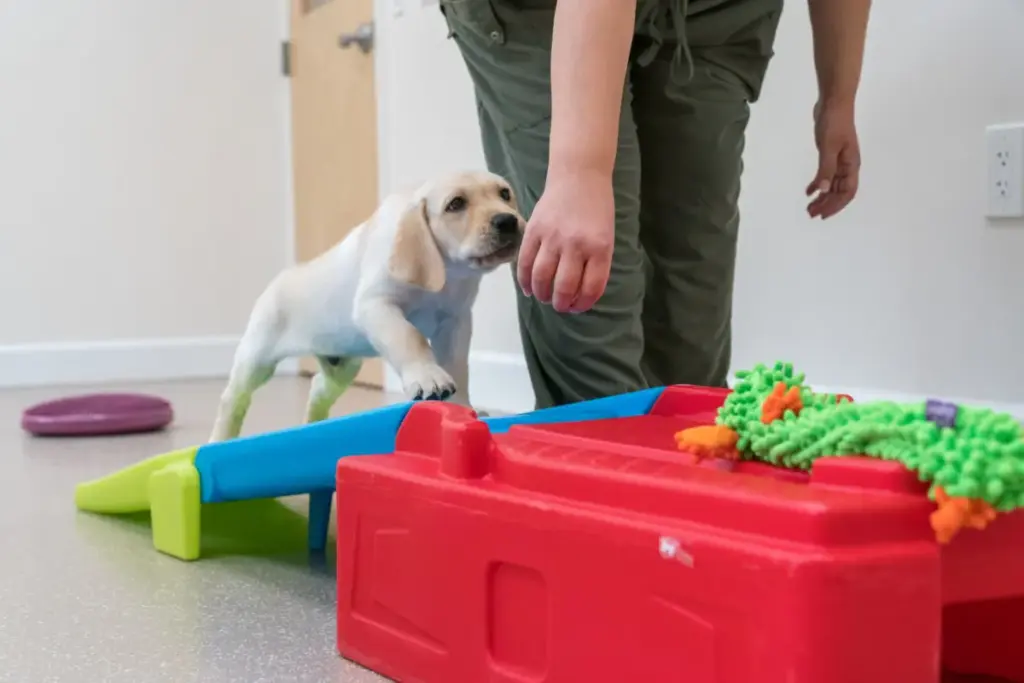
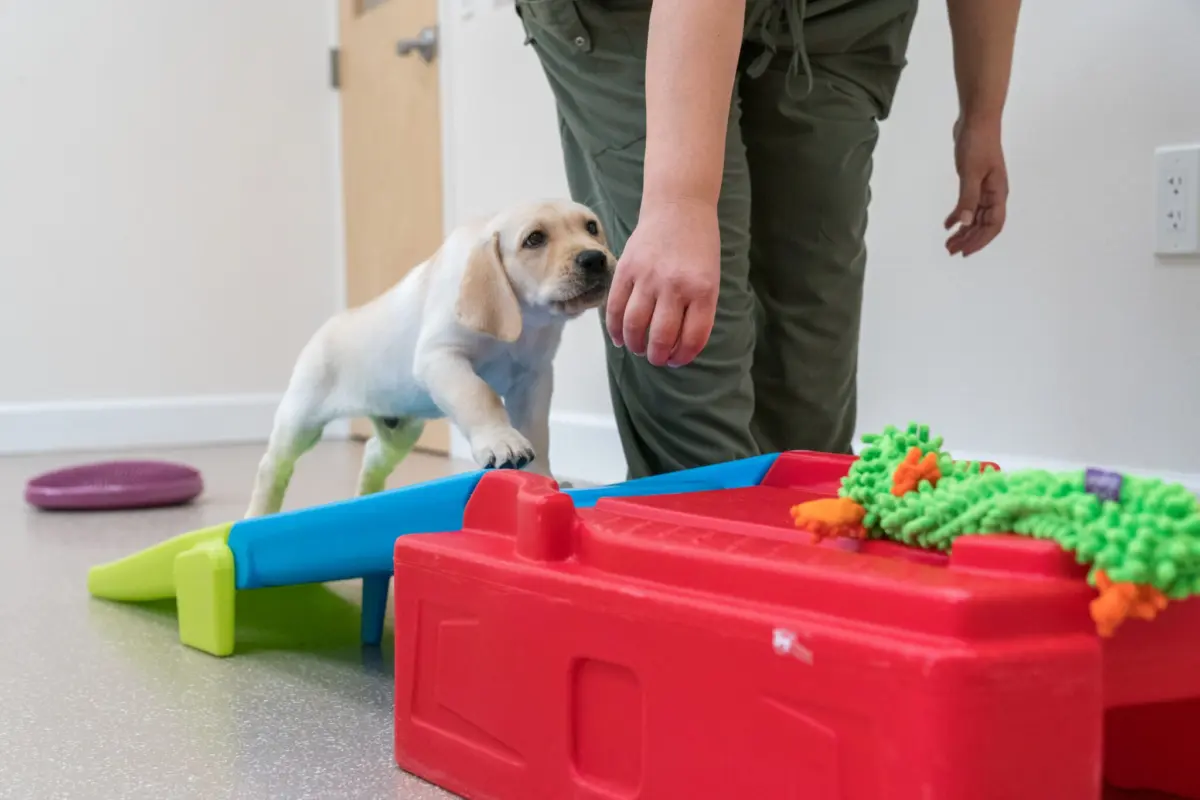
Often regarded as the golden window of behavioral development, the socialization period is when young puppies actively begin interacting with humans, diverse sounds, unfamiliar textures, other dogs, and novel environments.
By the time a puppy reaches eight weeks of age, foundational experiences must be carefully curated to build positive associations. Research indicates that by twelve weeks, structured exposure to various stimuli helps foster confidence, build emotional maturity, and dramatically reduce the likelihood of adult anxiety, fear, or aggression. During this phase, short, positive training sessions using positive reinforcement can begin, introducing basic cues around the three-month mark.

The Juvenile and Adolescent Stages: Six Months and Beyond
As puppies progress toward adolescence—which can onset as early as six months of age—they frequently begin testing boundaries, much like human teenagers. Between six and twelve months, most dogs reach reproductive maturity. Females experience their first heat cycles, while males display hormone-driven behavioral shifts.
Furthermore, behavioral scientists note that puppies navigate an average of four distinct "fear periods" during their growth cycle. During these temporary phases, even familiar objects or sounds can provoke uncharacteristic hesitation or fear, underscoring the absolute necessity of positive, patient reinforcement from puppy raisers and trainers.
Supporting Context & Metrics: The Mechanics of Early Neurological Stimulation
Early Neurological Stimulation (ENS) is a specialized practice rooted in historical research originally developed for military canine programs and later refined for broader working-dog applications. Designed specifically for the neonatal stage (birth through day sixteen), ENS introduces mild, controlled physical stressors to stimulate the neurological system.
How ENS Exercises Are Performed
ENS involves a series of five distinct, gentle exercises administered once daily per puppy. Each maneuver lasts precisely three to five seconds. Because these exercises place minor, temporary stress on the neonatal system, they trigger adaptive physiological responses.
The standard protocol typically includes:

- Tactile Stimulation: Holding the puppy in one hand and gently tickling the foot between the toes using a Q-tip for a few seconds.
- Head Erect: Holding the puppy perpendicular to the ground, with its head pointing straight up, for three to five seconds.
- Head Down: Holding the puppy firmly in both hands with its head inverted and pointed downward toward the ground.
- Supine Position: Placing the puppy flat on its back in the palm of the handler’s hand, allowing it to rest comfortably for a brief moment.
- Thermal Stimulation: Placing the puppy feet-down on a damp, cool towel for three to five seconds.
The Physiological Rationale
The primary objective of ENS is not to train puppies or accelerate obedience, but rather to optimize biological development. Proponents and observational studies suggest that these brief, controlled sensory inputs yield several lasting physiological benefits:
- Improved Cardiovascular Performance: Enhanced heart rate efficiency and regulation.
- Stronger Endocrine System: Better hormonal responses to physical and mental stress.
- Stress Tolerance: Greater adaptability and resilience when confronting novel environmental stimuli later in life.
- Enhanced Immune System: Marginal improvements in general disease resistance and overall hardiness.
However, experts emphasize that ENS is merely one chapter in a comprehensive book. A dog’s ultimate temperament, health, and working capability are governed by a complex matrix of genetics, maternal care, nutrition, socialization, and lifelong environmental enrichment.
Official Statements and Philosophy
Organizations dedicated to breeding and training elite assistance dogs maintain a holistic philosophy regarding canine development. Leaders at Dogs Inc stress that producing a successful guide or service dog requires an unwavering commitment to quality of care at every single milestone.
"Preparing future guide dogs and service dogs starts long before formal training ever begins. Early Neurological Stimulation and early developmental practices reflect our holistic philosophy: every touch, every sound, and every gentle challenge is intentionally designed to build a resilient foundation for the life-saving work these dogs will one day perform."
Industry experts continually reiterate that early puppy development is not about manufacturing a "perfect" or unflappable animal through artificial means. Rather, it is about unlocking a puppy’s inherent potential through compassionate, evidence-based management.

By treating every phase—from neonatal stimulation and transitional learning to structured socialization and adolescent boundary-testing—as an interconnected continuum, breeding programs can systematically cultivate the emotional stability required of working partners.
Future Outlook: Raising Life-Changing Partners
The path from a neonate nestled in a whelping box to a confident service animal guiding a visually impaired individual or assisting a veteran with PTSD is extraordinarily demanding.
As canine science continues to evolve, the methodologies surrounding early development will undoubtedly refine further. Integrating genetic insights with behavioral tracking allows organizations to better predict which puppies possess the precise psychological makeup required for complex assistance work.
Moreover, as public awareness of animal psychology expands, the emphasis on positive reinforcement, early environmental enrichment, and structured puppy raising will remain paramount. The continuation of lifelong learning—extending from puppy classes at sixteen months and beyond into advanced vocational training—ensures that these dogs remain adaptable, secure, and eager to partner with humans in any environment.
Ultimately, a puppy’s first weeks may pass in the blink of an eye, but they set in motion a lifelong journey. Through meticulous early care, pioneering neurological stimulation, and an unyielding commitment to excellence, organizations like Dogs Inc ensure that future guide and service dogs are equipped from day one to change lives.