
Long before a puppy takes its first clumsy steps on a leash, learns the fundamentals of basic obedience, or prepares to navigate a complex, bustling world as a lifeline for someone with a disability, an invisible yet monumental transformation is already underway. Behind closed doors, inside quiet whelping boxes, a puppy’s nervous system undergoes rapid, profound changes that will dictate how they process stress, adapt to novel environments, and execute high-stakes service work later in life.
At Dogs Inc, the journey toward raising a world-class guide or service dog does not begin with formal instruction at six months or a year old. Instead, it starts on day one. Through a meticulous blend of science-based protocols—most notably Early Neurological Stimulation (ENS)—breeding and training programs are proactively shaping resilient, confident, and emotionally stable canines from the very beginning of their lives.
Executive Overview: The Critical Foundation of Service Dog Development
The path to becoming a certified service or guide dog is fraught with rigorous demands. These animals must possess unwavering composure, the capacity to remain calm amidst sensory overload, and an innate ability to partner seamlessly with handlers who rely on them for independence and safety. According to canine developmental experts at Dogs Inc, cultivating these exceptional traits requires a lifelong continuum of care, starting long before a puppy’s eyes or ears even open.
In the fast-paced world of working dog breeding, early intervention is no longer a matter of intuition; it is an exact science. Early Neurological Stimulation (ENS)—a set of precise, gentle physical exercises introduced during the neonatal period—serves as the foundational cornerstone for this developmental model. While ENS is only one chapter in an expansive playbook that includes socialization, environmental enrichment, and positive reinforcement training, its impact on the neurological architecture of a young puppy is profound.
This report investigates the science of early puppy development, the precise mechanics of ENS, the critical distinctions between neonatal stimulation and later socialization windows, and why organizations like Dogs Inc invest heavily in every single milestone of a puppy’s maturation.
Detailed Chronology: From Whelping Box to Working Life
A dog’s developmental timeline moves with astonishing velocity. To understand how early handling influences adult behavior, canine behaviorists break a puppy’s first year down into distinct, highly sensitive periods. Each stage introduces unique neurological milestones, behavioral shifts, and learning opportunities.

1. The Neonatal Stage (Birth to 2 Weeks)
During the neonatal stage, newborn puppies are almost entirely dependent on their mother and littermates. At this fragile juncture, puppies spend the vast majority of their time sleeping and nursing. They are blind, deaf, and incapable of regulating their own body temperature.
Despite their seemingly inactive and vulnerable state, monumental internal changes are taking place. Their brains and nervous systems are firing at a microscopic level, absorbing chemical and physical inputs that wire their central processing units. This is the precise window where Early Neurological Stimulation is applied. Because puppies cannot yet process complex sensory information, ENS introduces mild, controlled physical stressors designed to stimulate the neurological system without inducing panic or distress.
2. The Transitional Stage (2 to 4 Weeks)
As puppies cross the threshold into the transitional stage, the physical world suddenly opens up. Their eyes and ears begin to unseal, allowing them to process sights and sounds for the first time. By four weeks of age, puppies can typically walk, wag their tails, and even emit tentative barks.
Simultaneously, their primary teeth begin to emerge, marking a dietary shift from exclusive nursing toward soft gruel and eventually solid food. This period also deepens their interaction with littermates, fostering early lessons in canine communication and bite inhibition under the watchful eye of the mother.
3. The Socialization Period (3 to 12 Weeks)
Often considered the most critical window in a dog’s life, the socialization period overlaps with the tail end of the transitional phase and extends through the third month. During this phase, a puppy’s brain is an absolute sponge for environmental data.
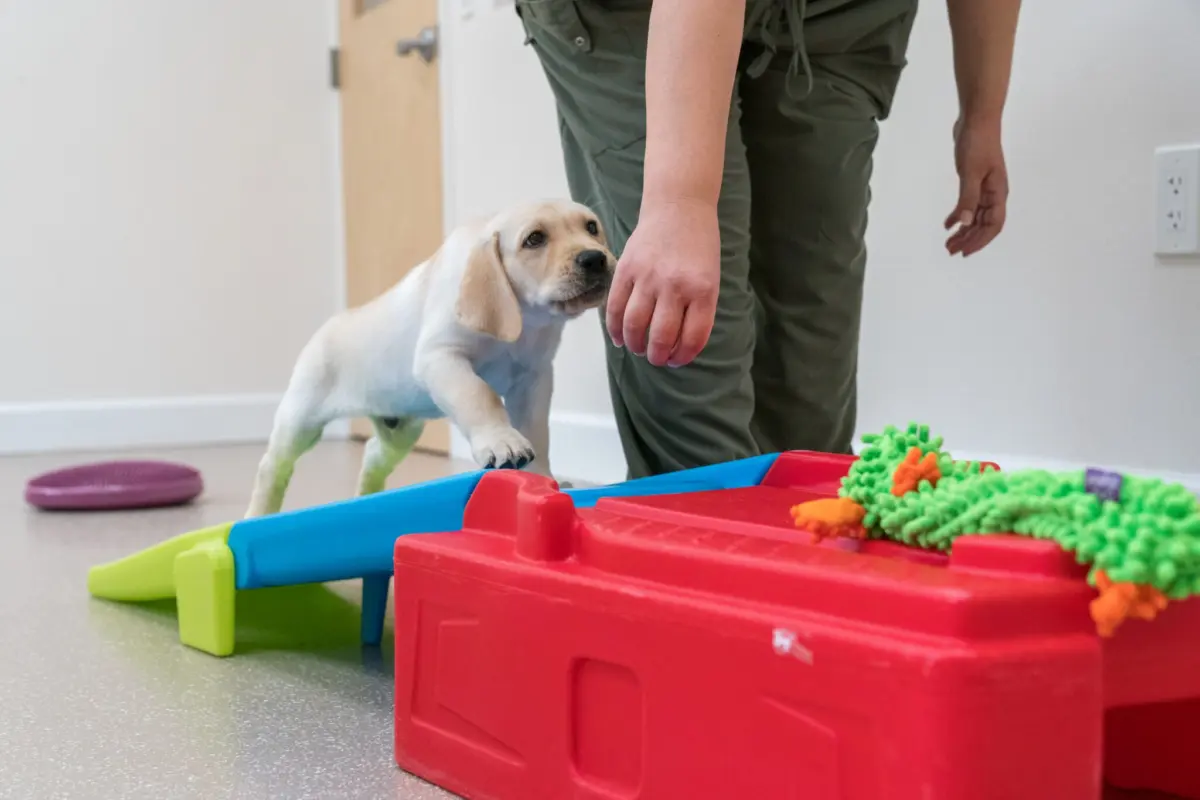
At Dogs Inc, this is where deliberate exposure takes center stage. Puppies are introduced to a wide array of novel stimuli: different floor surfaces (gravel, tile, metal grates), unusual sounds (sirens, vacuums, dropping keys), and diverse human handlers. By week eight, these positive associations lay the irreplaceable groundwork for a friendly, well-adjusted adult dog. By week twelve, systematic exposure helps prevent the development of fear-based anxieties, reactivity, and aggression.

[Neonatal Stage: Birth - 2 Wks] ➔ ENS & Neurological Kickstart
       │
       ▼
[Transitional Stage: 2 - 4 Wks] ➔ Eyes/Ears Open, Walking & Early Vocalizations
       │
       ▼
[Socialization Window: 3 - 12 Wks] ➔ Environmental Exposure, Novel Stimuli, Confidence Building
       │
       ▼
[Adolescent Stage: 6+ Mos] ➔ Boundary Testing, Hormonal Shifts, Advanced Task Training
4. Adolescence and Beyond (6 Months to 1 Year)
Just like human teenagers, canine adolescents undergo radical behavioral and hormonal shifts. The adolescent stage can manifest as early as six months of age, characterized by boundary-testing, short attention spans, and fluctuating confidence levels.
Concurrently, most dogs reach reproductive maturity between six and 12 months. For female dogs, this includes the onset of their first heat cycle, while male dogs experience hormone-driven behavioral adjustments. Throughout this turbulent phase, puppies experience an average of four distinct "fear periods" where they may suddenly react with apprehension to familiar objects or routines. Consistent, positive reinforcement training during these milestones is vital to steering them toward emotional maturity.
Supporting Context & Metrics: Decoding Early Neurological Stimulation (ENS)
Originally developed for military canine programs and later popularized by renowned breeders and researchers, Early Neurological Stimulation rests on the biological premise that brief, mild physical stressors at a very young age can accelerate neurological development and improve stress tolerance later in life.
The Five Core Exercises of ENS
Administered once daily between days three and 16 of life—a period when the neurological system is undergoing rapid structural formation—ENS consists of five specific handling exercises. Each exercise lasts precisely three to five seconds:
- Tactile Stimulation: Holding the puppy in one hand, the handler gently tickles the pad of one foot using a Q-tip or finger for three to five seconds. This stimulates neurological pathways through the extremities.
- Head Upheld: Holding the puppy perpendicular to the ground (vertical), with its head pointing up toward the ceiling, for three to five seconds. This engages the vestibular system, challenging balance and spatial orientation.
- Head Pointed Down: Holding the puppy perpendicular to the ground, gently positioning its head downward toward the floor for three to five seconds. This inversion stimulates a different set of vestibular and circulatory responses.
- Supine Position: Holding the puppy flat on its back, cradled in the palm of the handler’s hand, allowing the puppy to relax and experience a vulnerable orientation for three to five seconds.
- Thermal Stimulation: Placing the puppy feet-down on a damp, cool towel that has been chilled in a refrigerator for a short duration. The puppy is allowed to move freely on the cool surface for three to five seconds (without becoming hypothermic).
Documented and Observed Benefits
While ENS is not a magic wand that guarantees a flawless working dog, longitudinal observations and studies across working dog sectors point to several distinct physiological and psychological advantages:
- Improved Cardiovascular Performance: Enhanced heart rate and resting heart rates.
- Stronger Adrenal Glands: Improved output and regulation of stress hormones.
- Greater Tolerance to Stress: Enhanced resilience when confronted with novel or startling stimuli.
- Enhanced Immune System: Better overall disease resistance and physical vigor during early development.
However, experts emphasize that ENS is merely one piece of a massive, intricate puzzle. A service dog’s ultimate temperament and aptitude are determined by a complex matrix of genetics, maternal care, holistic health management, environmental enrichment, and long-term training.

Official Perspectives: The Philosophy of Dogs Inc
To fully appreciate the scope of these early interventions, one must look at the institutional philosophy guiding premier breeding facilities. Organizations dedicated to producing elite working dogs view development as an unbroken continuum rather than a series of disconnected phases.
"A service dog is not built overnight, nor are they simply trained at the end of their puppyhood. True operational reliability is forged through a lifelong accumulation of positive experiences, thoughtful biological stewardship, and unwavering patience," notes a senior canine development specialist at Dogs Inc.
"When we perform ENS or introduce a two-week-old puppy to novel textures, we are laying down the biological bricks and mortar. We are telling that puppy’s nervous system: The world is full of novel things, and you are fully equipped to handle them."
This philosophy underpins every operational decision at Dogs Inc. From genetic pairing strategies that prioritize health and stable temperaments to the deliberate management of the whelping environment, every step is calculated to maximize a puppy’s potential.
Furthermore, the organization stresses that early interventions must always be executed by trained professionals or knowledgeable handlers following strict protocols. Because neonatal puppies are intensely delicate, improper handling can cause physical trauma or undue distress, defeating the very purpose of the exercises.
Future Outlook: Raising the Standard for Working Canines
As veterinary science, canine behavioral research, and breeding technology continue to advance, the landscape of service dog preparation is evolving rapidly. Future initiatives in canine development are increasingly focused on personalized tracking, utilizing biometric monitoring during the neonatal and socialization windows to measure stress recovery rates and emotional resilience in real-time.
Despite technological advancements, the core philosophy championed by organizations like Dogs Inc remains timeless: excellence cannot be rushed.
By respecting every developmental window—from the microscopic neurological firings of the neonatal stage to the complex cognitive challenges of adolescence—program directors are able to unlock the true potential of future guide and service dogs.
For individuals with visual impairments or other disabilities who depend on these remarkable animals for their daily autonomy, this meticulous, science-driven approach to early puppy development translates directly into a safer, more confident, and more liberating partnership. As these tiny paws grow into steady guides, the careful work performed during their first two weeks of life stands as a testament to the profound power of science, compassion, and early intervention.