
Long before a puppy takes its first step on a leash, learns to sit on command, or prepares to guide a visually impaired handler through a bustling city street, a complex and critical chapter of its life is already underway. Behind closed whelping box doors, an intricate web of neurological wiring, sensory adaptation, and emotional development is taking shape.
In the specialized world of assistance dog breeding and training, organizations understand that the making of a life-changing service dog does not begin at six months or even six weeks of age. It starts on day one. At organizations like Dogs Inc, this meticulous journey relies heavily on science-backed protocols designed to maximize a puppy’s potential from the very beginning. Among the most foundational of these practices is Early Neurological Stimulation (ENS)—a brief, targeted regimen administered during the most fragile stage of canine infancy.
Executive Overview
The journey of an elite guide or service dog is a marathon of physical, psychological, and behavioral conditioning. While public perception often focuses on the obedience and task-training phases of an adult dog’s career, canine behavioral science underscores the immense weight of the neonatal and transitional periods.
Early Neurological Stimulation sits at the vanguard of this philosophy. Originally developed through military canine programs and later adopted by premier service dog organizations, ENS introduces mild, highly controlled tactile stressors to neonatal puppies. These micro-stressors are designed not to overwhelm, but to gently stimulate the neurological system, encouraging greater adaptability, improved cardiovascular performance, and stronger stress tolerance later in life.

However, experts emphasize that ENS is merely the prologue. Canine development is a continuum comprising overlapping phases—ranging from the neonatal and transitional stages to the crucial socialization window and adolescent boundary-testing periods. Each phase requires a tailored approach combining genetics, healthcare, environmental enrichment, and positive reinforcement training.
This report investigates the science, chronology, and strategic importance of early puppy development, exploring how organizations such as Dogs Inc lay an unyielding foundation for future service and guide dogs.
Detailed Chronology: From Neonatal Beginnings to Adolescent Maturity
A puppy’s psychological resilience and capacity to learn are heavily dictated by how it navigates key developmental milestones. Understanding these stages reveals why early interventions like ENS are so impactful.
1. The Neonatal Stage (Birth to 2 Weeks)
During the first fortnight of life, puppies exist in a state of absolute dependency. Blind, deaf, and unable to independently regulate their body temperature, neonates spend nearly 100% of their time nursing, sleeping, and huddled against their mother and littermates.

- Neurological State: Though outwardly inactive, the brain and central nervous system are experiencing explosive growth.
- The ENS Window: It is precisely during this window—typically from days 3 through 16—that Early Neurological Stimulation is implemented. Because the puppy’s nervous system is malleable and rapidly forming neural pathways, brief daily handling exercises prompt accelerated physiological adaptations.
2. The Transitional Stage (2 to 4 Weeks)
As puppies cross the two-week threshold, a dramatic transformation occurs. Eyes and ears begin to open, abruptly introducing them to sights and sounds.
- Physical Milestones: By four weeks of age, puppies find their footing, attempting to walk, play-bow, and even bark. Their deciduous (baby) teeth erupt, marking the biological shift from exclusive nursing to weaning onto soft and, eventually, solid foods.
- Social Learning: Interactions with littermates intensify, allowing puppies to establish baseline communication signals and rudimentary bite inhibition under the watchful eye of the dam.
3. The Socialization Period (3 to 12 Weeks)
Often considered the most critical psychological window in a dog’s life, the socialization period dictates how the animal will perceive the world as an adult.
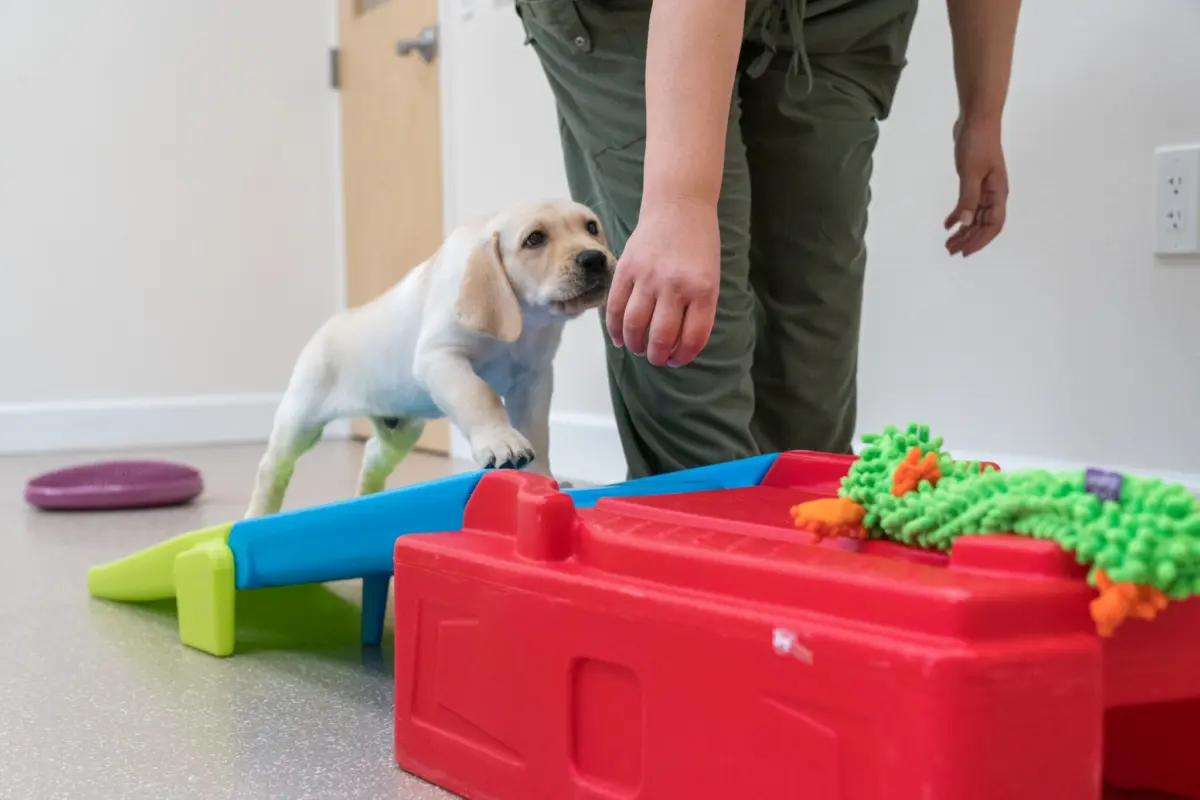
- Building Associations: Between 3 and 12 weeks, puppies rapidly form lasting associations with their environment. At Dogs Inc and similar institutions, this means intentional, positive exposure to various human demographics, unusual sounds, shifting textures underfoot, and novel objects.
- Confidence Building: By week 8, these experiences lay the foundation for a resilient, friendly temperament. By week 12, thorough exposure helps inoculate the puppy against chronic anxiety, fear-based aggression, and phobias. Structured training also begins around this time, with short, positive-reinforcement sessions introducing basic cues.
4. The Juvenile and Adolescent Stage (6 Months to Maturity)
Just as human children test boundaries during their teenage years, puppies enter adolescence around six months of age.
- Hormonal Shifts: Most dogs reach reproductive maturity between 6 and 12 months. Females experience their first heat cycles, while males exhibit hormone-driven behaviors. During this phase, adolescent dogs may momentarily "forget" commands, question boundaries, and require patient, consistent guidance.
- Fear Periods: Veterinary behaviorists note that puppies navigate an average of four distinct "fear periods" as they mature. During these phases, even familiar objects or environments can temporarily startle them, necessitating gentle, positive reassurance rather than coddling or punishment.
Supporting Context & Metrics: The Science of Early Neurological Stimulation
To appreciate ENS, one must look beyond the simple act of holding a puppy. The protocol involves a series of five distinct, brief tactile exercises performed once daily per puppy. These exercises include:

- Tactile Stimulation: Tickling the foot gently between the toes using a Q-tip.
- Head Up: Holding the puppy perpendicular to the ground, so its head is directly above its tail.
- Head Down: Holding the puppy gently upside down with its head pointed toward the ground.
- Supine Position: Holding the puppy flat on its back, allowing it to rest comfortably in the handler’s hands.
- Thermal Stimulation: Placing the puppy on a damp, cool towel for a designated few seconds.
Each exercise lasts only three to five seconds. Despite their brevity, scientific observations indicate that these controlled changes in position and temperature stimulate the adrenal and neurological systems.
Potential Benefits of ENS
While researchers and canine experts agree that no single protocol dictates a dog’s entire future, decades of anecdotal evidence and observational studies suggest several measurable benefits associated with ENS:
- Improved Cardiovascular Performance: Enhanced heart rate adaptability and cardiovascular output under mild stress.
- Stronger Stress Tolerance: Greater resilience when confronted with unfamiliar environments or novel sensory inputs.
- Enhanced Adrenal Gland Function: Improved hormonal regulation, allowing the body to recover more efficiently from environmental triggers.
- Greater Disease Resistance: Anecdotal reports from working dog handlers suggest improved baseline hardiness in neonates that received early stimulation.
ENS vs. Socialization: Understanding the Distinction
A common misconception among novice breeders and puppy raisers is that ENS and socialization are interchangeable terms. They are fundamentally distinct:
- ENS targets the neonatal stage (days 3–16), focusing primarily on physical, neurological, and physiological calibration through tactile and positional micro-challenges.
- Socialization targets the transitional and juvenile stages (weeks 3–12 and beyond), focusing on cognitive learning, emotional associations, confidence building, and social interactions with living beings and complex environments.
Both are vital, but they operate on entirely different developmental tracks and must be executed sequentially to yield a balanced adult dog.

Official Statements and Institutional Philosophy
Preparing an animal to anchor a person with a disability, guide a blind individual through rush-hour traffic, or provide medical alert services requires an uncompromising dedication to quality control and animal welfare.
Organizations at the forefront of this field, such as Dogs Inc, view puppy development through a holistic lens. Representatives emphasize that creating a successful service dog is not about chasing perfection, but rather about fostering emotional maturity, health, and adaptability.
"A puppy’s early weeks pass in the blink of an eye, but they lay the irrevocable cornerstone for everything that follows," notes a leading canine development specialist at Dogs Inc. "Early Neurological Stimulation gives us a head start, but it is merely the first chapter. Through lifelong socialization, structured puppy raising, and positive reinforcement, we guide these remarkable animals through every milestone until they are ready to change someone’s life."
This institutional philosophy recognizes that genetics, veterinary health, maternal care, environmental enrichment, and human mentorship are all intertwined links in a single chain. Neglecting any single link diminishes the strength of the final product.
Future Outlook: The Evolution of Canine Breeding and Training
As canine behavioral science continues to advance, the landscape of service dog preparation is evolving rapidly. Modern breeding and rearing programs increasingly incorporate data-driven tracking, individualized temperament assessments, and advanced environmental enrichment protocols.
Future advancements will likely focus on even more precise evaluations of neonatal resilience and stress recovery, allowing trainers to tailor socialization tracks to individual puppy personalities before they even leave the whelping box. Furthermore, as the public demand for highly skilled service and guide dogs grows, the standardization of early-intervention protocols like ENS will become increasingly vital across both working-dog institutions and ethical breeding programs worldwide.
The Lifetime Commitment
Ultimately, the meticulous care invested in a puppy’s first two weeks reverberates throughout its entire life. From the gentle tactile stimulation of the neonatal box to the complex urban navigation tasks of an adult service dog, every phase of development builds upon the last.
Organizations like Dogs Inc stand as a testament to what is possible when science, compassion, and dedication converge on day one. By honoring every developmental window and investing deeply in a puppy’s earliest moments, these programs ensure that when the time comes, their graduates are more than just well-trained animals—they are confident, life-changing partners ready to meet the world head-on.