
Executive Overview
In the heart of the Midwest, along the vital ecological artery of the Mississippi Flyway, a silent yet devastating crisis unfolds every migration season. Millions of birds traversing North America find themselves disoriented by the dazzling, artificial nocturnal illumination of Chicago’s urban landscape, leading to catastrophic collisions with architectural glass. In response to this staggering loss of avian biodiversity, Evanston-based artist Holly Greenberg has spearheaded a grassroots artistic initiative that merges community engagement, upcycled craft, and rigorous conservation advocacy.
Through a rapidly expanding network of public workshops held across schools, street fairs, and cultural hubs, Greenberg is rallying Chicagoans to handcraft nearly 11,000 individual cloth birds. Each textile replica serves as a tangible, sobering memorial to a real bird that perished after striking a Chicago building in 2023. When complete, these pieces will be meticulously stitched together into a monumental, 300-foot-long sculptural "carpet"—a striking visual indictment of urban hazards and a call to action for systemic architectural reform.
While the project—originally highlighted under the title "Crafting Awareness"—began as a deeply personal creative response to a single, catastrophic night of mass mortality, it has evolved into a powerful vehicle for public education and legislative mobilization. By combining hands-on artistic creation with practical solutions for residential window retrofits and staunch support for pending city council ordinances, Greenberg and her coalition of conservation partners are proving that art can bridge the gap between ecological data and civic empathy. This investigative feature explores the origins of the project, the mechanics of urban bird mortality, the human stories behind the workshops, and the broader push to re-engineer America’s built environment for coexistence with wildlife.
Detailed Chronology: From a Night of Horror to a Movement of Hope
The Catalyst: October 5, 2023
To understand the urgency driving Greenberg’s 300-foot tapestry, one must look back to a dark autumn night that permanently altered the landscape of Chicago’s conservation community. On October 5, 2023, weather patterns, migration timing, and intense artificial lighting converged to create a deadly vortex for migratory birds. As millions of warblers, sparrows, thrushes, and other species traveled down the Mississippi Flyway, they were drawn into the illuminated canyon of downtown Chicago.
When dawn broke, volunteers from organizations such as Chicago Bird Collision Monitors arrived at local landmarks to an apocalyptic scene. More than 2,000 dead and injured birds lay scattered across the urban pavement. Most notoriously, nearly 1,000 birds collided with a single structure: the sprawling, heavily glazed McCormick Place lakeside convention center. The sheer scale of the casualty event shocked even seasoned ornithologists and galvanized local activists who had long warned of the dangers posed by unchecked architectural glass.
The Vision Takes Shape
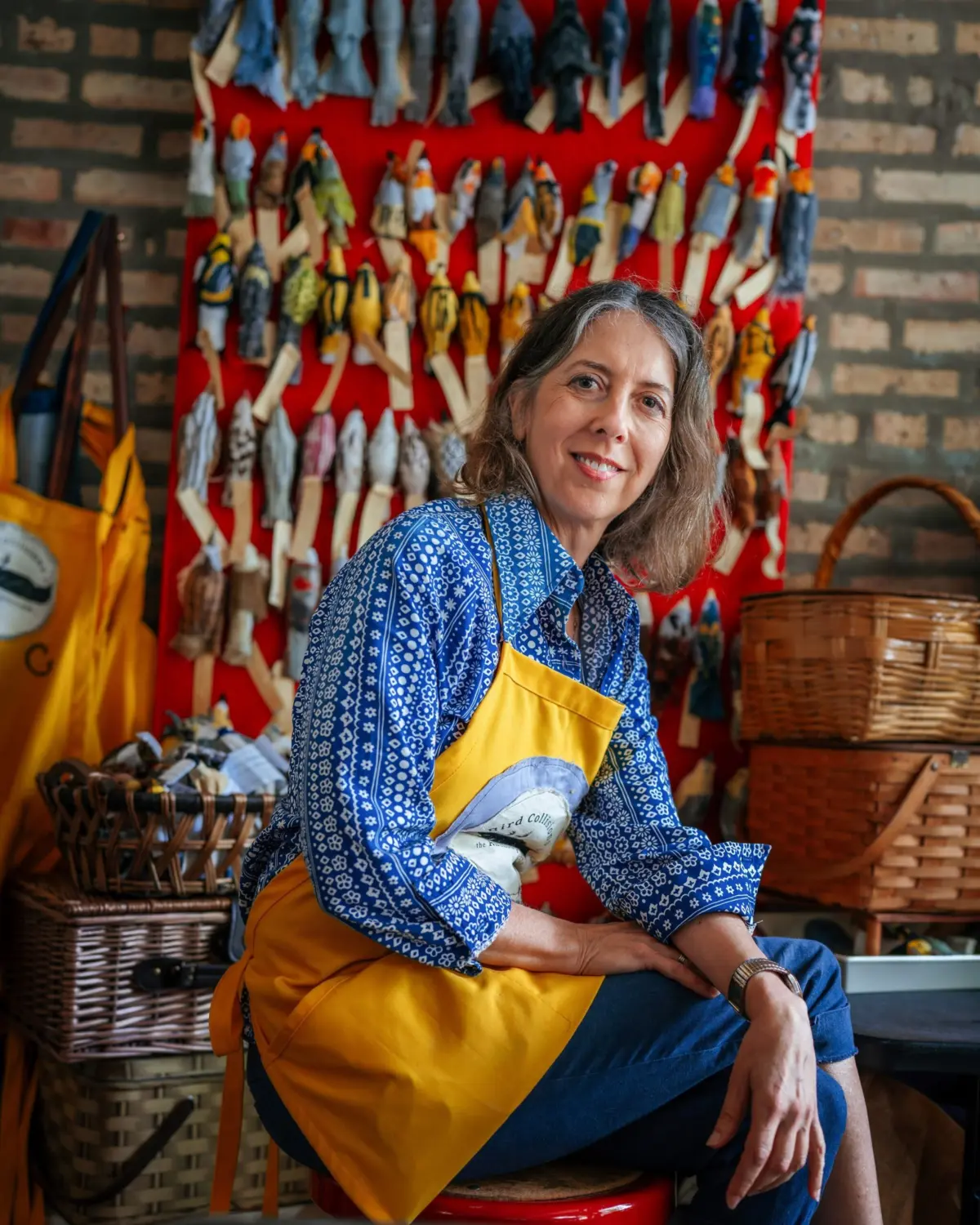
Holly Greenberg, an artist whose studio is based nearby in Evanston, Illinois, had only recently become deeply educated on the mechanics and frequency of fatal window strikes. Deeply moved by the October massacre at McCormick Place, she realized that traditional statistical reporting—while vital for scientific tracking—often failed to capture the emotional gravity of the crisis for the average citizen.
"I just dreamed up this plan to make these pop-up art studios," Greenberg recalls. She envisioned an art installation of monumental proportions: one that would materialize the exact death toll of a single year through tactile, human-made objects. Rather than abstract numbers on a spreadsheet, she wanted the public to grapple with the physical volume of 10,836 individual lives lost. To achieve this, however, she could not work alone; she needed a decentralized army of collaborators.
The Pop-Up Studio Phenomenon
What started as a conceptual spark quickly morphed into a widespread cultural phenomenon. Greenberg engineered a portable, zero-waste workshop model. She began hosting free public sessions at diverse venues, ranging from the Chicago Architecture Center to local schools, libraries, and neighborhood street fairs.
Word spread rapidly. Through her website, educators, community leaders, and out-of-state activists requested kits and guidance to host their own companion sessions. To date, Greenberg has personally led over 80 workshops in the Chicago area, while grassroots hosts have independently organized more than 100 additional sessions across the country and region.
At every table, participants are handed a standardized, blank stuffed bird form alongside piles of donated scrap fabric and eco-friendly glue. Working from visual guides, participants meticulously recreate the distinguishing plumage of more than 200 distinct species documented among the 2023 casualties. A volunteer might spend an hour layering fine strips of black and yellow felt to capture the striking throat pattern of a Magnolia Warbler, or delicately overlapping brown and tawny textiles to render the earthy tones of a House Sparrow. Through this meditative, hands-on labor, participants forge an intimate, empathetic connection with the vulnerable creatures sharing their urban ecosystem.
Supporting Context & Metrics: The Ecological Trap of the Windy City
The Geography of the Mississippi Flyway
To fully appreciate why Chicago is ground zero for this conservation battle, one must examine avian geography. The Mississippi Flyway is one of North America’s premier superhighways for bird migration, utilized by roughly 40 percent of the continent’s waterfowl and songbirds twice a year.
As these birds move between northern breeding grounds and southern wintering habitats, they encounter the western shoreline of Lake Michigan. For nocturnal migrants navigating by the stars and the Earth’s magnetic field, the vast, dark expanse of the lake presents a psychological and navigational barrier. Seeking shelter, food, and orientation, millions of birds concentrate heavily along the immediate lakefront.
The Urban Beacon and the Glass Trap
Upon reaching the Chicago shoreline, migratory birds encounter an intensely lit urban core. Unshielded architectural lighting, illuminated office towers late into the night, and sweeping landscape lights act as powerful ecological traps. They disorient birds, drawing them downward into concrete canyons.
Once trapped within the city environment at ground or mid-level heights, birds face an invisible enemy: architectural glass. Modern commercial and residential architecture relies heavily on reflective and transparent glass facades. To a bird flying at high speeds, clear glass appears as open sky or continuous foliage, while reflective glass mirrors the surrounding trees and clouds. Birds possess no evolutionary mechanism to comprehend the concept of a transparent barrier; they cannot perceive glass until impact occurs.
The Scale of the Crisis
The statistics compiled by conservationists are sobering:
- National Toll: Estimates from peer-reviewed studies published in scientific journals indicate that building collisions claim the lives of between 300 million and 1 billion birds annually in the United States alone.
- The Residential Factor: While iconic glass skyscrapers like McCormick Place capture headlines due to mass-mortality events, research reveals that low-rise buildings and residential homes account for nearly half of all fatal window strikes nationwide due to their sheer cumulative volume.
- Chicago’s Baseline: The 10,836 casualties recorded in 2023—and memorialized by Greenberg’s project—represent only a fraction of the actual toll, as many collision victims are scavenged by urban wildlife or fall into inaccessible areas before monitors can record them.
Official Statements and Expert Perspectives
The intersection of public art, urban planning, and ecological science has drawn praise from leading voices in conservation and architecture. Experts emphasize that solving this crisis requires a dual approach: raising bottom-up public consciousness while enacting top-down legislative mandates.
"Bird conservationists, of course, understand how dangerous Chicago is," notes Judy Pollock, former president of the Chicago Bird Alliance, an organization actively supporting Greenberg’s initiative. "I just don’t know how much the average person understands about that. Art has this incredible capacity to disarm people, to bypass political fatigue, and to make them look at a problem with their hearts as well as their minds."
Pollock and her peers stress that public engagement campaigns are vital for shifting cultural attitudes toward architectural design. For decades, aesthetic priorities favoring ultra-clear, floor-to-ceiling glass dominated commercial real estate development without regard for local ecology. Projects like Greenberg’s humanize the collateral damage of modern urban expansion.
At the architectural level, industry professionals are increasingly recognizing that beauty and bird safety are not mutually exclusive. Following the tragic October 2023 event, the Metropolitan Pier and Exposition Authority—operators of McCormick Place—faced intense public pressure and swift advocacy from conservation groups. Building management rapidly implemented structural retrofits to the facility’s massive glass facade, applying patterned, ultraviolet-reflective films and window treatments.
The results were immediate and staggering. Monitoring data from the subsequent migration season revealed a 95 percent reduction in bird collisions at McCormick Place, proving definitively that targeted architectural intervention can save thousands of lives with minimal disruption to human use.
Future Outlook: Weaving a Sustainable Legacy
As of late 2026, Holly Greenberg and her network of volunteers have successfully amassed over 4,000 completed cloth bird replicas. Based on the current trajectory of workshops and public participation, the artist estimates it will take several more years of meticulous stitching to reach the ultimate goal of 10,836 pieces and finalize the 300-foot installation.
Yet, Greenberg is in no rush to cross the finish line. For her, the true value of the project lies not merely in the final museum exhibition of the completed tapestry, but in the ongoing, intimate conversations that happen across workshop tables in community centers and school gymnasiums.
Practical Empowerment at the Household Level
Every workshop functions simultaneously as an art class and an educational seminar. Greenberg and her trained facilitators instruct participants on actionable steps they can take immediately in their own neighborhoods and homes. Because nearly 50 percent of all strikes occur on residential property, empowering homeowners is critical.
Workshop attendees learn how to treat residential windows using affordable, accessible methods:
- Decals and Patterns: Applying exterior window stickers spaced no more than two inches apart vertically and four inches horizontally to break up reflections.
- Paints and Markers: Utilizing tempera paint or specialized glass markers to create visible warning designs that can be easily washed off seasonally.
- Screens and Netting: Installing exterior insect screens or specialized bird-netting buffers that absorb kinetic impact before a bird strikes the glass surface.
The Legislative Frontier: Policy and Reform
Beyond individual behavioral changes, the momentum generated by grassroots art and advocacy is feeding directly into systemic political pressure. Conservation coalitions in Chicago and surrounding municipalities are actively lobbying the City Council to adopt comprehensive bird-safe building ordinances.
These proposed regulatory frameworks would mandate that all new commercial construction and major structural renovations incorporate bird-friendly design principles—such as fritted glass, patterned glazing, external shading devices, and minimized night lighting during peak migration windows—into their foundational building codes.
By grounding policy debates in the visible, visceral community commitment represented by thousands of handmade cloth birds, advocates hope to secure a legislative legacy that permanently alters the skyline of the Windy City.
Ultimately, Holly Greenberg’s 300-foot carpet serves as both a monument to past ecological loss and a roadmap for future coexistence. As each scrap of upcycled fabric is glued, stitched, and woven into the growing tapestry, it carries a silent yet resonant message: our cities can be designed to honor, protect, and preserve the wild migrants that share our skies.