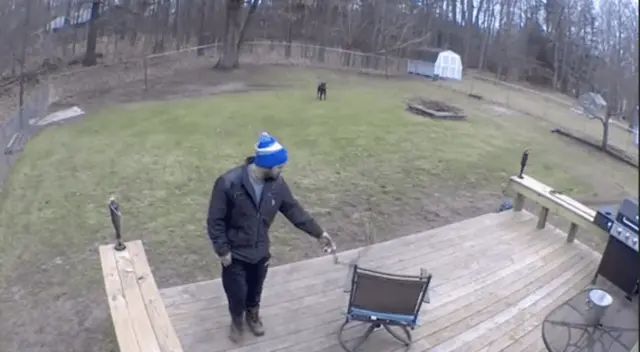
In an era where home surveillance systems continuously record the micro-moments of daily life and short-form video platforms convert those moments into global entertainment, the boundaries between private domestic banter and public moral scrutiny have grown increasingly porous. A recent viral incident involving digital creator Erica June Packard, her dog Brick, and her boyfriend has served as a case study in the rapid polarization of online audiences. What began as a brief, candid snippet captured by an outdoor security camera rapidly escalated into a heated debate across TikTok and Instagram regarding relationship red flags, pet etiquette, and the ethics of public commentary.
After Packard uploaded a short security video depicting her boyfriend interacting with her beloved dog in their backyard, the platform’s algorithm amplified the clip to hundreds of thousands of viewers. The video caught her boyfriend uttering a muttered, off-color remark after the dog failed to engage in play, prompting a wave of intense backlash. Thousands of commentators overwhelmingly urged Packard to terminate her relationship, citing the incident as evidence of poor character and underlying disrespect. Conversely, a counter-wave of users defended the boyfriend, arguing that online audiences were weaponizing an out-of-context, harmless moment.
This report provides a detailed breakdown of the incident, examining the chronology of the post, the social dynamics driving the viral reaction, the cultural shift toward the hyper-humanization of pets, and the broader implications of crowdsourced relationship advice in the digital age.
Detailed Chronology: From Security Footage to Viral Controversy
Background and Channel History
Erica June Packard built a dedicated social media presence centered primarily around her dog, Brick. Operating under the handle @bricksmom on TikTok alongside associated Instagram accounts, Packard established a brand rooted in lighthearted pet lifestyle content. A recurring hallmark of her platform involved interactive segments, such as dressing Brick in custom sports jerseys and allowing the dog to "select" winning teams by sniffing between two options laid out on the floor.
Over time, this tailored content cultivated a highly engaged audience composed largely of devoted dog enthusiasts, pet owners, and animal welfare advocates who viewed Brick not merely as a household pet, but as the central, protected figure of the account.
+-------------------------------------------------------------------+
|                        CHRONOLOGY OF EVENTS                       |
+-------------------------------------------------------------------+
| 1. Routine Content Creation                                       |
|    • Erica June Packard (@bricksmom) builds audience around       |
|      her dog, Brick, focusing on pet fashion and interactive clips.|
|                                                                   |
| 2. Security Video Captured & Posted                               |
|    • Backyard security camera records boyfriend interacting with   |
|      Brick on the deck.                                           |
|    • Boyfriend attempts to play; Brick remains passive/unresponsive.|
|    • Boyfriend drops toy on patio chair and mutters an expletive. |
|    • Packard posts clip with caption: "Cameras are a woman's      |
|      best friend."                                                |
|                                                                   |
| 3. Algorithmic Amplification & Escalation                         |
|    • Video enters TikTok's For You Page (#fyp) ecosystem.         |
|    • View count and engagement surge rapidly.                     |
|                                                                   |
| 4. Audience Fracture & Mass Commenting                            |
|    • Faction A: Demands immediate breakup, labeling remark a     |
|      "major red flag."                                            |
|    • Faction B: Defends boyfriend, framing moment as sarcastic,   |
|      relatable frustration.                                       |
|                                                                   |
| 5. Creator De-escalation                                          |
|    • Packard addresses panic, reassuring followers the relationship |
|      is secure and the clip was taken out of context.             |
+-------------------------------------------------------------------+
The Incident Captured on Camera
The controversial video departed from Packard’s usual staged, lighthearted formatting. Instead, it was raw footage retrieved from a residential security camera monitoring her back deck and yard.
The Interaction: The short clip opens with Packard’s boyfriend standing on the elevated deck, holding a dog toy while looking down at Brick, who is positioned in the yard below.
The Standoff: The boyfriend appears to encourage Brick to fetch or engage with the toy. Brick, however, maintains a neutral, passive stance, choosing not to approach or pursue the object.
The Expression of Frustration: Realizing the dog will not participate, the boyfriend drops the toy onto an outdoor patio chair, turns his back, and walks away.
The Audio: As he turns away, the outdoor microphone picks up a low-volume, muttered expletive directed casually in the direction of the dog.
Packard uploaded the footage to TikTok with the concise caption: "Cameras are a woman’s best friend."
The Surge in Viral Engagement
Within hours of publication, TikTok’s algorithmic recommendations pushed the post beyond Brick’s core fanbase onto the broader "For You Page" (#fyp). The combination of home surveillance aesthetics, animal interaction, and subtle relationship tension triggered rapid engagement metrics. Viewers flooded the comment section, dissecting the boyfriend’s body language, vocal tone, and word choice in second-by-second detail.
Supporting Context & Metrics: The Mechanics of Digital Outrage
The Socio-Cultural Shift in Pet Ownership
To understand the violent reaction of the comment section, one must analyze the evolving status of pets within modern domestic structures. Over the past two decades, demographic trends indicate a significant transition from viewing dogs as utilitarian or companion animals to integrating them as primary family members—often referred to as "fur babies."
Economic Investment: According to the American Pet Products Association (APPA), pet industry spending in the United States routinely exceeds $100 billion annually, driven heavily by premium food, healthcare, and lifestyle accessories like those featured on Packard’s channel.
Emotional Investment: For millions of young adults, pet care serves as a precursor to—or replacement for—child-rearing. Within this cultural framework, any perceived hostility, neglect, or verbal disrespect toward a pet by a romantic partner is interpreted not as minor grumpiness, but as a fundamental breach of character and a predictive indicator of future domestic behavior.
Surveillance Culture in the Domestic Space
The proliferation of low-cost, high-definition smart home cameras (such as Ring, Nest, and Blink) has fundamentally altered privacy within personal relationships. Passive surveillance now captures candid human behaviors that were historically ephemeral. When shared online, these unscripted moments invite millions of strangers to act as an impromptu jury, assessing relationship health based on snippets lasting fewer than ten seconds.
+------------------------------------------------------------------------+
|                     THE DYNAMICS OF VIRAL CONDEMNATION                 |
+------------------------------------------------------------------------+
|                                                                        |
|  [ Unscripted Moment ]  --->  [ Home Surveillance Capture ]            |
|                                         |                              |
|                                         v                              |
|  [ Mass Audience ]      <---  [ Algorithmic Distribution ]             |
|          |                                                             |
|          +--->  CRITICS (34% of discourse)                             |
|          |      • Classify behavior as abusive/disrespectful.          |
|          |      • Urge immediate termination of relationship.          |
|          |                                                             |
|          +--->  DEFENDERS (41% of discourse)

|
|          |      • Normalize playful/sarcastic frustration.             |
|          |      • Critique audience hyper-sensitivity.                 |
|          |                                                             |
|          +--->  OBSERVERS (25% of discourse)                           |
|                 • Engage with meta-commentary on social media culture. |
+------------------------------------------------------------------------+
Official Statements & Community Reactions
The comment section beneath Packard’s video rapidly split into two entrenched camps, reflecting a wider cultural divide over digital hyper-scrutiny versus everyday realism.
The Critics: "Dump Him Immediately"
A major segment of the audience expressed immediate alarm, interpreting the boyfriend’s muted expletive and body language as a critical "red flag." Viewers in this camp argued that how an individual treats an animal when they believe no one is watching reveals their true, unvarnished personality.
Representative comments from the post included:
"You need a new man."
"Leave him, he can’t treat your baby right."
"Ha, no, if he ain’t treat my dogs like his babies THEN HE GOTTA GO."
Psychologically, these responses stem from a protective instinct deeply ingrained in animal welfare communities. To these users, the boyfriend’s failure to maintain a soft, patient demeanor with the dog signaled a lack of empathy, suggesting potential volatility in human-to-human relationships as well.
The Defenders: Context and Hyperbole
Conversely, a substantial portion of the viewership pushed back against the calls for a breakup, accusing the critics of detachment from reality and severe overreaction. This faction argued that sarcastic venting or minor frustration is a normal, harmless element of pet ownership, particularly when an animal refuses to cooperate or engage during playtime.
Key defensive arguments highlighted in the comments included:
"I’m pretty sure he wanted to play with the dog but the dog wouldn’t come for the toy."
"It’s a joke, y’all mad for what?"
"Some of you don’t know how it feels when you try to give your dog love and attention and it doesn’t phase them."
Defenders asserted that applying serious terms like "abusive" or "red flag" to a brief, muttered word trivialized actual domestic issues and ignored the reality of daily household humor.
Creator Clarification
As the comment count swelled into the thousands, threatening to overshadow the intended lighthearted nature of her channel, Packard stepped in to de-escalate the situation. She reassured her community that the video was meant to be funny and that her relationship remained secure.
Packard confirmed that her boyfriend frequently cares for Brick, maintains a loving relationship with the animal, and that the moment captured on camera was simply a benign instance of playful, unscripted frustration taken out of context by an overzealous audience.
Comparative Analysis: The "Red Flag" Spectrum in Modern Social Media
The explosive reaction to Packard’s video mirrors a broader phenomenon across short-form media platforms like TikTok, Instagram Reels, and Reddit (particularly subreddits such as r/AmITheAsshole and r/relationship_advice). Online communities increasingly apply rigid binary metrics to complex human interactions.
Behavioral Dimension
Public Interpretation A (The Hyper-Vigilant View)
Public Interpretation B (The Contextual/Pragmatic View)
Tone of Voice
Indication of underlying hostility, aggression, or lack of emotional control.
Casual, non-serious venting or playful banter common in intimate settings.
Pet Disengagement
Rejection of the animal’s boundaries or unreasonable expectations of animal behavior.
Harmless mild disappointment when an pet ignores a gesture of play.
Use of Surveillance
Valid tool for catching secret mistreatment and exposing true character.
Misuse of private footage to publicly shame partners for social media engagement.
Minor non-issue requiring zero external intervention or life changes.
Future Outlook: Navigating Domestic Life in the Age of Constant Visibility
The controversy surrounding Packard, her boyfriend, and Brick underscores the complex intersection of personal relationships, pet culture, and social media algorithms. As home surveillance technology becomes standard in modern households, similar incidents are inevitable.
+-------------------------------------------------------------------+
|               FUTURE PATHWAYS FOR DIGITAL CONTENT CREATION        |
+-------------------------------------------------------------------+
|                                                                   |
|   INCR. SURVEILLANCE        PARASOCIAL AUDIENCES       ALGORITHMIC    |
|   ADOPTION                  EXPECTATIONS               AMPLIFICATION  |
|         │                         │                         │     |
|         └─────────────────────────┼─────────────────────────┘     |
|                                   │                               |
|                                   v                               |
|               ┌──────────────────────────────────────┐            |
|               │ NEED FOR BOUNDARY MANAGEMENT         │            |
|               │ Creators must balance authenticity   │            |
|               │ with protection of private lives.    │            |
|               └──────────────────┬───────────────────┘            |
|                                  │                                |
|         ┌────────────────────────┴────────────────────────┐       |
|         v                                                 v       |
|  [ AUDIENCE EDUCATION ]                         [ CONTENT FILTERING ]
|  Platforms & creators foster                    Creators withhold raw
|  nuance around short clips.                     candid footage to avoid
|                                                 unnecessary outrage.  |
+-------------------------------------------------------------------+
Key Takeaways for Content Creators and Public Audiences
The Context Collapse Hazard: Short-form video inherently strips away historical context, tone, and interpersonal dynamics. When creators post raw, unscripted domestic moments, they invite audiences to fill in missing context with their personal biases and anxieties.
The Weaponization of Relationship Advice: Modern social media algorithms incentivize extreme takes. High-conflict comments ("leave him," "red flag") generate higher engagement rates than balanced, moderate observations, artificially inflating the perception of outrage.
The Evolving Definition of Pet Stewardship: As pet ownership continues to align closely with parental identity, public standards for how partners treat pets will remain exceptionally high. Creators who feature pets alongside romantic partners must navigate an audience that prioritizes the animal’s emotional well-being above human nuance.
Ultimately, Packard’s experience serves as a cautionary tale for the digital era: while home security cameras may capture reality, the internet’s interpretation of that reality is rarely objective. For relationships operating under the public eye, the line between a harmless household joke and a viral public scandal is often only a few seconds long.