
Executive Overview
The rapid expansion of the global pet care sector has brought unprecedented focus onto companion animal dermatological health. As pet humanization trends drive consumer demand for clean, non-toxic, and physiologically aligned products, veterinary dermatologists and pet care researchers are emphasizing the critical need for specialized grooming agents tailored specifically for juvenile canines. A puppy’s skin barrier differs fundamentally from both human skin and adult canine skin, presenting higher permeability, lower epidermal thickness, and an underdeveloped acid mantle.
Using human shampoos or harsh adult dog formulations on young puppies can strip essential surface lipids, disrupt the delicate cutaneous microbiome, and trigger acute contact dermatitis. Consequently, the pet care market has witnessed a shift toward gentle, tear-free, pH-balanced, and botanical-based cleansing solutions.

This report provides an analytical review of the current veterinary grooming landscape, investigating the physiological requirements of puppy skin, dissecting market-leading formulations, evaluating safety standards, and outlining evidence-based bath management strategies for companion animals in their foundational stage of life.
Detailed Evaluation: Comparative Analysis of Market-Leading Puppy Formulations
Evaluating puppy shampoos requires analyzing surfactant profiles, pH adjusting agents, active emollients, and the presence of potential dermatological irritants. Below is a detailed assessment of six top-performing puppy shampoos currently driving quality standards in the companion animal care market.

+------------------------------------------------------+---------------------------------+-----------------------------------+-----------------------------------+
| Product Name                                         | Key Active Botanicals / Agents  | Age Minimum / Safety Profile      | Excluded Chemical Compounds       |
+------------------------------------------------------+---------------------------------+-----------------------------------+-----------------------------------+
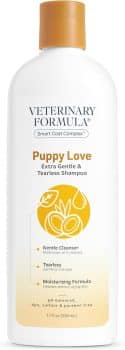
| Veterinary Formula Puppy Love Tearless               | Mild cleansers, fragrance oils  | > 6 weeks; Tearless               | Sulfates, DEA                     |
| Burt's Bees Natural Tearless with Buttermilk        | Buttermilk, Honey, Beeswax      | All ages; pH-balanced             | Sulfates, Dyes, Added Fragrance   |
| Arm & Hammer Tearless Puppy Shampoo                  | Baking Soda, Coconut Water      | All ages; Flea/Tick treatment-safe| Harsh Detergents, Parabens        |
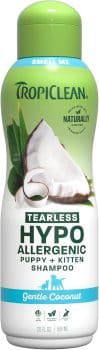
| TropiClean Coconut Hypoallergenic Dog Shampoo        | Aloe Vera, Vitamin E, Coconut   | > 12 weeks; Hypoallergenic        | Soaps, Parabens, Dyes             |
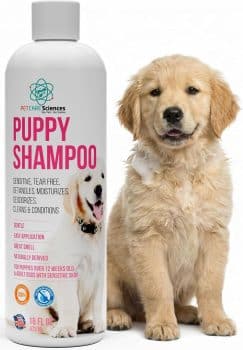
| PET CARE Sciences Tearless Shampoo & Conditioner     | Oatmeal, Aloe Vera, Coconut Oil | > 12 weeks; 2-in-1 formula        | Sulfates, Parabens, MEA/DEA       |
| Rocco & Roxie Sensitive Skin Shampoo & Conditioner   | Aloe, Rosemary, Chamomile       | All ages; Therapeutic             | Synthetic Dyes, Harsh Chemicals   |
+------------------------------------------------------+---------------------------------+-----------------------------------+-----------------------------------+
1. Veterinary Formula Solutions Puppy Love Extra Gentle Tearless Shampoo
Designed explicitly for puppies in their first year of growth, this formulation targets puppies as young as six weeks old. The product relies on a mild surfactant complex engineered to prevent corneal irritation during accidental ocular exposure.
- Biochemical Profile: Free of diethanolamine (DEA) and synthetic sulfates, reducing the risk of cutaneous lipolysis (stripping of natural fats).
- Clinical Utility: Formulated for frequent washing during early house-training phases when accidental contamination is common. It preserves moisture while maintaining a long-lasting, non-sensitizing fragrance.
2. Burt’s Bees for Pets Natural Tearless Puppy Shampoo with Buttermilk
Burt’s Bees applies a minimal-processing philosophy to canine hygiene, integrating natural emollient agents like buttermilk to condition delicate hair follicles.
- Biochemical Profile: Intentionally omits added synthetic fragrances, artificial colorants, phthalates, and sulfates.
- Clinical Utility: The inclusion of natural buttermilk aids in softening the coat, while its precise pH alignment respects the higher alkalinity of canine skin, preventing micro-fissuring of the stratum corneum.
3. Arm & Hammer for Pets Tearless Puppy Shampoo
Leveraging sodium bicarbonate (baking soda) technology, this product tackles organic compound decomposition—the primary root of odor in young canines—without resorting to aggressive chemical maskers.
- Biochemical Profile: Combines sodium bicarbonate with lipid-replenishing coconut water derivatives.
- Clinical Utility: Highly compatible with spot-on parasiticide therapies. The formulation ensures that topical flea and tick treatments remain bonded to the lipid layer of the skin while neutralizing metabolic odor byproducts.
4. TropiClean Coconut Hypoallergenic Dog Shampoo
Specifically targeted toward animals prone to atopic reactions and environmental allergies, TropiClean’s hypoallergenic preparation provides mild cleansing for dogs and cats aged 12 weeks and older.

- Biochemical Profile: Soap-free cleanser incorporating Aloe barbadensis leaf juice and Tocopheryl Acetate (Vitamin E).
- Clinical Utility: By excluding harsh soaps, the product avoids stripping sebum while offering relief from environmental allergens. It integrates seamlessly into broader hygiene routines involving dry cleansers and grooming wipes.
5. PET CARE Sciences Tearless Puppy Shampoo and Conditioner
A dual-action 2-in-1 formulation tailored for puppies past their first quarter of life (>12 weeks) that require enhanced conditioning alongside gentle cleansing.
- Biochemical Profile: Features a bio-based carrier containing colloidal oatmeal, virgin coconut oil, and aloe extracts. It completely eliminates monoethanolamine (MEA), DEA, sulfates, and phosphates.
- Clinical Utility: Provides coat detangling alongside cleansing. The colloidal oatmeal acts as an anti-pruritic agent, relieving minor localized inflammation and supporting skin hydration.
6. Rocco & Roxie Dog Shampoo and Conditioner for Sensitive Skin
Formulated with a focus on therapeutic herbal extracts, this product addresses puppies experiencing active skin irritation, xerosis (dry skin), or delicate coat structures.

- Biochemical Profile: Utilizes a botanical matrix featuring Aloe vera gel, Rosmarinus officinalis (rosemary) extract, and Matricaria chamomilla (chamomile).
- Clinical Utility: Rosemary provides natural antimicrobial and antioxidant properties, while chamomile and aloe work synergistically to suppress histamine-mediated itching and soothe hyperemic tissue.
Supporting Context & Dermatological Metrics
To understand why specialized puppy shampoos are medically necessary, pet parents and professionals must look at the physiological differences between human and canine skin.
       [Human Epidermis]                         [Canine Epidermis]
  +-------------------------+               +-------------------------+
  | Stratum Corneum         |               | Stratum Corneum         |
  | (10 to 15 Cell Layers)  |               | (3 to 5 Cell Layers)    |
  +-------------------------+               +-------------------------+
  | pH Level: 4.8 – 5.5     |               | pH Level: 6.5 – 7.5     |
  | (Slightly Acidic)       |               | (Neutral to Alkaline)   |
  +-------------------------+               +-------------------------+
  | Dense Lipid Barrier     |               | Thin, Fragile Barrier   |
  +-------------------------+               +-------------------------+
1. Cutaneous pH and the Acid Mantle
Human skin maintains an acidic surface mantle (pH range of 4.8 to 5.5), which protects against pathogenic microbial colonization. In contrast, the canine stratum corneum exhibits a neutral-to-alkaline pH profile, typically ranging from 6.5 to 7.5 depending on the breed and anatomical site.

Using human acidic shampoos on a puppy alters their native surface pH. This shift destroys the acid mantle, causing acute dehydration, severe scaling, and opportunistic colonization by pathogens such as Staphylococcus pseudintermedius and Malassezia pachydermatis.
2. Epidermal Layer Thickness and Turnover Rate
Canine skin is significantly thinner than human skin. Human skin boasts an epidermal thickness of 10 to 15 cell layers, whereas canine skin consists of only 3 to 5 cell layers. Furthermore, the cellular turnover cycle in canines occurs approximately every 20 to 28 days. Because a puppy’s epidermal barrier is so thin, harsh synthetic detergents—such as Sodium Lauryl Sulfate (SLS)—can easily penetrate the upper skin layers, causing systemic cutaneous toxicity and inflammation.

3. Toxicological Red Flags in Grooming Products
When evaluating pet hygiene formulas, veterinarians advise screening labels for the following harmful chemical groups:
- Sulfates (SLS / SLES): Aggressive anionic surfactants that strip the stratum corneum lipid matrix.
- Diethanolamine (DEA) & Monoethanolamine (MEA): Emulsifying agents that can form carcinogenic nitrosamines when mixed with certain preservatives.
- Synthetic Colorants & Dyes: Frequently derived from coal tar sources, presenting unnecessary allergenic risks to sensitive skin.
- Phthalates & Artificial Musk Fragrance: Known endocrine disruptors that can induce airway hyper-responsiveness and localized skin redness in young dogs.
Official Statements & Veterinary Industry Consensus
Leading veterinary bodies, including board-certified veterinary dermatologists, have established unified guidelines regarding juvenile canine hygiene.
Expert Guidelines on Bathing Frequency
"Over-bathing puppies with non-physiological cleansers represents one of the primary non-infectious causes of dry skin and secondary scratching observed in clinical practice," states veterinary consensus reports. "Unless a puppy has rolled in noxious material or presented with a diagnosed dermatological illness, routine bathing should be limited to once every three to four weeks using an un-perfumed or mildly fragranced, pH-balanced formulation."
The Science of "Tearless" Formulations
Veterinary ophthalmologists clarify that true tearless properties are achieved by replacing harsh anionic surfactants with high-molecular-weight amphoteric or non-ionic surfactants (such as polysorbates or betaines). These larger molecules are physically incapable of penetrating the ocular epithelial tissue, preventing the chemical stinging response when washing around the facial region.

Systematic Bathing Protocol for Optimal Skin Safety
To minimize stress and maintain skin safety during grooming, veterinary behaviorists and groomers recommend the following protocol:
- Water Temperature Management: Water must be maintained within a thermoneutral range (90°F to 95°F / 32°C to 35°C). Excessively warm water induces skin redness and exacerbates itching.
- Pre-Bath Brushing: Mechanical removal of loose undercoat fibers and dirt mats must be completed prior to wetting. Water can tighten existing mats, trapping moisture and soap against the skin.
- Controlled Dilution: Concentrated shampoos should be pre-diluted with warm water (typically a 1:4 or 1:10 ratio) in a applicator bottle to ensure uniform distribution and prevent localized residue accumulation.
- Targeted Rinse Procedures: Rinsing must be continued for twice as long as the application process. Residual shampoo left on the skin dries into micro-crystals, causing intense skin irritation.
- Drying Protocols: High-heat human blow dryers must be avoided due to the risk of thermal burns on thin puppy skin. Towel drying followed by ambient air drying or cool-air pet dryers is recommended.
Future Outlook: Trends in Canine Derma-Care
The landscape of companion animal dermatology is undergoing rapid development driven by consumer demand and advancing veterinary research. Key trends shaping the future of puppy hygiene include:

  [Microbiome Protection]  ---> Integrates prebiotics to support beneficial flora
  [Eco-Certifications]     ---> Demand for USDA Organic and Cruelty-Free labels
  [Waterless Solutions]    ---> Rise of foam cleansers to reduce bath-time stress
  [Targeted Therapeutics]  ---> Breed-specific lipid and pH customization
1. Microbiome-Centric Formulations
Future puppy cleansers are increasingly moving toward microbiome-friendly certification. Rather than attempting to eradicate all skin bacteria, modern formulations incorporate topical prebiotics (such as inulin) and postbiotic ferments that selectively nourish commensal flora while suppressing pathogenic strains.
2. Botanical Standardization and Green Science
As regulatory scrutiny around pet care labeling increases, manufacturers are migrating toward certified organic plant extracts. Transparent ingredient disclosures—detailing exact surfactant sources (e.g., coco-glucoside derived from renewable coconut oils)—are replacing vague descriptors like "cleansing base" or "natural mists."
3. Stress-Reduction Integration
Recognizing that early bath experiences permanently shape a dog’s behavioral responses, future product lines are pairing ultra-gentle, stress-free formulations with low-noise rinse systems, dry foam cleansers, and soothing botanical scents like natural lavender and chamomile to create a positive sensory environment.
Conclusion
Selecting an optimal puppy shampoo goes far beyond aesthetic preferences like fragrance or lather volume; it is a foundational dermatological choice. By selecting pH-balanced, tearless formulas free from aggressive sulfates, parabens, and synthetic dyes, pet parents protect their puppy’s delicate skin barrier. Combined with appropriate bathing techniques and sensible schedules, high-quality shampoos help ensure a comfortable, healthy, and happy start to a dog’s life.