
Executive Overview
The remote and pristine wilderness of Antarctica, long considered a final sanctuary shielded from many of the devastating anthropogenic pathogens sweeping the globe, has officially fallen victim to the relentless march of highly pathogenic avian influenza (HPAI). In a sobering milestone for polar ecology, a landmark scientific study has confirmed the first mass wildlife die-off driven by the H5N1 virus on the southernmost continent. Over the austral summers of 2023 and 2024, more than 50 skuas—large, predatory seabirds native to the polar regions—succumbed to the infection across the Antarctic Peninsula and surrounding archipelagos.
Published recently in the journal Scientific Reports and spearheaded by an international coalition of researchers from Erasmus MC in the Netherlands and the University of California, Davis (UC Davis), the study provides definitive proof that the virus is actively killing native Antarctic fauna. While sporadic detections of the virus in individual birds had been documented earlier in 2024, this research marks the critical transition from mere presence to active mortality.
The ramifications of this outbreak extend far beyond the immediate loss of several dozen birds. Skuas occupy a unique ecological niche as apex scavengers and predators, making them both barometers of ecosystem health and vectors for rapid viral dissemination. As H5N1 continues to rewrite the rules of wildlife epidemiology, the scientific community is issuing urgent calls for intensified surveillance, warning that a lack of baseline population data and mounting environmental pressures could blind researchers to a developing ecological catastrophe at the end of the Earth.
Detailed Chronology: Unfolding of the Antarctic Outbreak
Early Warnings and Initial Detections (Early 2024)
The shadow of H5N1 has been creeping toward the polar regions for years, but the alarm bells began ringing in earnest during the austral summer of early 2024. In January and February of that year, field researchers operating in the Antarctic sector detected the H5N1 virus in a single kelp gull and two skuas found dead in the region.
However, detecting genetic material in a carcass does not inherently prove the cause of death; the animal could have succumbed to starvation, trauma, or unrelated pathogens while coincidentally carrying the virus. This distinction bogged down early assessments, leaving wildlife veterinarians and virologists uncertain about the true lethality of the pathogen in the high southern latitudes.
The March 2024 Expedition: Investigating the Ground Zero
To pierce the veil of uncertainty, a dedicated research team launched the HPAI Australis Expedition in March 2024, arriving in Antarctica just as the breeding season for skuas and penguins was drawing to a close. The multi-institutional team targeted 10 distinct sites strategically distributed across the South Shetland Islands, the northern Weddell Sea, and the Antarctic Peninsula.
Armed with personal protective equipment and specialized sampling kits, the scientists executed comprehensive field necropsies whenever they encountered sick or deceased wildlife. Their scope was broad, encompassing gentoo penguins (Pygoscelis papua), Adélie penguins (Pygoscelis adeliae), and Antarctic fur seals (Arctocephalus gazella). While these other species were thoroughly screened, H5N1 was notably ruled out as the primary cause of mortality in those specific populations during this phase of the investigation.
Skuas, however, told a drastically different and tragic story.
"As the expedition progressed, it became obvious quickly that skuas were a major victim," noted Dr. Ralph Vanstreels, a wildlife veterinarian with the UC Davis One Health Institute.
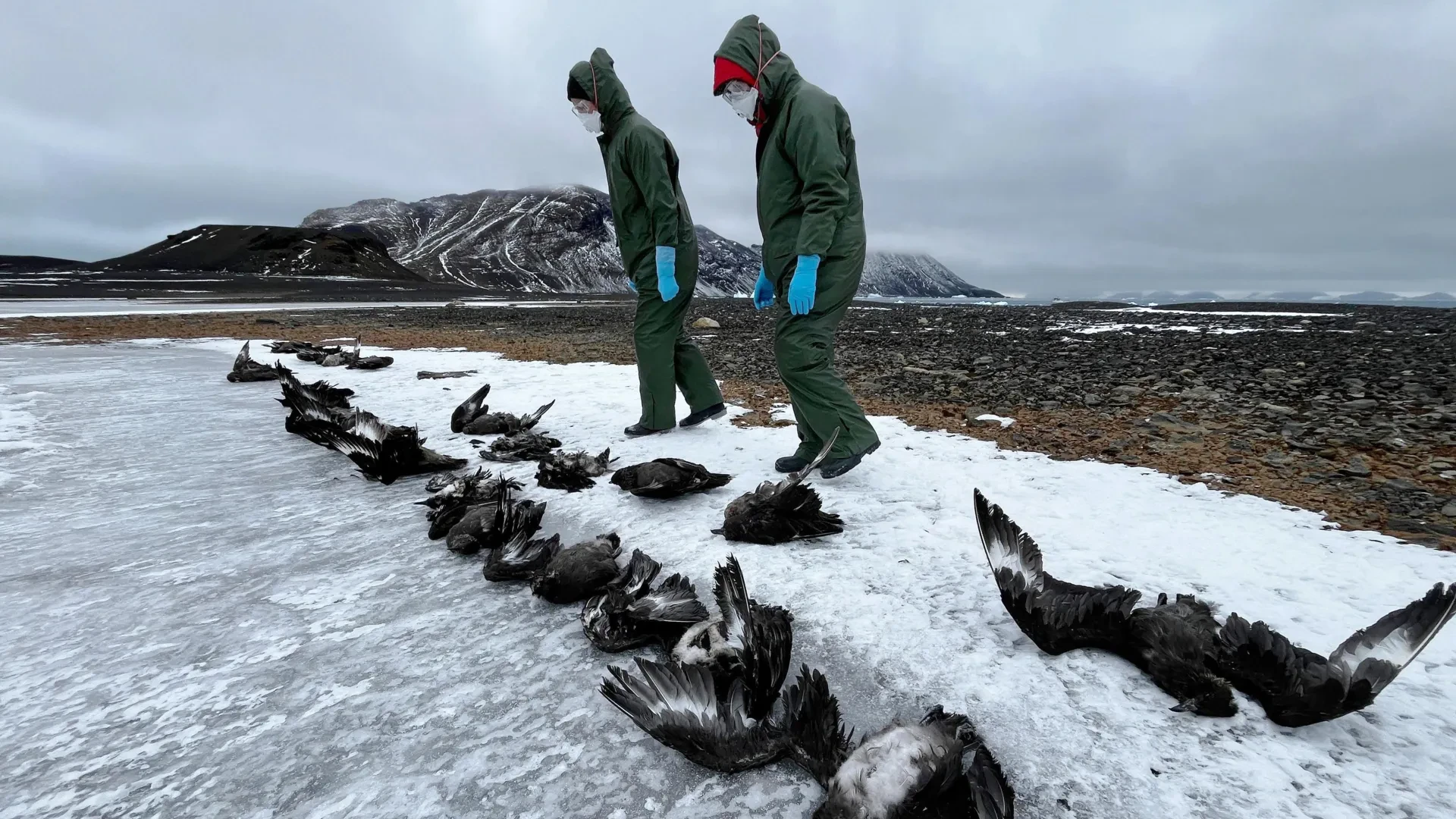
The researchers confirmed positive H5N1 mortalities across three key locations: Hope Bay, Devil Island, and Beak Island. Among these, Beak Island emerged as a chilling epicenter, exhibiting a massive, concentrated die-off of south polar skuas (Catharacta maccormicki).
"We diagnosed high pathogenicity avian influenza as the cause of death for nearly all of the dead skuas we found at Beak Island," stated lead author Matteo Iervolino, a Ph.D. candidate at Erasmus MC in Rotterdam. "There, I could really see with my eyes the impact this virus can have on these populations."
Supporting Context & Metrics: The Global Path of H5N1 and Ecological Vulnerability
The Pathogen’s Global Trail of Destruction
To understand the gravity of the Antarctic outbreak, one must trace the evolutionary and geographical trajectory of the H5N1 lineage. The blueprint of this crisis was drafted nearly three decades ago, in 1996, when a virulent strain of H5N1 was first isolated on a domestic goose farm in Southeast China.
For years, the virus simmered largely unchecked within intensive poultry production systems. Eventually, it breached the barrier between domestic agriculture and wild bird flyways. From that pivotal juncture, the virus demonstrated a terrifying capacity for global expansion, leapfrogging across continents. It swept relentlessly through Europe, the Middle East, and Africa, subsequently infiltrating North and South America before finally breaching the natural oceanic moats surrounding Antarctica by early 2024.
The statistical footprint of this panzootic is staggering:
- Poultry Losses: More than 400 million domestic birds have perished or been culled worldwide.
- Mammalian Spillover: The virus has broken species barriers with alarming frequency, infecting dairy cows, mink, foxes, bears, otters, elephant seals, and sea lions. Notably, the exact same strain currently plaguing Antarctic skuas was previously responsible for catastrophic mortality events among elephant seals and sea lions along the coast of Argentina.
- Human Impact: While primarily an animal pathogen, H5N1 is zoonotic. Of the approximately 1,000 documented human cases globally, roughly 50% have resulted in fatalities, underscoring the persistent, underlying public health risk.
Why Skuas? The Ecological Role and Risk Factors
Skuas are formidable seabirds belonging to the family Stercorariidae, sharing a close evolutionary lineage with gulls. Often described as the raptors of the marine world, they are aggressive predators and scavengers. They hunt other seabird chicks, steal food from gulls and terns, and eagerly feed upon the carcasses of marine mammals and penguins.
It is precisely this scavenging lifestyle that acts as their Achilles’ heel in the face of an avian influenza outbreak. By consuming the flesh of infected animals—such as marine mammals that succumbed to the virus on Argentine beaches or infected penguin carcasses—skuas ingest massive viral loads directly. Furthermore, their migratory behaviors and congregatory breeding habits facilitate the rapid transmission of the virus from individual to individual, turning local colonies into amplification hubs.
A Landscape of Compounding Pressures
The arrival of H5N1 does not occur in a vacuum. Antarctic wildlife is already grappling with an unprecedented convergence of systemic environmental stressors:
- Climate Change: Rapid warming along the Antarctic Peninsula is drastically altering sea ice dynamics, destabilizing food webs, and reducing available habitat for ice-dependent species.
- Tourism and Human Activity: A booming polar tourism industry increases the risk of anthropogenic disturbance and accidental pathogen transport.
- Invasive Species and Pollution: Microplastics, chemical pollutants, and invasive flora and fauna continue to degrade fragile polar ecosystems.
Overlaying avian influenza onto this stressed baseline creates a compounding crisis. Without robust institutional responses, the compounding effect of these pressures could push vulnerable local populations past their ecological tipping points.
Official Statements and Expert Analysis
The findings published in Scientific Reports have elicited grave concerns from the international scientific community, prompting leading researchers to reflect on regulatory failures, epidemiological realities, and the ethics of conservation monitoring.
Reflecting on the clinical presentation of the virus in the field, Dr. Ralph Vanstreels described a harrowing scene: "It’s a crisis in animal suffering."
H5N1 is a neurotropic virus in its advanced stages, aggressively attacking the central nervous system. Infected skuas exhibit acute neurological symptoms, including torticollis (twisted necks), erratic body stretching, and profound loss of coordination. Afflicted birds are frequently observed walking or swimming in tight circles, blindly crashing into physical obstacles, or dropping mid-flight due to sudden paralysis or disorientation.
The structural failure of global biosecurity in containing the virus in its infancy was a central theme emphasized by senior corresponding author Professor Thijs Kuiken of Erasmus MC.
"We let the virus slip out through our fingers when it first emerged in the poultry industry," Kuiken asserted bluntly. "Once it got into wild bird populations, we lost the ability to control this virus. Now it’s established in wild bird populations in all the continental regions of the world except Oceania."
Kuiken’s assessment highlights a harsh ecological truth: humanity has transitioned from an era of containment to an era of mitigation and observation. Because the virus is now entrenched in migratory wild bird populations spanning the globe, eradication is no longer a viable scientific prospect. Instead, the focus must pivot entirely toward understanding transmission dynamics, protecting highly endangered species, and minimizing further anthropogenic acceleration of the disease.
Future Outlook: The Urgent Call for Polar Surveillance
As the scientific community digests the sobering implications of the Erasmus MC and UC Davis study, attention is turning toward the future of Antarctic conservation management. The researchers emphasize that human activity—which catalyzed the initial global spread of the virus through intensive farming and international trade—remains the single most effective variable we can manipulate to limit its ongoing distribution. Strict biosecurity protocols for researchers, field stations, and commercial tour operators entering the Antarctic Treaty area are more critical now than ever before.
However, a glaring data gap threatens to undermine these conservation efforts.
"Everything points toward this virus spreading further," warned Professor Kuiken. "If nobody is watching, we won’t know what is happening."
A major impediment to accurately quantifying the ecological damage of H5N1 in Antarctica is the severe obsolescence of baseline population data. The last comprehensive census of Antarctic skuas was conducted in the 1980s, at which time researchers estimated a total population of approximately 800 breeding pairs. In the four decades since that baseline was established, climate shifts, changing marine food availability, and now viral pathogens have reshaped polar ecosystems. Without contemporary, high-resolution population censuses, wildlife managers are operating blind, unable to definitively calculate whether the loss of 50 birds represents a minor demographic dip or a catastrophic hit to localized gene pools.
To address these vulnerabilities, the study’s authors and allied polar researchers are issuing a unified call to action:
- Expanded Surveillance Networks: Establish systematic, continent-wide monitoring programs to rapidly detect, sample, and sequence H5N1 strains as they emerge in new colonies or species.
- Updated Population Censuses: Invest in modern ecological surveys to establish accurate baseline numbers for skuas, petrels, penguins, and other high-risk Antarctic avian species.
- Strict Biosecurity Enforcement: Enforce rigorous decontamination protocols for all personnel, equipment, and vessels moving between different Antarctic field sites to prevent human-mediated viral transfer.
- Interdisciplinary Collaboration: Foster deeper partnerships between virologists, wildlife veterinarians, climatologists, and tourism bodies—exemplified by the support provided to this expedition by the International Association of Antarctica Tour Operators (IAATO), Ocean Expeditions, the European Union, and Spain’s Consejo Superior de Investigaciones Científicas (CSIC).
The confirmation of H5N1-driven mortality in Antarctic skuas serves as a stark reminder that no ecosystem on Earth remains untouched by the consequences of global interconnectedness. As the white continent faces this unprecedented biological frontier, the imperative for vigilance, funding, and proactive international cooperation has never been more urgent.