
Executive Overview
For decades, the domestic cat tree has served as an essential household fixture, balancing the fine line between feline behavioral enrichment and the preservation of human living room furniture. Originally patented in 1968 to deter indoor cats from clawing expensive draperies and upholstery, these vertical architectures have evolved from simple carpet-wrapped posts into sophisticated, design-forward modular systems. Today, pet behavioral experts agree that a quality cat tree is just as fundamental to a cat’s well-being as a clean litter box.
Vertical spaces provide indoor cats with a deep-seated sense of security, territorial autonomy, and vital physical exercise. In multi-cat households—or environments shared with energetic dogs and young children—these elevated retreats can entirely eliminate household friction, reducing stress-induced medical issues such as feline lower urinary tract disease.
To help pet owners navigate the crowded marketplace of over 65 evaluated models, our testing team enlisted 19 feline testers across six distinct homes, putting 17 top cat trees through rigorous stability trials, stain-resistance challenges, and everyday durability assessments. Whether you are looking for a heavy-duty option for large Maine Coons, a renter-friendly floor-to-ceiling tension pole, or an upscale architectural showpiece, this comprehensive guide covers the best cat trees available today.
Detailed Chronology: From 1968 Patents to Modern Feline Architecture
The Genesis of Feline Verticality
The foundational concept of the modern cat tree dates back to a 1968 United States patent designed specifically to mitigate the destructive natural behaviors of indoor felines. Before this invention, indoor cats lacked appropriate designated surfaces to satisfy their innate urges to stretch, scratch, and seek high vantage points. The earliest iteration offered a floor-to-ceiling column that simultaneously provided a scratching medium and a vertical climbing route.
Over the ensuing decades, manufacturers transformed these rudimentary carpeted posts into complex multi-level structures. However, the core philosophy has remained entirely intact: vertical territory is non-negotiable for domestic felines. According to Adi Hovav, senior feline behavior counselor at the ASPCA, a cat tree addresses fundamental physical and psychological imperatives.
Modern Behavioral Impact
The psychological implications of vertical space are profound. Dr. Mikel Delgado, a certified applied animal behaviorist and cat behavior consultant, emphasizes that elevation is a primary currency of feline confidence.
"Cat trees can make or break relationships in multi-cat households, or homes where you have a cat and kids or a dog, by giving the cat the ability to stay out of reach of other creatures they might feel uncomfortable with," Dr. Delgado explains.
Furthermore, physical layout directly impacts internal health. A landmark 2017 study highlighted by Dr. Delgado revealed that cats deprived of adequate vertical territory faced a measurably increased risk of stress-related urinary tract disorders. By integrating cat trees into strategic household locations—most notably sun-drenched windows for bird-watching—owners can drastically reduce household tension and enrich their pets’ daily lives.
Comprehensive Testing Protocols & Metrics
To separate durable investments from flimsy, short-lived novelties, our testing methodology utilized strict evaluation criteria under real-world conditions.
The Testing Cohort
Our evaluation spanned two distinct phases:
- Initial Safety Screening: Every model was assembled and evaluated in a controlled home environment for one week to assess foundational safety, structural integrity, and out-of-box quality.
- Real-World Feline Testing: Surviving models were distributed across multiple homes, including an active foster environment housing nearly a dozen cats ranging from 6 months to 11 years old, and weighing anywhere from 4 to 22 pounds. Several participating feline testers were partially or fully blind, testing the accessibility and intuitive design of each tree.
Core Evaluation Metrics
- Stability: Evaluated using an 18-pound bag of rice dropped repeatedly onto platforms to measure sway, sliding, and displacement. We also checked for included wall-anchoring hardware.
- Material Quality: Assessed the caliber of wood, cardboard cores, faux fur, organic cotton, and scratching wraps (sisal, jute, or hemp) relative to the retail price point.
- Ease of Cleaning: Subjected fabric components to simulated cat vomit (blended cat food) to test spot-cleaning efficacy, alongside machine-washability assessments for removable cushions.
- Assembly Complexity: Recorded total build times, clarity of instructions, and hardware sufficiency.
- Ergonomics & Spacing: Measured vertical distances between tiers. Dr. Delgado recommends an ideal spacing of 8 to 12 inches to accommodate aging or low-mobility cats.
- Modularity & Repairability: Prioritized brands offering replaceable scratching surfaces, modular expansion capabilities, and robust product warranties.
Top-Tier Product Recommendations
1. Top Pick: New Cat Condos Large Cat Tree for Multiple Cats
- Cat Weight Limit: Up to 20 lbs
- Max Weight Capacity: 80 lbs
- Dimensions: 64 x 24 x 24 inches (HWD)
Why it stands out: While it may not win architectural design awards, this 65-inch powerhouse is built by a company with over four decades of dedicated manufacturing experience. Its solid wood support posts (contrasting sharply with the hollow cardboard cores used by competitors) ensure long-term durability. Assembly takes under five minutes, requiring little more than twisting posts and perches into place.
Real-world performance: Reviewers noted that its sturdy frame accommodates massive breeds like Maine Coons with ease. Notably, homes with special-needs cats reported incredible success; fully blind feline testers Gulliver and Clover navigated effortlessly to the topmost perches without hesitation.
- Minor Flaws: Carpet shades can occasionally vary due to complex sourcing, and the tall profile lacks built-in wall straps out of the box (easily remedied by placing it flush against a wall).
2. Top Pick: Mau Cento
- Cat Weight Limit: Up to 23 lbs
- Dimensions: 45.5 x 23.5 x 18 inches (HWD)
Why it stands out: For owners who despise traditional carpeted boxes, the Mau Cento offers a stunning, nature-inspired alternative. Utilizing real tree branches as structural posts wrapped in thick jute rope, it blends seamlessly into modern home decor. It features durable woven paper baskets over a metal frame and high-grade polyester-acrylic cushions. Furthermore, Mau provides easily accessible replacement parts for long-term ownership.
- Minor Flaws: At around $300, it is pricey. The base is relatively compact, meaning it lacks an anchoring strap, and the manufacturer notably declined to participate in direct informational interviews regarding their supply chain.
3. Runner-Up: Easyego Modern Cat Tree
- Cat Weight Limit: Up to 28 lbs
- Dimensions: 45.6 x 35.5 x 16.5 inches (HWD)
Why it stands out: Sharing a natural-branch aesthetic similar to the Mau Cento at roughly half the price, the Easyego features an exceptionally wide 35.5-inch base that dramatically minimizes tipping risks. Its shorter tier distances make it exceptionally friendly for older or mobility-impaired cats, and its dual-sided cushion features a plush winter side alongside a smooth cooling surface.
- Minor Flaws: Natural pear-wood posts (2 to 2.5 inches in diameter) exhibited slight wobbling during intense play, and initial assembly produced mild faux-fur shedding.
4. Runner-Up: Tangkula Modern Cat Tree
- Cat Weight Limit: Up to 22 lbs (44 lbs max capacity)
- Dimensions: 41 x 17.5 x 17.5 inches (HWD)
Why it stands out: Despite a narrow 18-by-18-inch base, the Tangkula maintains impressive stability thanks to its diagonal pole distribution. It provides a neutral, unobtrusive aesthetic, rapid 10-minute assembly, and a budget-friendly price point.
- Minor Flaws: The water-hyacinth straw baskets proved irresistible to teething kittens, showing chewing wear after just one week. Top cushions are non-removable and require spot-cleaning.
5. Budget Pick: Feandrea 33.1-Inch Cat Tower
- Cat Weight Limit: Up to 16 lbs
- Dimensions: 33.1 x 23.6 x 15.7 inches (HWD)
Why it stands out: In a saturated market of cheap, cramped towers, the Feandrea stands out by incorporating wider cave openings (allowing large cats to enter comfortably without crunching up), anti-skid base feet, and a generous 22-inch top lounge perch capable of supporting two feline companions. It also includes an anchoring strap and machine-washable top cushioning.
- Minor Flaws: Built from standard particleboard and plush, the materials are serviceable for 1 to 2 years rather than a lifetime, and the top pillow insert feels thin without secondary foam padding.
6. Upgrade Pick: Purrsona Heritage Treehouse
- Cat Weight Limit: Up to 25 lbs (50 lbs max capacity)
- Dimensions: 56 x 24 x 31 inches (HWD)
Why it stands out: Hand-finished in small batches by Amish furniture makers in Ohio, the Purrsona Heritage Treehouse is constructed from solid maple wood, organic cotton twill/sherpa fabrics, natural latex foam, and wool felt. Backed by a lifetime warranty on the wooden frame, it functions as genuine heirloom-quality furniture.
- Minor Flaws: It commands a premium luxury price tag, and online photography for the Smoked Maple finish appears significantly warmer than the actual gray-toned wood in person.
7. Best for Less-Mobile Cats: EliteField 40-in Faux Fur Cat Tree
- Cat Weight Limit: Up to 20 lbs
- Dimensions: 39.5 x 20 x 20 inches (HWD)
Why it stands out: Designed with fanned steps featuring only 8 inches of vertical rise, this tower allows senior or physically limited cats to climb gracefully without dangerous leaps. The multi-tiered steps also double as active communal lounging benches.
- Minor Flaws: Faux fur and sisal components shed heavily during initial unboxing before stabilizing.
8. Best for Camouflaging: 4 Cats N Dogs Clifford Cat Tree Bookshelf
- Cat Weight Limit: Up to 30 lbs
- Dimensions: 68.75 x 36 x 15 inches (HWD)
Why it stands out: Disguised as a modern wooden bookcase that blends seamlessly with standard office shelving (such as IKEA Billy units), the Clifford features curved cutouts and dual cubbies. Its heavy engineered wood, adjustable metal leveling feet, and optional washable Maine Mats make it a durable, highly stable sanctuary.
- Minor Flaws: Weighing 93 pounds, it is exceptionally heavy and requires roughly 80 minutes to assemble. Bare wood shelves require purchasing soft adhesive pads for feline traction.
9. Best for Color: Vetreska Chroma Cat Climber
- Cat Weight Limit: Up to 22 lbs
- Dimensions: 48.4 x 22 x 22 inches (HWD)
Why it stands out: Featuring a bold primary color scheme (red, yellow, blue, green) and bouclé-adjacent teddy-fleece fabric, this climber makes an artistic statement. Sisal-wrapped posts and foam-padded platforms provide superior lounging comfort.
- Minor Flaws: The top enclosed cave is quite compact, limiting use to smaller cats under 10 pounds, and the upper structure exhibits moderate wobble during aggressive jumping.
10. Best for Customization: Omlet Freestyle Cat Tree
- Cat Weight Limit: Up to 65 lbs
- Height: Up to 14.4 feet maximum
Why it stands out: The Omlet Freestyle is the ultimate modular vertical playground. Built with an aluminum core and bamboo platforms, it anchors securely to ceilings and walls, offering endless accessory configurations (hammocks, ramps, tents) that can support massive weight loads and multiple active cats simultaneously.
- Minor Flaws: Assembly is complex, requiring ceiling drilling and roughly 30 minutes per pole, and a fully accessorized multi-pole setup can easily exceed $1,500.
11. Best for Renters: Katpole
- Cat Weight Limit: Up to 30 lbs
- Height: Up to 10.33 feet maximum
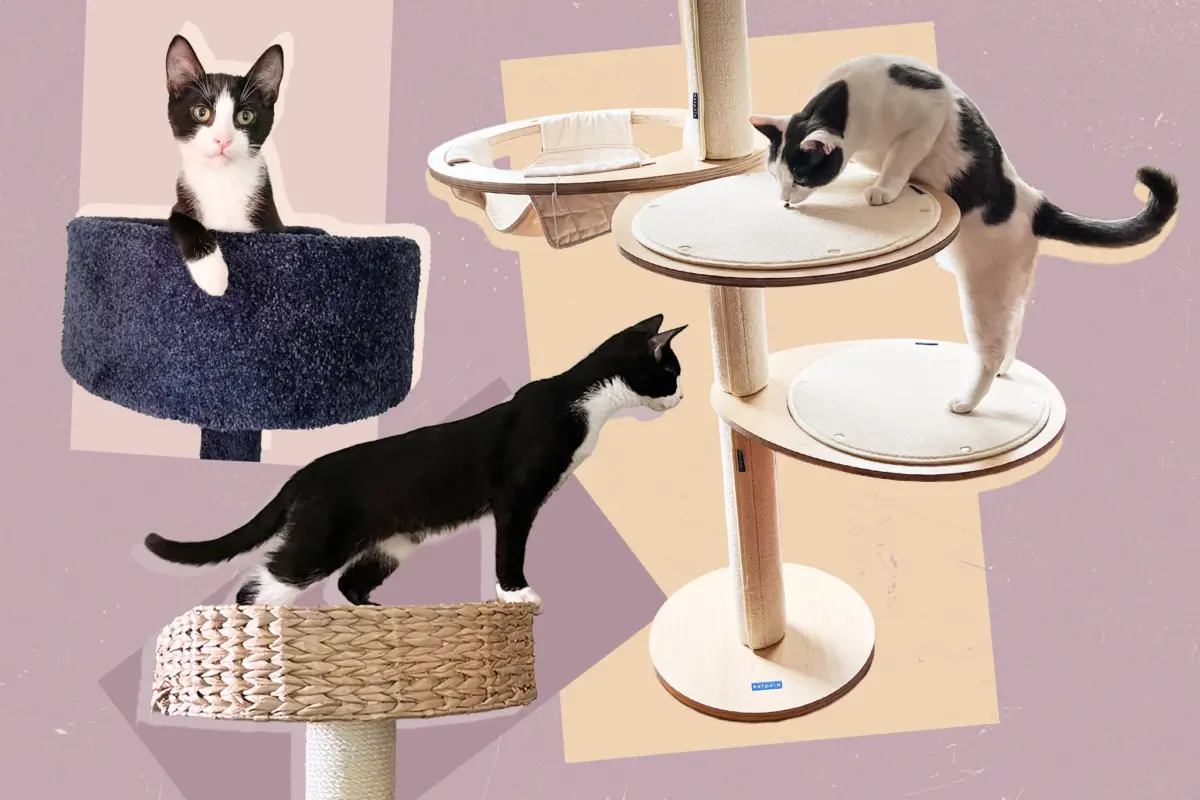
Why it stands out: Canadian-engineered and backed by a 10-year warranty, the Katpole utilizes tension-mounting between floors and ceilings, requiring zero drilling or wall damage. It is exceptionally stable, supports up to 10 feet 4 inches of height, and features replaceable carpet segments.
- Minor Flaws: Retailing around $900, it represents a substantial investment, and the pole carpets tend to show minor pilling and pulls under heavy scratching.
Comparative Specifications at a Glance
| Model Name | Primary Material | Max Cat Weight | Notable Advantage | Main Drawback |
|---|---|---|---|---|
| New Cat Condos Large | Solid Wood / Carpet | 20 lbs | Ultra-sturdy, great for big/blind cats | Varies in carpet color matching |
| Mau Cento | Real Wood Branches / Jute | 23 lbs | Stunning natural aesthetic | High price, small base |
| Easyego Modern | Natural Pear Wood / Fur | 28 lbs | Wide base, senior-friendly | Minor initial fur shedding |
| Tangkula Modern | Particleboard / Hyacinth | 22 lbs | Affordable, compact profile | Fragile basket straw (chewing risk) |
| Feandrea 33.1" | Particleboard / Plush | 16 lbs | Large cave doors, budget-friendly | Shorter structural lifespan |
| Purrsona Heritage | Solid Maple / Organic Cotton | 25 lbs | Amish handcrafted, lifetime warranty | Premium luxury pricing |
| EliteField 40" | Particleboard / Faux Fur | 20 lbs | Low-rise steps for mobility support | Initial shedding phase |
| 4 Cats N Dogs Clifford | Engineered Wood / Metal | 30 lbs | Bookcase camouflage design | Heavy (93 lbs), complex assembly |
| Vetreska Chroma | Particleboard / Fleece | 22 lbs | Bold primary colors, padded tiers | Small top cubby, slight wobble |
| Omlet Freestyle | Aluminum / Bamboo | 65 lbs | Endless modular customization | Requires ceiling drilling, costly |
| Katpole | Aluminum / Vinyl / Wood | 30 lbs | Renter-friendly tension mount | Premium pricing ($900+) |
Future Outlook: Trends in Feline Environmental Design
As pet humanization continues to drive consumer markets, the future of cat furniture is moving decisively away from disposable, carpet-wrapped cardboard eyesores and toward sustainable, architectural home decor. Manufacturers are increasingly prioritizing non-toxic materials, organic cottons, natural latex, and modular repairability—allowing owners to replace worn components rather than discarding an entire tree.
Furthermore, as urban living spaces become more compact, vertical integration will remain paramount. Whether opting for renter-friendly tension systems like the Katpole or fully customizable architectural installations like the Omlet Freestyle, investing in high-quality vertical territory is a proven methodology for ensuring long-term feline health, behavioral harmony, and household tranquility.