
Fact-checked by Kenn Kaufman, Field Editor, Audubon Magazine
Executive Overview
When bird enthusiasts picture the diverse avifauna of North America, a palette of earthy browns, striking yellows, brilliant blues, and crisp blacks and whites typically comes to mind. True pink plumage remains remarkably scarce across the continent. Even when applying a generous definition of pink—accounting for rare vagrants, fleeting seasonal coloration, and minimal plumage highlights—fewer than a dozen species proudly display this captivating hue.
Yet, what these birds lack in sheer numbers, they make up for in ecological wonder, evolutionary adaptation, and aesthetic brilliance. At the pinnacle of this vibrant spectrum stand two iconic wetland waders: the Roseate Spoonbill and the American Flamingo. However, they are far from alone. North America’s roster of pink birds also includes sought-after montane finches, beloved backyard feeder visitors, and a dazzling trio of hummingbirds whose iridescent gorgets flash with electric intensity.
The biological mechanisms behind these shades are as varied as the species themselves. For waders like the flamingo and spoonbill, the vividness of their pink and rose hues is entirely diet-dependent, rooted in the ingestion of carotenoid-rich organisms. For hummingbirds, structural coloration—specifically microscopic, pancake-like structures within their feathers—refracts light to create breathtaking pink iridescence. Among finches, soft pinks and deep maroons are governed at the genomic level.
This comprehensive survey explores the taxonomy, distribution, behavioral ecology, and conservation status of North America’s rare pink avians, providing birders with the insights needed to locate, identify, and attract these remarkable species.
Detailed Chronology & Ecological Context: The Anatomy of Pink Plumage
Understanding why North American birds wear pink requires an exploration of three distinct biological pathways: dietary accumulation, structural optics, and genetic expression.
The Carotenoid Pathway: Waders and Their Diet
The vibrant pinks of the American Flamingo (Phoenicopterus ruber) and the Roseate Spoonbill (Platalea ajaja) do not originate within their own genetic codes. Instead, these birds are what they eat. Carotenoids are naturally occurring organic pigments—primarily reds, oranges, and yellows—synthesized by plants, algae, and certain fungi.
In wetland ecosystems, microscopic algae produce carotenoids. These pigments are consumed by brine shrimp, crabs, crayfish, and small schooling fish. When flamingos and spoonbills prey upon these aquatic animals, their digestive systems break down the pigments, depositing the fat-soluble molecules into their growing feathers and skin. A lack of a carotenoid-rich diet results in faded, washed-out plumage, underscoring how environmental health directly translates to avian vibrancy.
Structural Iridescence: The Hummingbird’s Prism
For Anna’s (Calypte anna), Calliope (Selasphorus calliope), and Broad-tailed (Selasphorus platycercus) hummingbirds, pink is an optical illusion rather than a pigment. The feathers of their gorgets (throat patches) and crowns contain microscopic, air-filled platelet structures—metaphorically described as "pancake" layers.
When sunlight strikes these structures at precise angles, light waves interfere with one another constructively, amplifying specific wavelengths of light. This phenomenon, known as structural coloration or iridescence, causes the feathers to shift from drab grey-brown to a piercing, electric magenta or rose-pink only when the bird catches the light just right.
Genomic Pigmentation: The Finch Family
Unlike waders and hummingbirds, North American finches—such as the Purple Finch (Haemorhous purpureus), Cassin’s Finch (Haemorhous cassinii), and the high-altitude rosy-finches—owe their reddish-pink hues to metabolic processing of dietary carotenoids managed by their genetic architecture. These species ingest precursors in seeds and buds, which their bodies chemically convert into specific red and pink keto-carotenoids deposited during the annual molt.
Taxonomic Profiles: Telling Apart American Flamingos and Roseate Spoonbills
Two of North America’s most recognizable pink waders share similar habitats along the southern tier of the United States, yet they belong to entirely different taxonomic families and utilize divergent foraging strategies.
American Flamingo (Phoenicopterus ruber)
Historically, popular consensus held that flamingos were merely exotic escapees or rare vagrants in the United States, with no stable, native breeding population in Florida. However, recent ecological shifts are challenging this assumption. Hurricanes frequently displace wild birds from Caribbean populations, blowing them northward into the Sunshine State, where some individuals take up permanent residency and show signs of establishing colonies in the Everglades.
- Physical Characteristics: The American Flamingo stands out as one of only two long-legged pink waders in the U.S. It boasts an entirely pink body, long neck, and a heavy, sharply curved bill tipped in black.
- Foraging Mechanics: Flamingos utilize "inverted foraging." By turning their specialized, filter-feeding bills upside down in the water column, they pump water through lamellae to strain out microscopic plants, insects, and crustaceans.
Roseate Spoonbill (Platalea ajaja)
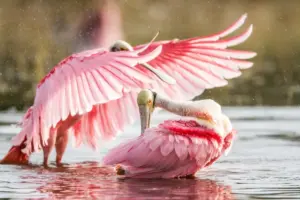
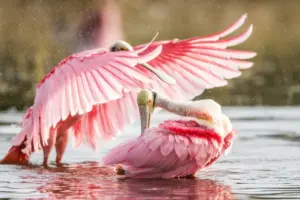
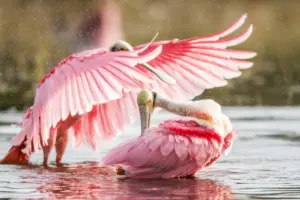
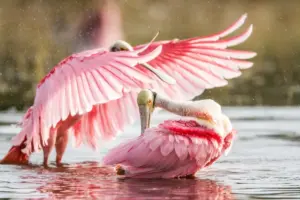
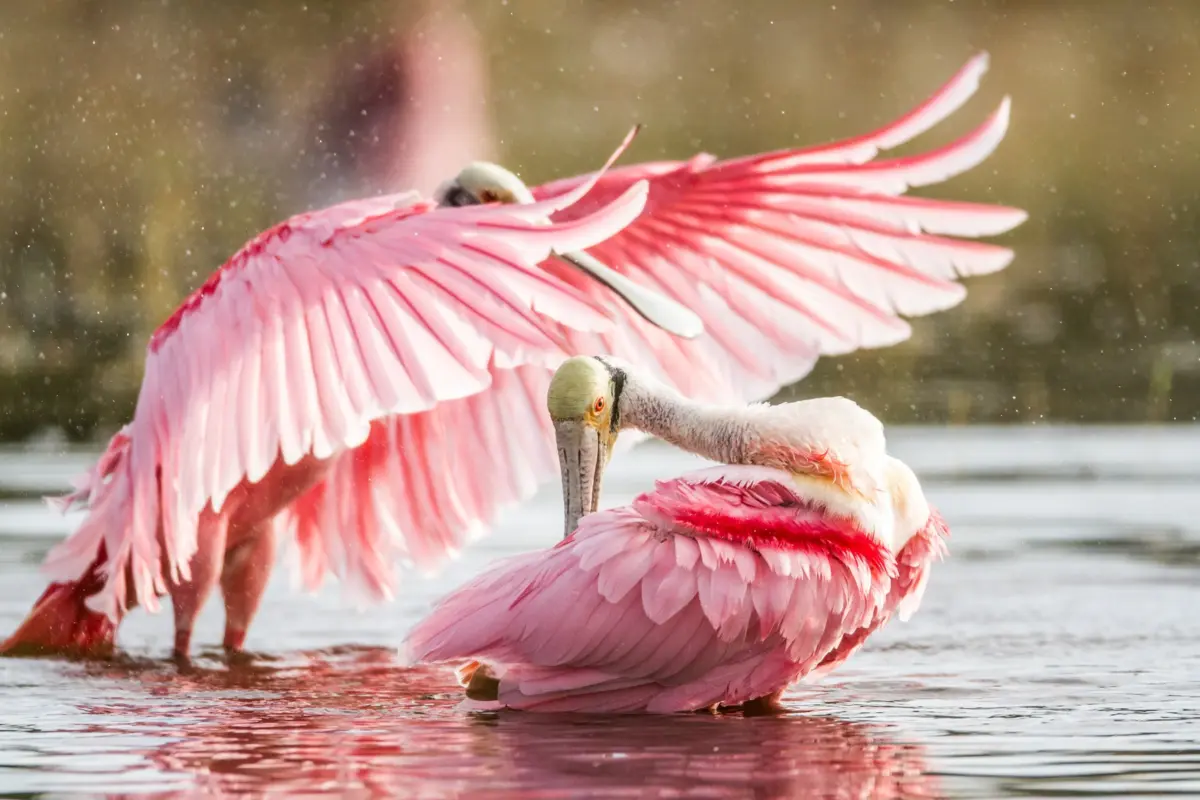
While far from abundant, the Roseate Spoonbill is considerably more common than the flamingo, maintaining healthy, year-round populations along the Gulf Coast and southern Florida.
- Physical Characteristics: From a distance, a flying spoonbill can easily be mistaken for a flamingo. However, its distinctive, spatula-shaped bill instantly gives it away. Spoonbills feature a white neck, a greenish, unfeathered head, and rosy-pink wings and underparts. Recent years have seen a notable northward range expansion, with breeding populations pushing deeper into temperate zones.
- Foraging Mechanics: Spoonbills wade through coastal shallows, estuaries, and mudflats, sweeping their sensor-rimmed bills back and forth in wide arcs. Their mandibles are packed with specialized nerve endings that instantly detect the tactile vibrations of small fish and aquatic invertebrates.
Supporting Context & Metrics: Common and Rare Pink Birds
Beyond the iconic waders, North America hosts a curated selection of pink songbirds, finches, and hummingbirds.
Common Backyard and Garden Visitors
- Anna’s Hummingbird: Resident year-round along the West Coast and extending into southern Arizona. Males exhibit an electric pink crown and gorget that gleams aggressively when displaying.
- Calliope Hummingbird: North America’s smallest breeding bird. The male sports a patchy, jagged gorget that flares outward, flashing magenta and rose. Their summer range spans the Intermountain West, Pacific Northwest, and western Canada.
- Broad-tailed Hummingbird: A signature species of high-elevation mountain meadows and pine forests across the American West. Males possess a rose-pink gorget and emit a distinct, metallic buzzing sound with their wings during flight.
- Purple Finch: Despite its moniker, the male’s plumage ranges from deep crimson to soft rose-pink. Breeding primarily in Canada’s boreal forests, they irrupt southward in winter, delighting backyard birders across the East and West Coasts.
- Cassin’s Finch: A nomadic conifer specialist of the high western mountains. Males feature a soft pink breast and face, capped by a bright crimson crown.
Elusive Montane Specialties: The Rosy-Finches
For dedicated birders, the three North American rosy-finches represent the ultimate "grail species"—requiring rugged expeditions into extreme high-altitude environments.
- Black Rosy-Finch: A rare resident of the Great Basin’s highest peaks. The male features a striking contrast of black, brown, and gray body plumage underscored by bold, frosted pink highlights on the wings and belly.
- Brown-capped Rosy-Finch: Highly localized to the jagged alpine zones of the Rocky Mountains, ranging from Wyoming to New Mexico. It exhibits warmer brown tones and a softer pink hue than its black counterpart.
- Gray-crowned Rosy-Finch: The most widespread of the three rosy-finches, breeding from western Alaska down to California and Montana, wintering throughout the Intermountain West.
Official Guidelines: Where to Find and How to Attract Pink Birds
Observing North America’s pink avians requires precise geographic targeting and seasonal awareness.
Prime Field Locations
- Roseate Spoonbills: Target reliable Gulf Coast refuges, such as Florida’s J.N. "Ding" Darling National Wildlife Refuge or Texas’s Smith Oaks Rookery.
- Hummingbirds: Mountain trails throughout the West during spring and summer offer prime viewing for Broad-tailed and Calliope hummingbirds. Pacific Coast parks and gardens host Anna’s Hummingbirds year-round.
- American Flamingos: Everglades National Park, Biscayne Bay, and the Florida Keys remain the most reliable zones for spotting wild vagrants.
- Rosy-Finches: To check off all three rosy-finch species in a single afternoon, intrepid birders journey to Sandia Crest, New Mexico—recognized as the only location in North America where Black, Brown-capped, and Gray-crowned Rosy-Finches regularly congregate at winter feeding stations.
Backyard Habitat Enhancement
Attracting pink birds to residential properties depends entirely on geographic location and resource provision:
- For Hummingbirds: Install standard nectar feeders filled with a strict 4-to-1 ratio of water to refined white sugar (avoiding red dyes or honey). Plant native tubular flowers such as penstemons, salvias, and columbines.
- For Finches: Deploy platform or tube feeders stocked with high-grade black oil sunflower seeds and safflower seeds, which are favored by Purple and Cassin’s Finches.
Future Outlook: Conservation Challenges and Climate Pressures
The long-term viability of North America’s pink bird populations faces complex environmental pressures. Wetland-dependent species like the Roseate Spoonbill and American Flamingo serve as critical bio-indicators for ecosystem health in the Greater Everglades and Gulf Coast estuaries. Restoration initiatives, such as the Comprehensive Everglades Restoration Plan (CERP), are vital for securing the shallow hydrological cycles these waders require for successful foraging and breeding.
Meanwhile, high-altitude specialists like the rosy-finches and montane hummingbirds face mounting threats from global climate change. As warming temperatures shift alpine treelines upward, the fragile tundra and talus slope habitats utilized by rosy-finches are shrinking. Conservation biologists emphasize the necessity of continuous monitoring via citizen-science platforms like eBird to track shifting distribution ranges and ensure targeted protections for these irreplaceable avian treasures.