
Executive Overview
For generations, paleontologists and evolutionary biologists have wrestled with one of the most persistent enigmas in natural history: the apparent sudden explosion of animal life leading up to the Cambrian Period. While the sudden diversification of complex life forms between 539 and 487 million years ago is well-documented in the geological record, scientists have long suspected that the rootstock of the animal kingdom—Metazoa—must stretch much further back in time.
However, attempts to pin down an exact genesis date have continually collided with a frustrating absence of physical proof. Scientists have traditionally relied upon the negative evidence of exceptional fossil deposits—sites where microscopic organisms are preserved in breathtaking, cellular detail—to draw hard lines on the timeline of evolution. If a deposit is remarkably well-preserved yet completely devoid of animal remains, conventional scientific consensus dictated that animals simply could not have existed when those rocks were laid down.
Now, a groundbreaking study published on October 2 in Science Advances shatters this foundational assumption. Led by an international team of researchers from the University of Oxford, alongside colleagues from the University of California Berkeley, ETH Zürich, and Yale University, the new research reveals that the absence of animal fossils in ancient deposits does not mean animals were absent from the Earth.
By analyzing exquisitely preserved microfossils from the Kheseen Biota in Mongolia, the research team demonstrated that environments capable of preserving delicate biological structures can completely fail to capture animal remains, even during eras when we know animals were definitively flourishing elsewhere on the planet. This revelation dismantles a primary constraint used to date the origin of animals. When the researchers recalibrated their evolutionary models using older geological baselines, the estimated birth date of the animal kingdom was pushed backward by an astonishing 200 million years.
This profound recalibration places the possible origin of animal life deep in the Neoproterozoic Era—somewhere between 800 and 700 million years ago. If validated, this timeline suggests that Earth’s earliest animals may have evolved before, or even survived through, some of the most cataclysmic global ice ages in planetary history: the "Snowball Earth" events of the Cryogenian Period.
Detailed Chronology: From the Weng’an Biota to the Kheseen Discovery
To understand the magnitude of the new study, one must trace the methodological journey that led paleobiologists to rethink the fossil record. The scientific debate centers heavily on how researchers interpret "Lagerstätten"—rare, fossil-rich sedimentary deposits that preserve soft tissues and microscopic organisms with extraordinary fidelity.
The Weng’an Biota Assumption
For years, the anchor of maximum age estimates for animal life has been the Weng’an Biota in South China. Formed roughly 590 million years ago during the Ediacaran Period, the Weng’an deposits contain an astonishing array of microscopic organisms, including algae, bacteria, and mysterious spherical structures preserved down to the cellular and subcellular level.
Because the Weng’an Biota is so exquisitely preserved, paleobiologists reasoned that if animals—particularly microscopic, soft-bodied larvae or simple multicellular organisms—had existed at that time, they surely would have left a trace in the deposit. The total absence of definitive animal fossils in Weng’an was thus interpreted as a hard biological constraint: animals had not yet evolved 590 million years ago. This assumption created a ceiling, preventing molecular clock models from pushing the origin of animals back beyond the late Ediacaran.
Putting the Assumption to the Test in Mongolia
To test whether exceptionally preserved microfossils are truly reliable proxies for the absence of animal life, the international research team turned their attention to the Kheseen Biota in Mongolia.
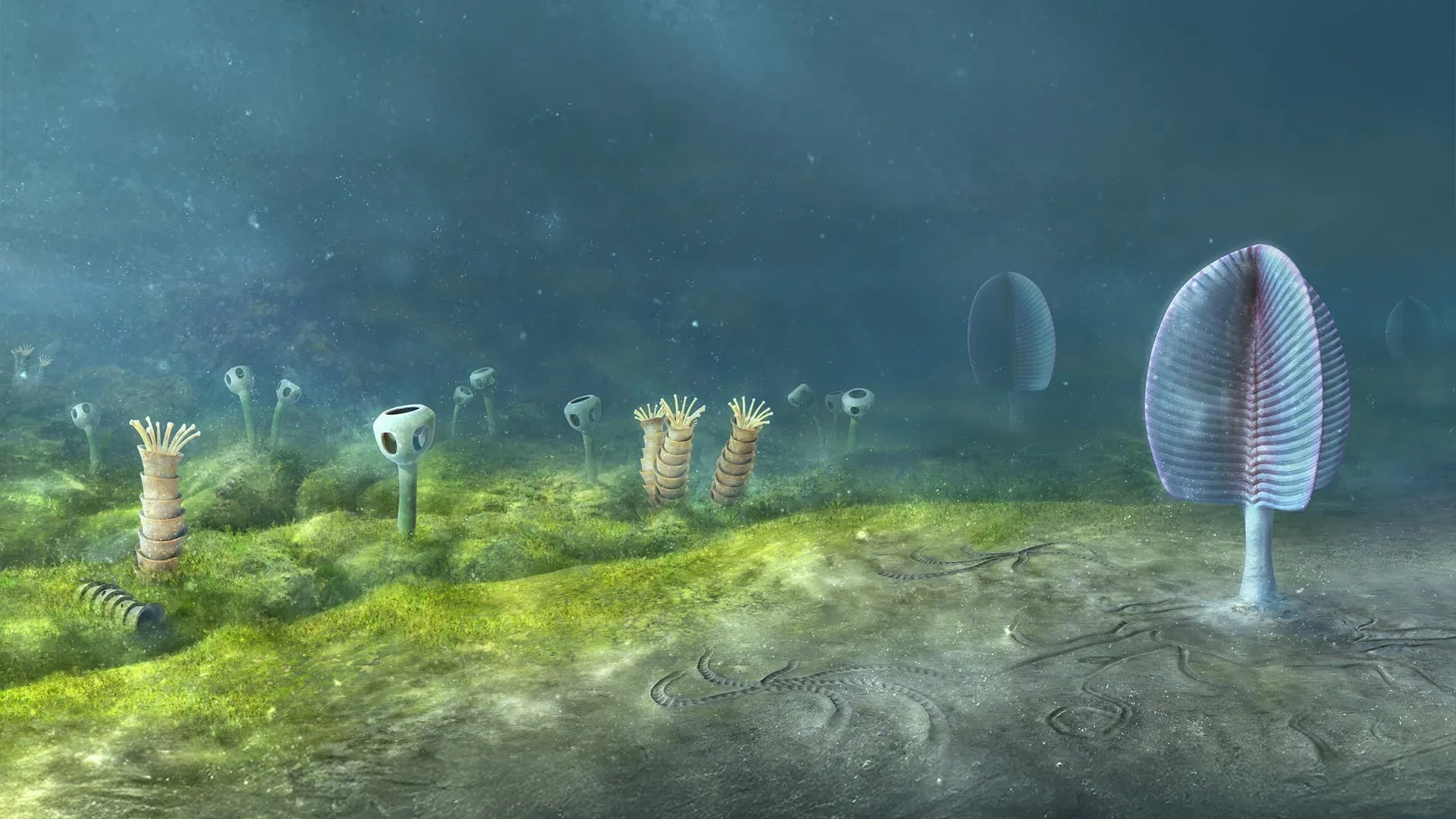
The Kheseen Biota is roughly 40 million younger than the Weng’an Biota, placing it later in the Ediacaran timeline. Crucially, paleontologists already possess definitive, global proof that animals existed in various marine environments worldwide by the time the Kheseen deposits formed, with well-documented fossil sites in places like Namibia and South China yielding undisputed animal remains.
The research team collected and analyzed more than 140 rock samples from the Kheseen Biota, including materials gathered from previously undocumented stratigraphic locations. Utilizing advanced scanning electron microscopy (SEM), the team peered into the microscopic architecture of the rocks. They uncovered a wealth of exceptionally preserved microfossil species, including intricate acritarchs—tiny spherical organisms adorned with delicate spines and branching projections—alongside fragile, embryo-like fossils featuring clearly preserved internal cell divisions.
Yet, despite this breathtaking preservation, not a single specimen could be confidently identified as an animal.
This discovery delivered a fatal blow to the traditional Weng’an assumption. As Senior Author Associate Professor Ross Anderson of the Oxford University Museum of Natural History noted, the Kheseen Biota completely breaks the old paradigm. If rocks can preserve delicate microfossils and embryo-like cells in pristine detail while still failing to capture animals that we know existed at the time, then the absence of animal fossils in older rocks tells us nothing about whether those animals were alive.
Recalibrating the Molecular Clock
With the Weng’an constraint invalidated, the research team was forced to look much further back in the geological record to establish maximum boundaries for animal evolution. They turned their attention to ancient, fossil-rich deposits dating from approximately 850 to 730 million years ago.
These older formations include:
- The Svanbergfjellet Formation in Norway
- The Bitter Springs Group in Australia
- The Chuar Group in Arizona, USA
All three of these geological formations are rich in microfossils and possess chemical and physical characteristics capable of exceptional preservation, yet none have yielded confirmed animal body fossils.
Using these older, pre-Ediacaran formations as constraints, the team performed a rigorous molecular clock analysis. Molecular clock techniques allow scientists to estimate when evolutionary lineages diverged by measuring the accumulation of genetic mutations among living species, integrating this data with known fossil calibration points and modeled rates of molecular evolution.
When the researchers substituted the younger Weng’an constraint with the older 850-to-730-million-year-old formations, the mathematical models responded dramatically. The estimated origin of the animal kingdom was pushed backward by approximately 200 million years, placing the emergence of the first animals squarely between 800 and 700 million years ago.
Supporting Context & Metrics
The implications of pushing the animal timeline back by two centuries of millions of years ripple across multiple disciplines, uniting paleontology, geochemistry, and evolutionary biology.
The Fragility of Early Life and Taphonomic Bias
Why did it take so long for animals to appear in the fossil record if they were walking, crawling, or floating in the oceans 800 million years ago? The answer lies in the harsh realities of taphonomy—the study of how organisms decay and become fossilized.
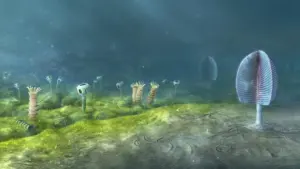
The earliest ancestral animals were overwhelmingly small, delicate, and entirely soft-bodied. Lacking mineralized skeletons, shells, teeth, or rigid collagenous structures, these primitive metazoans possessed an exceptionally low preservation potential. Unlike the trilobites and brachiopods that would later dominate the Cambrian seas, early soft-bodied organisms decomposed rapidly upon death. Their fossilization required an extraordinarily rare confluence of environmental factors:
- Rapid burial in fine-grained sediment to cut off oxygen and scavengers.
- Immediate geochemical authigenesis—where minerals rapidly replace organic tissues before decay completes.
- Specific microenvironmental water chemistry that prevents bacterial degradation.
Without this improbable lottery of preservation, entire ecosystems could thrive, diversify, and vanish from the rock record without leaving a single structural trace.
Chemical Fossils and Biomarkers
While physical body fossils from the pre-Ediacaran era remain elusive, indirect evidence has long whispered of a deeper biological history. Geochemists studying ancient sedimentary rocks have identified specific organic molecules known as biomarkers, or chemical fossils.
Lipids and other resilient organic compounds synthesized exclusively by certain biological groups—such as 24-isopropylcholestane, a lipid commonly associated with modern demosponges—have been extracted from rocks dating back at least 650 million years. These molecular signatures reside tens of millions of years beneath the oldest undisputed macroscopic animal fossils, hinting that sponge-grade organisms were quietly filtering the ancient oceans long before the first hard parts evolved.
The Shadow of "Snowball Earth"
Perhaps the most staggering consequence of an 800-to-700-million-year origin for animals is its intersection with the Cryogenian Period. Beginning roughly 720 million years ago, Earth experienced a series of extreme, globally extensive glaciation events colloquially known as "Snowball Earth," during which ice sheets advanced all the way to the equator, locking the planet in ice for tens of millions of years.
If the Oxford-led study’s molecular clock models are correct, it introduces two fascinating possibilities:
- Survival: Animal life had already originated prior to the onset of the Cryogenian ice ages and managed to survive through the most severe climatic bottlenecks in planetary history, likely finding refuge in equatorial open-water refugia, hydrothermal vent systems, or beneath thin, translucent sea-ice sheets.
- Innovation: The extreme environmental pressures and subsequent massive geochemical shifts associated with the thawing of Snowball Earth may have acted as an evolutionary catalyst, sparking the diversification and eventual fossilization of early animal lineages.
Official Statements from Key Researchers
The study’s authors have emphasized both the revolutionary nature of their findings and the cautious humility required when peering into the deep geological past.
Orin Lole Durbin, lead author of the study and a PhD student at Virginia Tech (who was an undergraduate at the University of Oxford when the research was conducted), reflected on the boundaries of the discovery:
"Pre-Ediacaran animal body fossils still elude us, and this analysis does not prove that animals existed 800 million years ago. However, our new fossil evidence from Mongolia undermines one of the main arguments for restricting animal origins to the Ediacaran interval. Meanwhile, our molecular-clock analyses show how much further back their evolutionary history could extend."
Associate Professor Ross Anderson, senior author of the study based at the Oxford University Museum of Natural History, underscored the shift in how paleontologists must view exceptional fossil deposits:
"The Kheseen Biota breaks the argument that the exceptional microfossils of Weng’an mean we would have seen animal fossils in the assemblage had they existed at the time. The Kheseen microfossils are just as well-preserved, yet animals continue to be absent—despite the fact we know at that point they existed."
Addressing the ongoing quest to pinpoint the exact moment animal life sparked into being, Professor Anderson added a note of caution:
"Until that evidence becomes available, the precise birth date of the animal kingdom remains uncertain."
Future Outlook: The Next Frontier in Paleobiology
As the scientific community digests the implications of the Science Advances publication, researchers are already mapping out the next phases of exploration. Resolving the true timeline of animal origins will require a multi-pronged scientific offensive that bridges gaps between field paleontology, molecular genetics, and analytical geochemistry.
1. Diversifying the Search Across Depositional Environments
Historically, paleontologists have focused their search for early life on specific, highly visible sedimentary basins. Future research must cast a much wider net, examining microfossil and macrofossil deposits from a diverse array of geographic locations, paleolatitudes, and ancient depositional environments—from deep-water marine settings to shallow coastal lagoons. By understanding how different environments preserve or destroy biological signals, scientists can construct a more comprehensive global picture of ancient ecosystems.
2. Triangulating Lines of Evidence
The future of evolutionary timing relies on an integrated, holistic approach. Scientists must no longer rely solely on body fossils or molecular clocks in isolation. Instead, modern paleobiology demands the seamless synthesis of:
- Animal Body Fossils: Continued field excavation in Ediacaran and pre-Ediacaran strata.
- Trace Fossils: The search for cryptic bioturbation, burrows, and tracks left by motile, soft-bodied organisms traversing ancient microbial mats.
- Chemostratigraphy and Biomarkers: High-resolution organic geochemical analyses tracking shifts in carbon, nitrogen, and sulfur isotopes alongside lipid biomarkers in ancient rocks.
3. Refining Molecular Clock Models
As genetic databases expand and analytical techniques become more sophisticated, molecular clock models will continue to undergo rigorous calibration. By integrating newly discovered fossil constraints and accounting for variable rates of genomic evolution across different phyla, geneticists can tighten the confidence intervals surrounding the birth of the metazoan tree of life.
Conclusion
The research led by the University of Oxford does not definitively prove that animals were swimming through Earth’s oceans 800 million years ago. What it achieves is far more disruptive: it removes the methodological barricade that told science they could not have been there. By proving that exceptional fossil preservation is entirely compatible with the complete absence of animal remains, the Kheseen Biota has forced a major paradigm shift.
As scientists return to the field armed with these new insights, the hidden history of Earth’s earliest animals—concealed for hundreds of millions of years in microscopic details and molecular whispers—is slowly beginning to come to light.