
Executive Overview
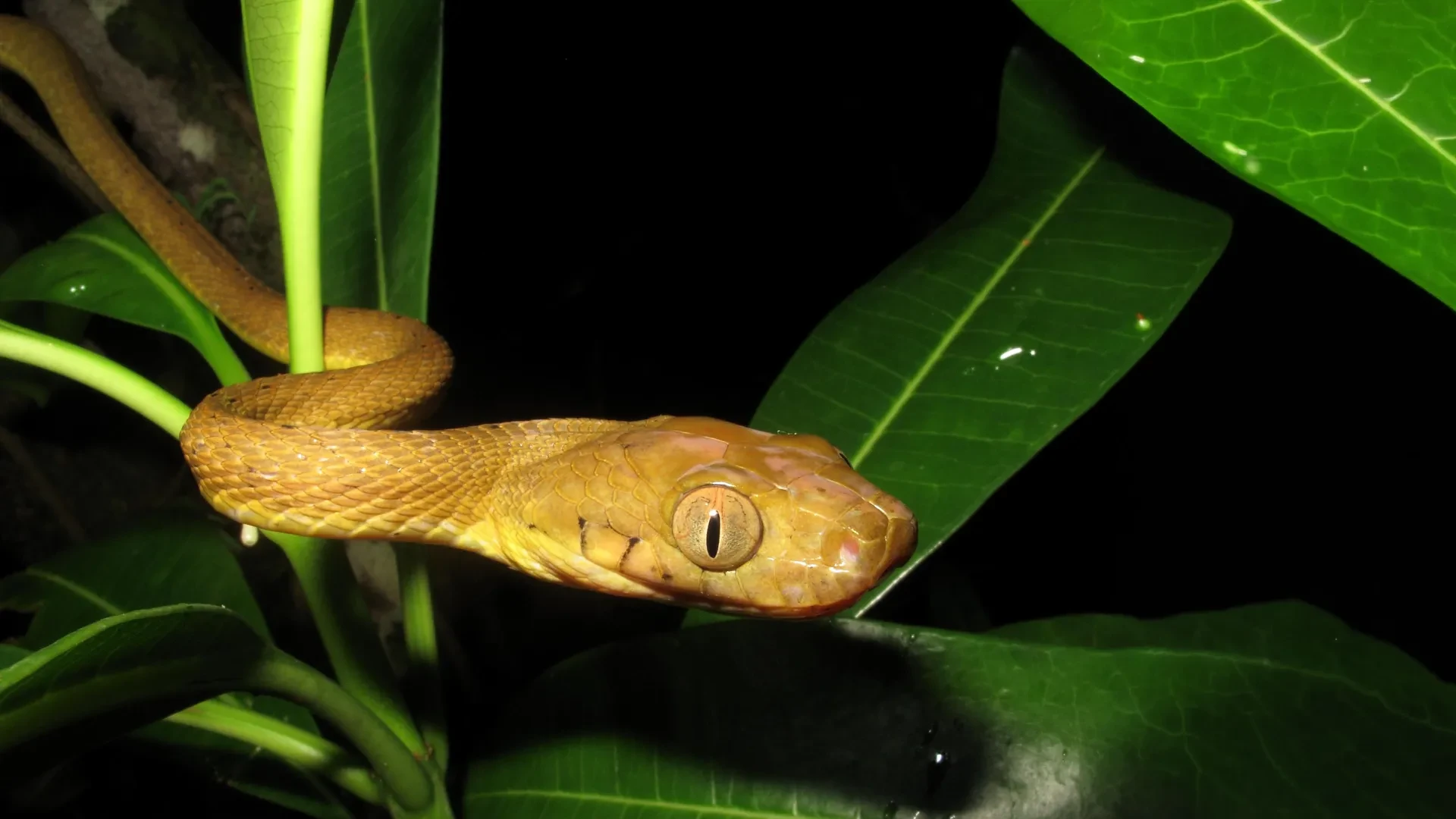
For decades, the brown tree (Boiga irregularis) has stood as a textbook cautionary tale in the annals of conservation biology. Native to the coastal forests and woodlands of Australia and the South Pacific, this slender, nocturnal predator accidentally hitchhiked to the strategic U.S. island territory of Guam aboard military cargo transports shortly after World War II. In the decades since its arrival, the snake has engineered a silent, catastrophic restructuring of the island’s ecosystem.
Devoid of natural predators on Guam, the brown tree snake population exploded, driving numerous native forest bird species to local extinction and triggering massive economic and infrastructure damage. The reptiles regularly scale utility poles and electrical infrastructure, short-circuiting power grids and causing hundreds of disruptive power outages annually. In localized pockets of the island, population densities have reached an astonishing, unsustainable peak of up to 30,000 snakes per square mile.
For evolutionary biologists and wildlife management agencies, the Guam invasion has long presented a confounding paradox. Historical estimates indicate that the island’s entire invasive population was founded by a mere handful of pioneering individuals. Under conventional evolutionary theory, such an extraordinarily narrow founding population should trigger a severe "genetic bottleneck." Inbreeding depression—the accumulation of deleterious mutations and a drastic reduction in genetic diversity—typically drains a species of its adaptive plasticity, stalling rapid population expansion and leaving it vulnerable to environmental stressors.
Yet, the brown tree snake completely shattered these biological expectations. Instead of withering away or collapsing under the weight of severe inbreeding, the population surged into a hyper-abundant plague.
Now, a groundbreaking study led by the University at Buffalo (UB), in close collaboration with the U.S. Geological Survey (USGS) and published in Science Advances, reveals the secret behind the snake’s resilience. Utilizing advanced, next-generation long-read DNA sequencing technologies, researchers have uncovered a massive, previously hidden reservoir of genetic variation within the brown tree snake genome. Far from being genetically impoverished, these invasive reptiles possess tens of thousands of structural genomic variants that have quietly fueled their evolutionary success, offering unprecedented insights into how invasive species—and conversely, endangered populations—interact with their environments.
Detailed Chronology: From Accidental Stowaway to Genetic Revelation
To fully grasp the magnitude of the recent UB-led discovery, one must trace the timeline of the brown tree snake’s catastrophic expansion and the technological evolution that finally allowed scientists to decode its biological success.
Post-WWII Arrival and Ecological Collapse
Sometime in the late 1940s or early 1950s, amidst the chaotic demobilization and heavy cargo shipments following World War II, a small number of brown tree snakes slipped past human inspection protocols and landed on Guam. The island was a biological paradise entirely unprepared for an agile, venomous arboreal predator.
Within a generation, the consequences were devastating:
- Avian Extirpation: Guam’s native bird populations, having evolved in the absence of mammalian or reptilian tree-dwelling predators, possessed no defensive behaviors. The snakes systematically decimated Guam’s forest avifauna, wiping out nearly all native forest bird species, including the Guam flycatcher, the rufous fantail, and the Micronesian kingfisher (which now survives solely in captive-breeding programs).
- Infrastructure Vulnerability: Beyond the ecological collapse, the snakes began disrupting human life. Their propensity for climbing metal towers and power lines resulted in frequent short circuits, plunging military installations, businesses, and residential neighborhoods into sudden darkness on a regular basis.
- The Density Peak: As prey species dwindled, the snakes adapted, shifting their diets and maximizing their reproductive output until populations swelled to densities as high as 30,000 snakes per square mile in certain areas—an ecological saturation point rarely documented in vertebrate predators.
The Decades-Long Scientific Riddle
As the invasion progressed through the late 20th century, geneticists attempted to sample the Guam population to understand its evolutionary trajectory. Using traditional DNA sequencing tools available at the time, researchers confirmed that the island’s snakes exhibited low genetic diversity when examined at the level of individual base pairs.
This finding deepened the paradox. Standard population genetics dictated that low diversity should equal low adaptability. Yet, eradication teams deployed by the USGS Rapid Response Team (RRT) found that the snakes were remarkably resilient, adapting to novel prey, surviving control measures, and maintaining high physiological fitness despite generations of intense inbreeding.
The Technological Breakthrough of 2024
The turning point arrived with a paradigm shift in genomics. For years, science relied on short-read sequencing technologies, which read DNA in tiny fragments—akin to examining a massive historical library letter by letter through a magnifying glass. While effective at spotting single-nucleotide polymorphisms (SNPs)—such as an ‘A’ mutating into a ‘G’—these legacy tools were fundamentally blind to larger architectural rearrangements within the genome.
In the study published on July 24, a multi-institutional research team bypassed these limitations by applying advanced long-read sequencing to the brown tree snake genome. This sophisticated technique allowed scientists to sequence continuous, massive stretches of DNA, bringing structural variations—mutations affecting 50 base pairs or more—into sharp focus.
The results were astonishing: the researchers identified more than 19,000 structural variants scattered across the snake’s genome. These large-scale insertions, deletions, duplications, and inversions altered nearly eight times more of the genome than single base-pair changes alone, unmasking the hidden genetic engine that had driven the Guam invasion all along.
Supporting Context & Metrics: Unpacking the Genome
The discovery of over 19,000 structural variants fundamentally changes how geneticists must evaluate both invasive threats and vulnerable native wildlife. To understand why this hidden diversity matters, one must examine where these structural changes were concentrated and how they function.
The Architecture of Genetic Adaptation
When the UB and USGS researchers mapped the locations of the structural variants, they discovered a striking pattern: the mutations were not distributed randomly across the chromosomes. Instead, they were heavily concentrated in specific functional categories of genes, most notably those governing immune function and olfaction (the sense of smell).
+-------------------------------------------------------------------+
|               BROWN TREE SNAKE GENOMIC ARCHITECTURE               |
+-------------------------------------------------------------------+
| Total Structural Variants Identified: >19,000                     |
| Genomic Footprint: Alters ~8x more genome than single base pairs  |
| Primary Concentration Hotspots:                                   |
|   1. Immune System Genes (Pathogen resistance & resilience)       |
|   2. Olfactory Genes (Foraging, navigation, & kin recognition)    |
+-------------------------------------------------------------------+- Immunity and Pathogen Defense: In dense populations where individuals live in close proximity, disease transmission becomes a critical bottleneck. The heightened structural diversity in immune-related genes suggests that Guam’s brown tree snakes may possess a robust, adaptable immune toolkit capable of fighting off novel pathogens encountered in their introduced range.
- Olfaction and Behavioral Adaptations: Brown tree snakes rely intensely on their forked tongues to sample airborne chemical cues, guiding their movements, territory mapping, and hunting strategies. The surprising richness in olfactory gene variants sheds light on a long-standing behavioral mystery. While brown tree snakes in their native Australian habitats frequently cannibalize one another, instances of intraspecific predation on Guam are remarkably rare. The researchers hypothesize that heightened olfactory sensitivity allows the snakes to accurately recognize close relatives—a byproduct of severe inbreeding—effectively reading them as "siblings" rather than food items.
The Debate Over Timing: Innate vs. Acquired Diversity
A central question currently occupying the research team is the temporal origin of these structural variants: Did the snakes bring this genetic toolkit with them from Australia, or did the severe bottleneck of the invasion actually accelerate the generation of structural variants?
While traditional evolutionary timelines dictate that large genomic rearrangements accumulate slowly across deep time, emerging genomic literature hints that extreme environmental stress and population bottlenecks can act as accelerators for structural mutation. Resolving this question will require comprehensive comparative sequencing of native Australian and South Pacific brown tree snake populations to establish a definitive baseline.
Official Statements and Expert Perspectives
The implications of the study extend far beyond the jungles of Guam, challenging foundational assumptions in conservation biology and invasive species management.
Dr. Trevor Krabbenhoft, PhD, associate professor in the UB Department of Biological Sciences and corresponding author of the study, emphasized that the scientific community has historically underestimated the true dimensions of genetic variation:
"The brown tree snake is maybe not wildly diverse, but it has important sources of genetic diversity that have been underappreciated."
Krabbenhoft noted that the traditional metrics used by conservationists have been constrained by the limitations of historical laboratory tools, leaving massive blind spots in how we assess species resilience.
Dr. Christopher Osborne, PhD, an aquatic biologist at SUNY Oswego and first author of the study—who completed the work as a doctoral student in Krabbenhoft’s lab—pointed out the dual-edged nature of the findings. While the discovery complicates eradication efforts on Guam, it offers a glimmer of hope for the world’s most endangered, highly inbred species:
"It’s possible that endangered species may have more flexibility in their genes than we realize. We’re now getting a better understanding of unappreciated sources of genetic diversity that may explain how some inbred species can still respond to their environment."
Dr. Levi Gray, PhD, a postdoctoral researcher in Krabbenhoft’s lab and former USGS researcher who worked directly with the Brown Tree Snake Rapid Response Team (RRT), used an intuitive literary analogy to explain the technological leap in sequencing:
"It’s like looking at portions of two books letter by letter with a magnifying glass and thinking they’re the same, but not realizing entire paragraphs have been moved around or duplicated. Older sequencing technology didn’t allow us to easily see that DNA in one individual might be in a completely different place on the chromosome than in another. How we define genetic diversity and how we actually measure it is shaped largely by the technology of the day."
Future Outlook: Managing Invaders and Saving the Endangered
The publication of this study in Science Advances marks a critical milestone in wildlife genomics, but it also opens up an urgent roadmap for future research and applied conservation management.
Implications for Invasive Species Control on Guam
For federal agencies such as the USGS, USDA, and local wildlife management teams on Guam, the revelation that brown tree snakes possess a deep reserve of structural genetic flexibility is sobering. Greater resilience means that eradication programs cannot rely solely on the assumption that inbreeding will naturally weaken the population over time. Management strategies must account for a species that is genetically equipped to withstand environmental pressures, adapt its behaviors, and maintain high physiological fitness against the odds.
A Beacon of Hope for Endangered Taxa
Conversely, the study provides a vital theoretical framework for conservationists battling to save critically endangered species trapped on the brink of extinction. Many high-profile conservation icons—such as the black-footed ferret, the northern white rhinoceros, or isolated island bird populations—suffer from extreme genetic bottlenecks.
For decades, conservation geneticists feared that populations reduced to a handful of individuals were biologically doomed due to inevitable inbreeding depression. However, if structural variants are common across the animal kingdom, many endangered species may harbor hidden reservoirs of genetic flexibility that standard tests have missed. Recognizing these unappreciated sources of diversity could revolutionize captive breeding and reintroduction programs, allowing scientists to identify resilient lineages that are better equipped to adapt to rapidly changing, human-altered ecosystems.
Next Steps in Genomic Research
To build upon these findings, the UB and USGS research team—which includes co-authors M. Renee Bellinger, PhD, and Melia Nafus, PhD from the USGS, alongside UB research scientist Brian Foote, postdoctoral researcher Steven Fleck, PhD, and PhD students Sarah Chang and Hannah Waterman—plan to expand their comparative genomic analyses. By sequencing native populations across Australia and the South Pacific, the team hopes to determine whether structural variation is an ancient trait of the species or a rapid, stress-induced evolutionary response to invasion.
Ultimately, the brown tree snake has proven that life finds a way through mechanisms science is only just beginning to comprehend. By refining our technological lenses and looking beyond simple base-pair changes, researchers are gaining a clearer, more nuanced understanding of the genetic machinery that drives both ecological collapse and evolutionary survival.