
Every year, an estimated 10 million cats and dogs go missing in the United States, leaving their owners in a state of emotional limbo known clinically as "ambiguous loss." Unlike the defined grief of a pet’s passing, a missing animal provides no closure. It is a persistent open wound that leaves families trapped in agonizing cycles of wondering, searching, and waiting.
To combat this epidemic of lost companions, the consumer pet technology market has evolved rapidly. Standard ID tags and microchips remain critical safety nets—crucial for reuniting pets with owners once they are found—but they are entirely passive. When a dog bolts through an open gate or an adventurous cat vanishes into the brush, passive identification does nothing to help you find them in the moment.
Enter the GPS pet tracker: a sophisticated tool powered by cellular data networks and satellite positioning systems designed to bridge the gap between panic and recovery. These devices offer near-real-time location tracking, escape alerts, and activity insights. However, as extensive testing by industry experts reveals, not all trackers are created equal. Across multiple rounds of rigorous evaluation encompassing 26 models, testers discovered that while modern GPS collars are technological marvels, they are also prone to software glitches, variable connection speeds, and subscription paywalls.
This comprehensive review explores the top-performing GPS pet trackers for dogs and cats, evaluating their accuracy, battery life, design flaws, data privacy policies, and real-world utility to help you make an educated choice for your four-legged family members.
Detailed Chronology of Testing and Methodology
The pursuit of the ultimate pet tracking device demands rigorous, real-world testing under diverse environmental conditions. Evaluators spanned multiple years and geographic locations, subjecting 16 different models to more than 30 outings in the humid, variable climate of Lincoln, Nebraska, and another 35 outings in the urban and suburban terrain of New Haven, Connecticut.
Tests were conducted in blazing summer heat, freezing winter cold, heavy rain, and dense cloud cover—environments designed to deliberately challenge satellite and cellular reception. The primary canine tester, an active dog named Dave, put the collars through their paces on standard walks, off-leash runs at dog parks, and simulated escape scenarios where walkers were given a head start. Feline testing was equally demanding, relying on indoor-outdoor cats in Nebraska and Philadelphia to evaluate how gear performed on animals navigating trees, alleys, and dense shrubbery.
The testing methodology focused on several critical performance vectors:
- Location Accuracy During Live Tracking: Devices were evaluated on their ability to update a pet’s coordinates in real time. Testers compared app displays against actual physical locations during head-start tracking tests and open-field runs.
- GPS Connection Speed: Time is of the essence during an emergency. Evaluators timed how long it took each device to activate its "live tracking" or "lost mode" feature and establish a satellite lock.
- Escape-Alert Response Time: Geofenced "safe zones" were established around homes. Testers measured the exact delay between a pet crossing the virtual boundary and the app delivering a push notification.
- Battery Endurance: Devices were subjected to 18 consecutive outings utilizing the battery-intensive live-tracking mode to measure real-world power retention.
- Ease of Use and Physical Design: Apps were judged on interface clarity, map rendering, and setup friction. Physical designs were assessed for weight, bulk, waterproof ratings (such as IP68 standards), and collar attachment mechanisms.
Supporting Context & Metrics: The Contenders and Their Performance
Through systematic elimination, researchers weeded out general-purpose Bluetooth trackers—like Apple AirTags and Tile devices—which rely on proximity to smartphones and are utterly useless when a pet flees beyond urban crowds. Devices utilizing punitive electrical stimulations or "invisible fence" shock mechanisms were also summarily dismissed due to animal welfare concerns and international bans.
What remained was a curated field of dedicated GPS and radio-frequency devices. Here is how the top picks and category leaders stacked up:
Top Pick for Dogs: Tractive Dog 6 Smart Dog Tracker
The Tractive Dog 6 emerged as a powerhouse for canine tracking, offering the most reliable location accuracy and some of the fastest connection times in the category.
- Accuracy & Speed: During live tracking, it updates every 2 to 3 seconds under optimal conditions, typically staying within a few yards of the dog’s actual position. It connected to live tracking in an average of 13 seconds.
- Battery Life: After 18 half-hour active outings, the battery retained 71% of its charge.
- Build & Features: Equipped with a USB-C port, dual LED light strips for nighttime visibility, and an IP68 waterproof rating capable of withstanding submersion up to 1.5 meters for 30 minutes.
- Drawbacks: It is relatively bulky and requires a minimum one-year prepaid subscription.
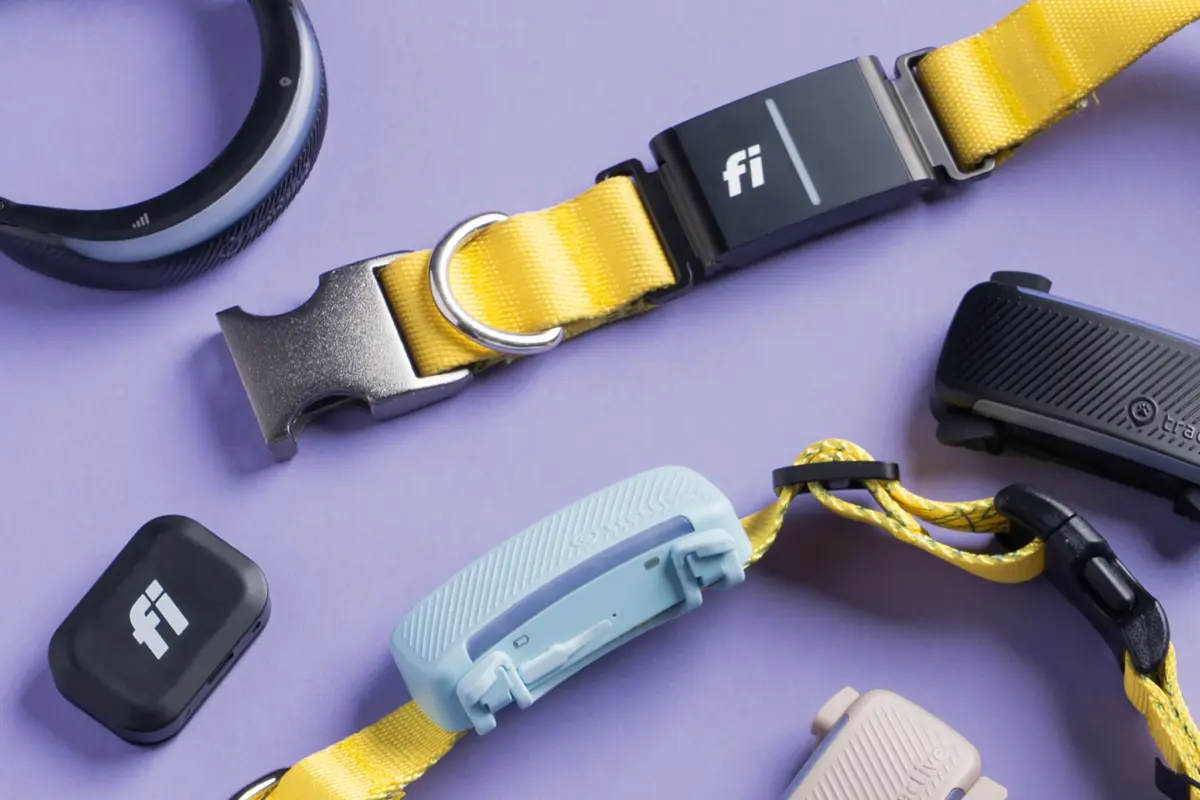
Top Pick for Dogs: Fi Series 3+
For owners seeking a sleeker, highly accurate device, the Fi Series 3+ offers a brilliant alternative packaged in a marine-grade stainless steel casing.
- Design & Weight: Weighing just 1 ounce (excluding collar and endlinks), it is roughly 40% lighter than the Tractive device and significantly slimmer. However, it must be used with Fi’s proprietary endlink collars.
- Battery Optimization: Fi utilizes a base station that connects via Bluetooth Low Energy while indoors, shifting to home Wi-Fi when roaming nearby, and only tapping power-heavy GPS signals when an escape is detected. This strategy yielded a stellar 71% battery retention after 18 test walks.
- Behavioral Insights: Beyond location, it tracks advanced metrics like eating, drinking, and licking habits.
Runner-Up for Dogs: Fi Mini
The Fi Mini bridges the gap for owners who want Fi’s ecosystem benefits without being locked into proprietary hardware.
- Universal Fit: Weighing an astonishingly light 0.56 ounces, the Mini attaches to almost any existing dog collar or harness using included silicone straps or protective cases.
- Performance: It matched the Series 3+ in connection speed (averaging 18 seconds to enter Lost Mode) and battery retention (68% after 18 walks) but lacks built-in LED lights and is constructed entirely of plastic rather than stainless steel.
Top Pick for Cats: Tractive Cat 6 Mini
Feline tracking presents unique sizing and behavioral challenges, which the Tractive Cat 6 Mini handles expertly with a curved chassis designed to contour comfortably around a cat’s neck.
- Tracking & History: It mirrors the exceptional live-tracking accuracy of the dog version while adding a comprehensive history menu, heat maps of favorite snoozing spots, and territory boundary toggles.
- Battery Trade-off: Due to its compact size, battery life is significantly shorter, draining completely after roughly 5.5 days of active indoor/outdoor use. It also relies on a proprietary magnetic charging cable rather than universal USB-C.
Niche Alternatives: Tractive Dog 6 XL & TabCat V2
- For Large Dogs: The Tractive Dog 6 XL is built for dogs weighing 70 to 80 pounds and up. It blew away the competition in battery endurance, retaining an astounding 93% charge after 18 rigorous test sessions.
- For Indoor-Only Hiding: The TabCat V2 Cat & Kitten Tracker utilizes radio-frequency technology rather than GPS. With a 500-foot range and zero subscription fees, it is unrivaled for finding a cat cowering inside a dark wall cavity or under a mattress where GPS signals fail.
Official Statements and Industry Insights
The integration of consumer tracking hardware into daily pet care raises profound questions regarding data privacy, psychological well-being, and corporate transparency.
Dr. Megan Auster-Rosen, a clinical psychologist specializing in grief, emphasized the psychological weight of pet loss. Referring to the phenomenon of ambiguous loss, she noted, "It’s like a missing person… When a pet is lost forever, we usually don’t find out what happened to them. This lack of closure can cause us to get stuck in different stages of the grieving process." Devices like GPS trackers serve as a vital psychological shield against this specific type of trauma.
Corporate leadership has been forced to address growing consumer anxieties regarding data privacy. Max Eddy, Wirecutter’s privacy and security expert, pointed out that pet trackers inherently collect deeply intimate data: "Remember that your dog is probably near you most of the time. Using just the dog’s data, some inferences could potentially be made about the person’s life and habits." Furthermore, geolocation metadata generated by apps can theoretically be subpoenaed by law enforcement.
In response to these concerns, industry executives have defended their practices. Andrew Bleiman, executive vice president at Tractive, noted that as a European company, Tractive operates under the stringent mandates of the General Data Protection Regulation (GDPR). "At no time does Tractive sell or license this data," Bleiman stated.
Similarly, Fi CEO and founder Jonathan Bensamoun addressed data sharing within his company’s ecosystem: "We do not and will never sell any data." Bensamoun explained that while information is retained to power targeted marketing on platforms like Meta, law enforcement requests are strictly gated behind rigorous legal documentation requirements.
Future Outlook
The pet technology sector is expanding at a blistering pace. As cellular networks transition to more advanced iterations of IoT (Internet of Things) connectivity and satellite-to-device messaging becomes mainstream, future iterations of pet trackers promise even faster connection speeds, hyper-accurate indoor positioning, and extended battery life without the current bulk penalties.
Reviewers and testing bodies continue to monitor emerging market entrants, with ongoing long-term evaluations of established picks alongside upcoming hardware like the Life360 Pet GPS. For pet owners, the future looks increasingly secure—provided they are willing to navigate subscription fees, battery charging routines, and minor software quirks to keep their beloved companions safely on the map.