
Executive Overview
Deep within the hyper-arid expanses of Peru’s northern coast, archaeologists have unearthed a biological and cultural treasure trove that rewrites the timeline of South America’s most distinctive canine companion. At Castillo de Huarmey—the premier administrative and ceremonial stronghold of the pre-Inca Wari Empire—researchers have uncovered the first definitive physical evidence of Peruvian hairless dogs dating back more than 1,200 years.
The breakthrough, recently detailed in the Journal of Anthropological Archaeology, rests upon an extraordinary intersection of natural mummification, genetic sleuthing, and cutting-edge isotopic analysis. Far from ordinary skeletal fragments, the excavation yielded naturally preserved mummies complete with hairless skin, meticulously applied cinnabar pigment, and a peculiar physiological giveaway: missing teeth. By correlating genetic markers of hairlessness with dental reduction, scientists confirmed that these ancient animals belonged to the fragile, elegant lineage recognized today as the Peruvian Inca Orchid.
Beyond simply identifying the dogs, the multidisciplinary research team—comprising specialists from Dartmouth College, the University of Warsaw, and the University of Pittsburgh—has mapped a complex narrative of human-animal interaction. The findings challenge modern assumptions about ancient fauna, revealing that these hairless companions shared the dinner plates of the elite, received preferential care during puppyhood, and occupied a nuanced, deeply stratified social status centuries before the rise of the Inca Empire.
Detailed Chronology: Unearthing the Wari Empire and Its Canines
To understand the weight of this discovery, researchers must look back through the layers of time that define Castillo de Huarmey. Located approximately 190 miles north of Lima, this sprawling 110-acre complex functioned as a vital hub of Wari governance, trade, and ritual from 600 to 1050 CE—predating the sweeping conquests of the Inca by roughly four centuries.
A History of Monumental Finds
Castillo de Huarmey is no stranger to archaeological headlines. For decades, the site’s desert climate—characterized by extreme aridity—has acted as a natural preservation chamber, locking away organic materials like textiles, leather, pigments, and delicate ceramics that typically disintegrate in humid environments.
- 2012: Excavators made international news by uncovering the first completely undisturbed elite Wari tomb. Hidden deep within the complex, the chamber held the remains of 58 high-status noblewomen, six sacrificial human victims, and an astonishing 1,300 precious artifacts fashioned from gold, silver, bronze, and rare textiles.
- 2022: Archaeologists expanded their understanding of Wari class stratification by identifying nearby burial sites dedicated to elite craftspeople. These graves were accompanied by specialized gold, silver, and bronze tools, illuminating the sophisticated industrial and artistic output of the empire.
- 2010–2025: Continuous excavations in the northern sector of the main ceremonial precinct shifted focus toward domestic and sacrificial fauna. Amid remains of South American camelids (llamas and alpacas) and general refuse, researchers encountered a series of enigmatic dog bones and mummies.
The Seismic Threat and Stratigraphic Puzzle
The journey to these canine discoveries was fraught with natural and human disruption. In 1970, a massive earthquake rattled the region, causing structural collapses that exposed interior burial chambers and invited widespread looting. Unscrupulous treasure hunters tore through upper stratigraphic layers, scattering and mixing artifacts.
Fortunately, the deeper, primary Wari contexts remained intact. It was within these complex upper-to-intermediate layers of the northern ceremonial precinct that the three standout dog specimens were recovered, defying decades of disturbance to yield pristine biological data.
Supporting Context & Metrics: Genetics, Diet, and Stratigraphy
The investigation into the Castillo de Huarmey dogs required an intricate blend of zooarchaeology, osteology, and biogeochemistry. The sheer volume of material recovered provides a robust statistical baseline for researchers tracking ancient biodiversity.
The Osteological Fingerprint: Why Teeth Matter
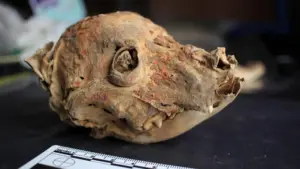
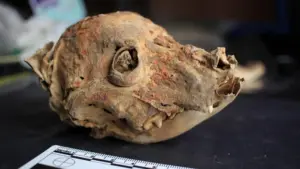
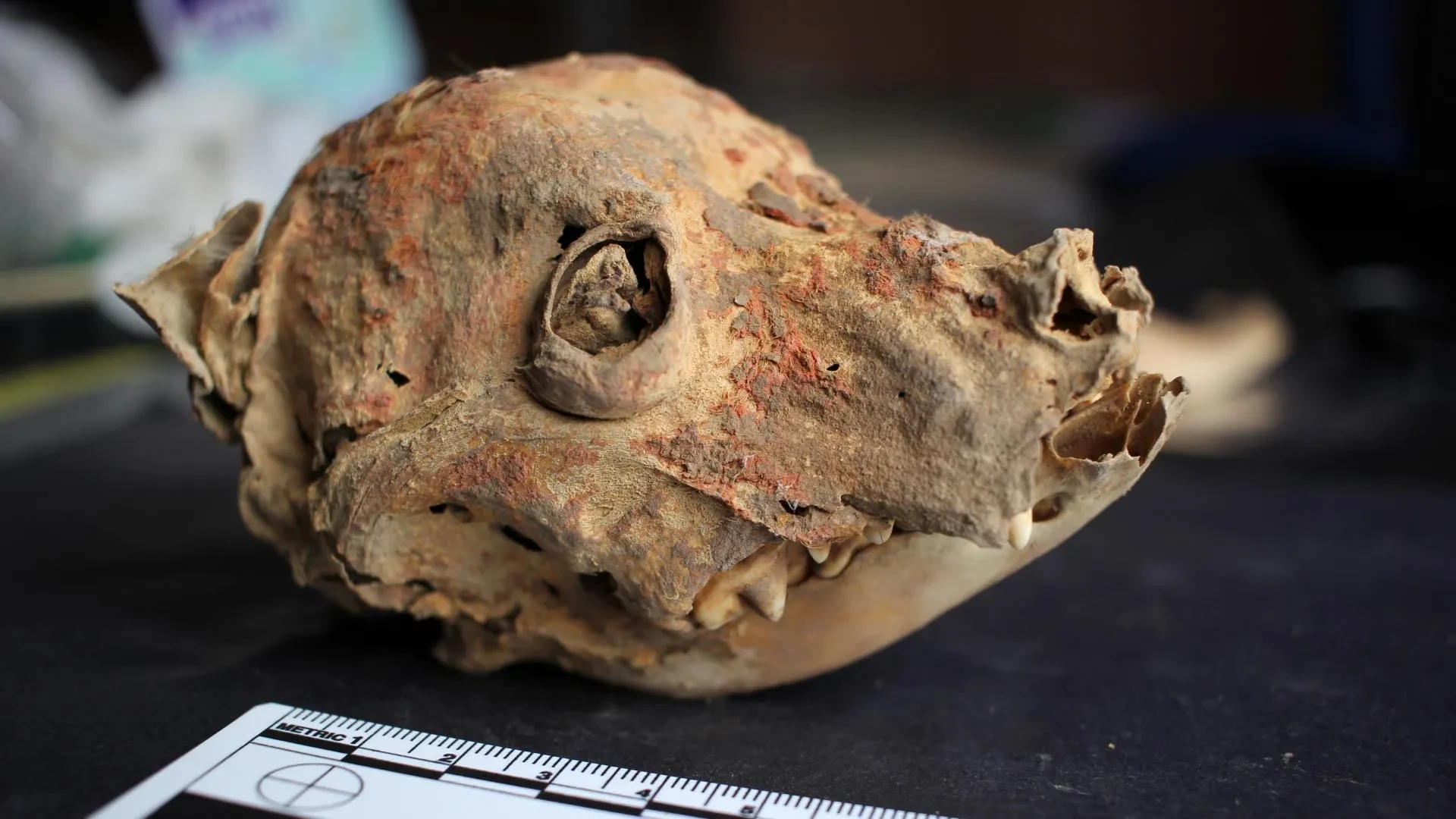
The identification of the dogs hinged on an ingenious biological correlation. When first unearthing a complete, naturally mummified male dog in a shallow pit, lead researchers initially feared the remains might be of modern origin—perhaps deposited by looters a mere half-century ago.
However, co-author Weronika Tomczyk observed two definitive anomalies:
- Cutaneous Evidence: The preserved skull retained visible, hairless skin and intact ears.
- Dental Reduction: The skulls universally lacked their first premolars and, in some instances, final molars—not due to age-related wear, periodontal disease, or trauma, but because the teeth had never erupted.
In mammalian biology, the genetic mutation responsible for congenital hairlessness (FOXI3 gene mutations in many canine lineages) is pleiotropic, meaning it simultaneously governs dental development. This specific genetic hitch provided the undeniable signature of Peruvian hairless dogs, distinguishing them from other ancient Andean canines.
Quantitative Metrics of the Excavation
- Total Specimen Count: 341 individual dog bone fragments recovered.
- Minimum Number of Individuals (MNI): At least 19 distinct dogs, supplemented by complete or partial mummies.
- Radiocarbon Milestone: The newly analyzed male dog mummy has been scientifically dated to at least 1,200 years old, establishing it as the oldest radiocarbon-verified canine specimen recovered from the Castillo de Huarmey complex to date.
Isotopic Insights: Dining Like Royalty
To reconstruct the daily lives, movements, and feeding habits of these ancient dogs, the team executed rigorous isotopic analyses on bone and tooth samples. By measuring variations in carbon, nitrogen, oxygen, and strontium isotopes, scientists unlocked a biochemical diary of each animal’s life.
- Childhood vs. Adulthood: Because canine teeth erupt rapidly during puppyhood, tooth enamel records early-life diets. Bone collagen, by contrast, reflects the metabolic intake of the final year of life.
- The Maize Connection: Isotopic signatures revealed that nearly all the dogs consumed significant amounts of maize (corn), a dietary staple of the human population throughout the pre-Hispanic Andes.
- The Hairless Advantage: Hairless puppies displayed distinct dietary profiles closely mirroring those of human children, suggesting they were deliberately fed or provided specialized scraps. As they matured, their diets diversified, pointing toward controlled breeding practices and targeted human care.
Official Statements & Expert Perspectives
The complex, often contradictory relationship between humans and animals in antiquity forms the cornerstone of the study’s conclusions. Researchers stress that ancient societies viewed companion animals through lenses just as multifaceted as those of modern pet owners.
"Our findings indicate that humans and dogs coexisted at this Wari site, but reconstructing their bond is challenging, as past emotions are difficult to capture through archaeological methods," notes Weronika Tomczyk, first author of the study and a research associate in Dartmouth’s Department of Anthropology, alongside her role as a postdoctoral fellow in its Ecology, Evolution, Environment and Society Program.
Tomczyk emphasizes that the data complicates romanticized views of ancient pet ownership, noting the paradox of human affection versus utility:
"The goal of our study was to not only present data on Castillo de Huarmey’s dog burials, but also emphasize that people in the past had often contradictory relationships with the animals, just as they do today: a pet for one group of people could at the same time be considered a pest by their closest neighbors."
The physical placement of the dog remains within elite zones of the complex underscores their elevated, albeit diverse, social standing. For instance:
- The bones of a 6-to-8-week-old puppy were interred directly alongside an elite craftsperson known as the "Master Basketmaker."
- An adult dog was discovered buried within the heart of the site’s palace structure.
- A puppy skeleton accompanied an adult male (designated individual XY), who is believed to have been ritually sacrificed to serve as a perpetual tomb guardian.
Despite these intimate placements, the researchers found minimal evidence of butchery marks, indicating that while these dogs were not treated uniformly, they were rarely viewed as a primary food source.
"While we will never know if any of the three dogs were pets or how people treated them, it is evident they received different treatment than other dogs," Tomczyk concludes.
The collaborative framework behind these revelations bridges international institutions. Tomczyk’s co-authors include Miłosz Giersz, Wiesław Więckowski, and Roberto Pimentel Nita of the University of Warsaw, as well as Claire Ebert of the University of Pittsburgh—all contributing specialized expertise in Andean archaeology, osteology, and geoarchaeology.
Future Outlook
The confirmation of 1,200-year-old Peruvian hairless dogs at Castillo de Huarmey opens compelling new avenues for Andean archaeology and evolutionary biology. As researchers continue to process the extensive botanical, faunal, and human remains recovered from the site, several key initiatives are set to shape future research:
- Ancient DNA (aDNA) Profiling: While morphological and isotopic data have successfully linked the skeletal remains to modern Peruvian hairless breeds, planned aDNA extractions will allow scientists to map the precise genetic lineage of these ancient canines, tracing evolutionary bottlenecks and geographic migrations across pre-Columbian South America.
- Refining Wari Chronology: With the male dog mummy establishing a robust radiocarbon anchor point, researchers will re-evaluate the sequential phasing of the northern ceremonial precinct, helping to establish a more granular timeline of Wari administrative expansion and ritual practices.
- Broader Comparative Studies: Future excavations aim to compare the Huarmey dog populations with contemporaneous canines from other Wari administrative nodes and coastal settlements, determining whether hairless breeding programs were localized phenomena or widespread imperial enterprises.
Ultimately, these hairless mummies bridge a millennia-long gap, reminding the modern world that the deep-seated emotional, social, and symbiotic bonds between humans and their dogs are as ancient as civilization itself.