
Executive Overview
Deep within the hyper-arid sands of Peru’s northern coast, archaeologists have unearthed a stunning cache of natural mummies, skeletal remains, and ritual artifacts that push the historical timeline of the region’s iconic hairless dogs back more than 1,200 years. Long predating the sprawling dominance of the Inca Empire, a sophisticated pre-Hispanic civilization known as the Wari Empire populated the sprawling administrative and ceremonial complex of Castillo de Huarmey.
The breakthrough discovery, recently detailed in the Journal of Anthropological Archaeology, provides the first definitive physical evidence of Peruvian hairless dogs at a Wari site. Researchers identified the ancient canines not merely through standard osteological analysis, but via a distinct genetic telltale sign: missing teeth. Because the genetic mutation responsible for canine hairlessness is inextricably linked to developmental dental reduction—specifically the absence of first premolars and occasional last molars—scientists were able to definitively classify these millennium-old remains.
The implications of this discovery stretch far beyond evolutionary biology. By combining radiocarbon dating, zooarchaeological observation, and sophisticated isotopic analysis of carbon, nitrogen, oxygen, and strontium, the research team mapped out the diets, origins, and burial contexts of at least 19 individual dogs. The findings illustrate a nuanced, multifaceted relationship between humans and canines in pre-Columbian South America. Far from being monolithic, ancient attitudes toward these striking animals varied wildly across the social strata of the Wari Empire, mirroring the contradictions, affection, and utilitarian perspectives that characterize modern human-animal bonds today.
Detailed Chronology: Unlocking the Secrets of Castillo de Huarmey
To contextualize the discovery of the ancient dog remains, researchers had to untangle centuries of occupation, natural disaster, and illicit excavation at Castillo de Huarmey. Located approximately 190 miles north of Lima, the 110-acre complex served as a major political, administrative, and mortuary hub for the Wari Empire between 600 and 1050 CE—roughly four centuries before the rise of the Incas.
A Legacy of High-Status Discoveries
Castillo de Huarmey is no stranger to archaeological headlines. Over the past two decades, successive excavation campaigns have yielded extraordinary insights into the governance and social hierarchy of the Wari state:
- 2000: The Peruvian government officially designates the Peruvian hairless dog as part of the nation’s cultural heritage, cementing its status as an enduring national symbol tied to ancient Andean roots.
- 2012: Archaeologists announce the monumental discovery of the first completely undisturbed elite Wari tomb at the site. The chamber holds the remains of 58 high-status noblewomen, six human sacrificial victims, and approximately 1,300 exquisitely crafted artifacts made of gold, silver, textiles, and exotic feathers.
- 2010–2025: Ongoing excavations across the northern sections of the main ceremonial area and palace complexes unearth substantial quantities of South American camelid remains (llamas and alpacas), alongside scattered and clustered canine bones.
- 2022: Researchers identify adjacent burials belonging to elite craftspeople who were interred alongside specialized tools of gold, silver, and bronze, illustrating the sophisticated industrial and artistic output supported by the Wari state.
The Impact of Natural Disasters and Looting
The integrity of Castillo de Huarmey has faced severe modern threats. In 1970, a catastrophic earthquake struck the region, causing structural collapses within parts of the ancient complex. This seismic event exposed deep-seated burial chambers laden with valuable ceramics and metalwork, triggering a wave of illegal looting that disturbed upper archaeological stratigraphy.
Fortunately, deeper, undisturbed strata remained protected within their original Wari contexts. It was within these complex upper and intermediate layers—particularly in the northern ceremonial zone—that researchers isolated the pivotal canine remains that would redirect the course of the study.
The Triumphant Identification of Hairless Canines
Among the recovered specimens, three distinct sets of remains immediately captured the attention of the scientific team:
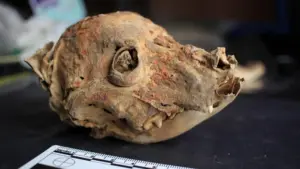
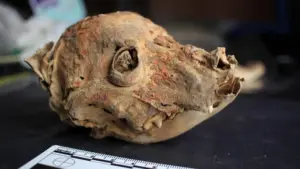
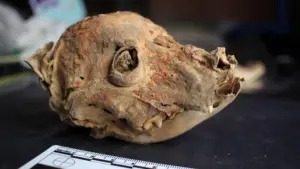
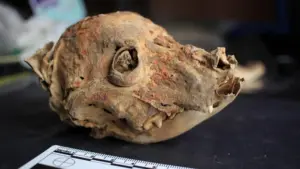
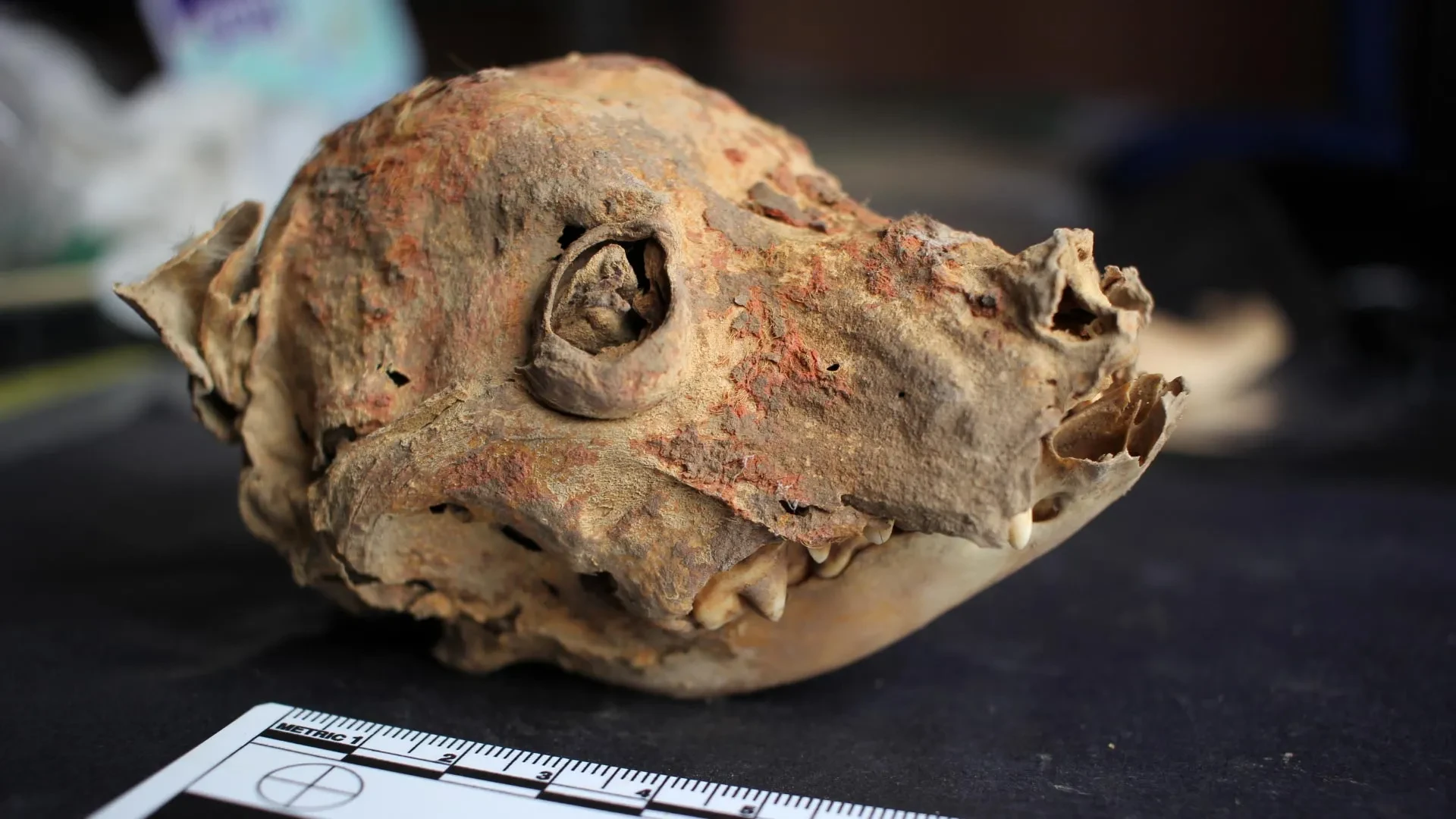
- The Cinnabar-Pigmented Skull: A naturally mummified canine skull retaining visible patches of hairless skin, intact ears, and a deliberate coating of bright red cinnabar pigment—a mineral frequently used in high-status Andean mortuary rituals.
- The Large Skull and Complete Male Mummy: A second, larger canine skull paired with a nearly complete, naturally mummified male dog recovered from a shallow pit, missing only the lower portions of its front limbs.
- The Genetic Marker: Initially suspected to be modern intrusions or the result of twentieth-century looting due to their pristine preservation, these specimens were reassessed when researchers noted a shared anatomical anomaly: the congenital absence of first premolars. This dental signature confirmed their identity as ancient Peruvian hairless dogs.
Supporting Context & Metrics: Diet, Geography, and Social Status
The research effort went far beyond visual identification. To understand how these animals lived, what they ate, and how they fit into Wari society, the team deployed a battery of rigorous scientific techniques, including zooarchaeological osteometry, radiocarbon dating, and multi-element isotopic analysis.
Quantifying the Canid Population
In total, the excavations at Castillo de Huarmey cataloged 341 individual dog bone specimens, representing a minimum population count of 19 distinct dogs, in addition to the pristine, fully mummified male dog.
| Specimen / Context | Estimated Age / Description | Associated Burial Context | Significance |
|---|---|---|---|
| Mummified Male Dog | Adult male; nearly complete skeletal structure. | Shallow pit, northern ceremonial area. | Radiocarbon-dated to at least 1,200 years old; oldest radiocarbon-verified specimen from the site. |
| Puppy Remains ("Master Basketmaker") | 6 to 8 weeks old. | Interred alongside an elite craftsperson. | Demonstrates close physical association between young hairless dogs and high-status workers. |
| Palace Dog | Adult. | Discovered within the interior of the Wari palace complex. | Suggests residential integration and potential special status within elite architectural zones. |
| Sacrificial Guardian Dog | Puppy. | Buried with an individual designated "XY," interpreted as a sacrificial tomb guardian. | Highlights ritualized canine sacrifice or companion interment in mortuary contexts. |
Isotopic Analysis: Tracing Diets and Life Stages
The scientific team extracted bone and tooth samples from the canids to analyze isotopes of carbon, nitrogen, oxygen, and strontium. Because tooth enamel forms early in life and remains chemically stable, it preserves a snapshot of an animal’s puppyhood diet and geographic origin. Bone collagen, conversely, remodels over time, reflecting the animal’s food sources during the final year of its life.
The chemical signatures revealed a striking overlap between the diets of the dogs and the human population of Castillo de Huarmey:
- Maize Consumption: The vast majority of the dogs consumed diets heavily reliant on maize (corn), a staple agricultural crop across the pre-Hispanic Andes.
- The Puppy Dietary Shift: Hairless puppies exhibited distinct isotopic signatures during their early weeks of life that closely mirrored the diets of human children. As these animals matured into adulthood, their dietary intake broadened significantly.
- Controlled Rearing: These dietary patterns strongly suggest that hairless puppies may have received specialized human care, targeted feeding, or intentional provisioning—point toward organized breeding practices rather than feral scavenging.
Furthermore, strontium isotope analysis, which tracks the geological signatures absorbed through local water and food sources, allowed scientists to evaluate whether the dogs were bred locally or brought to Castillo de Huarmey from distant regions under Wari control.
Official Statements and Expert Insights
The research team emphasizes that while the archaeological record cannot definitively declare whether these ancient dogs were beloved household pets, sacred ritual offerings, or specialized working animals, their distinct treatment sets them apart from ordinary fauna.
"Our findings indicate that humans and dogs coexisted at this Wari site, but reconstructing their bond is challenging, as past emotions are difficult to capture through archaeological methods," explains Weronika Tomczyk, lead author of the study, a research associate in Dartmouth’s Department of Anthropology, and a postdoctoral fellow in its Ecology, Evolution, Environment and Society Program.
Tomczyk highlights the complex and contradictory nature of human-animal interactions across time:
"The goal of our study was to not only present data on Castillo de Huarmey’s dog burials, but also emphasize that people in the past had often contradictory relationships with the animals, just as they do today: a pet for one group of people could at the same time be considered a pest by their closest neighbors."
Discussing the pivotal moment of identification, Tomczyk expands on the genetic link between hairlessness and dental anomalies:
"What I noticed is that some of the dog skeletons were missing teeth, and not that they lost them during their lifespan; some teeth, especially first premolars and sometimes last molars, had just never erupted. And then I found in the literature that the same gene which is responsible for hairlessness in dogs is responsible for a reduced number of teeth, indicating that these were Peruvian hairless dogs."
Commenting on the implications of the isotopic findings regarding canine husbandry, Tomczyk adds:
"We do not know if the dogs were intentionally fed maize or if perhaps, they were just eating leftovers or trash. Yet, the distinct dietary patterns of hairless puppies provide insights into what may have been organized breeding."
Summarizing the broader historical significance of the mummified remains and their varied depositional contexts, Tomczyk notes:
"While we will never know if any of the three dogs were pets or how people treated them, it is evident they received different treatment than other dogs."
The collaborative international team behind the research includes Miłosz Giersz, Wiesław Więckowski, and Roberto Pimentel Nita from the University of Warsaw, alongside Claire Ebert of the University of Pittsburgh. Their collective expertise bridges Andean archaeology, osteology, and chemical ecology.
Future Outlook: The Next Chapter in Andean Zooarchaeology
The discovery of 1,200-year-old Peruvian hairless dogs at Castillo de Huarmey opens vital new avenues for pre-Columbian research. As archaeological science continues to refine biomolecular techniques, several key areas of inquiry are set to shape future investigations:
- Ancient DNA (aDNA) Sequencing: Future projects will likely target the preserved soft tissue and bone fragments of the mummified canines to extract mitochondrial and nuclear DNA. This genetic sequencing will map the phylogenetic tree of the Peruvian hairless dog, tracking its lineage from the Wari era through the subsequent Inca Empire and into the modern era.
- Expanded Geographic Mapping: By broadening strontium and oxygen isotope baselines across contemporary Wari provincial sites, researchers hope to trace the movement and trade of elite domestic animals throughout the Andean cordillera and coastal valleys.
- Refining Mortuary Typologies: As additional undisturbed layers are analyzed, archaeologists aim to establish a standardized framework for identifying animal sacrifice versus domestic burial in Andean archaeology, shedding light on the spiritual dimensions of human-canine co-evolution.
Ultimately, the revelations from Castillo de Huarmey transcend dry academic metrics. They serve as a poignant reminder that human civilization has long shared its hearths, homes, and ceremonial spaces with loyal canine companions. Across millennia, empires may rise and fall, landscapes may shift from fertile fields to parched deserts, but the bond between humanity and our four-legged counterparts remains an enduring thread in the rich tapestry of human history.