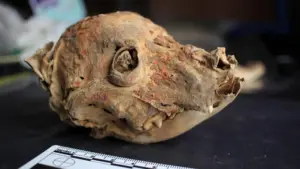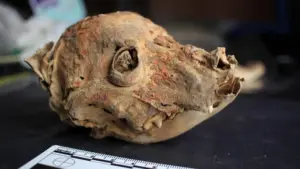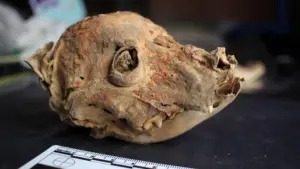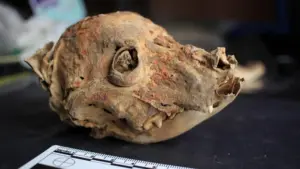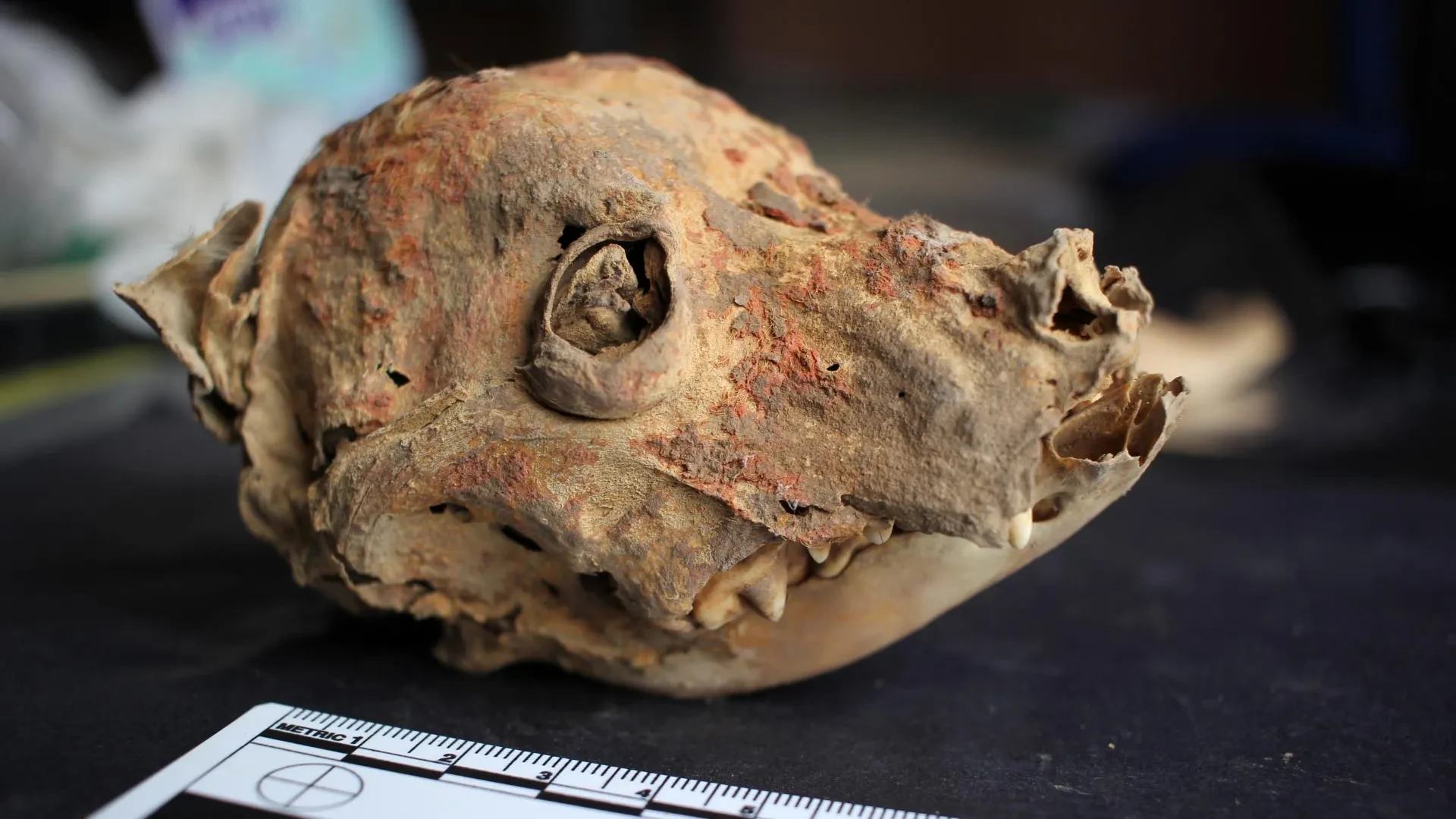

Archaeological excavations at the ancient Andean ceremonial and administrative complex of Castillo de Huarmey in Peru have yielded extraordinary physical evidence of Peruvian hairless dogs dating back more than 1,200 years. Long predating the rise of the Inca Empire, these remarkable discoveries include naturally mummified remains, unique skeletal adaptations, and profound geochemical clues regarding the diet, life history, and socio-cultural roles of these distinctive canines.
Published in the Journal of Anthropological Archaeology, the comprehensive study marks the first time that undisputed physical evidence of Peruvian hairless dogs has been scientifically documented at Castillo de Huarmey—the sole known administrative site of the Wari Empire discovered thus far on Peru’s northern coast. The research reveals complex human-animal dynamics that mirror modern contradictions, where certain animals were cherished or treated with ceremonial reverence while others coexisted merely as part of the broader domestic landscape.
By integrating zooarchaeological analysis, radiocarbon dating, and multi-element isotopic evaluations of bones and teeth, an international research team led by scientists from Dartmouth College and the University of Warsaw has illuminated a sophisticated pre-Columbian society where biological markers, such as congenital tooth agenesis linked to hairlessness, serve as a master key to unlocking ancient evolutionary and cultural histories.
Detailed Chronology
The chronological framework of Castillo de Huarmey spans over four centuries of pre-Columbian civilization, punctuated by monumental architectural developments, periods of crisis, and modern scientific breakthroughs.
[600 CE] Wari Empire occupies Castillo de Huarmey
   │
[1050 CE] End of Wari occupation; site transitions
   │
[1970 CE] Major earthquake damages upper strata and exposes chambers
   │
[2012 CE] Discovery of the first undisturbed elite Wari tomb (58 women)
   │
[2022 CE] Unearthing of elite craftsperson burials with precious metal tools
   │
[2010–2025 CE] Systematic excavations recover 341 dog specimens and mummies
The Wari Epoch (600–1050 CE)
Occupied between 600 and 1050 CE—roughly 400 years prior to the imperial consolidation of the Incas—Castillo de Huarmey functioned as a vital regional administrative and religious hub for the expansive Wari Empire. During this era, urban planning, elite funerary practices, and specialized craft production flourished across the 110-acre complex located 190 miles north of modern-day Lima.
The Cataclysm of 1970
Centuries after abandonment, the site faced severe physical disruption. In 1970, a powerful earthquake struck the region, causing structural collapses within parts of Castillo de Huarmey. The seismic event inadvertently exposed internal burial chambers laden with ancient ceramics and precious artifacts, which subsequently attracted illicit looting that disturbed upper archaeological stratigraphy and mixed animal remains across upper layers.
Modern Scientific Interventions (2012–2025)
Despite upper-layer disturbances, deep, sealed stratigraphic strata remained pristine, preserving primary Wari contexts. In 2012, researchers announced the monumental discovery of the first intact elite Wari tomb containing the remains of 58 noblewomen, human sacrificial victims, and 1,300 luxury artifacts. This was followed in 2022 by the discovery of elite craftspeople interred alongside advanced gold, silver, and bronze smithing tools.
Between 2010 and 2025, intensive excavations in the northern ceremonial sectors yielded 341 individual dog bone specimens representing at least 19 distinct animals, alongside exceptionally preserved mummified remains. Radiocarbon dating confirmed that a complete male hairless dog mummy recovered from these layers is at least 1,200 years old, establishing it as the oldest verified radiometric dog specimen from the complex and providing a critical chronological benchmark for the site.
Supporting Context & Metrics
The hyper-arid environment of the Peruvian Pacific coast creates exceptional preservation conditions, allowing organic substances—such as hair, leather, pigments, textiles, and animal tissue—to endure for millennia without undergoing typical microbial decay.
Biological Identification Through Genetics
The physical identification of the hairless dog specimens relied upon a crucial physiological indicator: missing teeth. Weronika Tomczyk, a research associate in Dartmouth’s Department of Anthropology and lead author of the study, observed that several recovered skulls and jaws exhibited congenital absence (agenesis) of the first premolars and occasionally the last molars.
In canine genetics, the FOXI3 gene mutation responsible for mammalian ectodermal dysplasia causes both hairlessness and corresponding dental anomalies. This biological linkage provided definitive proof that the remains belonged to the ancestral lineage of the Peruvian hairless dog, rather than standard coated canine populations introduced later or present in lower frequencies.
┌─────────────────────────┐     ┌──────────────────────────┐     ┌──────────────────────────┐
│    FOXI3 Gene Mutation   │ ──> │ Ectodermal Dysplasia     │ ──> │ Hairlessness & Congenital│
│    (Genetic Marker)     │     │ (Biological Expression)  │     │ Tooth Agenesis (Premolars│
└─────────────────────────/     └──────────────────────────┘     │ & Molars Never Erupted)  │
                                                                 └──────────────────────────┘
Quantifying the Archaeological Record
- Site Dimensions: 110 acres (approximately 45 hectares) serving administrative and elite funerary functions.
- Geographic Distance: Located 190 miles (approx. 305 km) north of Lima, Peru.
- Specimen Count: 341 individual dog bone specimens recovered, accounting for a minimum number of individuals (MNI) of 19 dogs, plus multiple natural mummies.
- Chronological Depth: Occupational span from 600 to 1050 CE; radiocarbon-dated dog specimens exceeding 1,200 years of antiquity.
- Interdisciplinary Collaborations: Co-authored by researchers from Dartmouth College, the University of Warsaw (Miłosz Giersz, Wiesław Więckowski, Roberto Pimentel Nita), and the University of Pittsburgh (Claire Ebert).
Isotopic Insights and Diet Reconstructive Metrics
To reconstruct the life histories and feeding behaviors of the ancient animals, the research team applied zooarchaeological analysis alongside stable isotope geochemistry (carbon, nitrogen, oxygen, and strontium) extracted from bone collagen and tooth enamel.
- Tooth Enamel Isotopes: Because canine teeth calcify rapidly during early development, dental isotopic signatures reflect the juvenile environment and diet of the animal.
- Bone Collagen Isotopes: Bone turnover reflects dietary intake over roughly the final year of the animal’s life.
- Strontium Isotopes: Strontium signatures vary according to underlying local geology, enabling researchers to trace geographic provenance and mobility patterns.
- Maize Consumption: Isotopic profiles demonstrated that the dogs regularly consumed maize (corn)—a dietary staple of the pre-Hispanic Andean human population. Notably, isotopic signatures among hairless puppies closely mirrored those of human children, suggesting specialized feeding regimens or deliberate provisioning within domestic or institutional settings.
Official Statements
The complexities of interpreting ancient human-animal relationships are highlighted by the researchers involved in the groundbreaking investigation:
"Our findings indicate that humans and dogs coexisted at this Wari site, but reconstructing their bond is challenging, as past emotions are difficult to capture through archaeological methods. The goal of our study was to not only present data on Castillo de Huarmey’s dog burials, but also emphasize that people in the past had often contradictory relationships with the animals, just as they do today: a pet for one group of people could at the same time be considered a pest by their closest neighbors."
— Weronika Tomczyk, Lead Author, Research Associate in Dartmouth’s Department of Anthropology & Postdoctoral Fellow in the Ecology, Evolution, Environment and Society Program.
Addressing the unique genetic and developmental markers observed during osteological processing, Tomczyk added:
"What I noticed is that some of the dog skeletons were missing teeth, and not that they lost them during their lifespan; some teeth, especially first premolars and sometimes last molars, had just never erupted. And then I found in the literature that the same gene which is responsible for hairlessness in dogs is responsible for a reduced number of teeth, indicating that these were Peruvian hairless dogs."
Commenting on the differential burial treatments accorded to the animals across elite and common precincts of the Castillo de Huarmey administrative center:
"While we will never know if any of the three dogs were pets or how people treated them, it is evident they received different treatment than other dogs."
Future Outlook
The confirmation of ancestral Peruvian hairless dogs at Castillo de Huarmey opens new avenues for Andean zooarchaeology and paleogenomics. Future research trajectories will likely focus on extracting ancient DNA (aDNA) from the mummified tissue samples to map the precise genetic lineage and mutation rates of the breed across millennia.
Furthermore, expanding isotopic analyses across broader regional Wari sites will help determine whether these hairless dogs were bred locally within northern coastal enclaves or traded across ecological zones between the Andean highlands and the Pacific coast. As analytical techniques continue to advance, the preservation conditions of the Peruvian desert promise to yield further revelations, deepening our understanding of how ancient Andean civilizations interacted with their domestic fauna long before European contact.