
Originally published in the Alley Cat Action® 2026 Summer Newsletter.
Executive Overview
In the wake of what meteorologists and long-time residents have confirmed as the worst flooding to hit the island of Oahu in two decades, communities along Hawaiʻi’s picturesque North Shore were left grappling with catastrophic property damage, displaced families, and infrastructural gridlock. Amidst the chaos of rushing waters, mudslides, and uprooted trees, a vulnerable population faced an invisible crisis: the island’s community cats and outdoor feline populations.
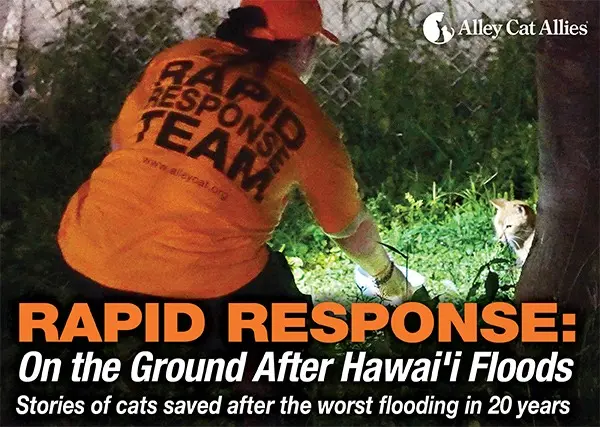
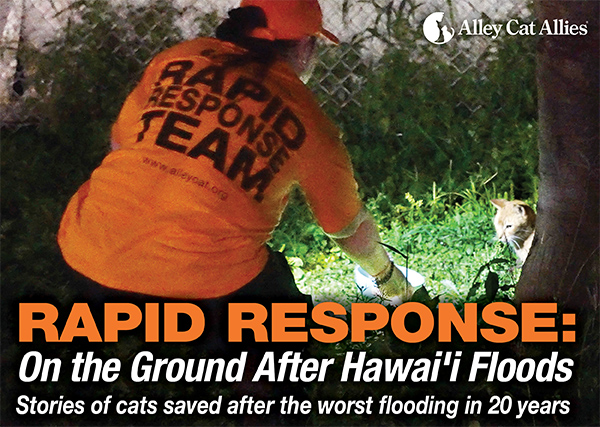
When standard emergency management systems struggled to address the immediate needs of non-human residents, the Alley Cat Allies Rapid Response Team deployed immediately. Working around the clock in treacherous conditions, the specialized animal rescue unit delivered vital sustenance, fresh water, and high-level veterinary interventions to areas cut off by the deluge.
This comprehensive report details the mobilization of the Rapid Response Team during the Oahu disaster, highlighting individual survival stories like those of Lieutenant Dan and Pumpkin, examining the operational challenges of animal rescue during extreme weather events, and outlining the imperative need for community-level disaster preparedness.
Detailed Chronology: Days in the Trenches of the North Shore
The Immediate Aftermath: Assessing the Damage
When the skies opened over Oahu, dropping inches of rain per hour and transforming quiet coastal roads into raging rivers, local caregivers were forced to evacuate or shelter in place. Once the immediate human search-and-rescue phase stabilized, the true scale of the ecological and domestic animal crisis became apparent.
Alley Cat Allies’ Rapid Response Team hit the ground running within hours of the storm’s peak. Operating in the North Shore region—an area notoriously difficult to navigate even under normal weather conditions due to narrow roadways and dense foliage—the team established mobile distribution points.
[STORM EVENT] ---> [RAPID DEPLOYMENT] ---> [GROUND ASSESSMENT] ---> [FIELD RELIEF] ---> [VET TRIAGE]
  Oahu Floods       Alley Cat Allies        North Shore Access       Food & Water       Emergency Care
  (Worst in 20 yrs)   Arrives on Scene        Navigating Mud/Debris    Provided 24/7      Fully Funded
Because floodwaters contaminate local food sources and wash away familiar landmarks, outdoor and community cats often become disoriented, starving, and acutely vulnerable to injury. The Rapid Response Team spent relentless days and nights scouring high-risk zones, setting up feeding stations, and establishing trust with local residents who knew where colonies typically congregated.
Bridging the Gap in Emergency Veterinary Care
Providing food and water was only the first line of defense. As receding waters exposed the physical wreckage left behind—including sharp debris, corrugated metal sheets, and jagged branches—cats emerged with severe lacerations, puncture wounds, and signs of secondary infections.
Recognizing that local veterinary clinics were already overwhelmed with emergency cases from across the island, Alley Cat Allies forged an immediate financial and operational partnership with regional veterinarians. Under this emergency pact, Alley Cat Allies committed to covering 100% of the medical costs for any cat rescued from the flood zones, removing financial barriers that might otherwise prevent caregivers from seeking immediate medical attention.
Inspiring Tales of Resilience: Lieutenant Dan and Pumpkin
Behind every disaster statistic lies an individual life shaped by the trauma of the event and the healing power of community compassion. Two feline survivors capture the essence of the Oahu mission.
Lieutenant Dan: The Tuxedo Survivor
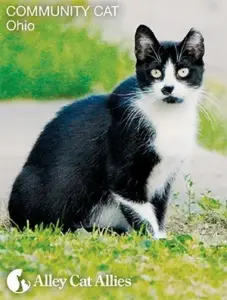
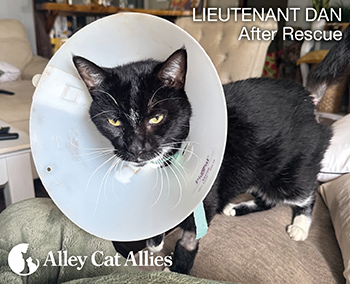
Seven-year-old Lieutenant Dan is a legendary fixture in his North Shore neighborhood. Known for his charismatic personality and striking tuxedo coat, he had earned the affection of multiple human residents who looked out for him daily.
When the historic floodwaters surged through his territory, Lieutenant Dan managed to find high ground and survived the tempest. However, the receding debris left a heavy toll: a severe, gaping laceration injury wrapped around his tail.
The moment a local caregiver caught sight of the injured cat, they acted without hesitation, rushing him to a partner veterinary clinic. Because of the emergency fund established by Alley Cat Allies, the medical team was able to immediately administer pain management, clean and suture the wound, and monitor him for signs of infection.
Once Lieutenant Dan was stitched up, pain-free, and cleared for release, his neighborhood community was waiting with open arms to bring him back to his familiar domain. His recovery stands as a testament to the symbiotic relationship between community cats and the people who love them.
Pumpkin: The Orange Tabby Who Refused to Eat
Hours after dropping off support supplies and checking on Lieutenant Dan at the veterinary clinic, the Alley Cat Allies team bore witness to another dramatic rescue. A North Shore resident rushed through the clinic doors carrying a modest pet carrier.
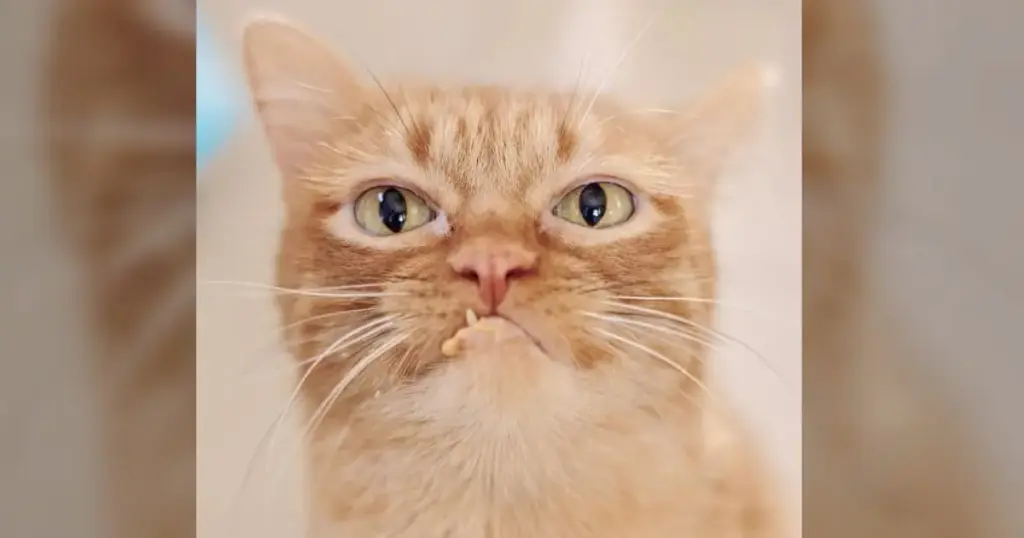
Inside was Pumpkin, an orange tabby cat discovered cowering in a zone that had been entirely submerged just days prior. When the rescuer had first placed a bowl of food near her, Pumpkin refused to touch it—a red flag for any animal lover.
Upon examination, the reason for her anorexia became agonizingly clear. Pumpkin was suffering from a painful, inflamed wound on her ear, compounded by acute psychological trauma from surviving the flood. The combination of intense pain and environmental shock had entirely suppressed her appetite.
Thanks to the collaborative intervention of the clinic staff and the financial backing of Alley Cat Allies, Pumpkin received comprehensive medical treatment for her ear. More than that, recognizing that her previous territory was too devastated for an immediate return, the rescue network coordinated a specialized foster care placement. Pumpkin was safely sheltered, nursed back to health, and nurtured until her appetite returned, paving the way for her eventual transition into a permanent, loving forever home.
Supporting Context & Metrics: The Anatomy of Animal Disaster Response
Disaster response in isolated island environments presents unique logistical hurdles. Unlike mainland operations where supplies can be trucked in across state lines within hours, emergency relief in Oahu relies heavily on air freight, pre-positioned caches, and local volunteers who understand the micro-geography of the island.
The Vulnerability of Community Cats in Floods
- Disorientation: Rapidly rising water levels erase scent markers and familiar pathways, causing cats to become lost within their own territories.
- Waterborne Pathogens: Floodwaters carry chemical runoff, sewage, and bacteria, leading to high rates of skin infections, gastrointestinal illness, and leptospirosis risks.
- Trauma and Injury: Floating debris acts as a mechanical hazard, frequently causing blunt force trauma, bone fractures, and deep lacerations.
Financial and Logistical Support Breakdown
The intervention mounted by Alley Cat Allies utilized a three-pronged approach:
- Direct Field Relief: Immediate deployment of industrial-grade pet food and bottled water caches to prevent dehydration and starvation among displaced colonies.
- Medical Underwriting: 100% coverage of emergency veterinary bills, surgical procedures, and post-operative medications for all disaster-impacted felines.
- Long-Term Placement Coordination: Facilitating foster networks and adoption pipelines for cats whose home territories were rendered completely uninhabitable by the storm.
Official Statements & Industry Insights
Animal welfare experts continue to emphasize that natural disasters of this magnitude are becoming increasingly frequent due to shifting global weather patterns, making structured emergency planning an absolute necessity rather than an afterthought.
"When disaster strikes, community cats are among the most vulnerable because they are tied to a specific outdoor landscape," notes a senior disaster response coordinator. "When that landscape is violently altered by floods, fires, or hurricanes, they cannot fend for themselves without human intervention. Our mission is to ensure that no cat is left behind simply because they do not live inside a traditional house."
Veterinary partners on the ground in Oahu echoed these sentiments, praising the agility and fiscal support provided by national organizations during local crises. The seamless coordination between grassroots caregivers, clinical professionals, and national non-profits proved to be the decisive factor in saving lives during the North Shore crisis.
Future Outlook: The Best Defense is Preparation
While the immediate emergency in Oahu has abated and survivors like Lieutenant Dan have returned to their communities while others like Pumpkin transition to safe foster environments, the broader lesson of the 2026 summer floods remains clear: Preparedness saves lives.
Disaster experts urge all cat caregivers, colony managers, and pet owners to take proactive steps well in advance of severe weather season. Emergency protocols should include:
- Identification and Tracking: Ensuring outdoor cats are microchipped or ear-tipped for rapid identification.
- Evacuation Kits: Stocking non-perishable food, potable water, carriers, and medical records in an accessible location.
- Shelter Networks: Identifying local foster networks and pet-friendly emergency shelters before disaster strikes.
For comprehensive resources, downloadable guides, and step-by-step instructions on how to safeguard cats during natural disasters, visit the official Alley Cat Allies disaster response portal at alleycat.org/Disaster. By preparing today, communities can ensure that when the next storm approaches, our feline companions are protected every step of the way.