
Executive Overview
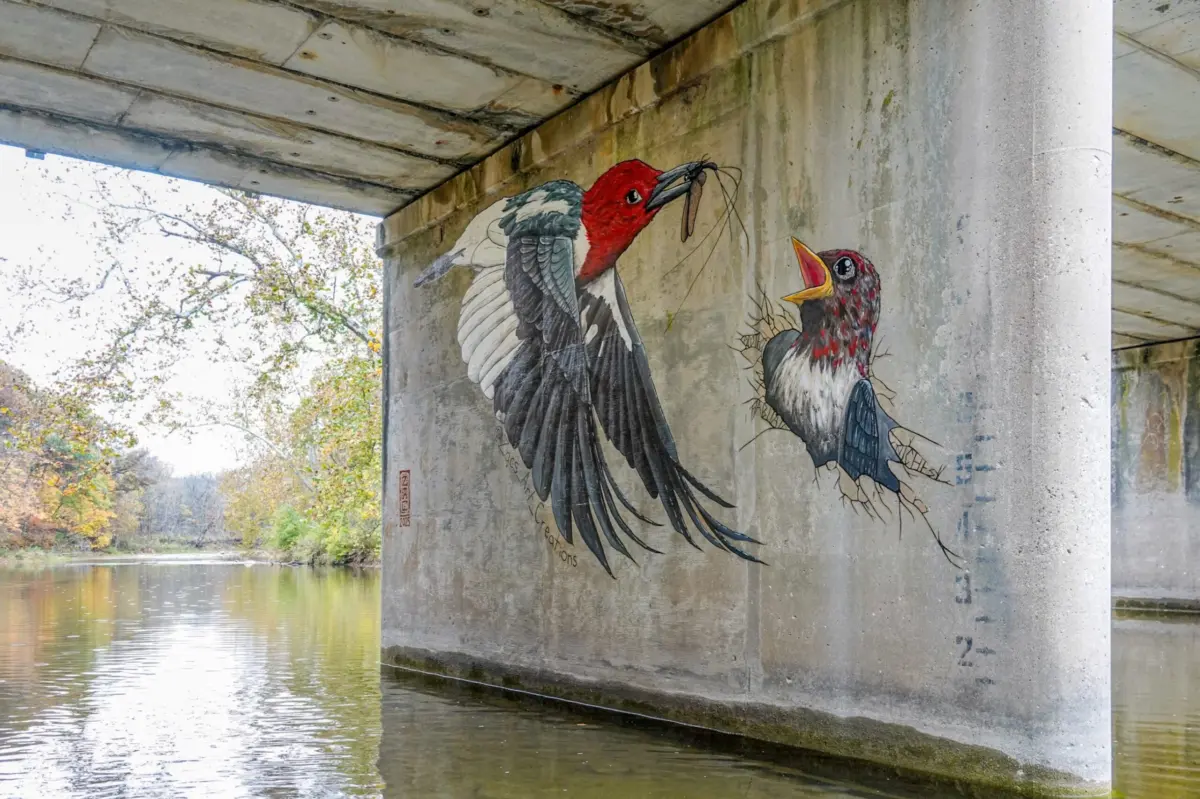
In the rolling landscapes of Warren County, Indiana, where the fertile floodplains of the Wabash River converge with the rushing waters of Big Pine Creek, a striking new monument to local biodiversity has taken root. Completed on October 7, 2025, a sweeping concrete underpass mural now commands the shadows beneath the southern pylon of the Twin Bridges. Painted by local artist Zac Cody as a proud contribution to the renowned Audubon Mural Project, the artwork depicts a vivid, high-contrast Red-headed Woodpecker clutching a mayfly, descending toward its nestling. The baby bird appears to burst dynamically out of the concrete wall itself, its beak open in anticipation, framed by three subtly woven words: "Protect," "Habitat," and "Niches."
This initiative is far more than a decorative public works project; it is the physical manifestation of a collaborative vision spearheaded by the Warren County Community Foundation. As part of an expanding public art series along the Wabash River Blueway, the mural is intentionally designed to serve as an ecological gateway. By marrying large-scale, hyper-detailed wildlife art with the raw, untamed beauty of Indiana’s waterways, local leaders and creators aim to draw residents and tourists out of their cars, down to the riverbanks, and into a deeper, more mindful relationship with the local environment.
Yet, beneath its aesthetic appeal lies a sobering environmental subtext. The Red-headed Woodpecker—once an omnipresent fixture of North America’s open woodlands and rural corridors—faces mounting ecological pressures. While still categorized by the International Union for Conservation of Nature (IUCN) as a species of "least concern," cumulative threats ranging from habitat fragmentation and competition with invasive species to the looming specter of climate change threaten to drastically shrink its geographic range. Through this lens, Cody’s mural transforms from a simple painting into a cultural touchstone: a celebration of successful local land stewardship, a warning regarding ecological fragility, and a testament to the resilience of an artist who turned personal tragedy into a full-time mission for wildlife conservation.
Detailed Chronology: From Ashes to Underpasses
The Catalyst: A 2023 Tragedy and Artistic Rebirth
The journey that led Zac Cody to the south pylon of the Twin Bridges is rooted in a moment of profound personal disruption. For years, Cody maintained a dual identity typical of many modern creatives: he pursued various artistic mediums, including painting and pottery, while paying the bills through a steady day job as a professional photographer. However, his life trajectory shifted irrevocably in 2023 when a devastating fire consumed his home.
Amid the smoke, chaos, and loss, Cody managed to salvage a single, vital possession: his watercolor paints. Standing amidst the wreckage of his former life, the disaster served as a brutal, clarifying forcing function. Rather than retreating into despair, Cody recognized the fragility of time and the urgency of purpose.
"I had a big realization," Cody recalls. "I wanted to run my own business and try and make it."
In the wake of the fire, Cody cast off the safety net of his day job, dedicating himself entirely to wildlife painting. His portfolio rapidly expanded from modest watercolor studies to ambitious, large-scale public murals. Eschewing the conventional urban settings that typically host street art, Cody deliberately sought out rural, ecologically integrated canvases. For Cody, placing murals in remote natural environments offers a distinct emotional resonance. "You mostly see murals in urban places," he notes. "लेकिन [but] they feel a little more special, hidden, and few and far between out in the country."
The Commission and the Canvas
Cody’s rising profile in the regional art scene eventually caught the attention of the Warren County Community Foundation. Executive Director Michele Stucky had been spearheading the "Blueway Art" initiative—an ambitious effort funded and coordinated through the Wabash River Blueway project to integrate visual arts with natural resource appreciation. The foundation sought artists who could capture the spirit of local fauna while encouraging public engagement with the river corridor.
By mid-2025, Cody was selected to execute a mural under the Twin Bridges crossing Big Pine Creek, a critical ecological artery flowing into the Wabash River. The site presented unique technical and conceptual challenges. The underpass, characterized by drifting shadows and damp, textured concrete surfaces, demanded an approach that would command attention without clashing with the surrounding topography.
Working methodically throughout late summer and early autumn, Cody utilized broad, dynamic strokes of black and white paint, punctuated by the unmistakable, fiery splash of the adult woodpecker’s crimson head. By October 7, 2025, the mural was officially completed. During the painting process, Cody experienced a serendipitous validation of his subject matter: he personally counted three live Red-headed Woodpeckers foraging near the site—an encouraging biological indicator that the riparian ecosystem of Big Pine Creek remains remarkably healthy.
Supporting Context & Metrics: The Ecology of the Red-headed Woodpecker
Habitat, Behavior, and Ecological Indicators
To fully appreciate the significance of Cody’s mural, one must understand the ecological niche occupied by its avian subject (Melanerpes erythrocephalus). Recognized instantly by its bold, checkerboard pattern of black-and-white wing patches and a brilliant, firetruck-red head and neck, this species has long been a charismatic symbol of North America’s open woodlands, savannas, agricultural edges, and riverine clearings.
Unlike many other woodpecker species that rely strictly on living timber for foraging, Red-headed Woodpeckers are opportunistic omnivores and master aerial acrobats. They are frequently observed launching themselves in erratic, swooping arcs from a high perch to snap flying insects out of the air—a behavior vividly captured in Cody’s depiction of the adult bird delivering a mayfly to its nestling. They also cache food items, wedging seeds, nuts, and insects into crevices in bark, fence posts, and wooden poles.
Crucially, the presence of Red-headed Woodpeckers serves as a bioindicator of ecosystem health. Because they rely heavily on standing dead trees (snags) for cavity nesting, their population density directly reflects the quality of local forest management and land stewardship. As Michele Stucky observed:
“[The mural] is a nod to good land stewardship. If you have the Red-headed Woodpecker here, it means you’re doing a good job with how you’re taking care of the land.”
The Gathering Storm: Threats and Climate Projections
Despite their historical abundance across the eastern and central United States, Red-headed Woodpecker populations have experienced steady, concerning declines over the past several decades. Ornithologists and conservation biologists attribute these downward trends to a convergence of anthropogenic pressures:
- Habitat Loss and "Sanitized" Landscapes: The modern forestry and agricultural practice of removing standing dead trees and fallen timber deprives the woodpeckers of critical nesting cavities and foraging grounds.
- Invasive Competitors: The proliferation of non-native European starlings has introduced intense competition for available nesting sites. Starlings frequently harass and evict Red-headed Woodpeckers from established cavities.
- Roadside Mortality: Because these birds frequently forage for insects along roadside clearings and gravel berms, their slow, low-altitude flight paths make them highly vulnerable to vehicular strikes.
While the IUCN currently lists the species as of "least concern," long-term climate models paint a much more precarious picture. According to comprehensive projections from the National Audubon Society’s landmark Survival by Degrees report, continued greenhouse gas emissions and rising global temperatures could severely disrupt the species’ breeding distribution. If warming trends continue at their current pace, Red-headed Woodpeckers stand to lose an alarming 94 percent of their current summer breeding range, threatening the species with catastrophic geographic contraction.
Official Statements and Community Vision
The unveiling of the Twin Bridges mural has ignited enthusiastic discussions among municipal leaders, conservationists, and local residents regarding the intersection of public art and environmental advocacy.
Michele Stucky, Executive Director of the Warren County Community Foundation:
Stucky’s primary motivation for commissioning the Blueway Art series was to combat modern sedentary habits by creating tangible lures to the outdoors. The foundation recognized that traditional signage often fails to capture public imagination, whereas immersive art creates an emotional tether to the landscape.
“Because the mural is so detailed, it will make them want to get closer, whether that be taking off their shoes and wading over or bringing a kayak to get right next to it,” Stucky explained during the project’s launch. “We’re using the mural to encourage people to come and see the space, and then we’re hoping that they’ll want to spend longer there.” By extending the duration of visitor stays, the foundation hopes to foster organic appreciation for watershed conservation, water quality monitoring, and habitat preservation along the Wabash River corridor.
Zac Cody, Artist and Wildlife Educator:
For Cody, mural painting is not merely an exercise in aesthetic decoration, but an act of rigorous scientific translation. To maintain absolute anatomical and behavioral accuracy in his work, Cody engages in exhaustive independent study, researching the specific ecological niches and life histories of his animal subjects.
When sharing his creative process with his growing digital audience via his social media platform (@zacs_art_creations), Cody routinely pairs visual reveals with educational breakdowns of avian biology. He views this educational layer as essential to bridging the empathy gap between humans and wildlife.
“What I like to do with my art is highlight unseen things,” Cody reflects. “I like to do wildlife up close because it’s a perspective that, if you’re not a photographer or sitting in the woods watching animals, you don’t always see.”
By embedding the words "Protect," "Habitat," and "Niches" directly into the splintering concrete matrix surrounding the young woodpecker’s head, Cody intentionally forces viewers to confront the philosophical underpinnings of conservation. The design suggests that nature is not merely something to be passively observed, but an intricate, fragile architecture that requires active human defense.
Future Outlook: The Intersection of Art and Conservation in Warren County
As public interest in the Wabash River Blueway continues to swell, the success of Zac Cody’s Red-headed Woodpecker mural provides a scalable blueprint for rural conservation initiatives across the American Midwest. By leveraging regional community foundations and local artistic talent, municipalities can transform neglected civil infrastructure—such as bridge underpasses, culverts, and retaining walls—into open-air galleries that double as environmental classrooms.
Looking ahead, the Warren County Community Foundation plans to evaluate the impact of the Blueway Art series on local tourism metrics, recreational kayak rentals, and volunteer participation in watershed clean-up efforts. Conservationists are also eyeing the project as a potential model for grassroots educational campaigns aimed at mitigating the threats faced by vulnerable native species. For instance, pairing public art installations with community-led initiatives—such as the construction of artificial nesting boxes, the preservation of agricultural snags, and public education campaigns regarding roadside wildlife safety—can directly translate aesthetic appreciation into concrete conservation outcomes.
Ultimately, the underpass beneath the Twin Bridges stands as a poignant reminder of ecological resilience. As commuters and paddlers pass through the drifting shadows of Big Pine Creek, they are greeted by the striking visage of a baby woodpecker bursting through solid concrete—a powerful visual metaphor for life breaking through barriers, demanding space, and reminding humanity of its solemn duty to protect the fragile niches that sustain us all.