
Executive Overview
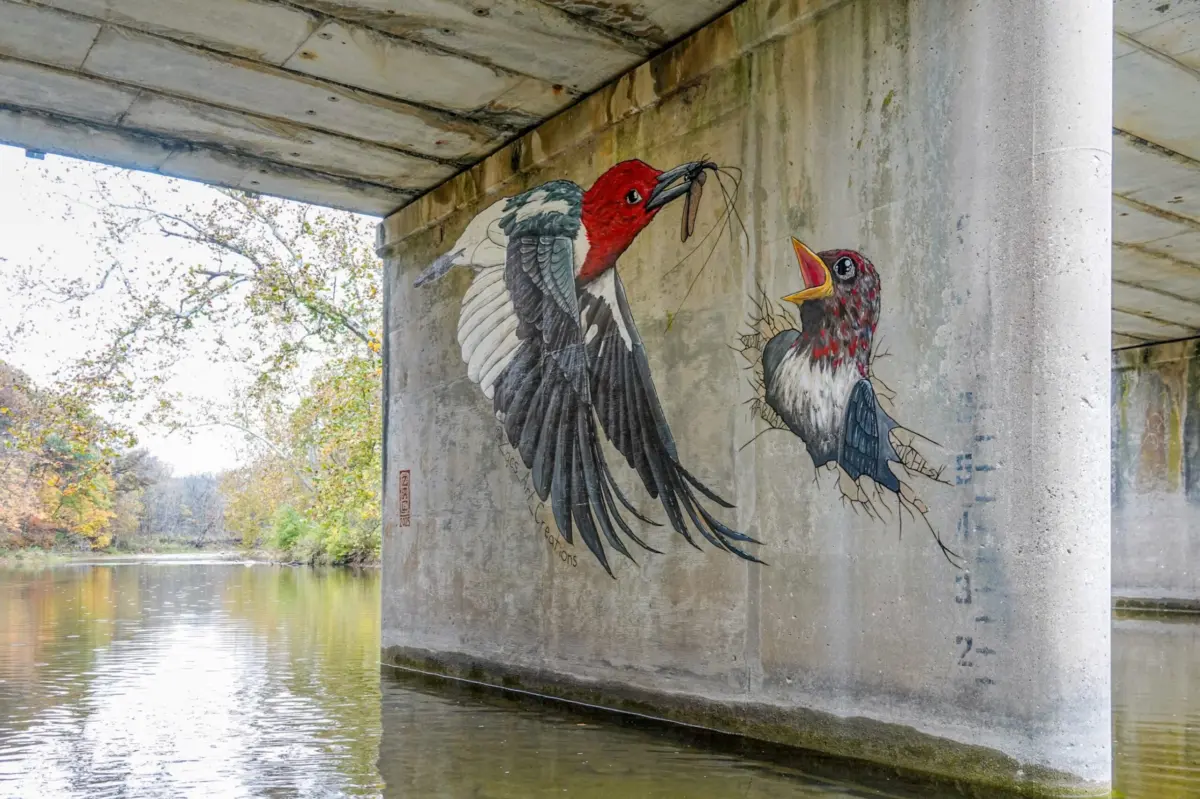
In the heart of rural Indiana, where the sprawling agricultural fields give way to the winding corridors of the Wabash River and its tributaries, a striking new work of public art has emerged from the shadows of heavy civil infrastructure. Painted on October 7, 2025, a magnificent large-scale mural now graces the southern pylon of the Twin Bridges spanning the Big Pine Creek in Warren County. Created by local artist and photographer Zac Cody for the renowned Audubon Mural Project, the artwork depicts a vibrant Red-headed Woodpecker clutching a mayfly, descending to feed its eager, concrete-breaking nestling.
More than merely an aesthetic enhancement to a concrete underpass, this mural serves as a physical manifestation of a broader regional initiative. Commissioned by the Warren County Community Foundation as part of the Wabash River Blueway art series, the project is purposefully designed to draw people out of their homes and into the natural landscape. By marrying breathtaking visual storytelling with critical environmental messaging—subtly weaving the words “Protect,” “Habitat,” and “Niches” into the fractured concrete design—the mural functions as both an invitation to recreation and a stark reminder of the ecological fragility of the American Midwest.
This enterprise arrives at a pivotal ecological moment. While the Red-headed Woodpecker remains classified globally as a species of least concern, its populations have faced persistent, stealthy declines over recent decades due to shifting land-use practices, invasive species competition, and vehicular strikes. Compounding these local pressures, continental climate models project that rising global temperatures could strip the species of up to 94 percent of its current summer breeding range. Through this lens, Cody’s mural transcends local beautification; it stands as a sentinel for land stewardship, a celebration of regional biodiversity, and a deeply personal testament to an artist who rebuilt his life around the very nature he portrays.
Detailed Chronology: From Ashes to Underpass
The Catalyst: A 2023 Tragedy and Artistic Rebirth
To understand the depth and emotional resonance of the Big Pine Creek mural, one must first look at the journey of its creator, Zac Cody. For years, Cody maintained a classic duality familiar to many creative professionals: he pursued various artistic mediums, including painting and pottery, while paying the bills through a steady day job as a professional photographer. His life took an abrupt, dramatic turn in 2023 when a catastrophic fire completely destroyed his home.
Amidst the devastation and loss of his worldly possessions, Cody managed to salvage a single, vital tool: his watercolor paints. Standing amidst the charred remains of his residence, the disaster forced a profound psychological and professional reckoning.
"I had a big realization," Cody recalls of the immediate aftermath. "I wanted to run my own business and try and make it."
This crucible moment stripped away hesitation. Cody made the definitive choice to pivot away from conventional employment, dedicating himself entirely to full-time wildlife painting and large-scale muralism. Rather than letting tragedy defeat him, he channeled the experience into a laser-focused drive to capture the natural world with unprecedented urgency and precision.
The Vision of the Warren County Community Foundation
Parallel to Cody’s personal renaissance, civic leaders in west-central Indiana were laying the groundwork for a unique cultural and environmental initiative. Michele Stucky, executive director of the Warren County Community Foundation, recognized an untapped potential in the region’s waterways. Through the Wabash River Blueway art series, the foundation set out to commission a collection of high-caliber public art pieces depicting native wildlife along the river and its major tributaries, such as Big Pine Creek.
Stucky’s vision was holistic. She recognized that public art in rural settings could serve a dual purpose: enriching the visual landscape while acting as a catalyst for ecotourism and public engagement. Traditional murals are overwhelmingly concentrated in dense urban cores, where foot traffic is guaranteed. Stucky and the foundation, however, sought to decentralize public art, embedding it directly into the wild, rugged terrain of rural Indiana.
When the opportunity arose to partner with the Audubon Mural Project—an ambitious national initiative dedicated to painting climate-threatened birds across North America—the partnership with Cody proved to be an ideal match.
Execution on the Concrete Pylon: October 7, 2025
On October 7, 2025, Cody brought his vision to the southern pylon of the Twin Bridges over Big Pine Creek. Utilizing broad, deliberate strokes of black and white paint contrasted with a shock of firetruck-red, he transformed a cold, utilitarian concrete underpass into a dynamic ecosystem.
The composition is intentionally dramatic. Cast in the drifting natural shadows of the bridge structure, the adult Red-headed Woodpecker swoops downward, a delicate mayfly held firmly in its beak. Below, its nestling appears to burst outward from the very fabric of the concrete wall itself, its bright eyes shining with hunger as its beak opens wide to receive the meal.
This trompe-l’œil effect—giving the illusion that the bird is emerging from the physical bridge—draws the viewer into an intimate, microscopic narrative. Woven seamlessly into the splintering, textured design surrounding the baby bird’s head are three foundational ecological words: “Protect,” “Habitat,” and “Niches.”
Supporting Context & Metrics: Ecology, Environment, and Art
The Avian Subject: The Red-headed Woodpecker (Melanerpes erythrocephalus)
The choice of the Red-headed Woodpecker for this specific ecological installation is both deeply appropriate and scientifically telling. Historically, this species was an absolute fixture throughout the eastern and central United States. Instantly recognizable by its striking tri-color pattern—a solid, vibrant red head, stark black back and tail, and brilliant white patches on its wings and underparts—the bird is a visual icon of North American ornithology.
+--------------------------------------------------------------------------+
|                     RED-HEADED WOODPECKER AT A GLANCE                    |
+--------------------------+-----------------------------------------------+
| Scientific Name          | Melanerpes erythrocephalus                    |
+--------------------------+-----------------------------------------------+
| Visual Characteristics   | Firetruck-red head, black back/tail,          |
|                          | white wing patches                            |
+--------------------------+-----------------------------------------------+
| Primary Habitat          | Open deciduous forests, orchards, clearings,  |
|                          | dead timber stands                            |
+--------------------------+-----------------------------------------------+
| IUCN Conservation Status | Least Concern (with localized population      |
|                          | pressures)                                    |
+--------------------------+-----------------------------------------------+
| Primary Threats          | Loss of dead trees, European starling         |
|                          | competition, roadside vehicle strikes,        |
|                          | climate change range loss (up to 94%)         |
+--------------------------+-----------------------------------------------+
Unlike many other woodpecker species that spend their time methodically drilling into live tree bark for hidden larvae, the Red-headed Woodpecker is an exceptionally agile aerial hunter. They are well-known for launching themselves from high perches in open habitats—such as dead timber stands, orchards, and forest clearings—to catch flying insects mid-air. They also possess a notoriously harsh, rattling call that echoes clearly across open landscapes.
Ecological Indicators and Local Stewardship
Despite its current classification by the International Union for Conservation of Nature (IUCN) as a species of "Least Concern," ornithologists and conservationists monitor the Red-headed Woodpecker closely because it acts as an ecological barometer.
During the process of painting the mural along Big Pine Creek, artist Zac Cody noted that he personally counted three live Red-headed Woodpeckers in the immediate vicinity. For environmental experts, this is not merely a pleasant coincidence; it is a clear biological indicator of a healthy, functioning riparian habitat.
"It’s a nod to good land stewardship," notes Michele Stucky. "If you have the Red-headed Woodpecker here, it means you’re doing a good job with how you’re taking care of the land."
The presence of these birds requires specific environmental conditions, most notably the availability of standing dead trees (snags) which are essential for nesting and roosting. Modern forestry and agricultural practices frequently remove these snags for aesthetic or neatness reasons, inadvertently robbing cavity-nesting species of their homes. Furthermore, invasive species like the European starling aggressively compete with native woodpeckers for available nest cavities, frequently evicting them. Additionally, because these woodpeckers regularly forage for insects along sun-warmed roadsides, they suffer disproportionately high rates of vehicle strikes.
The Looming Shadow of Climate Change
While local habitat management can mitigate immediate threats, continental-scale pressures present a formidable challenge to the species’ long-term survival. According to comprehensive projections published in the National Audubon Society’s landmark Survival by Degrees report, unchecked anthropogenic climate change threatens to fundamentally upend the distribution of North American birds.
The models paint a stark picture for Melanerpes erythrocephalus. If global carbon emissions and warming continue at their current trajectory, the Red-headed Woodpecker could lose an astounding 94 percent of its current summer breeding range. As temperature zones shift northward and historical ecosystems experience severe disruptions from droughts, extreme weather events, and changing floral communities, the birds will face unprecedented pressure to adapt or perish. It is precisely this looming, macro-level ecological crisis that gives the word “Protect” in Cody’s mural such profound, urgent weight.
Official Statements and Stakeholder Perspectives
The integration of fine art, public infrastructure, and wildlife conservation has generated a chorus of enthusiastic commentary from the various stakeholders involved in bringing the Big Pine Creek mural to life.
Bridging the Gap Between Concrete and Water
For Michele Stucky and the Warren County Community Foundation, the project was engineered from the outset to be experiential rather than merely observational. Standard public art is viewed passively from a sidewalk or a car window; the Twin Bridges mural demands physical participation.
"Because the mural is so detailed, it will make them want to get closer, whether that be taking off their shoes and wading over or bringing a kayak to get right next to it," Stucky explains, highlighting the deliberate design strategy behind the site selection. "We’re using the mural to encourage people to come and see the space, and then we’re hoping that they’ll want to spend longer there."
By placing world-class wildlife art in a rugged, semi-remote river setting, the foundation is successfully shifting the paradigm of rural tourism. Visitors drawn to the striking imagery of the baby woodpecker bursting from the concrete pylon are simultaneously introduced to the broader recreational opportunities of the Wabash River Blueway, fostering a deeper, lasting personal connection to the watershed.
The Artist’s Perspective: Intimacy and Education
For Zac Cody, creating art in rural and natural environments offers a distinct advantage over traditional urban gallery spaces or downtown building walls. Operating under the creative moniker Zac’s Art Creations, Cody views his work as an educational mission for both himself and his audience.
"You mostly see murals in urban places," Cody observes, reflecting on his choice of canvas. "Pero they feel a little more special, hidden, and few and far between out in the country."
To achieve the striking realism that characterizes his work, Cody refuses to rely on superficial depictions. He engages in rigorous preparatory research, studying the precise anatomical structures, behavioral patterns, and micro-habitats of his subjects. When he documents his process and shares his finished pieces across his social media channels, he routinely pairs the visuals with detailed educational trivia about the biology of the species.
This pedagogical approach is central to his artistic philosophy. By breaking down the barrier between humans and wildlife through hyper-realistic, intimate portrayals, Cody hopes to awaken a protective instinct in everyday observers.
"What I like to do with my art is highlight unseen things," Cody notes. "I like to do wildlife up close because it’s a perspective that, if you’re not a photographer or sitting in the woods watching animals, you don’t always see."
Future Outlook: The Intersection of Art and Environmental Advocacy
As public art continues to evolve in the 21st century, projects like the Red-headed Woodpecker mural on Big Pine Creek point toward a powerful new paradigm for community development and environmental advocacy. By transforming mundane civil infrastructure—bridges, underpasses, and pylons—into sprawling canvases for native biodiversity, communities can achieve multiple goals simultaneously:
- Placemaking and Tourism: Creating unique, high-value visual landmarks that draw visitors into rural and natural economies.
- Environmental Education: Using powerful visual imagery to spark curiosity about local ecosystems, native species, and conservation challenges.
- Ecological Mindfulness: Reminding the public of our shared responsibility to practice sound land stewardship, ensuring that future generations can witness the real birds just as vividly as they see them rendered on the concrete.
For Warren County, Indiana, the southern pylon of the Twin Bridges is no longer just a structural support holding up asphalt and vehicular traffic. It has become a vibrant monument to resilience—echoing the personal renewal of its creator, Zac Cody, and the enduring spirit of a remarkable, fiery-headed bird fighting to maintain its niche in a changing world. As kayakers paddle down Big Pine Creek and waders pause in the cool waters beneath the bridge, they are greeted not by gray anonymity, but by a bold, unyielding call to action painted in black, white, and red: Protect. Habitat. Niches.