
Fact-checked by Kenn Kaufman, Field Editor, Audubon Magazine
Executive Overview
When birdwatchers and naturalists conjure mental images of North America’s avifauna, a palette of earthy browns, striking yellows, midnight blacks, and brilliant blues typically dominates. True pink birds are surprisingly scarce across the continent. Even when casting a wide net that includes rare vagrants, minimal plumage highlights, and subspecies, fewer than a dozen species proudly display shades of pink in North America.
Yet, this biological rarity makes encounters with these blush-toned species all the more memorable. From the iconic, long-legged waders of the southern estuaries to elusive high-altitude finches and iridescent backyard hummingbirds, North America’s pink birds represent an astonishing display of evolutionary adaptation.
The mechanisms behind these captivating hues are as diverse as the species themselves. While the striking coloration of the American Flamingo and the Roseate Spoonbill is entirely dependent on their diets, hummingbirds owe their electric pink flashes to microscopic structural architecture within their feathers. Finches, meanwhile, derive their reddish-pink pigments directly at the genomic level.
As climate change shifts historical ranges, weather patterns push vagrant populations northward, and conservationists race to protect specialized high-elevation habitats, understanding these colorful birds has never been more critical. This comprehensive report explores the biology, identification, geographic distribution, and conservation outlook of North America’s extraordinary pink avian species.
Detailed Taxonomy and Morphological Breakdown
To properly appreciate North America’s pink avifauna, one must examine how different species achieve their coloration, alongside their distinct physical and behavioral morphologies.
The Waders: Flamingos and Spoonbills
North America plays host to two large, long-legged wading birds that immediately capture attention with their striking pink plumage: the American Flamingo (Phoenicopterus ruber) and the Roseate Spoonbill (Platalea ajaja).
- The American Flamingo: Often mistakenly thought of as a permanent fixture of Florida’s native landscape, historical records indicate that stable, self-sustaining breeding populations have historically been absent or sparse. However, recent ecological shifts—including wild birds blown inland by intensifying tropical storms—have established year-round residency in the Sunshine State, raising hopes of a permanent breeding comeback in places like the Everglades and Florida Bay. The flamingo stands apart due to its entirely pink body, long serpentine neck, and heavily curved, black-tipped bill engineered for inverted underwater foraging.
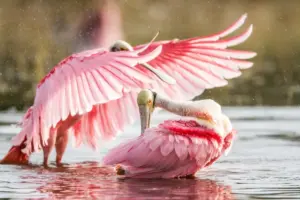
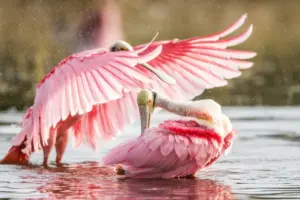
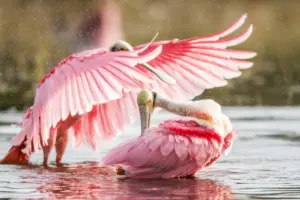
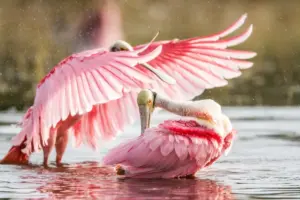
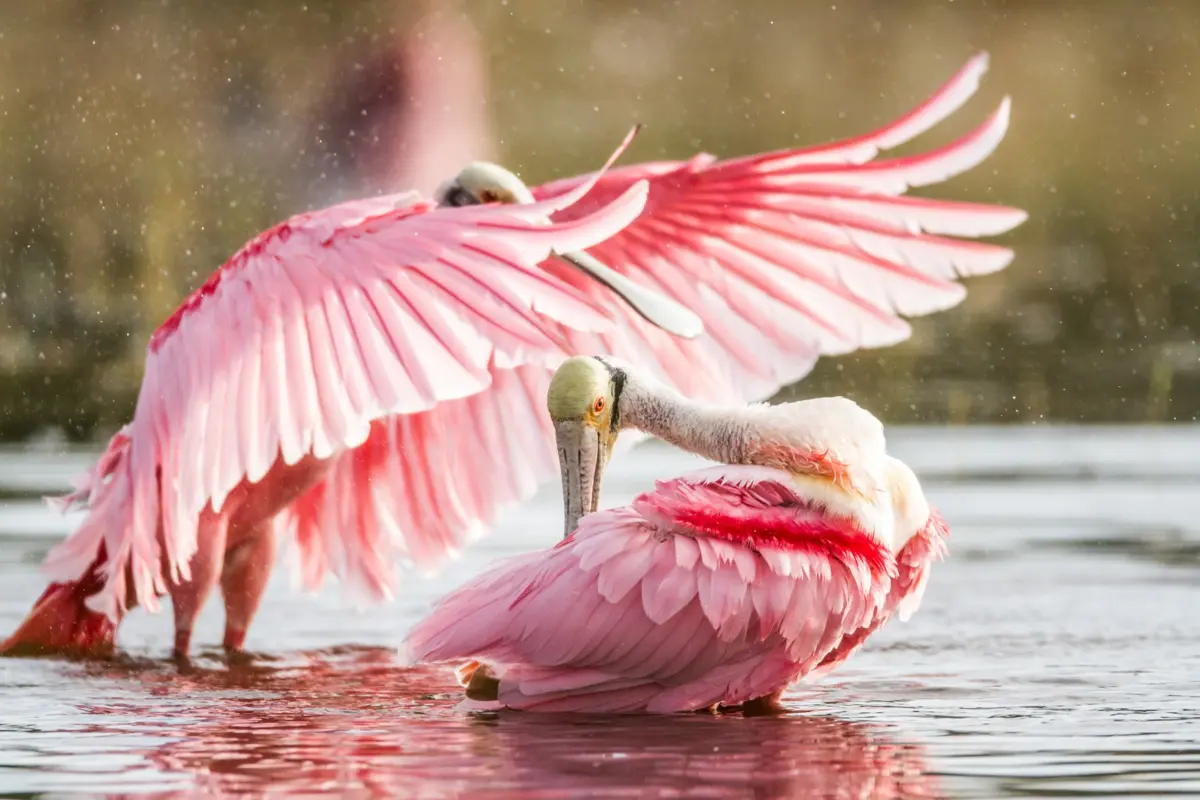
- The Roseate Spoonbill: Considerably more common than its flamingo counterpart, the Roseate Spoonbill maintains a healthy, stable population year-round along the Gulf Coast and southern Florida. While distant flocks might evoke the silhouette of a flamingo, the spoonbill’s extraordinary, paddle-shaped bill immediately distinguishes it. Foraging in coastal shallows, estuaries, and brackish wetlands, the spoonbill swings its sensor-rimmed bill in wide lateral arcs to sweep up small fish and crustaceans. Unlike the entirely pink flamingo, the spoonbill features a stark white neck and a greenish, unfeathered head. In recent years, populations have expanded their range northward, signaling changing wetland dynamics.
The Iridescent Icons: Hummingbirds
North America hosts three hummingbird species featuring brilliant flashes of pink, relying on physics rather than pigment for their striking displays.
- Anna’s Hummingbird (Calypte anna): When struck by direct sunlight, the head of a male Anna’s Hummingbird glows with an electric pink iridescence. Unlike most hummingbird species, Anna’s possess iridescent feathers covering both their crown and their gorget (throat patch). Year-round residents along the Pacific Coast and down through southern Arizona, they are frequent, welcomed visitors to backyard gardens and nectar feeders.
- Calliope Hummingbird (Selasphorus calliope): The smallest bird breeding in North America, the male Calliope sports a distinctive, fragmented gorget that flares outward during territorial displays, flashing in shades ranging from soft pink to vibrant magenta. Its summer range spans Northern California, the Intermountain West, the Pacific Northwest, and into western Canada.
- Broad-tailed Hummingbird (Selasphorus platycercus): Familiar to hikers and residents across the Mountain West and southwestern states, male Broad-tailed Hummingbirds feature a glowing rose-pink gorget. Preferring high-elevation forests and alpine meadows, their wings produce a distinct, metallic buzzing sound in flight that serves as an acoustic calling card.
The Seed-Eaters: Common and Rare Finches
The remaining pink bird species belong to the finch family (Fringillidae), where complex genetics and dietary carotenoids dictate their plumage.
- Purple Finch (Haemorhous purpureus): Despite its name, the male Purple Finch exhibits a wash of red plumage ranging from deep maroon to bright raspberry pink. Breeding primarily in Canada’s boreal forests and overwintering across the eastern United States, they are regular feeder visitors, particularly during cyclical "irruption" years when food shortages push them southward.
- Cassin’s Finch (Haemorhous cassinii): A western counterpart to the Purple Finch, the male Cassin’s Finch features a soft pink breast and face paired with a bright crimson, spiky crown. Highly nomadic, these conifer-loving birds prefer high elevations and are frequently heard singing from the tops of trees.
- The Rosy-Finches (Black, Brown-capped, and Gray-crowned): These three high-elevation specialists are the holy grail for dedicated North American birders. The Black Rosy-Finch (Leucosticte atrata) inhabits the highest elevations of the Great Basin, combining black, brown, and gray body feathers with bold pink highlights on its wings and belly. The Brown-capped Rosy-Finch (Leucosticte australis) is restricted almost exclusively to the highest peaks of the Rocky Mountains from Wyoming to New Mexico, displaying a more subdued brown-and-pink palette. Finally, the Gray-crowned Rosy-Finch (Leucosticte tephrocotis), the most widespread of the three, nests from western Alaska down to California and northern Montana, sporting a distinct gray cap alongside its pink belly markings.
Supporting Context & Nutritional Science: Why Are They Pink?
The physiological mechanisms driving pink coloration in North American birds are fascinatingly diverse, rooted in biochemistry, physics, and evolutionary genetics.
+-----------------------------------------------------------------+
|              BIOLOGICAL MECHANISMS OF PINK PLUMAGE              |
+----------------------+------------------------------------------+
| Mechanism Type       | Biological Process & Contributing Species|
+----------------------+------------------------------------------+
| Dietary Carotenoids  | Ingestion of pigments from algae, shrimp,|
|                      | and crustaceans.                         |
|                      | * American Flamingo                      |
|                      | * Roseate Spoonbill                      |
+----------------------+------------------------------------------+
| Microscopic Physics  | Light refraction via specialized air     |
| (Structural Color)   | bubble structures in feather barbules.   |
|                      | * Anna’s Hummingbird                     |
|                      | * Calliope Hummingbird                   |
|                      | * Broad-tailed Hummingbird               |
+----------------------+------------------------------------------+
| Genomic Regulation   | Metabolic conversion of ingested         |
|                      | pigments into red/pink keratin at        |
|                      | the cellular level.                      |
|                      | * Purple & Cassin's Finches              |
|                      | * Rosy-Finches                           |
+----------------------+------------------------------------------+
The Carotenoid Connection
For the American Flamingo and the Roseate Spoonbill, pigmentation is directly tied to the food web. These waders consume diets heavy in aquatic invertebrates, such as brine shrimp, crabs, crayfish, and small fish, which in turn feed on microalgae rich in carotenoids—natural red, orange, and yellow organic pigments.
As the birds digest these organisms, the carotenoid pigments are broken down and deposited into their growing feathers. A well-nourished flamingo feeding in a thriving, undisturbed ecosystem will display a deep, vibrant rose color, whereas captive or malnourished birds often fade to a pale, washed-out white or light pink.
Structural Iridescence in Hummingbirds
Unlike flamingos, hummingbirds do not get their color from what they eat. The brilliant pink gorgets of Anna’s, Calliope, and Broad-tailed Hummingbirds are the result of structural coloration.
The barbules of their throat feathers contain microscopic, air-filled platelet structures. When light hits these nanoscale layers, it interferes constructively and destructively, reflecting specific wavelengths while canceling out others. This structural "pancake" arrangement creates an intense metallic iridescence that appears to shift from dull gray to glowing neon pink depending entirely on the angle of the observer and the sun.
Genomic Processing in Finches
For North America’s pink-hued finches, coloration is controlled at the genomic level. These birds ingest carotenoids through seeds and buds, but their bodies must possess the specific genetic machinery required to metabolize and chemically alter these dietary pigments into ketocarotenoids, which are then deposited into growing feathers during molting cycles.
Geographic Distribution and Where to Find Them
Because North America’s true pink birds are relatively sparse, locating them requires targeted geography and seasonal timing.
Wetland Waders
- Roseate Spoonbills: To observe these striking waders, birders should visit reliable Gulf Coast strongholds. Prime locations include Florida’s J.N. "Ding" Darling National Wildlife Refuge on Sanibel Island or the Smith Oaks Rookery in High Island, Texas, during the spring breeding season.
- American Flamingos: While historically sporadic, vagrant wild populations can now be reliably sought in extreme southern Florida. The shallow flats of Everglades National Park, Biscayne Bay, and the Florida Keys offer the highest probability of sighting wild individuals.
Western Hummingbirds
- Anna’s Hummingbird: Easily encountered year-round in parks, suburban gardens, and wild chaparral along the entire Pacific Coast, from Washington down through California and into southern Arizona.
- Calliope & Broad-tailed Hummingbirds: Best observed during the spring and summer months along high-elevation mountain trails throughout the Intermountain West, Pacific Northwest, and western Canada. Backyard nectar feeders within their native ranges remain the most foolproof method for close observation.
High-Elevation Finches and Nomads
- Purple & Cassin’s Finches: Both species readily frequent backyard feeding stations offering black oil sunflower seeds and safflower. Purple Finches prefer eastern deciduous forests and boreal breeding grounds, while Cassin’s Finches favor high-altitude western conifer forests.
- The Rosy-Finches: Observing all three rosy-finch species requires specialized travel. While the Brown-capped and Black Rosy-Finches are restricted to isolated alpine zones in the Rockies and Great Basin, the summit of Sandia Crest, New Mexico, stands alone as the only location in North America where all three species (Black, Brown-capped, and Gray-crowned) can routinely be observed together during the winter months.
Conservation Outlook and Ecological Future
The conservation status of North America’s pink-feathered species varies widely, reflecting broader environmental challenges facing wetlands, boreal forests, and alpine peaks.
Wetland Restoration and Climate Pressures
Roseate Spoonbills and American Flamingos serve as vital biological indicators of wetland health. In South Florida, the comprehensive restoration of the Everglades ecosystem has a direct, positive correlation with the recovery of wading bird nesting colonies. As water management practices improve and historic sheet-flow patterns return to the River of Grass, wading bird populations are experiencing expanded breeding success and wider geographic dispersal. However, rising sea levels and intensifying tropical cyclone activity driven by global climate change pose ongoing threats to coastal nesting colonies.
High-Altitude Vulnerabilities
The Rosy-Finches—particularly the Brown-capped and Black species—face acute ecological pressures. Restricted to fragile, high-altitude alpine zones above the tree line, these birds are acutely vulnerable to global warming. As temperatures rise, alpine ecosystems shrink upward, reducing the availability of the cold, windswept talus slopes and snowfields where these birds forage for seeds and dormant insects. Conservation biologists monitor these populations closely, utilizing community science platforms like eBird to track shifting distribution ranges.
Frequently Asked Questions
Q: What is the most common pink bird in North America?
A: Among birds that display true pink plumage, the Anna’s Hummingbird and the Broad-tailed Hummingbird are arguably the most widespread and commonly encountered across the western United States. Among seed-eaters, the Purple Finch and Cassin’s Finch are also abundant across their respective regional ranges.
Q: Why do captive flamingos sometimes lose their pink color?
A: Captive flamingos lose their vibrant pink coloration if their diet lacks sufficient carotenoid pigments. In the wild, they consume brine shrimp and algae rich in these organic compounds. Zoos compensate for this by supplementing captive diets with specialized carotene-rich additives, such as extracted canthaxanthin or crushed krill.
Q: How can I attract pink birds to my backyard?
A: Homeowners living within the appropriate geographic ranges can easily attract hummingbirds using standard nectar feeders filled with a simple 4:1 ratio of water to refined white sugar. For Cassin’s and Purple Finches, offering black oil sunflower seeds and safflower in hanging tube feeders provides an irresistible food source.
Q: Are Roseate Spoonbills related to flamingos?
A: Despite sharing a similar pink coloration and wetland habitat, Roseate Spoonbills and American Flamingos are not closely related. Spoonbills belong to the order Pelecaniformes (closely related to ibises and herons), while flamingos belong to their own distinct order, Phoenicopteriformes, having evolved from a separate ancient lineage.