
Executive Overview
In an era dominated by high-definition digital databases, real-time audio recognition algorithms, and crowd-sourced biodiversity apps, physical field guides occupy a curious space. Once the indispensable companions of naturalists, ornithologists, and weekend birders, these heavily bound volumes now frequently gather dust on bookshelves, replaced by the instant accessibility of eBird, the Merlin Bird ID app, and iNaturalist. For many nature enthusiasts, however, discarding these dog-eared volumes feels akin to discarding old friends.
Enter the creative conservation movement of field guide upcycling—a tactile, imaginative craft that transforms redundant, outdated, or duplicate identification books into bespoke textile-and-paper art. By marrying the precision of natural history illustration with the meditative practice of "cross-out poetry" and hand embroidery, makers are finding novel ways to honor the literature of the natural world. This comprehensive report explores the phenomenon of repurposing field guides, detailing the step-by-step methodology behind cross-out poetry, examining the broader cultural shift toward tactile crafts in a hyper-digital age, and offering a forward-looking perspective on how conservationists and artists alike are redefining the lifecycle of printed educational media.
Detailed Chronology: The Evolution from Shelf-Bound Reference to Textile Art
To understand the current renaissance of field guide crafting, one must trace the lifecycle of these printed manuals from their golden age of field utility to their current resting place in secondhand bookshops and garage sales.
Phase I: The Golden Age of Print Reference (Mid-to-Late 20th Century)
For decades, authoritative paperbacks—ranging from the iconic Peterson Field Guides to the sprawling volumes of the National Audubon Society—served as the primary gatekeepers of ecological knowledge. Birders, botanists, and marine biologists spent countless hours flipping through heavily illustrated pages, cross-referencing range maps, plumage descriptions, and morphological markers. Over time, enthusiastic amateurs amassed vast collections: local guides for their home states, aspirational tropical guides for dream vacations to Costa Rica or Australia, and specialized taxonomic manuals dedicated solely to butterflies, coral reefs, and alpine wildflowers.
Phase II: The Digital Disruption (Early 21st Century)
The proliferation of smartphones fundamentally altered how humans interact with nature. Digital platforms democratized species identification through machine learning, high-resolution photography databases, and acoustic monitoring tools. While these advancements revolutionized field research and citizen science, they rendered physical reference libraries largely obsolete for active fieldwork. Consequently, thousands of outdated, duplicate, or inherited field guides found themselves relegated to static shelf space, too beloved to throw away yet too burdensome to actively utilize.
Phase III: The Upcycling Renaissance (Present Day)
Faced with domestic clutter and an emotional attachment to vintage illustrations, contemporary crafters began experimenting with adaptive reuse. The resulting methodology—popularized by environmentally conscious makers—transforms passive reading material into active, frameable mixed-media art. By combining vintage book pages with fabric backings and embroidered poetry, this modern craft movement bridges the gap between literary preservation and contemporary textile art.
Supporting Context & Metrics: The Mechanics of Field Guide Upcycling
Transforming a reference manual into a museum-quality piece of textile poetry requires a deliberate, methodical approach. Practitioners break the process down into distinct operational phases, ensuring that every page is handled with creative intention.
Step 1: Material Procurement and Preparation
The transformation begins with an inventory of available literature. While rare first editions or pristine regional guides are best left intact, outdated North American volumes or duplicate copies serve as ideal raw material.
- The Literature: Ideal candidates feature rich, descriptive text blocks paired with detailed photographic plates or artistic illustrations. Pages highlighting migratory birds, such as woodpeckers, gulls, or warblers, offer ample descriptive vocabulary.
- The Toolkit: Essential supplies include sharp crafting scissors, a fine embroidery needle, complementary spools of thread, and a felt backing material. Felt—easily sourced from general craft stores or local markets—provides structural integrity and a clean framing edge.
Step 2: Editorial Curation and Page Selection
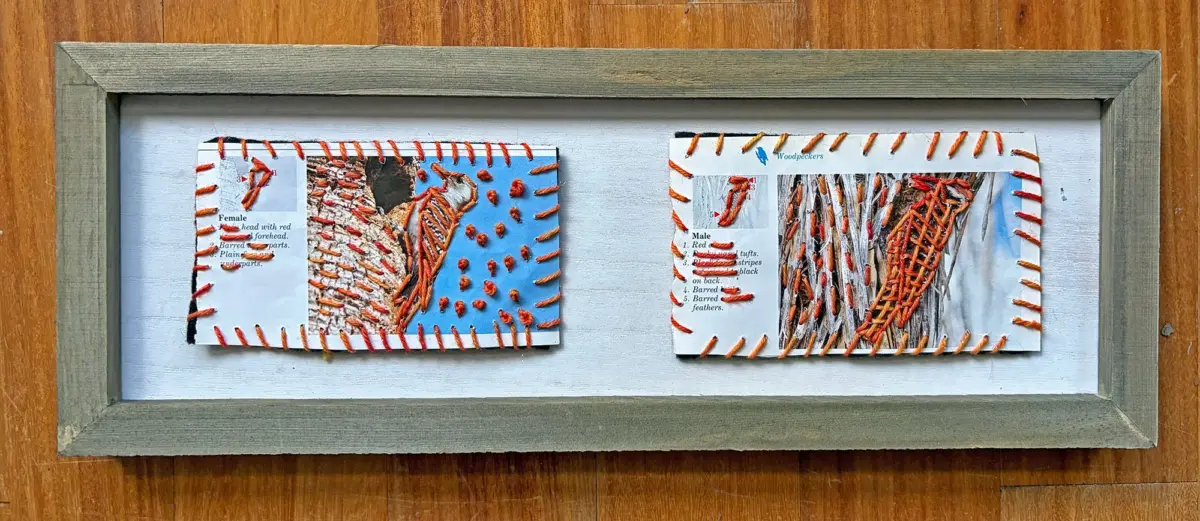
The curation phase mirrors the editorial process of finding hidden narratives within preexisting text. A maker selects a specific page based on visual appeal and narrative potential. For instance, a plate featuring the Ladder-backed Woodpecker and the Red-bellied Woodpecker—spanning habitats from the sun-drenched canopies of Florida to the arid scrublands of California—provides a sprawling geographical and ecological canvas. The accompanying descriptive paragraphs contain a dense mix of behavioral notes, anatomical descriptions, and environmental observations ripe for poetic extraction.
Step 3: Precision Extraction and Textile Reinforcement
Once the target page is selected, it is cleanly excised from the binding. Crafters typically leave a deliberate one-centimeter white border around the periphery of the text and images to frame the composition. A corresponding piece of felt is cut to identical dimensions.
Using basic needlework techniques, the paper and felt are bound together along the edges. Perfectionism is intentionally sidelined; uneven stitches often enhance the organic, handmade aesthetic of the final piece.
Step 4: The Art of Cross-Out Poetry and Surface Embroidery
The defining feature of the craft is the creation of a "cross-out poem." By threading a needle and weaving tightly across unwanted words, the maker systematically erases the original taxonomic prose. The surviving, uncrossed words coalesce into a new, evocative poetic verse that reinterprets the bird’s existence through a lyrical lens.
Beyond mere redaction, makers frequently embellish the photographic plates themselves using advanced needlework:
- French Knots: Used to simulate texture, foliage, or atmospheric depth.
- Back Stitch: Outlining anatomical features or creating abstract geometric trails across the page.
- Weaving: Interlacing thread directly through punctured paper to create tactile, dimensional layers that burst from the flat surface of the page.
Step 5: Exhibition and Epistolary Sharing
The completed mixed-media pieces are inherently versatile. Standard sizing allows them to be slipped directly into decorative wall frames, transforming domestic interiors into personal natural history galleries. Alternatively, their lightweight, compact dimensions make them ideal for epistolary art—slipping a stitched bird portrait into an envelope serves as a tangible, heartfelt greeting for fellow nature enthusiasts and friends.
Official Statements & Maker Perspectives
The resurgence of tactile book arts is supported by a broader cultural philosophy regarding environmental stewardship, mental wellness, and creative reuse. Educators, environmental advocates, and fiber artists have increasingly spoken out on the value of upcycling educational ephemera.
"We live in an age where our primary engagement with nature—and with literature—is mediated through screens. There is a profound psychological grounding that occurs when you physically touch paper, thread, and fabric. By taking a book that has outlived its functional utility in the field and reimagining it as poetry, we aren’t destroying history; we are translating it into a new emotional language."
— Dr. Helena Vance, Professor of Material Culture & Environmental Art
Environmental organizations have similarly praised the ethos of waste reduction inherent in the craft. While digital apps have undeniably streamlined conservation data collection, the physical remnants of the print era continue to linger in basements and thrift stores nationwide.
"Reusing old field guides keeps paper out of landfills while deepening our appreciation for the species documented within those pages. Organizations like the Audubon Society spend decades protecting the habitats of birds like the Red-bellied Woodpecker and the Ladder-backed Woodpecker. When crafters highlight these birds through handmade art, they keep the conversation about conservation alive in living rooms, schools, and communities."
— Field Conservation Outreach Initiative (Statement on Creative Reuse and Public Engagement)
Future Outlook: The Intersection of Digital Efficiency and Tactile Preservation
As we look toward the future of natural history education, the relationship between digital technology and physical media will continue to evolve. Far from being mutually exclusive, technology and traditional craft are forming a symbiotic partnership.
1. The Hybrid Naturalist Ecosystem
While field identification will almost certainly remain anchored in digital apps, machine learning, and cloud databases, the sentimental and aesthetic value of physical print will experience a sustained renaissance. Outdated field guides will increasingly be viewed not as obsolete garbage, but as a premier medium for upcycled art, collage, and literary experimentation.
2. Community Workshops and Collaborative Eco-Art
Makerspaces, botanical gardens, and Audubon chapters are beginning to host collaborative workshops focused on field guide upcycling. These events serve a dual purpose: they educate the public on local avian conservation efforts while teaching foundational fiber arts skills to younger generations who may be entirely unaccustomed to physical sewing and embroidery.
3. Sustainable Design and Circular Economies
The broader craft and DIY sector is shifting definitively toward circular economic models. As consumers grow increasingly weary of fast-fashion and disposable decor, items characterized by slow craftsmanship, recycled materials, and personal storytelling command a high premium. Field guide poetry represents the vanguard of this movement—a quiet, contemplative rebellion against digital fatigue that honors the feathered inhabitants of our shared ecosystems one stitched word at a time.