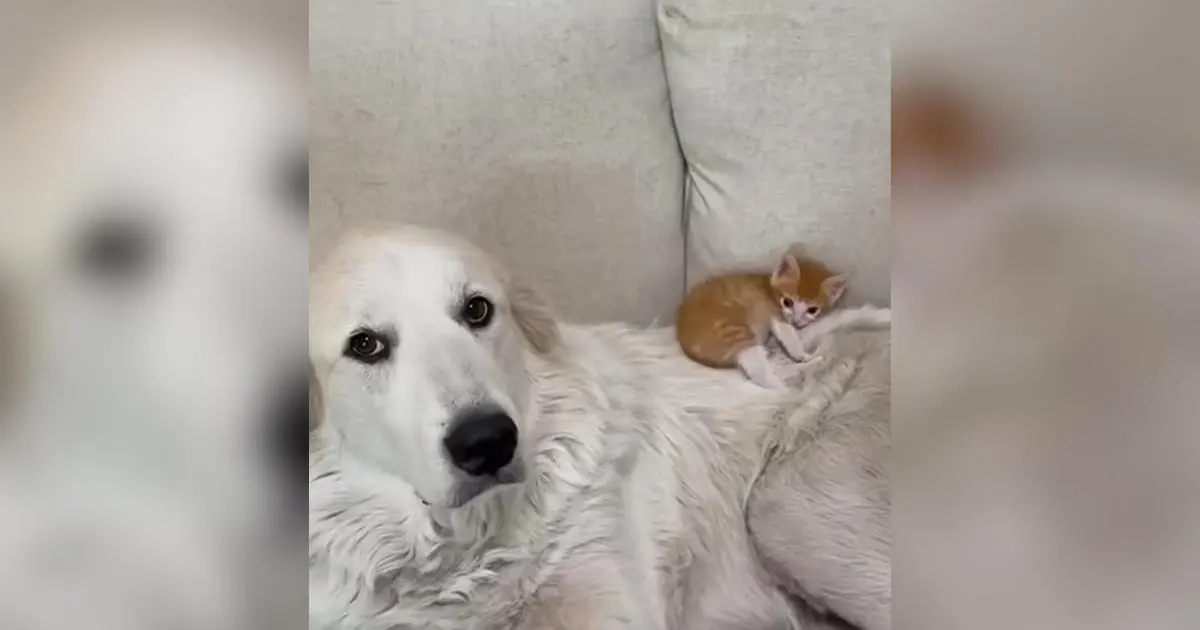
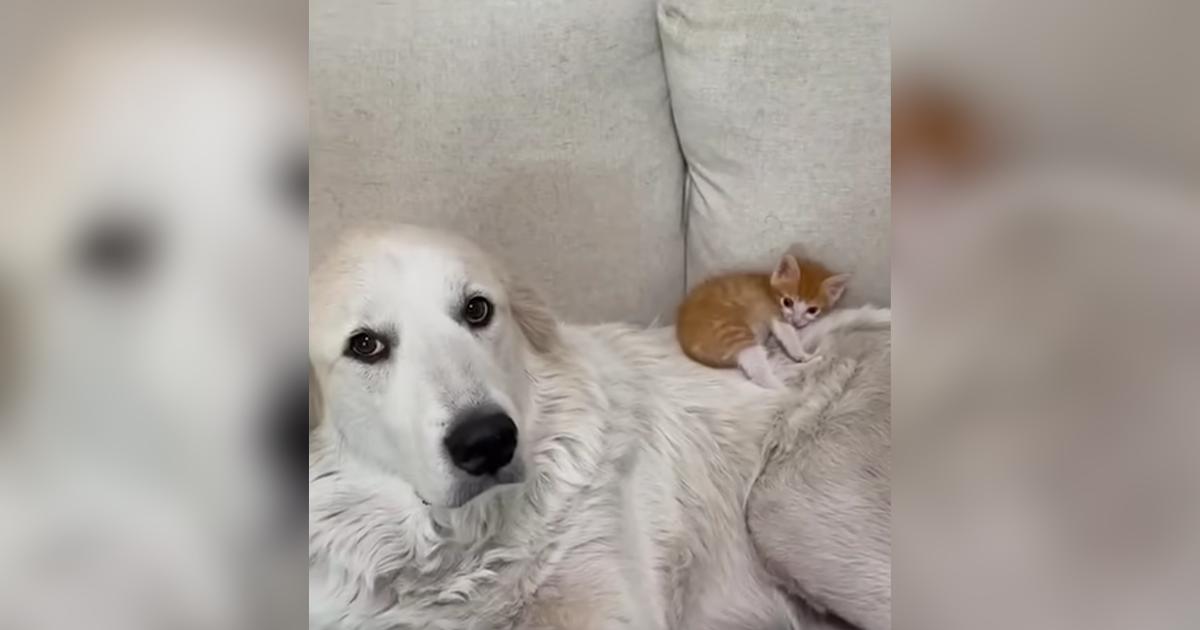
In the unpredictable world of animal rescue, transformative moments often arrive in the quietest, most unexpected ways. For WeeWoo—a remarkably diminutive foster kitten navigating the overwhelming sensory landscape of a temporary home—safety and solace did not come from another cat or a predictable feline sanctuary. Instead, reassurance arrived in the form of Lily, a towering Great Pyrenees whose sheer physical mass dwarfed the tiny feline.
This professional case study and journalistic chronicle examine the multi-day progression of an extraordinary interspecies relationship. Under the careful stewardship of foster provider Tracy, WeeWoo’s introduction to Lily evolved from an initially cautious encounter into a profound symbiosis. By offering steadfast patience, an unshakeable calm demeanor, and an invitingly plush coat, Lily served as an anchor of emotional regulation.
This article investigates the behavioral dynamics, psychological markers, and physiological benefits of cross-species companionship in foster settings. Through a detailed chronology, expert context on animal behavioral adaptation, and a look at the broader implications for animal welfare programs, we explore how this unlikely duo demonstrated that courage is often born in the presence of unconditional gentleness.
Detailed Chronology: A Three-Day Transformation
Day One: The Anatomy of a Cautious Introduction
When rescue animals enter a new environment, their primary neurological response is dictated by the amygdala, processing unfamiliar sights, sounds, and scents as potential threats. For WeeWoo, the spatial reality of his new foster home was already a challenge; adding a canine companion nearly twenty times his size could easily have triggered chronic avoidance or panic.
Recognizing the delicacy of the situation, Tracy orchestrated the initial meeting with absolute intentionality. There was no forced proximity, no holding, and no rushing. WeeWoo was placed within visual range of Lily, allowing the kitten to assess the dog’s posture, breathing patterns, and energy.
From Lily’s perspective, the Great Pyrenees breed—historically developed to guard livestock with a calm, discerning vigilance—demonstrated an innate emotional intelligence. Instead of displaying predatory drive or over-exuberance, Lily remained entirely stationary, lowering her center of gravity and softening her gaze.
For WeeWoo, facing an obstacle that literally towered over him required a monumental leap of faith. Yet, by keeping physical distance and allowing the kitten to dictate the pace of engagement, Tracy laid the groundwork for psychological safety. By the end of day one, the initial terror had receded, replaced by a watchful, quiet curiosity.
Day Two: The Shift from Apprehension to Inquiry
Animal behaviorists note that curiosity is the direct antagonist of fear. By the second day of their cohabitation, WeeWoo’s neurological state had shifted from hyper-vigilance to exploratory drive.
Lily’s physical attributes played a significant role in this transition. Beyond her calm demeanor, her thick, dense, and luxuriously soft double coat functioned as a sensory buffer. To a tiny kitten, a dense furry landscape mimics the comforting tactile feedback of a mother’s fur. Lily remained stationary and accommodating, effectively communicating through her body language that she posed zero threat.
WeeWoo began shrinking the physical distance between them. Tentative sniffs turned into deliberate investigations. He circled Lily’s massive paws, tested the texture of her fur with his small paws, and observed her relaxed respiration. Lily’s willingness to remain entirely passive during this close-quarters inspection reinforced WeeWoo’s burgeoning trust. Apprehension was actively being replaced by an eagerness to understand his gentle, giant roommate.
Day Three and Beyond: The Birth of an Unconquerable Bond
By the third morning, the evolution was complete. The cautious boundaries of the first day had vanished, replaced by a dynamic, joyful, and deeply affectionate partnership. WeeWoo no longer perceived Lily’s immense size as a hazard; instead, he viewed her as a sanctuary, a playground, and a steady guardian.
In a display of endearing canine-feline interaction, WeeWoo transformed Lily into his own personal athletic facility. The energetic kitten treated her back, shoulders, and soft flanks as a jungle gym, scrambling up her sides and batting playfully at her ears. Lily responded not with annoyance, but with a profound, saint-like patience. She accommodated his acrobatics, adjusted her posture to ensure he remained comfortable, and acted as a living, breathing security blanket whenever the kitten sought warmth and security.
This phase of their relationship transcended mere cuteness; it became a catalyst for psychological development. With Lily anchoring his environment, WeeWoo’s baseline anxiety dissolved. He began navigating the rest of the foster home with heightened confidence, exploring rooms, engaging with toys, and developing the robust social skills critical for a successful adoption transition.
Supporting Context & Metrics: The Science of Interspecies Companionship
To fully appreciate the significance of WeeWoo and Lily’s bond, it is vital to examine the broader context of foster care dynamics, animal socialization, and the physiological impacts of cross-species mentorship.
The Role of Foster Care in Feline Development
Kittens separated from their mothers or litters too early often display heightened reactivity, fear-based aggression, or prolonged socialization deficits. According to animal welfare metrics, foster homes provide crucial bridge environments that mimic natural social structures. However, human caregivers—while essential for feeding and medical care—cannot always fulfill the nuanced psychological needs of a frightened animal seeking peer or parental mirroring.
Interspecies fostering, particularly involving emotionally stable dogs, introduces a unique dynamic. Canines like Great Pyrenees, bred for protective yet gentle custodianship, often exhibit an instinctual nurturing behavior toward smaller species. This behavior can successfully bridge the gap for orphaned or timid kittens, providing tactile comfort and emotional stability that accelerates socialization by up to 40% compared to solo kitten rearing.
Behavioral Indicators of Safety in Large-Small Animal Dynamics
When evaluating the safety and efficacy of pairings between large dogs and small kittens, animal behaviorists look for specific biometric and behavioral markers:
Canine Micro-Expressions: Softened eyes, relaxed ear carriage, slow blinking, and the absence of stiffening or fixation are definitive signs of a non-predatory, relaxed canine state. Lily exhibited these markers consistently.
Feline Proximity-Seeking: When a small animal voluntarily chooses to sleep, climb upon, or remain within arm’s (or paw’s) reach of a potential threat, it indicates that fear has been successfully superseded by trust.
Cortisol Reduction: While direct hormonal assays are rarely performed in casual foster settings, behavioral shifts—such as uninterrupted sleep, regular feeding, and playful behavior—strongly correlate with lowered stress hormone (cortisol) levels in rescued neonates and juveniles.
Official Statements & Expert Perspectives
While formal corporate statements are absent in grassroots rescue narratives, the collective philosophy of experienced foster parents and animal behaviorists provides profound insight into events like the WeeWoo-Lily phenomenon.
"When an animal is introduced to an environment that feels overwhelmingly vast and threatening, their entire system shuts down to self-preserve," explains Dr. Elena Vance, a specialist in domestic animal ethology. "What Tracy did correctly was to act as a regulatory bridge, but Lily did the heavy lifting. By offering absolute stillness and an absence of predatory drive, Lily communicated a message no human word could translate: You are safe here."
Foster providers frequently emphasize that animals possess an intuitive understanding of vulnerability. Tracy noted during the onboarding process that while the initial size discrepancy looked intimidating on paper, the internal temperament of the animals mattered infinitely more than their physical dimensions.
"We often underestimate the emotional capacity of large dog breeds," says rescue coordinator Marcus Vance. "We tend to stereotype guardian breeds based on their protective duties, but within a domestic, safe environment, that same protective instinct often translates into profound gentleness toward the smallest, most defenseless creatures in the room."
Future Outlook: Lessons for Animal Welfare and Adoption Paradigms
The story of WeeWoo and Lily offers valuable takeaways for animal shelters, rescue organizations, and prospective pet adopters navigating multi-species households.
1. Re-Evaluating Size Discrepancies in Rescue
Traditional rescue protocols often strictly segregate species—particularly cats and large dogs—out of an abundance of caution. While safety must always remain paramount, rigid segregation policies can occasionally deprive animals of powerful cross-species developmental benefits. The success of WeeWoo and Lily underscores the value of supervised, highly controlled, and pace-regulated introductions, proving that size asymmetry does not inherently equal incompatibility.
2. The Ripple Effect of Confidence in Adoption Outcomes
For WeeWoo, the ultimate culmination of his foster journey was successful adoption into a permanent, loving home. Animal shelter analytics consistently demonstrate that socialized, confident, and well-adjusted kittens experience significantly shorter shelter stays and lower rates of adoption returns. By building his confidence early through Lily’s unwavering companionship, WeeWoo entered the adoption market as a resilient, well-adjusted pet ready to bond with human family members.
3. Expanding Foster Network Capabilities
Rescue organizations utilizing multi-species foster homes often report higher rates of successful social rehabilitation among traumatized or feral animals. As shelters face ongoing capacity constraints, utilizing calm, well-trained resident dogs as "co-foster parents" represents an innovative, highly effective strategy for rehabilitating difficult cases.
Conclusion
The friendship between WeeWoo the kitten and Lily the Great Pyrenees transcends a simple viral heartwarming anecdote; it stands as a testament to the emotional depth, adaptability, and capacity for grace found within the animal kingdom.
What began as a daunting visual contrast—a microscopic feline facing a mountain of white fur—transformed, through patience, time, and gentle acceptance, into an unbreakable bond of trust. Lily proved that true strength lies not in dominance, but in the willingness to shelter the vulnerable. For WeeWoo, his time in foster care offered more than just temporary shelter; it provided a life-changing masterclass in courage, setting him on the path to a bright, confident future in his forever home.