
Executive Overview
For decades, the remote and icy expanse of Antarctica stood as one of the final natural fortresses on Earth—a sanctuary isolated from the rapid ecological degradation and devastating zoonotic pathogens ravaging the rest of the globe. That era of isolation has officially ended.
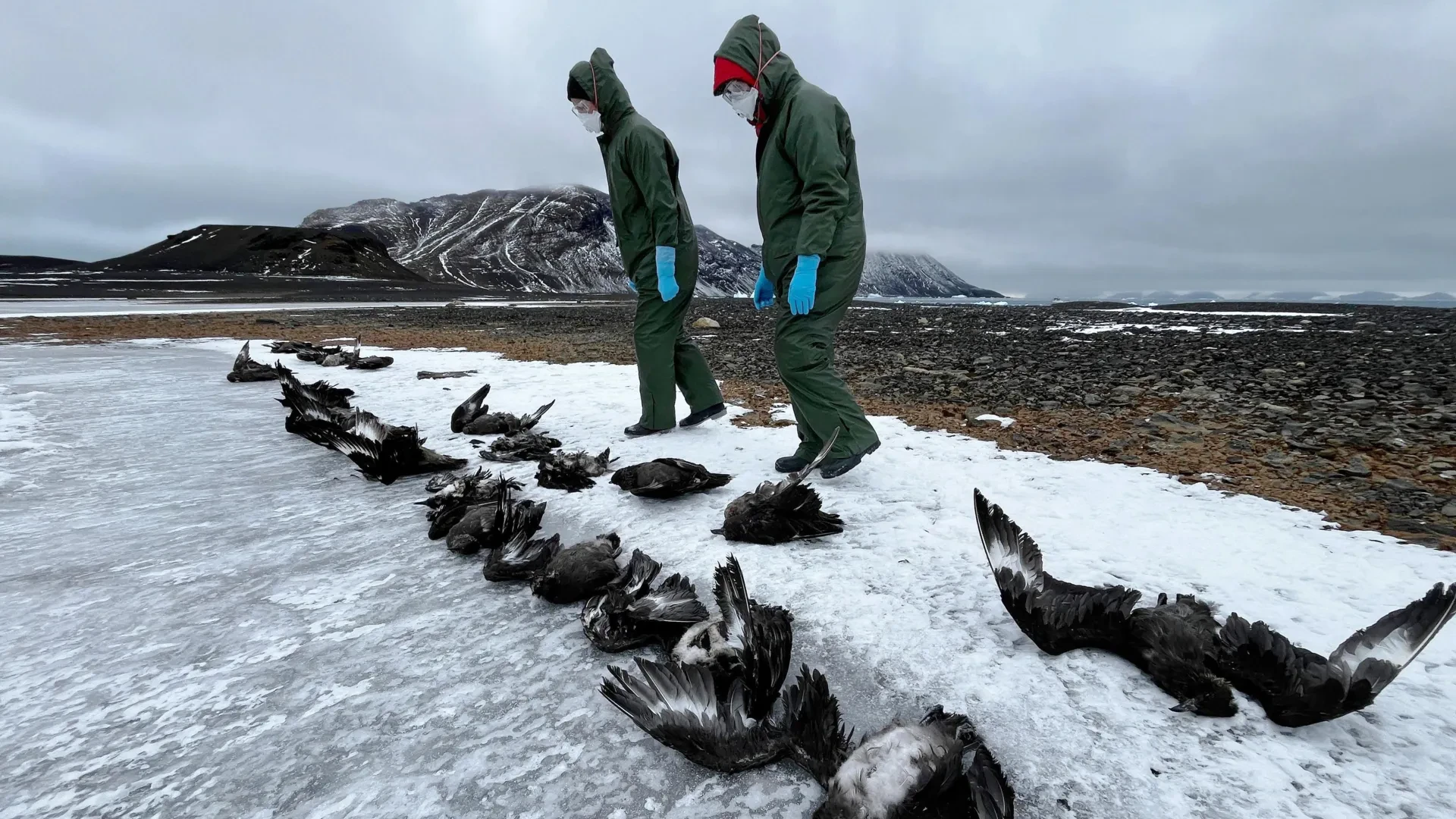
In a landmark scientific finding recently published in the journal Scientific Reports, researchers have confirmed the first mass wildlife mortality event driven by the highly pathogenic avian influenza virus (HPAI) H5N1 on the Antarctic continent. During the austral summers of 2023 and 2024, over 50 brown and south polar skuas perished after contracting the lethal pathogen.
Led by an international coalition of scientists from Erasmus MC in the Netherlands and the University of California, Davis (UC Davis), the study marks a grim milestone in the global trajectory of the H5N1 panzootic. While previous sightings indicated the presence of the virus in isolated Antarctic birds, this research provides definitive pathological proof that the virus is actively killing native wildlife in unprecedented environments.
The arrival of H5N1 in Antarctica introduces a catastrophic new variable to an ecosystem already buckling under the weight of climate change, melting sea ice, expanding human tourism, and overfishing. Experts warn that because skuas are apex scavengers, their behavioral ecology makes them both the primary victims and the most efficient vectors for distributing the virus deeper into fragile penguin colonies and marine mammal populations. With global containment efforts having failed decades ago, the scientific community is now racing against time to implement rigorous monitoring systems before the virus permanently alters the polar biosphere.
Detailed Chronology: Unfolding the Antarctic Outbreak
The Early Warnings (Late 2023 – Early 2024)
The shadow of avian influenza began stretching toward the southernmost continent late last year. As the H5N1 virus tore through South America—decimating populations of elephant seals and sea lions along the coast of Argentina—epidemiologists feared its inevitable leap across the Drake Passage.
Those fears materialized in January and February 2024. Field researchers operating in the sub-Antarctic and peripheral maritime regions detected H5N1 genetic material in a single kelp gull and two skuas found dead. However, detection of the virus in a carcass does not automatically prove it was the cause of death; scavengers can ingest pathogens post-mortem or carry them asymptomatically.
The March 2024 Expedition
Recognizing the urgent need for boots-on-the-ground investigation, an expedition team launched the HPAI Australis Expedition in March 2024, immediately following the peak breeding season for Antarctic skuas and penguins. Co-funded by the International Association of Antarctica Tour Operators (IAATO) and Ocean Expeditions, alongside grants from the European Union and the Spanish Consejo Superior de Investigaciones Científicas (CSIC), the team targeted 10 distinct sites.
Their survey footprint spanned the South Shetland Islands, the northern Weddell Sea, and the Antarctic Peninsula. Utilizing rigorous veterinary protocols, the scientists performed comprehensive necropsies, harvested tissue samples, and conducted environmental testing on a wide array of species, including gentoo penguins, Adélie penguins, and Antarctic fur seals.
While other species were examined, the expedition quickly realized that one particular family of birds was bearing the brunt of the invisible assault.
"As the expedition progressed, it became obvious quickly that skuas were a major victim," noted Dr. Ralph Vanstreels, a wildlife veterinarian with the UC Davis One Health Institute.
Pinpointing the Epicenters
The hardest-hit zones quickly emerged during field assessments at Hope Bay, Devil Island, and Beak Island. Among these, Beak Island stood out as the site of a severe, localized mass die-off of south polar skuas.
Matteo Iervolino, a Ph.D. candidate at Erasmus MC in Rotterdam and lead author of the study, described the harrowing scenes encountered in the field.
"We diagnosed high pathogenicity avian influenza as the cause of death for nearly all of the dead skuas we found at Beak Island," Iervolino stated. "There, I could really see with my eyes the impact this virus can have on these populations."
Supporting Context & Metrics: The Ecology of the Skuas and the Pathogen
Understanding the Skuas
To understand why the outbreak took such a devastating toll on skuas, one must examine their evolutionary niche and behavior. Skuas are large, robust seabirds belonging to the family Stercorariidae, closely related to gulls and terns. Thriving in polar and subpolar domains, they occupy a high trophic level as aggressive predators and scavengers.
In many ways, skuas function like avian raptors. They hunt other seabirds, raid nests for eggs and chicks, and aggressively scavenge marine mammal carcasses washed ashore. While this ecological cleaning-service role is vital for nutrient cycling, it fundamentally acts as an epidemiological trap. By feeding directly on infected carcasses, migrating animals, or contaminated marine debris, skuas willingly expose themselves to maximum viral loads—subsequently transforming themselves into airborne vectors capable of traversing vast distances across the polar ice sheet.
Pathology: The Neurological Nightmare
The specific strain of H5N1 currently circulating does not merely target the respiratory systems of birds; it exhibits a profound neurotropic affinity. Once a skua is infected, the virus attacks the central nervous system, inducing acute encephalitis and triggering a cascade of horrific neurological symptoms.
Dr. Ralph Vanstreels categorized the ongoing situation as a literal "crisis in animal suffering." Field researchers documented infected birds exhibiting extreme loss of coordination, including:
- Twisted, locked necks (torticollis)
- Unusual and erratic body stretching
- Repetitive circling behavior while walking or swimming
- Sudden, catastrophic loss of flight control, resulting in mid-air stalls and violent crashes into rocks or ice
A Global Trail of Destruction
The arrival of H5N1 in Antarctica is the final chapter of a nearly three-decade epidemiological tragedy. The lineage was first identified in 1996 on a commercial goose farm in Guangdong Province, Southeast China. For years, the virus simmered undetected and unchecked within dense poultry production systems before spilling over into wild migratory bird flyways.
From there, the pathogen embarked on a relentless global march:
- Eurasia and Africa: Swept through domestic and wild bird populations across Europe, the Middle East, and Sub-Saharan Africa.
- The Americas: Crossed the Bering Strait and Atlantic flyways to devastate wildlife populations throughout North, Central, and South America.
- Antarctica: Successfully breached the southern polar barrier by the 2023–2024 austral summer.
The statistical footprint of the H5N1 panzootic is staggering:
- Poultry Industry: Over 400 million domestic birds have been culled or died directly from the virus worldwide.
- Mammalian Spillovers: The virus has broken the species barrier to infect an alarming array of mammals, including dairy cattle in North America, elephant seals and sea lions in South America, minks, foxes, black bears, otters, and various cetaceans.
- Human Health: While primarily an animal pathogen, H5N1 has recorded approximately 1,000 confirmed human cases globally, with a devastating case-fatality rate hovering around 50%.
Official Statements & Expert Analysis
The scientific community’s response to the study reflects a mixture of profound sorrow over lost biodiversity and mounting frustration regarding historical failures in global disease governance.
Professor Thijs Kuiken, a senior corresponding author from Erasmus MC, pulls no punches when assigning accountability for the current global ecological crisis.
"We let the virus slip out through our fingers when it first emerged in the poultry industry," Kuiken remarked. "Once it got into wild bird populations, we lost the ability to control this virus. Now it’s established in wild bird populations in all the continental regions of the world except Oceania."
Kuiken’s assessment highlights a harsh reality: humanity’s intensive agricultural practices created an incubator for hyper-lethal pathogens, and despite decades of warnings, institutional safeguards proved inadequate to halt its globalization.
Dr. Ralph Vanstreels emphasized the importance of distinguishing between mere viral presence and actual mortality during the early phases of an outbreak.
"We knew there were animals with the infection, but this is the first study to show they died of the viral infection," Vanstreels explained. "It’s an important distinction in the early days of an outbreak."
This diagnostic rigor is what transforms anecdotal observations into actionable scientific data, giving conservationists the empirical foundation needed to lobby governments and international bodies for emergency funding and intervention protocols.
Future Outlook: The Urgency of Enhanced Surveillance
Cumulative Pressures on the Antarctic Biosphere
The introduction of H5N1 does not occur in a vacuum. Antarctic wildlife is already subjected to an unprecedented convergence of anthropogenic and environmental pressures:
- Climate Change: Rapid warming along the Antarctic Peninsula is driving the disintegration of ice shelves, altering krill availability, and destroying breeding habitats.
- Commercial Tourism: A surge in post-pandemic polar tourism increases the risk of human-vectored transmission of pathogens and physical disturbance to nesting sites.
- Invasive Species and Pollution: Microplastics, chemical pollutants, and non-native seeds continue to infiltrate the fragile polar food web.
The Blind Spots of Conservation
Compounding the threat of avian influenza is a glaring lack of foundational demographic data. Astoundingly, the last comprehensive census of Antarctic skuas was conducted in the 1980s, at which time researchers estimated the population stood at roughly 800 breeding pairs.
Because comprehensive, modern population baselines do not exist, wildlife authorities are forced to evaluate the loss of 50 birds in a vacuum. Without knowing total population health, localized collapse can occur silently before regional metrics register the decline.
A Call to Action
The study’s authors conclude with an urgent plea for structural investment in polar wildlife surveillance. Mitigating the spread of H5N1 will require strict biosecurity protocols for research stations, tour operators, and fishing vessels operating within Antarctic waters. Furthermore, governments signatory to the Antarctic Treaty System must prioritize funding for updated wildlife censuses.
"Everything points toward this virus spreading further," Professor Kuiken warned bluntly. "If nobody is watching, we won’t know what is happening."
As the ice hardens for another brutal southern winter, the fate of Antarctica’s apex scavengers hangs in the balance. Whether the continent’s unique ecosystems can adapt to this modern plague remains one of the defining ecological questions of the twenty-first century.