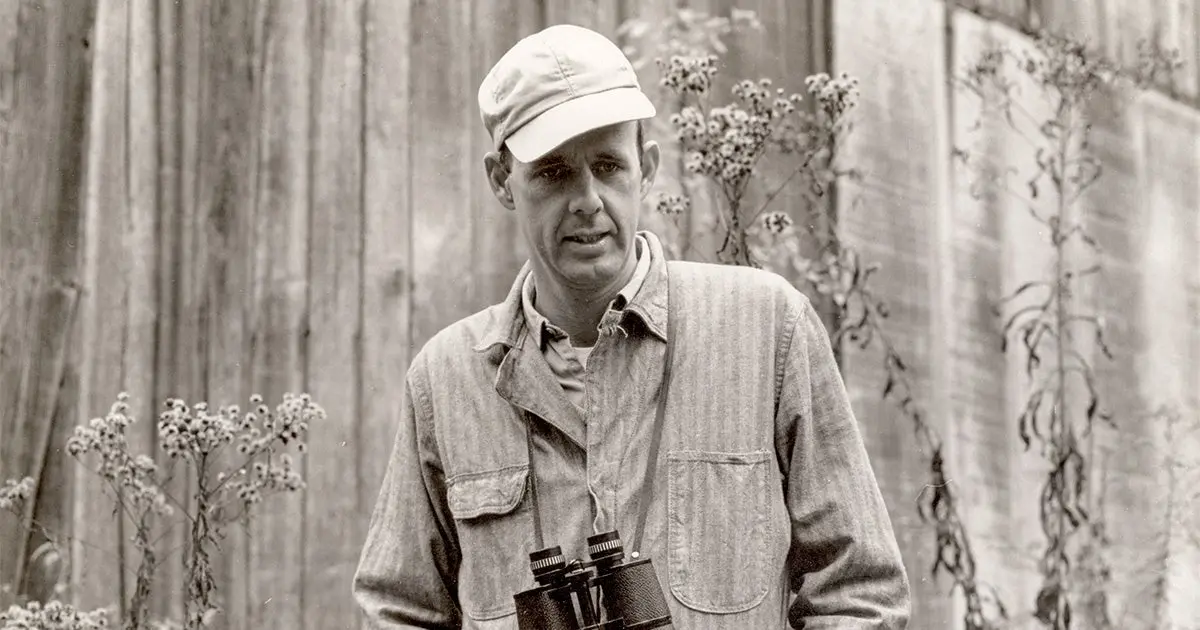

In the spring of 1971, environmental consciousness in the United States reached a critical juncture with the publication of The Unforeseen Wilderness: Kentucky’s Red River Gorge, featuring essays by acclaimed poet, novelist, and environmental essayist Wendell Berry. Originally appearing in the May 1971 issue of Audubon, Berry’s writing served as a vital cultural and literary intervention against a federal proposal to dam and flood the pristine Red River Gorge.
Berry’s overarching thesis confronted the fundamental flaw of modern American civilization: an insular, mechanical worldview that reduces the natural world to an economic commodity, a scenic backdrop, or an obstacle to be conquered. Through an examination of historical expansion, agricultural exploitation, and industrial short-sightedness, Berry argued that the physical destruction of ecosystems—exemplified by the proposed damming of the Red River Gorge—stems from a spiritual and psychological blindness. Modern humans, insulated within what Berry termed the "mollusk-shell of civilization," view the earth not as a continuous, living inheritance to be cherished, but as a temporary staging ground for extraction, recreation, and rapid profit.
This expanded retrospective reviews Berry’s foundational arguments, tracing the historical and mechanical roots of environmental degradation, analyzing the economic illusions underpinning ecological destruction, contrasting transient exploitation with sustainable stewardship, and evaluating the modern conservation movement’s persistent struggles against bureaucratic abstraction.
Detailed Chronology: The Roots of the American Land Ethic
To understand the crisis facing the Red River Gorge in the early 1970s, Berry traced the trajectory of European settlement across the North American continent, anchoring his historical critique in both myth and documented practice.
The Myth of John Swift and the Cult of Easy Wealth
Berry identified the foundational archetype of American expansion not in sustainable husbandry, but in the enduring Kentucky legend of John Swift’s silver mine, purportedly discovered around 1760. Swift’s incomplete journals and inaccurate maps birthed a persistent regional legend—documented by historian Thomas D. Clark—of individuals who "had rather seek fortune by searching for nebulous silver than by plowing corn."
For Berry, Swift was the true forefather of American resource exploitation:
"They have descended upon this land from the eastward passes and from their mothers’ wombs with their minds set on the dream of quick riches to be had, if not from a vein of precious metal, then from coal or from logs."
This foundational psychology prioritized extraction over stewardship. Whether through mining minerals, clear-cutting timber, or treating agriculture as a form of mining—taking growth from the soil and giving nothing back until the land was exhausted—generations of settlers operated under the illusion of quick, effortless enrichment.
The Immitative Failure of American Agriculture
As settlers pushed westward into Kentucky and beyond, they brought agricultural practices fundamentally unsuited to the local topography. English farmers in Virginia attempted to replicate English farming memories rather than adapting to Virginian realities; their descendants repeated these imitations in the Kentucky wilderness.
On flat lands, this method yielded mediocre results; on steep lands, it proved catastrophic. Berry observed farmers stripping hillsides for row-cropping, overgrazing pastures down to the roots, and abandoning depleted soils once profitability vanished. This cyclical ruin stemmed from a deep-seated cultural bias: the social fashion that viewed physical, land-based labor as menial and degrading. Consequently, farming was treated not as an honorable, permanent calling, but as a form of bondage from which to escape as soon as capital allowed.
Supporting Context & Metrics: The Economics of Ecological Destruction
At the heart of the environmental conflict in the Red River Gorge—and throughout industrial America—lies a profound conflict between short-term market valuation and long-term ecological continuity.
The Fallacy of Strip-Mining Metrics
Proponents of industrial resource extraction frequently justify the destruction of vast tracts of land by utilizing narrow economic metrics. Strip miners defended their operations by calculating that the immediate market value of the subsurface minerals exceeded the value of the surface crops and forests.
Berry exposed the fundamental absurdity of this logic:
"They would be right only if the world, or if people’s dependence on it, should come to an abrupt end the day after the seam was mined out."
Contrasting this short-termism with enduring agrarian traditions, Berry pointed to the agricultural systems of China, Korea, and Japan, where sustainable farming methods have continuously produced food crops for over six millennia. By contrast, American agricultural and industrial practices treated land as a disposable asset.
The Mechanics of Watershed Collapse
The economic calculus of extraction invariably triggers cascading ecological failures. When steep hillsides are stripped of vegetation, overgrazed, or subjected to inappropriate row-cropping, the natural hydrology of the watershed is fundamentally altered.
Without forests and root systems to absorb and regulate rainfall, slopes function merely as roofs, shedding runoff directly into tributaries. The resulting soil erosion chokes waterways with silt, rendering streams shallow and muddy. When downstream municipalities experience the predictable consequence of this upper-watershed abuse—severe seasonal flooding—their response mirrors their initial blindness: they demand technological conquest over nature rather than addressing root causes.
Official Statements and Bureaucratic Abstraction: The Damming of the Gorge
The proposal to construct a flood-control dam in the Red River Gorge perfectly illustrated the institutionalized disconnect between human bureaucracy and natural reality.
The Role of the U.S. Army Engineers
When downstream urban populations, enclosed within their technological "clamshells," cried out against high water, they perceived nature merely as an enemy. The U.S. Army Corps of Engineers responded with a technocratic solution: build a dam.
Berry dissected the abstract methodologies of bureaucratic planning:
"Between two points on a topographical map a dam is to be built, requiring a certain predicted expenditure of dollars, backing the water to the level of a certain contour, able to control a certain amount of runoff from the slopes upstream and to deliver a specified number of gallons daily to the city water companies downstream."
This administrative abstraction reduced a complex, living river valley to a two-dimensional water-level tabulation. Furthermore, this mechanical abstraction readily married itself to human avarice: the creation of a lake promised tourism, recreational developments, real estate deals, and capital investment—transforming an ecological disaster into an economic bonanza on paper.
Entering the Watershed: Reality Versus Propaganda
Stepping past the charts, statistics, and propaganda into the watershed of the Red River revealed a starkly different reality. Wading through the river revealed that slow-moving sections were choked not with clean gravel, but with knee-deep silt—the wasted topsoil washed down from mismanaged ridges upstream.
To build a flood-control dam under such conditions, Berry argued, was as foolish as putting a stopper in the mouth of a volcano. Without addressing the underlying misuse of the watershed, the dam would merely initiate the creation of a stagnant swamp, serving short-term speculative illusions rather than environmental reality.
Future Outlook: Rebuilding the Land Ethic
Berry’s 1971 essay was not merely a critique of a single federal dam project; it was an urgent call for a fundamental realignment of human consciousness and relationship with the earth. The eventual protection of the Red River Gorge proved that organized resistance could halt immediate bureaucratic overreach, but Berry cautioned that institutional preservation alone is insufficient.
The Limits of Scenic Conservation
Berry critiqued both industrial exploiters and mainstream conservationists who viewed nature strictly through the lens of "scenery." Weekend tourists, encapsulated in automobiles and traveling at highway speeds, demanded neatly packaged "views" while remaining oblivious to the complex ecological cycles of life and death, growth and decay, unfolding around them.
Similarly, cosmetic conservation laws—such as fencing junkyards or landscaping strip-mined highway corridors—represented another illusion of ease: the belief that a process of industrial ruin can be offset by superficial beautification. Natural beauty, Berry maintained, is merely a byproduct of natural health; an abused earth cannot simply be made pretty.
The Path of True Stewardship
True sustainability requires a radical departure from the prevailing social currents that pull humanity toward urban abstraction, specialization, and migratory restlessness. Drawing on the example of resilient families living quietly within the Red River Gorge—bound to their place by love, generational continuity, and daily labor—Berry outlined the requirements of a regenerative human presence:
- Spiritual Grounding: The effort to clarify human sight must begin in the individual eye and mind, breaking through the crust of preconceptions and economic blinders.
- Ecological Humility: Embracing the discipline of observation and recognizing that human consciousness and the natural world are inextricably linked.
- Intergenerational Obligation: Operating under the profound realization, as Berry famously summarized, that "the world is not given by his fathers, but borrowed from his children."
- Permanent Bond with Place: Rejecting artificial wanderings and speculative escapes in favor of localized stewardship—doing the arduous, humble work of repairing damaged soils, preserving woodlands, and restoring ecological health.
Ultimately, Berry’s prophetic voice reminded modern society that survival depends upon abandoning the dream of easy wealth and re-entering the complex, endless, and deeply rewarding labor of living in harmony with the natural world.