
Executive Overview
From the bustling suburban backyard feeder to the remote stretches of the boreal forest and the windswept shorelines of the Atlantic and Pacific coasts, North America is home to an astonishing array of bird species adorned in monochrome. While vibrant bursts of red, yellow, and blue often steal the spotlight in ornithological photography, the classic combination of black and white remains one of the most successful, widespread, and functionally diverse color palettes in the avian world.
Dozens of North American bird species—ranging from tiny songbirds like the Black-and-white Warbler to massive waterbirds like the Common Loon and the Canada Goose—feature black-and-white plumage. Unlike their brightly colored counterparts, whose brilliant breeding hues often fade or shift during the non-breeding season, most black-and-white birds maintain their striking contrast year-round. This visual consistency makes them invaluable touchstones for both novice birders and seasoned ornithologists.
Beyond aesthetic appeal, the abundance of black-and-white plumage is a masterclass in evolutionary biology. Far from being a mere aesthetic choice, these high-contrast feathers serve critical ecological functions. From structural durability and thermal regulation to sophisticated anti-predator strategies such as countershading, black-and-white patterns are vital survival tools. This comprehensive guide explores the evolutionary mechanics behind these monochromatic feathers, details how to identify key backyard and wilderness species, and provides practical strategies for observing and attracting these birds to your home.
Detailed Chronology and Evolutionary Context
The prevalence of black and white in the avian world is not a random genetic quirk; it is the result of millions of years of evolutionary refinement driven by natural selection. To understand why so many birds wear this timeless palette, one must examine the chemical and physical properties of feathers, as well as the pressures of predation and environmental adaptation.
The Science of Feather Pigmentation and Strength
Feather coloration is primarily determined by pigments known as melanins, specifically eumelanin and phaeomelanin. Eumelanin is responsible for black, dark brown, and grey shades. Crucially, eumelanin granules do more than just provide color—they physically reinforce the keratin structure of the feather.
Because feathers saturated with eumelanin contain denser pigment granules, they are structurally stronger, more resistant to abrasion, and less susceptible to degradation by feather-degrading bacteria than unpigmented or lightly pigmented feathers. This is a primary reason why many white feathers feature black tips or wing edges (such as those seen on gulls, pelicans, and gannets): the black tips reinforce the areas of the wing that experience the highest aerodynamic friction and wear during flight.
Conversely, pure white feathers contain no pigment at all. Instead, the microscopic structure of the feather scatters light in all directions, resulting in a brilliant white appearance. This lack of pigment makes white feathers structurally lighter and completely hollow of heavy granules, which can be advantageous in certain contexts, though it leaves them more vulnerable to structural wear unless reinforced with melanin.
The Mechanics of Countershading
When black and white feathers appear together on the same bird—particularly in a pattern where the upperparts are dark and the underparts are light—the arrangement is known as countershading. First described mathematically by artist and naturalist Abbott Handerson Thayer, countershading nullifies the optical effects of natural overhead lighting.
In a standard three-dimensional object, overhead sunlight illuminates the back and casts a shadow on the belly, making the object appear solid and easily detectable to predators or prey. However, a countershaded bird—dark on top and white below—receives the most light where it is darkest (the back) and remains in shadow where it is lightest (the belly). This creates a visual flattening effect, allowing the bird to blend seamlessly into its background.
For seabirds floating on the ocean surface, this adaptation is life-saving. Viewed from below by aquatic predators, a white belly blends into the bright, shifting reflections of the sky through the water column. Viewed from above by avian predators, a dark back helps the bird vanish into the murky, deep water below.
Supporting Context & Metrics: Identifying Common Black-and-White Birds
North America’s black-and-white avifauna can be categorized by habitat, behavior, and frequency of observation. Field identification relies heavily on recognizing specific field marks, geographic ranges, and vocalizations.
Backyard Favorites and Feeder Visitors
Many everyday species feature black-and-white plumage and are regularly encountered around residential areas and feeding stations:
- Black-capped Chickadee (Poecile atricapillus): A tiny, round songbird of the northern United States, easily identified by its distinctive chickadee-dee-dee call. It is distinguished from its southern cousin, the Carolina Chickadee, by wider white edges on its wing feathers and cleaner white cheeks.
- White-breasted Nuthatch (Sitta carolinensis): A common backyard visitor sporting a grey back and a stark black cap. Nuthatches are famous for their unique foraging behavior, frequently spiraling downward headfirst along tree trunks and visiting suet blocks to cache seeds.
- Downy Woodpecker (Dryobates pubescens): The most common and widespread U.S. woodpecker. While males sport a small red patch on the back of the head, both sexes share a uniform black-and-white checkered pattern across woodlands, parks, and backyard suet feeders.
- Hairy Woodpecker (Dryobates villosus): Visually nearly identical to the Downy Woodpecker and occupying the same range, the Hairy Woodpecker is noticeably larger. As a reliable rule of thumb for field identification: a Downy can comfortably fit inside a pint glass, while a Hairy cannot.
Striking Migrants and Regional Specialists
Beyond the backyard, various regional and migratory species add seasonal brilliance to the North American landscape:
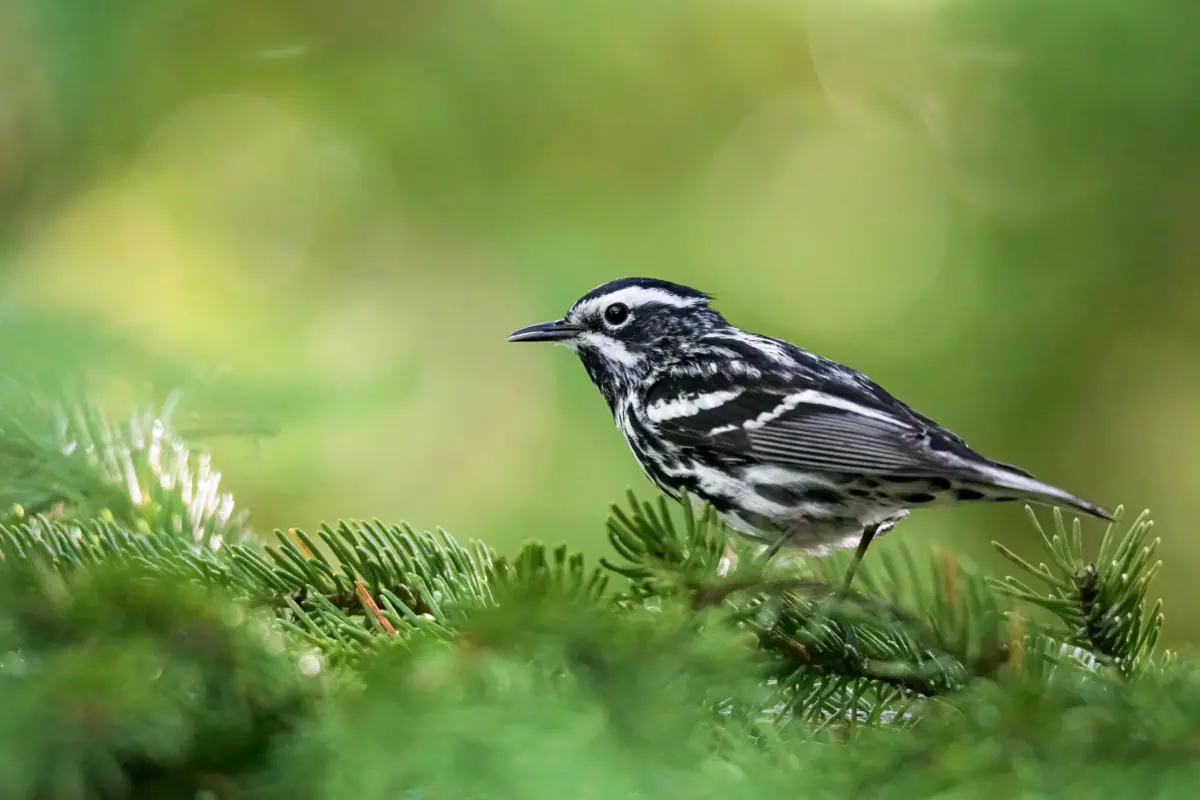
- Black-and-white Warbler (Mniotilta varia): A neotropical migrant heavily striped in black and white. True to its name, it creeps along tree trunks and low branches like a nuthatch as it travels north each spring to breed in the boreal forests and the Appalachians.
- Black-billed Magpie (Pica hudsonia): A large, long-tailed corvid of the Mountain West. While its striking black-and-white pattern dominates its silhouette, a closer look reveals stunning blue-green iridescence on its wings.
- Common Loon (Gavia immer): An iconic waterbird of northern lakes in summer and coastal waters in winter, recognized by its oblong silhouette, dagger-like bill, stark monochromatic checkered plumage, and haunting, far-carrying call.
- Anhingas and Cormorants: While many waterbirds display partial monochromatic traits, specialized shorebirds like the Black-necked Stilt utilize long red legs, stark white underparts, and glossy black upperparts to create an unmistakable silhouette on western mudflats.
Official Perspectives and Expert Insights
Ornithologists and field biologists emphasize that studying black-and-white plumage patterns offers deep insight into avian ecology. According to avian behaviorists, plumage contrast plays a critical role in intraspecific communication.
"High-contrast markings act as visual flags in dense forest canopies or turbulent open waters," notes field ornithology literature from conservation groups like the National Audubon Society. "When a bird flashes a white wing-bar or spreads a tail feather banded in black and white, it communicates species identity, territory boundaries, and mating readiness instantly, even in low-light environments."
Furthermore, evolutionary biologists point out that sexual dimorphism in black-and-white birds often provides clues about behavioral roles. While species like the Downy Woodpecker show minimal difference between sexes—save for the male’s small red occipital patch—other species exhibit stark divisions. For example, male Rose-breasted Grosbeaks feature a striking black hood, bright white underparts, and a triangular red chest patch, while females are entirely streaked brown, providing vital camouflage while incubating eggs on open nests.
Future Outlook: Conservation and Observation Trends
As habitats face increasing fragmentation due to climate change and human development, monitoring the populations of both resident and migratory black-and-white birds has never been more critical.
Habitat Protection and Citizen Science
Many species that rely on specialized habitats—such as the threatened Red-cockaded Woodpecker in southern pine woodlands or neotropical warblers depending on intact boreal forests—are key indicators of ecosystem health. Conservation initiatives increasingly rely on citizen science platforms, such as eBird and the Audubon Bird Migration Explorer, to track population shifts, migration timing, and breeding success.
Birders equipped with binoculars, telephoto lenses, and modern mobile field guide applications play a vital role in data collection. By logging sightings of seasonal visitors like the Bobolink or the Black-throated Gray Warbler, everyday observers contribute to large-scale ecological databases that inform policy and habitat preservation efforts.
How to Attract Black-and-White Birds to Your Property
Creating an avian-friendly habitat is one of the most effective ways to support local biodiversity. Homeowners can attract a wide variety of black-and-white species by implementing a few targeted strategies:
- Install Suet Feeders: Woodpeckers, nuthatches, and chickadees are naturally drawn to high-energy suet blocks, especially during autumn and winter months.
- Offer Black Oil Sunflower Seeds: A favorite of nuthatches, grosbeaks, and chickadees, offering high-fat seeds ensures backyard visitors receive adequate nutrition.
- Plant Native Flora: Cultivating native trees, shrubs, and flowering plants provides natural foraging grounds for insectivorous migrants like warblers, as well as nesting materials and protective cover.
- Provide Clean Water: A shallow birdbath or backyard water feature will draw everything from resident songbirds to migrating waterfowls looking to drink and bathe.
Ultimately, the ubiquity and elegance of North America’s black-and-white birds remind us of the intricate balance between form and function in the natural world. Whether listening for the cheerful call of a chickadee outside a kitchen window or scanning a remote shoreline for the striking silhouette of a loon, observing these monochromatic masterpieces offers a profound connection to the complex mechanics of wildlife conservation and evolutionary history.