
Executive Overview
In the realm of modern canine companionship, few groups of dogs are as consistently misunderstood, misidentified, and maligned as the broader "bully breed" classification. Among the most frequent victims of mistaken identity are the American Bulldog and the American Pit Bull Terrier (APBT). At first glance—and even to the untrained eye of an experienced veterinarian—these two distinct breeds share a striking visual overlap: broad skulls, powerful jaws, muscular physiques, and an aura of unmistakable physical strength.
Yet, beneath this superficial veneer of shared aesthetics lies a profound divergence in genetics, history, structural morphology, behavioral proclivities, and physiological needs. Conflating the two not only does a disservice to the historical legacy of each breed, but it also places unprepared owners at a disadvantage, risking behavioral friction and misunderstandings that can have severe welfare consequences.
This investigative report provides a comprehensive, authoritative breakdown of the American Bulldog versus the American Pit Bull Terrier. By analyzing their evolutionary lineages, distinct physical metrics, behavioral blueprints, and persistent cultural myths—such as the infamous "locking jaw" fallacy—we aim to separate canine reality from sensationalized fiction. Whether you are an aspiring owner, a rescue advocate, or a canine behavioral specialist, understanding the subtle yet critical differences between these two athletic powerhouses is essential for fostering safe, harmonious, and enriching human-canine relationships.
Detailed Chronology: The Historical Trajectories of Two Resilient Breeds
To fully appreciate why the American Bulldog and the American Pit Bull Terrier behave and look the way they do today, one must travel back through centuries of selective breeding, shifting societal norms, and dramatic rescue efforts that pulled these animals back from the brink of extinction.
The Ancient Roots and the Old English Bulldog
The historical narrative of both breeds begins with the now-extinct Old English Bulldog. During the 17th and 18th centuries in Great Britain, these dogs were not bred for companionship or hearth-and-home comfort; they were working utility dogs utilized in brutal blood sports such as bull-baiting and bear-baiting. Breeders selected for tenacity, high pain tolerance, massive jaw strength, and fearlessness.
When the British Parliament officially banned these blood sports through the Cruelty to Animals Act of 1835, the primary purpose of the Old English Bulldog vanished overnight. Without a functional working role, the pure Old English Bulldog population plummeted, eventually fading into extinction—but not before contributing its genetic material to the creation of entirely new lineages.
The American Bulldog: Farm Guardian and Savior
As settlers migrated from Europe to the American South, they brought working utility bulldogs with them. These immigrant dogs were tasked with rugged, dangerous farm work: catching feral hogs, guarding homesteads against predators, and driving stubborn cattle. Unlike their British ancestors, American Bulldogs were bred for size, endurance, and functional versatility on expansive rural properties.
However, by the mid-20th century, modernization and changing agricultural practices left the American Bulldog population severely depleted. The breed faced imminent extinction until a dedicated enthusiast named Dr. John D. Johnson stepped forward. Beginning in the late 1940s, Dr. Johnson traveled throughout the rural American South, tracking down the finest remaining working bulldogs. Alongside co-breeder Alan Scott, Johnson meticulously engineered a breeding program that revived the American Bulldog, standardizing its traits into the powerful, confident farm guardian recognized worldwide today.

The American Pit Bull Terrier: The Agility-Driven Cross
Simultaneously, breeders in England, Ireland, and America sought to create a faster, more agile canine by crossing the heavy Old English Bulldog with various native terrier breeds (such as the Old English White Terrier). The goal was to combine the relentless grip and muscular power of the bulldog with the speed, gameness, and high-octane reactivity of the terrier.
The resulting canine—the American Pit Bull Terrier—was subsequently brought to North America, where it established itself as an all-around farm dog, hunter, and family companion. While early iterations were unfortunately exploited in illicit pit-fighting rings following the decline of bull-baiting, the modern APBT is valued primarily for its athleticism, unwavering loyalty, and versatility in canine sports such as weight pulling, agility, and obedience.
Supporting Context & Metrics: Comparative Breed Analysis
While both breeds belong to the broader molosser and terrier heritage spectrum, their physical dimensions, metabolic needs, and life expectancies diverge significantly. The following comparative data highlights these structural and biological differences:
| Metric / Trait | American Bulldog | American Pit Bull Terrier (APBT) |
|---|---|---|
| Height Range | 20–27 inches (51–69 cm) | 17–21 inches (43–53 cm) |
| Weight Range | 75–125 lbs (34–57 kg) | 35–65 lbs (14–29 kg) |
| Coat Variations | Solid white, brindle, red, brown, or patched | Brindle, fawn, blue, black, red, and various multi-colors |
| Skeletal Build | Heavy-boned, stocky, broad-chested, and muscular | Lean, streamlined, athletic, and agile |
| Energy Output | Moderate to high; driven by endurance | Extremely high; driven by explosive agility |
| Primary Temperament | Confident, loyal, protective, and occasionally stubborn | Highly energetic, fiercely loyal, affectionate, and people-oriented |
| Lifespan | 10–12 years | 12–15 years |
Morphological Contrast: Substance vs. Speed
The structural differences between the two breeds are immediately apparent upon physical inspection.
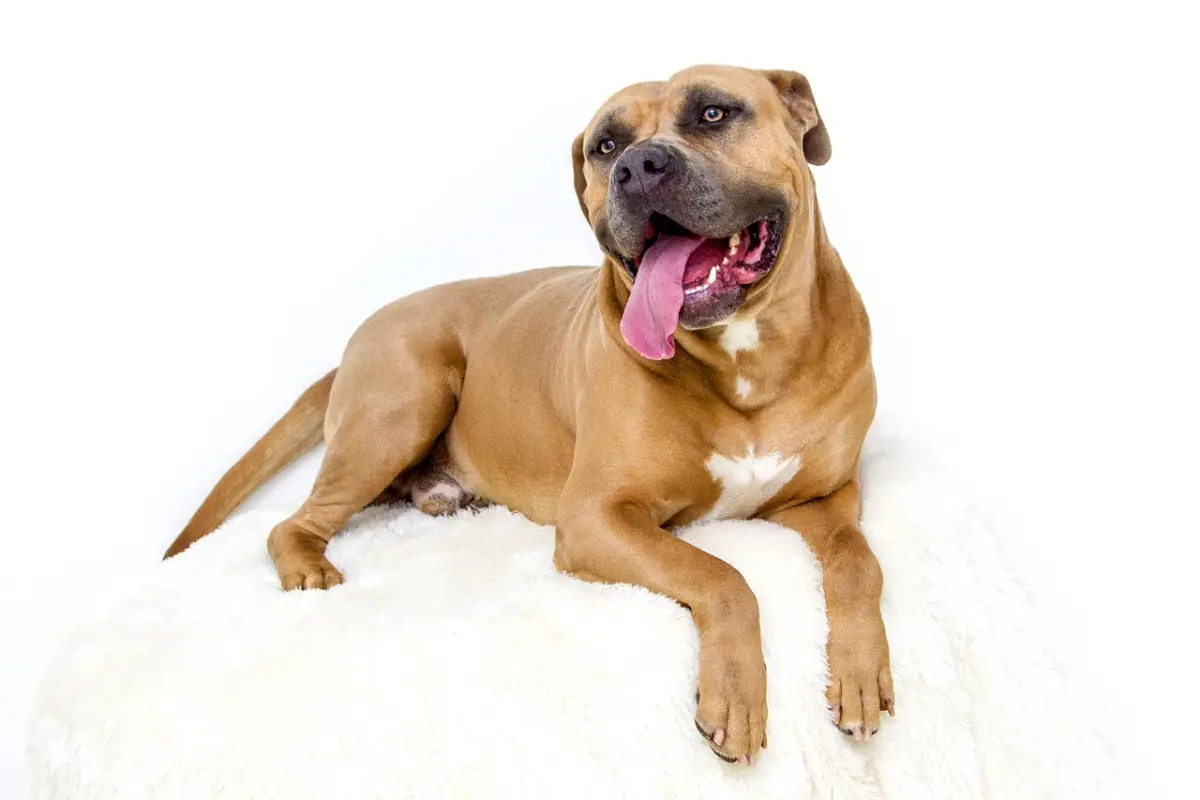
- The American Bulldog is a heavyweight contender. Males routinely tip the scales well past 100 pounds, supported by heavy bone density, a massive blocky head, and a deep, broad chest designed for raw pushing power. Their shorter muzzles (in some variations, such as the Johnson type) mean they are more susceptible to heat exhaustion and require careful monitoring during rigorous hot-weather exercise.
- The American Pit Bull Terrier is built like a middleweight boxer. Lighter, more compact, and possessing a lower center of gravity, the APBT trades raw mass for explosive speed and nimbleness. Their chiseled musculature is wrapped around a lean frame, allowing them to pivot, jump, and accelerate with astonishing quickness.
Behavioral Blueprints: Temperament, Socialization, and Working Drives
Understanding a dog’s behavior requires looking at the evolutionary pressures that shaped its mind. Though both breeds are fiercely loyal to their human families, their social instincts toward unfamiliar humans and other animals reveal stark contrasts.
The American Bulldog: The Confident Protector
American Bulldogs are natural guardians. Bred to protect livestock and homesteads, they possess a strong innate protective instinct. When properly socialized, this translates into a deeply loyal, stable, and discerning family companion who remains calm and observant in unfamiliar environments.
However, their guardian heritage means they are not "universal socialites" with strangers. An unsocialized American Bulldog may display aloofness or suspicion toward unfamiliar people and animals. Furthermore, their independent working background can sometimes manifest as stubbornness, requiring a firm, consistent, and patient handler who understands positive reinforcement leadership.
The American Pit Bull Terrier: The High-Energy Loyalist
APBTs are famously, almost overwhelmingly, human-centric. When bred and raised responsibly, they exhibit an infectious zest for life, an intense desire to please their handlers, and a profound affection for children (historically earning the moniker "nanny dogs" in early 20th-century America due to their gentle patience with human kids).

Yet, prospective owners must confront the breed’s historical baggage regarding animal reactivity. Because of their terrier and fighting-dog ancestry, many APBTs retain a higher predisposition toward dog-selectivity or dog-aggression as they mature. While early and continuous socialization can mitigate this, responsible owners must always remain vigilant and proactive in managing public interactions with other canines.
Official Statements and Veterinary Insights: Debunking Canine Myths
Public perception of bully breeds is frequently distorted by media sensationalism, breed-specific legislation (BSL), and persistent urban legends. Leading veterinary and animal behavior organizations—including the American Veterinary Medical Association (AVMA) and the ASPCA—have repeatedly weighed in on these misconceptions.
Myth 1: "Pit Bulls Have Locking Jaws"
One of the most persistent myths in canine folklore is that Pit Bulls (and, by extension, related bulldogs) possess a specialized physical mechanism or anatomical "jaw-lock" that prevents them from opening their mouths once they clamp down.
The Scientific Reality: Extensive veterinary anatomical studies have proven that the jaw structure of an American Pit Bull Terrier or American Bulldog is identical in bone, muscle, and tendon formation to that of any other dog breed of comparable size. There is no biological locking mechanism. The myth persists because of the breed’s high prey drive, tenacity, and gameness—traits that cause them to hold onto tug toys, flirt poles, or objects with stubborn determination once engaged.
Myth 2: "Bully Breeds Are Inherently Vicious to Humans"
Another damaging fallacy is that these dogs are ticking time bombs programmed for unprovoked human aggression.
The Expert Consensus: Canine behavioral scientists emphasize that aggression is not a binary switch hardcoded into a specific breed name; rather, it is a complex behavioral output shaped by genetics, early socialization, maternal care, training, and environmental treatment. In controlled temperament tests conducted by organizations like the American Temperament Test Society (ATTS), both American Bulldogs and American Pit Bull Terriers routinely score higher (passing at rates above 85% to 87%) than many popular family breeds, such as Beagles or Border Collies.
Future Outlook: Responsible Ownership in a Regulated World
As urban density increases and local governments grapple with animal control policies, the future for both the American Bulldog and the American Pit Bull Terrier hinges on two critical pillars: education and responsible ownership.
- Mandatory Early Socialization: Both breeds require intensive, positive exposure to novel environments, human strangers, and controlled animal interactions during their critical puppy development windows (8 to 16 weeks of age).
- High-Energy Outlets: Boredom is the enemy of the molosser. Providing a minimum of 60 to 90 minutes of vigorous daily exercise—whether through weighted cart pulling, agility courses, long-distance jogging, or intense fetch sessions—is non-negotiable for maintaining their mental and physical well-being.
- Advocacy and Legislation Reform: Forward-thinking municipalities are increasingly moving away from blunt, ineffective Breed-Specific Legislation (BSL) and toward targeted, owner-accountability laws that penalize negligent behavior rather than punishing an animal based solely on its physical silhouette.
Conclusion
The American Bulldog and the American Pit Bull Terrier are magnificent testicles to canine athleticism, history, and loyalty. While their physical similarities often lead to confusion on the street and in shelters, their distinct origins demand distinct approaches to care, training, and management. By honoring their unique heritages—providing the heavy-boned American Bulldog with steady leadership and space, and channeling the APBT’s explosive agility into constructive outlets—owners can unlock the true potential of these misunderstood canine companions.