
Executive Overview
In the vast and endlessly fascinating world of feline coat genetics, few visual phenomena capture the public imagination quite like the bicolor cat. While standard tuxedo cats—distinguished by their sleek black coats accented by crisp white chests, paws, and facial bibs—have long enjoyed cultural renown, a captivating alternative has recently taken the internet by storm: the "reverse tuxedo" cat.
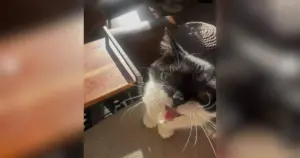
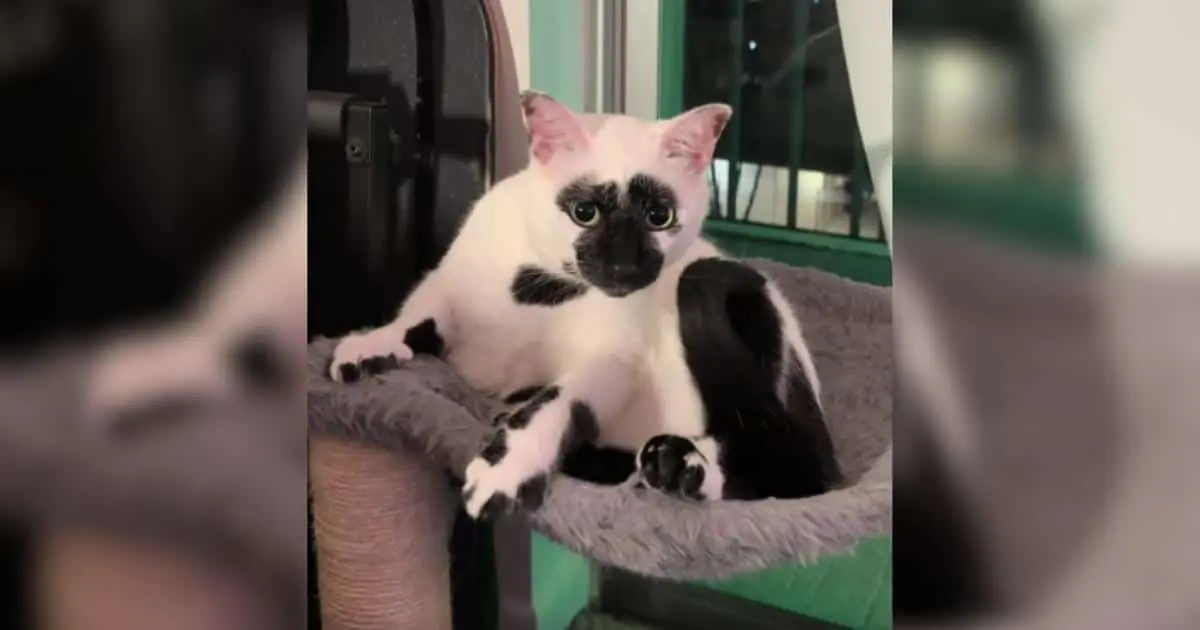
Characterized by a predominantly snowy white coat splashed with bold black patches and an arresting facial mask, this striking aesthetic has upended traditional expectations of feline markings. The phenomenon recently burst into mainstream consciousness courtesy of Mickey, a viral internet feline whose dramatic, mid-groom pause and movie-star facial markings captured the hearts of millions on TikTok.
Beyond the viral charm, however, lies a complex interplay of developmental biology. Far from being a separate breed or an entirely distinct genetic mutation, the reverse tuxedo pattern is simply a unique manifestation of the well-documented KIT gene’s white-spotting effect. This article explores the science behind the pattern, deconstructs its place on the biological spectrum of feline coloration, investigates the viral phenomenon surrounding Mickey, and separates genetic fact from internet myth regarding temperament and related color variants.
Detailed Chronology: The Rise of Mickey and the Viral Spread of the Reverse Tuxedo
The modern cultural fascination with the reverse tuxedo pattern did not emerge from a veterinary conference or a feline genetics laboratory; rather, it began on an ordinary afternoon in a domestic living room, captured through the modern lens of social media.
The Inciting Incident: A Moment Frozen in Time
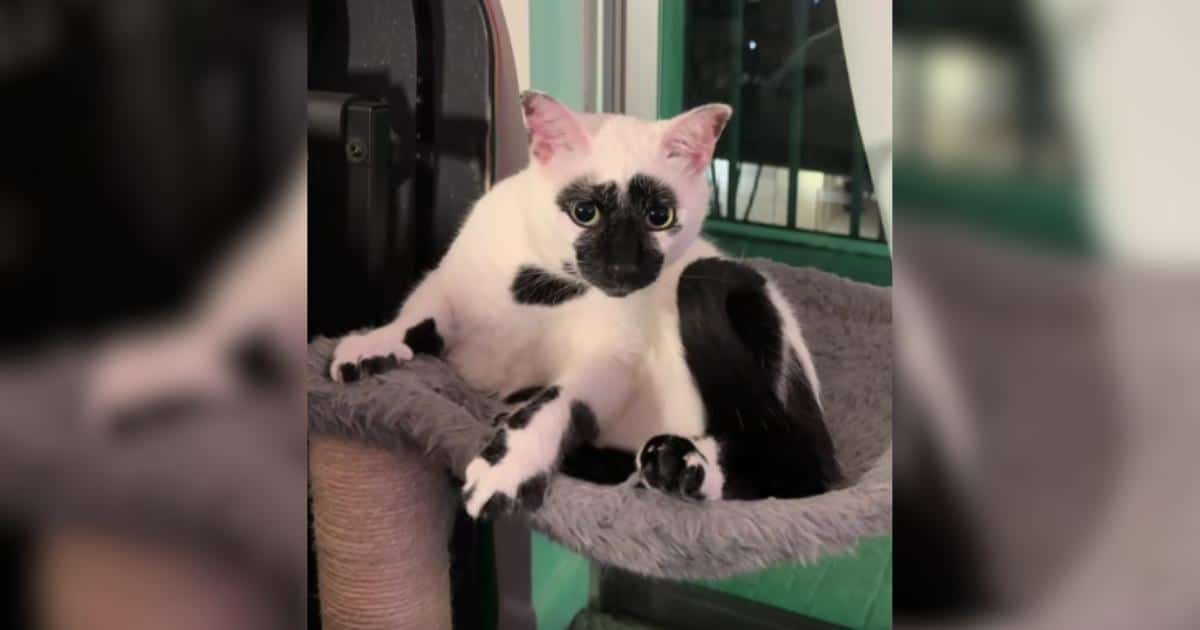
The story centers on Mickey, a cat whose physical appearance already set him apart from the average household pet. Perched casually upon his favorite cat tree, Mickey was engaged in a routine grooming session—a display of quiet, methodical feline focus. Without warning, the domestic tranquility shifted. Mid-lick, Mickey froze.
His pink tongue hovered in the air; his muscular frame instantly stiffened; and his large, luminous eyes locked onto an unseen, distant point across the room. It was not merely the sudden cessation of movement that commanded attention, but the canvas upon which it occurred. Mickey’s face featured a striking, solid black mask stretching completely across his eyes, nose, and mouth, creating an optical illusion of permanent, wide-eyed astonishment.
The Digital Explosion
Documented and shared by his owners via the TikTok account @mickeyginocats, the resulting video clip quickly transcended typical pet-content metrics. Viewers across the globe flooded the comments section, mesmerized by the cat’s uncanny aesthetic.
Commenters began dissecting the visual contradiction of his coat. "Somehow the tuxedo is reversed in every place you’d think it would be," remarked one user, highlighting the counterintuitive placement of pigment. Others playfully debated whether Mickey was fundamentally a black cat with expansive white stripes or a white cat with symmetrical black patches. Due to his stark facial markings and lean, expressive frame, frequent comparisons were drawn to wild animals, particularly lemurs and masked forest dwellers.
From Anecdote to Public Discourse
As the video amassed millions of views and shares, it sparked a broader digital conversation about feline coat variations. Pet owners and animal enthusiasts began sharing images of their own uniquely marked pets, while simultaneously bombarding search engines with queries regarding "reverse tuxedo cat personality" and the underlying science of such striking markings. What began as a fleeting, comical moment of feline distraction transformed into an impromptu masterclass in veterinary genetics, as animal lovers sought to understand the biological mechanisms responsible for Mickey’s unforgettable look.
Supporting Context & Metrics: The Science of the KIT Gene and Feline Pigmentation
To understand why Mickey and other reverse tuxedo cats look the way they do, one must look deep into embryonic development. Feline coat patterns are not determined by competing colors battling for dominance on the surface of the skin; rather, they are dictated by cellular migration during the earliest stages of gestation.
The Role of the KIT Gene and Melanoblast Migration
According to data compiled by the UC Davis Veterinary Genetics Laboratory, all black-and-white bicolor patterns—including standard tuxedos, reverse tuxedos, and van patterns—are governed by a single gene family: the KIT gene, which controls the white-spotting effect.
During fetal development, pigment-producing cells known as melanoblasts originate in the neural crest and slowly migrate across the growing kitten’s skin to populate the hair follicles with color.
- The Standard Tuxedo: When melanoblast migration proceeds efficiently and covers the vast majority of the body’s surface area, the resulting cat is predominantly black, with pigment-free areas restricted to the extremities—namely the paws, chest, and lower belly. This produces the classic, dapper "tuxedo" appearance.
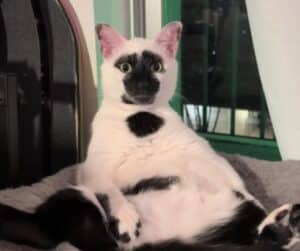
- The Reverse Tuxedo: Conversely, when melanoblast migration stalls early in development, the pigment cells fail to reach large portions of the body. Color is consequently restricted to smaller, localized territories—typically the head, ears, tail, and a narrow stripe along the spine. The rest of the body is entirely overtaken by white fur. Thus, the reverse tuxedo features the exact same genetic building blocks as the standard tuxedo, but with a severely reduced canvas for dark pigmentation.
Where Does the Reverse Tuxedo Sit on the Bicolor Spectrum?
Feline coat registries, such as the Cat Fanciers’ Association (CFA), categorize these variations under the broad umbrella of "bicolor." Rather than discrete categories, bicolor coats exist on a sliding scale defined by the percentage of white fur:
- Low White-Spotting: Mostly colored cats with minimal white markings (e.g., standard tuxedo, locket, or "button" cats).
- Medium White-Spotting: Balanced distribution of color and white (often referred to simply as bicolor or "piebald").
- High White-Spotting (Reverse Tuxedo & Van): Dominated by white fur, with color relegated to isolated patches. In a true "Van" pattern (named after the Lake Van cat of Turkey), color is strictly confined to the head and tail. A reverse tuxedo sits just adjacent to the Van pattern on the spectrum, retaining a bit more pigment along the back and featuring the dramatic facial mask that sets it apart.
Frequency and Rarity Metrics
A common question among cat enthusiasts is whether the reverse tuxedo pattern is scientifically rare. According to geneticists and breed registries, there are currently no formal population censuses or epidemiological studies tracking the precise frequency of the reverse-tuxedo variant of the KIT gene.
Because the white-spotting scale is a continuous spectrum rather than a series of rigid boxes, labeling a specific point on that spectrum as "rare" is largely subjective. While standard tuxedos are frequently encountered in domestic shelter populations, reverse tuxedos appear less commonly in mainstream media, leading to their perception as a rare and exotic anomaly.
Official Statements and Expert Insights
To contextualize the behavioral myths and genetic realities surrounding these cats, we turn to findings from academic research institutions and veterinary organizations.
Personality and Coat Color: Separating Fact from Fiction
A persistent cultural myth suggests that a cat’s coat color or pattern directly dictates its temperament—that orange cats are goofy, calicos are feisty, and tuxedo cats are exceptionally intelligent or polite. When it comes to reverse tuxedo cats, internet searches frequently probe whether their personalities match their dramatic appearance.
Veterinary science offers a definitive answer: there is no established genetic link between the KIT white-spotting gene and behavioral traits.

A landmark study published in the Journal of Applied Animal Welfare Science (led by researchers at the University of California, Davis) investigated potential correlations between feline coat coloration and aggressive behaviors. The study concluded that coat color and pattern are not reliable predictors of an individual cat’s temperament once confounding variables—such as socialization, environment, and breed history—are accounted for.
Experts emphasize that viral reverse tuxedo cats like Mickey are perceived as "bold," "expressive," or "dramatic" solely because human observers project narratives onto striking visual cues. The cat’s facial mask exaggerates its expressions of surprise or alertness, creating an anthropomorphic illusion of theatricality.
Addressing the "Reverse Siamese" Misconception
In discussions surrounding reverse tuxedo cats, internet users frequently invoke another colloquial term: the "reverse Siamese" cat. Veterinary geneticists at institutions like UC Davis clarify that this term is a misnomer born of visual confusion.
- The Siamese Phenotype: Classic Siamese coloration is not governed by the KIT white-spotting gene. Instead, it is the result of temperature-sensitive albinism (controlled by the TYR gene). The enzyme responsible for dark pigment is heat-sensitive; it functions only on the cooler extremities of the body—the face, ears, paws, and tail—leaving the warmer torso pale.
- The "Reverse Siamese" Reality: When individuals online describe a "reverse Siamese" (typically a cat with a dark body and a pale face), they are usually observing a variation of solid, sepia, or mink coloration, or a coincidence of non-standard pointing. The underlying genetic mechanism has not "flipped"; rather, the description is merely a descriptive nickname with no basis in distinct genetic taxonomy.
Future Outlook: The Intersection of Feline Genetics and Digital Culture
As the fields of veterinary genomics and consumer pet genetics continue to advance, our understanding of feline coat patterns will only grow more refined. Direct-to-consumer genetic testing for cats—offered by laboratories such as UC Davis and Optimal Life Data—now allows everyday pet owners to map their rescue cats’ DNA, identifying specific alleles responsible for coat color, length, and white-spotting percentages.
What Lies Ahead for Bicolor Research?
- Deeper Mapping of Regulatory Genes: While the KIT gene is known to be the primary driver of white-spotting, ongoing research seeks to identify the modifier genes that dictate where pigment cells halt their migration. This could eventually explain why one cat develops a neat tuxedo bib while another forms a dramatic facial mask reminiscent of a reverse tuxedo.
- The Evolution of Pet Media: Viral sensations like Mickey demonstrate the profound cultural impact of unique animal aesthetics. As social media platforms continue to elevate visually distinct pets, public interest in biological sciences naturally follows. Veterinarians and geneticists increasingly utilize these viral moments as educational springboards, transforming internet entertainment into accessible public science literacy.
- Adoption Trends: Historically, solid-colored cats (particularly black cats) have faced adoption biases rooted in superstition. The celebration of intricate bicolor variations—from classic tuxedos to high-spotting reverse tuxedos—draws positive attention to domestic shorthairs and mixed-breed shelter cats, highlighting the breathtaking diversity found within the general feline population.
Quick Answers: Frequently Asked Questions
- Is a reverse tuxedo cat a separate breed?
No. Reverse tuxedo describes a coat pattern, not a breed. It can appear in domestic shorthairs, domestic longhairs, and various purebred lines that carry the KIT white-spotting gene. - Are reverse tuxedo cats exceptionally rare?
There are no population studies tracking the frequency of specific points along the white-spotting spectrum. While less commonly photographed than standard tuxedos, they are a natural variation of standard bicolor genetics. - How does a reverse tuxedo differ from a Van pattern?
Both feature extensive white fur, but a Van cat restricts color almost entirely to the head and tail. A reverse tuxedo retains more pigment across the back and incorporates distinctive facial markings like a dark mask across the eyes and nose. - Do reverse tuxedo cats have unique personalities?
No. Scientific studies show no genetic link between the KIT white-spotting gene and temperament. Any perception of "dramatic" personality is driven by human observation of the cat’s striking facial markings. - What is a "reverse Siamese" cat?
It is an informal nickname, not a scientific classification. Siamese pointing is driven by temperature-sensitive albinism, which operates entirely independently of the white-spotting genes responsible for tuxedo patterns.