
Executive Overview
In the fields of veterinary science and animal behavior, the capacity of domestic canines to exhibit complex emotional states—specifically empathy and altruism—has long been a subject of rigorous study. While classical behaviorism often attributes animal actions to basic conditioning, a rapidly growing body of research suggests that dogs possess a highly sophisticated social intelligence. This intelligence is particularly pronounced in multi-dog households containing animals with histories of trauma or neglect.
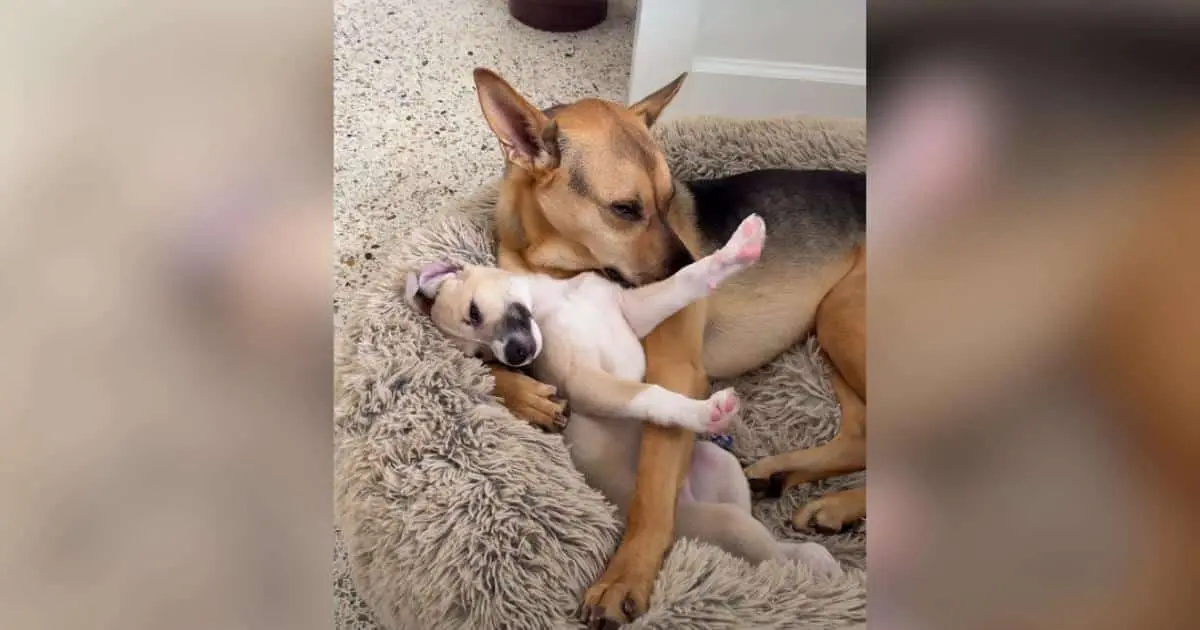
A compelling case study of this phenomenon has recently emerged from the digital sphere, capturing the attention of both the public and behavioral experts. The relationship between two rescue dogs, an older canine named Cactus and a newly adopted puppy named Cowboy, serves as a poignant demonstration of peer-to-peer rehabilitation. Cactus, a dog who overcame his own rescue-related challenges to secure a stable home, has voluntarily assumed a maternal, protective role over Cowboy.
This behavioral integration, captured in a viral video that has amassed over one million likes on Instagram, transcends mere domestic novelty. It offers valuable insights into "conspecific social buffering"—a biological process wherein the presence of a calm, stable companion mitigates the physiological stress responses of a traumatized or novel animal. This investigative report analyzes the chronology of Cactus and Cowboy’s bonding process, examines the underlying scientific mechanisms of canine empathy, evaluates the digital metrics of their viral reception, and discusses the broader implications for shelter dog rehabilitation.
Detailed Chronology
The pathway from shelter isolation to familial integration is rarely linear. For both Cactus and Cowboy, the journey required a delicate orchestration of human patience, environmental stability, and intuitive canine intervention.
[Cactus Rescued & Rehabilitated]
       │
       ▼
[Stable Home Environment Established]
       │
       ▼
[Cowboy Adopted (New Environment Stress)]
       │
       ▼
[First Conspecific Social Buffering (Cactus Initiates Closeness)]
       │
       ▼
[The "Cuddle" Verbal Cue & Behavioral Integration]
       │
       ▼
[Established Co-Regulation & Deep Sleep Cycle]
Phase I: The Foundation of Security (Cactus’s Background)
Years prior to the arrival of his smaller companion, Cactus was transitioned from a state of vulnerability into a permanent home. The initial phase of his rehabilitation focused on establishing a secure attachment to his human caretakers. According to canine development theories, a dog must first feel secure in its own environment before it can extend social support to another. Cactus’s successful transition from a rescue animal to a confident, emotionally stable household anchor laid the necessary neurological groundwork for his future role as a helper dog.
Phase II: The Introduction of Cowboy
Recently, the family made the decision to adopt Cowboy, a young rescue puppy exhibiting the typical behavioral markers of early-stage relocation stress: hyper-vigilance, restlessness, and a constant search for physical security. For a young puppy, transitioning from the chaotic environment of a shelter or foster network to a new household represents a profound disruption of sensory and social expectations.
Phase III: The Observation and the "Cuddle" Catalyst
Almost immediately upon Cowboy’s arrival, Cactus’s behavior shifted. Rather than exhibiting territorial guarding or aloofness—common reactions of established dogs to new puppies—Cactus began tracking Cowboy’s movements with protective interest.
The definitive demonstration of this dynamic was captured by their owner in a domestic setting that has since been widely scrutinized online:
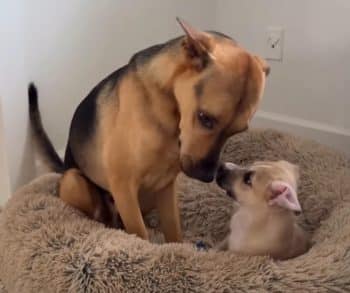
- Initial Positioning: Cactus was situated on a large, orthopedic dog bed, while Cowboy sat adjacent to him, displaying slight postural tension.
- The Verbal Prompt: The owner issued a soft verbal query, asking Cactus if he was going to "cuddle" the new puppy.
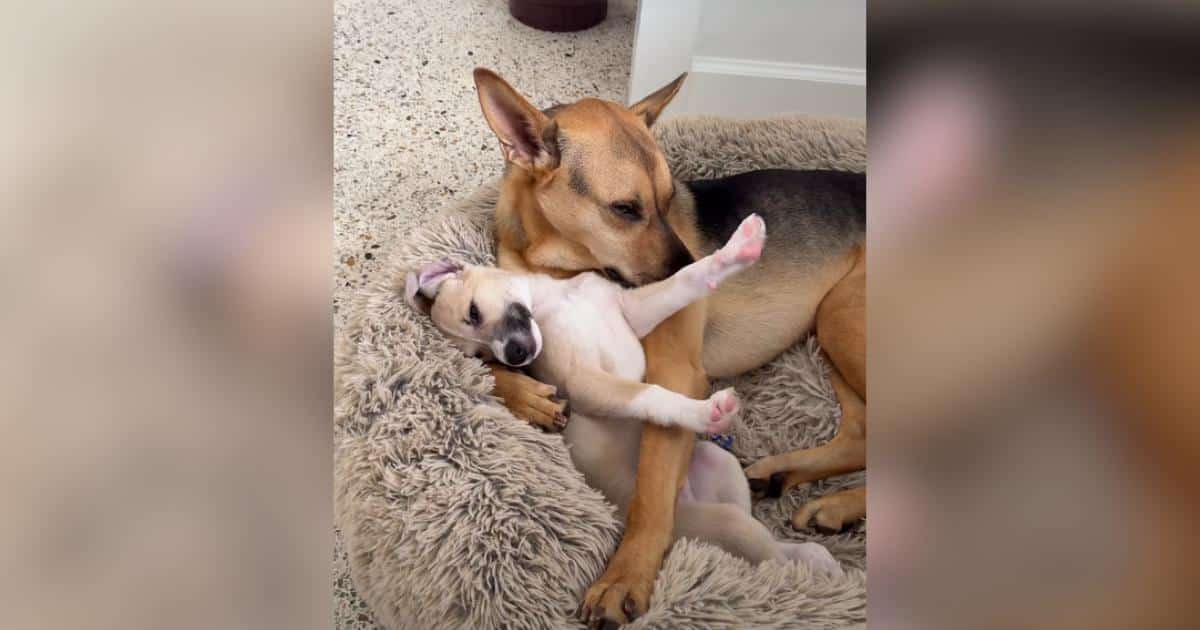
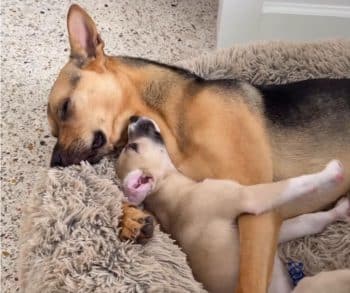
- The Behavioral Response: Upon hearing the prompt, Cactus did not merely shift position; he executed a deliberate, slow-motion lowering of his torso. He extended his forelimbs and neck around the puppy, effectively enveloping Cowboy’s smaller frame in a physical embrace.
- The Adjustment Phase: Captured in the video, Cowboy initially wiggled within the embrace, searching for optimal alignment. Cactus remained entirely immobile, acting as a passive, warm anchor.
- The Co-Regulation State: Within moments, Cowboy’s respiration slowed, his muscle tension dissipated, and he settled securely against Cactus’s chest. Both dogs subsequently entered a state of deep rest.
Supporting Context & Metrics
To understand why this interaction resonated so deeply with millions of observers, it is necessary to examine both the digital metrics of the event and the psychological principles that govern such animal relationships.
Digital Analytics and Public Engagement
The footage of Cactus and Cowboy was uploaded to Instagram, where it quickly bypassed standard algorithmic benchmarks to become a viral phenomenon.
| Metric | Data Point | Significance |
|---|---|---|
| Primary Engagement | 1,000,000+ Likes | Indicates exceptional cross-demographic appeal. |
| Primary Sentiment | Overwhelmingly Positive | Comments focused on themes of "healing," "comfort," and "empathy." |
| Secondary Reach | Multi-platform syndication | Shared widely across pet advocacy and veterinary behavioral networks. |
This high level of engagement points to a profound public appetite for authentic, non-anthropomorphic representations of animal empathy. Viewers did not merely view the video as "cute"; they recognized it as a visual documentation of emotional healing.
The Science of Conspecific Social Buffering
What occurs physiologically when an older, stable dog comforts a younger, stressed conspecific? The answer lies in canine endocrinology and neurology.
- Oxytocin Release: Physical touch between bonded individuals—even across different age groups within the same species—triggers the release of oxytocin, often referred to as the "bonding hormone." This hormone directly counters the production of cortisol, the primary stress hormone.
- Mirror Neurons: Canines possess mirror neuron systems that allow them to perceive and mirror the emotional states of those around them. When Cowboy observed Cactus’s relaxed, slow breathing and passive posture, his own nervous system interpreted the environment as safe, transitioning him from a sympathetic ("fight-or-flight") state to a parasympathetic ("rest-and-digest") state.
- The "Helper Dog" Phenomenon: In professional service dog training and shelter rehabilitation, stable "helper dogs" are routinely used to build confidence in fearful dogs. Cactus instinctively performed the role of a professional therapy animal, proving that formal training is often secondary to innate canine social structures.
Official Statements and Public Reception
The owner of Cactus and Cowboy has documented this evolving relationship with a mixture of awe and clinical observation. In statement updates provided via social media captions, the owner noted:
"These two amaze me every single day. Watching their relationship grow has been one of the most beautiful things I have ever witnessed."
The owner further emphasized that Cactus’s behavior was entirely self-directed. There was no training regimen designed to force the dog to guard or cuddle the puppy; the older rescue simply recognized the puppy’s vulnerability and adjusted his behavior accordingly.
Public and Professional Commentary
The public response to the video highlights a growing sophistication in how society views animal emotions. Commenters on the viral post noted the therapeutic nature of the interaction:
- User A: "This is the sweetest, most healing thing I have seen all week. You can literally see the anxiety leaving the puppy’s body."
- User B: "Cactus doesn’t just ‘think’ Cowboy is his baby; he has actively adopted him. The body language speaks for itself."
Veterinary behaviorists who reviewed the footage noted that Cactus’s willingness to share his resources—namely, his dedicated dog bed—is a highly positive indicator of social health. Resource guarding is a common issue among rescue animals; Cactus’s immediate willingness to yield space to Cowboy demonstrates a high level of emotional security and social intelligence.
Future Outlook
The ongoing relationship between Cactus and Cowboy offers a hopeful template for multi-dog integration, particularly within the rescue community.
[Early Stage: Social Buffering] ──► [Mid-Stage: Social Modeling] ──► [Long-Term: Reciprocal Partnership]
(Anxiety reduction)                 (Learning house rules/habits)      (Balanced pack dynamic)
Long-Term Behavioral Implications
As Cowboy matures, his behavioral profile will be heavily influenced by Cactus’s mentorship. This process, known as "social modeling," means that Cowboy is likely to mimic Cactus’s calm demeanor, house manners, and socialization habits. For rescue advocates, this highlights the immense value of placing young, impressionable rescue puppies in homes with stable, well-adjusted adult dogs.
The Role of Digital Media in Animal Welfare
The viral success of Cactus and Cowboy underscores the changing landscape of animal shelter advocacy. Historically, shelter marketing relied on pity-inducing imagery to encourage adoptions. Modern advocacy, however, increasingly leverages positive, science-supported narratives of transformation and companionship.
By showcasing the profound emotional capacity of rescue dogs, videos like those of Cactus and Cowboy do more than entertain; they actively dismantle stereotypes about shelter animals being "damaged goods." Instead, they present these animals as highly capable of empathy, resilience, and deep familial bonding.
Ultimately, Cowboy’s transition from a vulnerable rescue to a secure, cherished family member was fast-tracked by a companion who had walked the exact same path years prior. Through Cactus’s quiet guardianship, Cowboy has not only found a home—he has found his anchor.