The commercial pet food industry stands at a critical juncture where technological innovation, regulatory mandates, and biological safety intersect. Recently, leading freeze-dried and raw pet food manufacturer Vital Essentials announced the adoption of Electron Beam (E-Beam) technology to treat its product lines. This modern form of irradiation uses electricity to generate high-energy electron streams designed to eradicate pathogenic bacteria such as Salmonella, Listeria monocytogenes, and Escherichia coli.
While industry proponents champion E-Beam processing as a non-thermal solution that preserves raw nutrient profiles while meeting strict safety thresholds, the decision has reignited an intense debate among veterinary toxicologists, consumer advocates, and pet owners. Federal regulations enforced by the U.S. Food and Drug Administration (FDA) mandate that any packaged pet or human food subjected to ionizing radiation must display the international Radura symbol alongside clear labeling statements such as "Treated with radiation" or "Treated by irradiation."
       [ RADURA SYMBOL ]
  (Mandatory FDA Labeling for
    Irradiated Food Products)
This technological transition comes in response to the FDA’s stringent zero-tolerance enforcement policy for pathogens in pet food, formally implemented in 2013 under the Food Safety Modernization Act (FSMA). However, critical questions remain: Does terminal sterilization guarantee a safe product? Furthermore, does killing bacteria address the underlying contamination of raw ingredients, or does it merely conceal dirty supply chains while leaving heat-stable bacterial endotoxins behind?
This investigative report examines the history of pet food irradiation, contrasts various sterilization methodologies, analyzes decade-long pathogen recall metrics, and explores the unaddressed biological threat of bacterial endotoxins in the pet food supply chain.
Detailed Chronology: Key Milestones in Pet Food Irradiation
Understanding the current shift toward E-Beam technology requires analyzing past applications of ionizing radiation within the global pet food industry. Historical precedents reveal a complex history characterized by unexpected biochemical side effects and regulatory hurdles.
+-------------------------------------------------------------------------------+
|                        PET FOOD IRRADIATION TIMELINE                          |
+-------------------------------------------------------------------------------+
| 2008: Australian Orijen Cat Food Disaster                                     |
|   - Mandatory gamma irradiation causes severe neurological harm/paralysis in   |
|     cats. Australia subsequently banned pet food irradiation for quarantine.  |
+-------------------------------------------------------------------------------+
| 2007–2015: Chinese Jerky Treat Toxicity Crisis                                 |
|   - Thousands of pets fall ill; FDA tests for radiation markers like          |
|     2-alkylcyclobutanones but admits a lack of dose-determination methods.    |
+-------------------------------------------------------------------------------+
| 2013: FDA Imposes "Zero Tolerance" Policy                                     |
|   - CVM mandate enforces zero tolerance for Salmonella, Listeria, and E. coli |
|   - Accelerates adoption of HPP and E-Beam irradiation across raw pet foods.  |
+-------------------------------------------------------------------------------+
| Present: Commercial Adoption of E-Beam Technology                             |
|   - Vital Essentials implements E-Beam; industry debates terminal safety vs.  |
|     ingredient quality and residual endotoxin hazards.                        |
+-------------------------------------------------------------------------------+
1. The 2008 Australian Orijen Cat Food Disaster
The most severe historical fallout from pet food irradiation occurred in Australia in 2008. Under strict national quarantine laws, imported pet foods containing meat were required to undergo heavy gamma irradiation upon arrival. When Canadian brand Orijen imported its premium freeze-dried cat food into the country, the shipments were subjected to high-dose gamma radiation treatments ($25text to 50text kGy$) using Cobalt-60 ($^60textCo$) sources.
Shortly after consumer distribution, dozens of cats developed severe, mysterious neurological symptoms, including ataxia, hind-limb paralysis, loss of motor control, and death. A formal investigation by the Australian Parliament concluded that the high-dose gamma irradiation degraded essential nutrients—specifically causing severe depletion of Vitamin A—while simultaneously generating high concentrations of toxic free radicals and lipid peroxides through the oxidation of dietary fats.
This tragic event prompted Australia to amend its quarantine regulations, effectively banning the mandatory gamma irradiation of cat food entering the country.
2. The Chinese Jerky Treat Controversy (2007–2015)
During the widespread investigation into pet illnesses and fatalities linked to imported jerky treats manufactured in China, irradiation again came under intense scrutiny. Tens of thousands of dogs suffered from acquired Fanconi syndrome, acute kidney failure, and gastrointestinal distress.
Inspectors discovered that many imported treat shipments had undergone irradiation to satisfy microbial import criteria. During its multi-year investigation, the FDA Center for Veterinary Medicine (CVM) tested jerky samples for specific biochemical markers of food irradiation, such as 2-alkylcyclobutanones (2-ACBs)—compounds formed exclusively when fats are exposed to ionizing radiation.
Crucially, during the height of the crisis, the FDA issued a public update containing a troubling admission:
"Currently there are no validated methods to determine the dose of radiation that was used to ensure the product was properly irradiated."
This gap exposed a key regulatory challenge: while irradiation killed microbial targets, regulatory bodies lacked standardized forensic tools to verify whether products had been subjected to dangerous or excessive doses of radiation.
3. The 2013 FDA Zero-Tolerance Enforcement Mandate
In 2013, the FDA finalized its compliance policy regarding pathogenic bacteria in pet food, instituting a strict zero-tolerance threshold for Salmonella spp., Listeria monocytogenes, and Escherichia coli. Under this policy, the presence of a single colony-forming unit (CFU) of these organisms renders the pet food "adulterated" under federal law, subjecting the manufacturer to mandatory recalls, public warnings, and product seizures.
This zero-tolerance stance forced alternative pet food manufacturers—particularly those producing raw, freeze-dried, and dehydrated formulations—to seek aggressive "kill step" technologies to protect their businesses from regulatory shutdown, giving rise to widespread adoption of High-Pressure Processing (HPP) and, more recently, Electron Beam processing.
Technological Mechanisms & Scientific Metrics
To evaluate the safety and efficacy of contemporary pathogen mitigation, it is essential to distinguish between the physical mechanisms used in commercial food processing.
+---------------------------------------------------------------------------------------+
|                      COMPARATIVE PATHOGEN CONTROL TECHNOLOGIES                        |
+---------------------------------------------------------------------------------------+
| PARAMETER          | GAMMA IRRADIATION      | E-BEAM IRRADIATION     | HIGH-PRESSURE    |
|                    |                        |                        | PROCESSING (HPP) |
+--------------------+------------------------+------------------------+------------------+
| Energy Source      | Radioactive Isotopes   | Accelerated Electricity| Hydrostatic      |
|                    | (Cobalt-60 / Cesium)   | (Linear Accelerator)   | Water Pressure   |
+--------------------+------------------------+------------------------+------------------+
| Penetration Depth  | Deep (Pallet-level)    | Moderate (Package)     | Uniform via      |
|                    |                        |                        | Liquid Medium    |
+--------------------+------------------------+------------------------+------------------+
| Nutrient Degradation| High risk of lipid    | Claimed minimal at     | Minimal thermal  |
| Potential          | oxidation / Vit loss   | calibrated doses       | impact           |
+--------------------+------------------------+------------------------+------------------+
| Destroys Toxins?   | NO                     | NO                     | NO               |
+--------------------+------------------------+------------------------+------------------+
| Thermal Impact     | Negligible             | Negligible             | Negligible       |
+--------------------+------------------------+------------------------+------------------+
Gamma Irradiation vs. Electron Beam (E-Beam)
Gamma Irradiation: Relies on radioactive decay isotopes (such as Cobalt-60 or Cesium-137) to emit high-energy photons that penetrate deeply into target materials. While effective at high volumes, its deep radiation dose distribution increases the risk of radiolytic compound formation, lipid peroxidation, and nutrient destruction.
E-Beam Irradiation: Uses a linear accelerator (linac) to generate a concentrated stream of high-energy electrons powered entirely by electricity. Unlike gamma rays, E-Beam technology can be precisely tuned and turned off instantly. The accelerated electrons break the double-stranded DNA structure of bacteria, preventing cellular replication. Because E-Beam processing operates within milliseconds and delivers a controlled surface-to-core dose, manufacturers like Vital Essentials contend that it preserves food’s structural, enzymatic, and nutritional integrity without heating the product.
High-Pressure Processing (HPP) vs. Extrusion Thermal Cooking
High-Pressure Processing (HPP): Subjects packaged raw pet food to extreme hydrostatic pressures (up to 87,000 psi / 600 MPa) using cold water. The immense pressure disrupts the cellular membranes of vegetative bacteria while preserving heat-sensitive vitamins and enzymes.
Thermal Extrusion (Kibble Cooking): The traditional standard for commercial kibble, relying on high heat ($210^circtextF to 300^circtextF$), steam, and mechanical shear forces to cook starches and kill microorganisms.
The Regulatory Dilemma: Zero Tolerance vs. Recall Realities
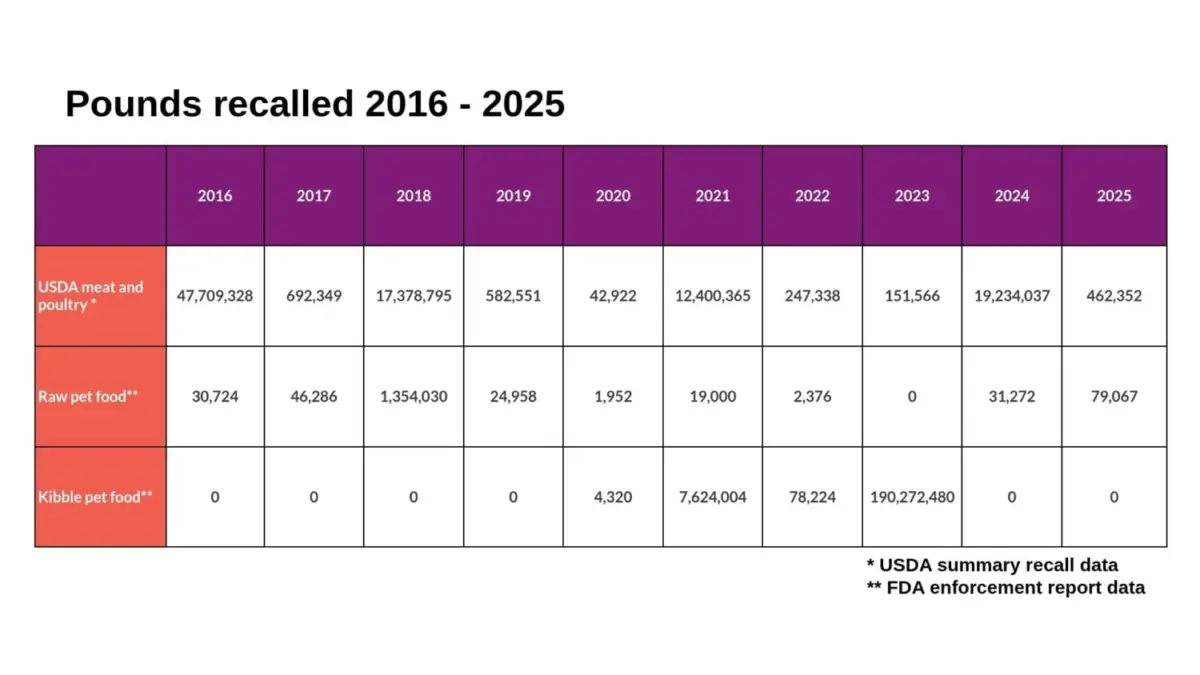
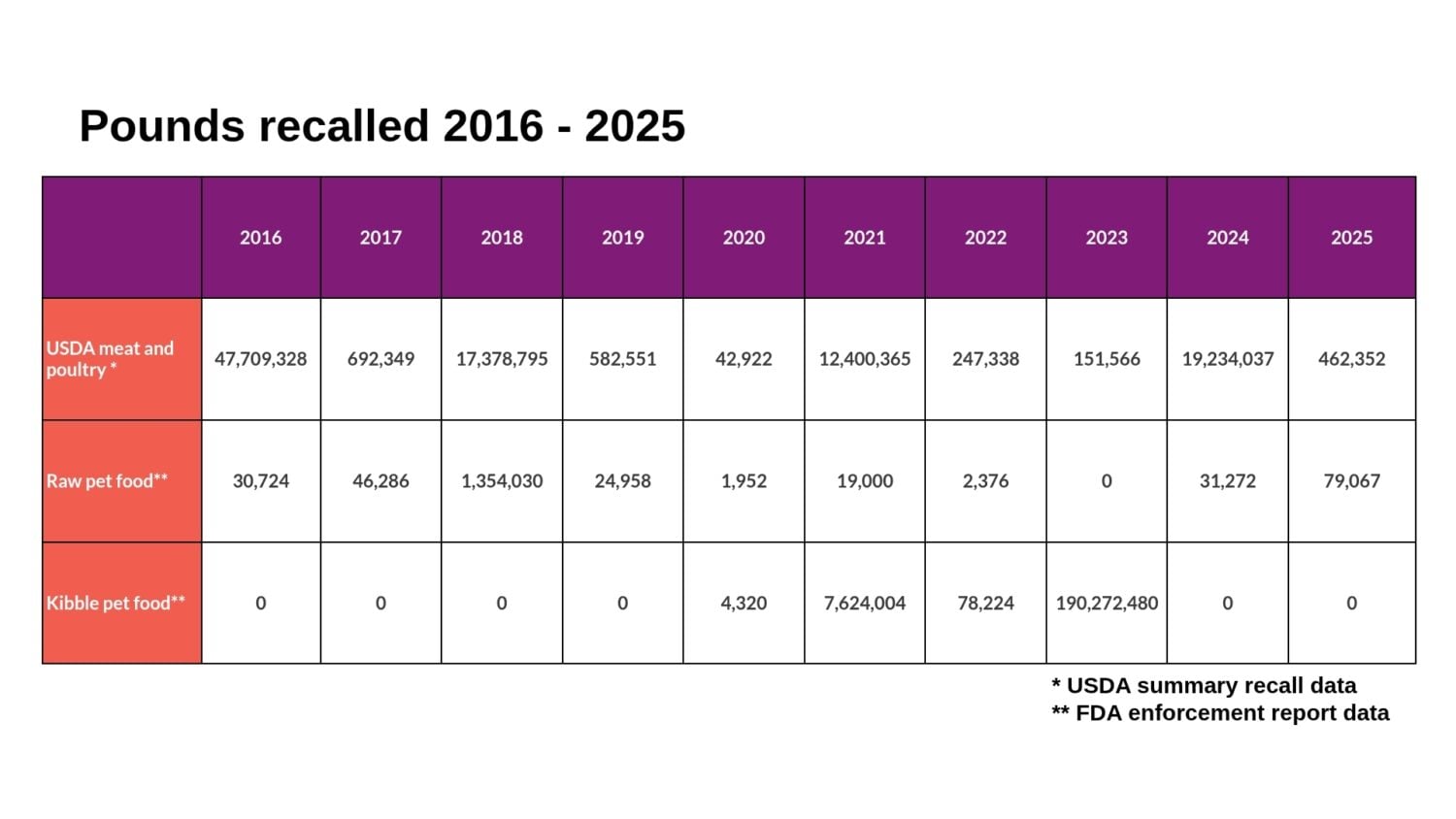
A primary argument for applying terminal technologies like E-Beam is the strict legal climate created by the FDA’s zero-tolerance mandate. However, analyzing a decade of recall metrics exposes a fundamental paradox: terminal kill steps have not eliminated pet food recalls.
   RECALL DYNAMICS: HUMAN MEAT VS. PET FOOD REGULATIONS

   USDA (Human Meat Standard)            FDA (Pet Food Standard)
   +-----------------------+             +-----------------------+
   | E. coli:      ZERO    |             | E. coli:      ZERO    |
   | Salmonella:   ALLOWED*|             | Salmonella:   ZERO    |
   | Listeria:     ALLOWED*|             | Listeria:     ZERO    |
   +-----------------------+             +-----------------------+
   (*Subject to performance standards)   (*Strict Zero Tolerance)
The Human vs. Pet Food Safety Double Standard
A stark regulatory divide exists between human meat safety enforced by the United States Department of Agriculture (USDA) and pet food safety regulated by the FDA:
USDA Standard (Human Food): The USDA enforces zero tolerance for E. coli O157:H7 and non-O157 STECs in raw ground beef, but allows low baseline levels of Salmonella and Listeria in raw poultry and meat products. The regulatory assumption is that human consumers will practice proper hygiene and thoroughly cook raw meat prior to consumption.
FDA Standard (Pet Food): The FDA enforces an absolute zero-tolerance rule for Salmonella, Listeria, and E. coli across all commercial pet food formats—including raw, freeze-dried, fresh, and traditional dry kibble.
Evaluating a Decade of Recall Trends
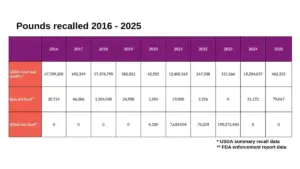
Despite the widespread adoption of thermal kill steps in traditional kibble manufacturing and post-packaging interventions like HPP in raw foods, millions of pounds of pet food are recalled every year due to microbial contamination.
The Kibble Fallacy: Ultra-processed dry kibble undergoes thermal extrusion engineered to eliminate all living pathogens. Yet, kibble accounts for a major share of total pet food tonnage recalled over the past decade. Contamination typically occurs post-extrusion during the application of topical fat coatings, cooling phase exposure, or handling in unhygienic facilities.
The Zero-Tolerance Failure: The data indicates that imposing an absolute zero-tolerance policy has driven manufacturers to rely on heavy-handed chemical, hydrostatic, or radiation interventions at the end of production rather than addressing pathogen loads at the farm, slaughterhouse, and supply chain level.
The Invisible Danger: Bacterial Endotoxins and Secondary Toxicity
Perhaps the most critical oversight in the debate over pet food sterilization is the distinction between viable bacteria and bacterial endotoxins. While terminal kill steps like E-Beam irradiation, HPP, and high-heat extrusion successfully kill living bacteria (rendering them unable to replicate), they do not destroy or neutralize the toxic chemical compounds left behind by dead bacterial cell walls.
+---------------------------------------------------------------------------------+
|                       THE BACTERIAL ENDOTOXIN CASCADE                           |
+---------------------------------------------------------------------------------+
| 1. RAW INGREDIENT CONTAMINATION:                                                |
|    High levels of live Gram-negative bacteria (Salmonella, E. coli) build up in |
|    substandard meat inputs.                                                     |
+---------------------------------------------------------------------------------+
| 2. TERMINAL KILL STEP APPLIED (Heat / HPP / E-Beam Irradiation):                |
|    Pathogen cell membranes undergo lysis (breakdown). Live bacteria are         |
|    eliminated, meeting FDA zero-tolerance rules.                                |
+---------------------------------------------------------------------------------+
| 3. ENDOTOXIN RELEASE:                                                           |
|    Heat-stable Lipopolysaccharides (LPS / Endotoxins) are liberated from dead  |
|    cell walls into the finished pet food product.                               |
+---------------------------------------------------------------------------------+
| 4. SYSTEMIC PATHOLOGY:                                                          |
|    Ingested endotoxins pass through the gut lining -> systemic circulation ->   |
|    chronic liver strain, inflammation, and cellular dysfunction.                |
+---------------------------------------------------------------------------------+
Understanding Lipopolysaccharides (LPS)
Gram-negative bacteria, including Salmonella and E. coli, feature an outer cell membrane composed largely of complex Lipopolysaccharides (LPS). When these bacteria die and their cell walls disintegrate during sterilization, the toxic Lipid A component of the LPS molecule is released. This freed compound is known as an endotoxin.
Endotoxins are exceptionally resilient:
They are heat-stable and easily survive standard extrusion temperatures ($250^circtextF+$);
They are radiation-resistant, remaining biologically active even after electron beam ionization or high-dose gamma exposure;
They are pressure-resistant, enduring the extreme forces of HPP unscathed.
Hepatic Clearance and Cumulative Organ Strain
When a pet consumes food containing high concentrations of bacterial endotoxins, these molecules cross the intestinal mucosal barrier and enter the hepatic portal system.
Renowned veterinary researcher and Professor Emeritus at the University of California, Davis, School of Veterinary Medicine, Dr. Donald R. Strombeck, documented the toxicological impact of dietary endotoxins in commercial companion animal nutrition:
"Endotoxin entering the body is carried to the liver where it is inactivated. Increased endotoxin levels can damage the liver. Moreover, when the amount of endotoxin reaching the liver is normal, the presence of another potential toxin can interact with endotoxin to damage the liver. The other substances are not necessarily toxins. They include vitamin A, copper and iron, and many drugs. Thus, any level of endotoxin can damage the liver. Exposure to endotoxin should be minimized as much as possible."
Dr. Strombeck’s work highlights a major safety concern: The higher the bacterial contamination of raw ingredients prior to sterilization, the higher the concentration of harmful endotoxins in the final product.
Because commercial pet foods are frequently formulated with elevated levels of trace minerals (such as copper and iron) and synthetic vitamins, the toxic synergistic interactions described by Dr. Strombeck present a real hazard for chronic hepatic inflammation, liver disease, and systemic metabolic stress in dogs and cats.
Official Statements & Stakeholder Perspectives
The debate over E-Beam technology and raw food processing highlights conflicting priorities across the pet food industry.
The Manufacturer’s Position (Vital Essentials / NextBeam)
In public disclosures and technical documentation, Vital Essentials defends its implementation of E-Beam processing as a modern, non-invasive safety standard:
Safety Assurance: The manufacturer states that E-Beam technology utilizes pure electricity to target microbial pathogens without introducing chemical additives or radioactive materials.
Nutritional Integrity: According to validation studies published by NextBeam (a leading electron beam service provider), the ultra-fast treatment process ensures that the target food maintains its full nutritional profile, amino acid stability, and bioavailable enzymes without altering organoleptic qualities.
The Regulatory Position (FDA CVM)
Approved Safety: The FDA maintains that food irradiation within established dosage limits is safe and effective for controlling foodborne pathogens across human and animal food sectors.
Mandatory Consumer Transparency: The agency enforces clear labeling standards, mandating that irradiated products carry the Radura logo and explicitly state that the product has been treated with radiation.
       +-------------------------------------------------------+
       |                  THE RADURA MARK                      |
       |                                                       |
       |                          |   /                       |
       |                          |  /                        |
       |                     (---=====---)                     |
       |                    /  |       |                      |
       |                   |   |   *   |   |                   |
       |                      |       |  /                    |
       |                     (---=====---)                     |
       |                        /  |                          |
       |                       /   |                          |
       |                                                       |
       |            STATEMENT REQUIRED BY FEDERAL LAW:         |
       |  "Treated with Radiation" OR "Treated by Irradiation"  |
       +-------------------------------------------------------+
Endotoxin Oversight: To date, the FDA Center for Veterinary Medicine has not established maximum residue limits (MRLs) or routine testing protocols for bacterial endotoxins in finished commercial pet food products, focusing regulatory actions entirely on the presence of viable colony-forming units (CFUs).
Susan Thixton, prominent pet food consumer advocate, founder of TruthaboutPetFood.com, and leader of the Association for Truth in Pet Food (ATPF), urges skepticism regarding the reliance on end-stage sterilization technologies:
"If there is no validated method to determine the dose of radiation… should anyone be using it? Relying on terminal kill steps places the cart before the horse. Regulatory focus must shift away from sanitizing heavily contaminated raw materials after the fact, and return to enforcing strict microbial hygiene at the ingredient source."
Thixton argues that relying on post-packaging kill steps like irradiation allows manufacturers to utilize lower-grade meat ingredients that may have accumulated high bacterial loads prior to processing, masking poor raw material quality while leaving pets exposed to invisible endotoxin loads.
Future Outlook & Actionable Guidance for Consumers
Industry Reform: Moving Beyond Terminal Sanitation
For the pet food industry to ensure long-term biological safety, regulatory frameworks must evolve beyond simple end-product screening. True safety requires systemic reforms:
Source-Level Microbial Standards: Regulatory authorities like the FDA and USDA must enforce strict bacterial limits at the slaughterhouse and transport stages, preventing the accumulation of massive bacterial loads before raw meats reach the processor.
Endotoxin Thresholds: The FDA CVM should establish clear limits for bacterial endotoxins in commercial pet foods to prevent chronic hepatic stress and long-term toxicity in companion animals.
Dosage Verification Assays: Regulatory agencies must develop validated testing methods to accurately measure and verify the exact radiation dosage applied to processed commercial pet foods.
A Practical Playbook for Pet Owners
Pet owners evaluating irradiated products or navigating raw, freeze-dried, and cooked pet foods should adopt an active approach to assessing product safety:
+---------------------------------------------------------------------------------------+
|                        CONSUMER DUE-DILIGENCE CHECKLIST                               |
+---------------------------------------------------------------------------------------+
| [ ] 1. INSPECT THE LABEL:                                                             |
|     Check packaging for the international Radura logo or the mandatory phrases        |
|     "Treated with radiation" or "Treated by irradiation."                             |
|                                                                                       |
| [ ] 2. REQUEST RECENT NUTRITIONAL ASSAYS:                                            |
|     Contact the manufacturer and request a comprehensive post-treatment nutritional  |
|     analysis verifying that heat- and radiation-sensitive vitamins (A, B1/Thiamine,   |
|     E) remain intact.                                                                 |
|                                                                                       |
| [ ] 3. INQUIRE ABOUT PATHOGEN PRE-TREATMENT STANDARDS:                                |
|     Ask the company: "What are your maximum allowable bacterial limits for incoming   |
|     raw meat ingredients BEFORE any kill step (HPP, E-Beam, or Cooking) is applied?" |
|                                                                                       |
| [ ] 4. ASK FOR ENDOTOXIN TESTING (LAL ASSAYS):                                        |
|     Inquire whether the manufacturer conducts Limulus Amebocyte Lysate (LAL) testing   |
|     to verify low bacterial endotoxin levels in their finished products.             |
+---------------------------------------------------------------------------------------+
Conclusion
The adoption of E-Beam technology by brands like Vital Essentials represents a technological solution to an aggressive regulatory landscape focused heavily on zero-tolerance pathogen enforcement. However, as science demonstrates, eliminating live bacteria with electrons, heat, or high pressure is only part of the food safety equation.
Until regulatory bodies address raw ingredient quality and establish clear standards for heat-stable bacterial endotoxins, pet parents must remain vigilant—demanding full transparency regarding processing methods, ingredient sourcing, and post-treatment nutritional integrity from the manufacturers they trust.