Long before a puppy learns to sit, walk calmly on a leash, or guide an individual through a complex and bustling world, a profound transformation is already underway behind the scenes. In the quiet, vulnerable opening chapters of a canine’s life, complex biological networks are firing, wiring, and laying the groundwork for future resilience, intelligence, and emotional stability. At organizations like Dogs Inc, the meticulous journey of preparing future guide and service dogs begins on day one—long before formal obedience training ever enters the picture.
Central to this early phase is a science-based practice known as Early Neurological Stimulation (ENS). While ENS is just one small chapter in the broader narrative of canine development, it exemplifies the deeply thoughtful, evidence-based approach required to support optimal health and emotional fortitude from birth. By introducing mild, highly controlled sensory challenges during the neonatal stage, specialists can help stimulate neurological pathways and set the stage for lifelong learning.
However, early stimulation is merely the starting point. Canine development is a dynamic continuum spanning the neonatal and transitional periods, the critical socialization window, and the adolescent milestones that test boundaries. Navigating these stages requires a comprehensive framework combining genetics, specialized handling, targeted socialization, and continuous positive reinforcement. This article explores the science of Early Neurological Stimulation, differentiates it from socialization, maps out the critical developmental milestones of a service dog in training, and highlights why proactive early care is the ultimate prerequisite for life-changing partnerships.
Detailed Chronology: From Neonatal Beginnings to Adolescent Milestones
Understanding how a service dog evolves from a fragile newborn into a confident, composed working partner requires examining the distinct chronological stages of early canine development. Each phase introduces unique physiological changes, behavioral breakthroughs, and developmental windows that shape the dog’s future capabilities.
The Neonatal Stage (Birth to Two Weeks)
During the first two weeks of life, newborn puppies exist in a completely dependent state. Relying entirely on their mother and littermates, neonates spend the vast majority of their time sleeping and nursing. At this juncture, their eyes and ears remain sealed, and they are physiologically incapable of regulating their own body temperature.
Despite their outwardly vulnerable appearance, intense developmental activity is occurring internally. The brain and central nervous system are growing at an exponential rate. It is precisely during this delicate window—typically spanning from birth through day sixteen—that Early Neurological Stimulation is introduced. Because puppies cannot yet process complex external environments, ENS protocols are restricted to brief, gentle handling exercises designed to stimulate the neurological system without causing distress or exhaustion.
As puppies cross the threshold into the transitional stage, dramatic physical and sensory awakenings occur. Eyes and ears open, allowing the animals to experience light, shadow, and ambient sounds for the first time. Around four weeks of age, puppies begin to find their footing, taking their first tentative steps and experimenting with vocalizations like barking.
Concurrently, their deciduous "baby" teeth begin to erupt, signaling a physiological shift away from exclusive nursing toward soft weaning foods and, eventually, solid nutrition. During this transitional period, interaction with littermates becomes increasingly active, teaching foundational social boundaries and bite inhibition.
The Socialization Period (Weeks Three to Twelve)
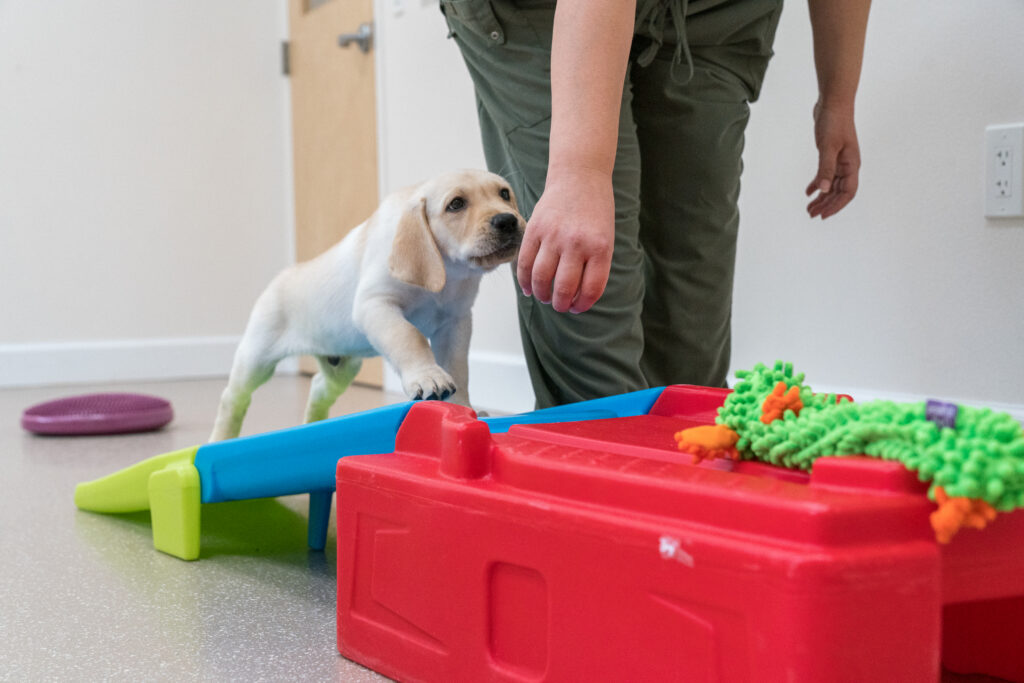
Often overlapping with the tail end of the transitional phase, the socialization window is universally recognized by canine behavioral scientists as the most critical period for emotional shaping. Spanning roughly from week three through week twelve, this window is when young puppies begin actively engaging with people, varied floor surfaces, novel sounds, other dogs, and diverse environmental stimuli.
By the time a puppy reaches eight weeks of age, these positive exposures begin laying the concrete groundwork for a friendly, adaptable adult temperament. Between eight and twelve weeks, structured introductions to new environments help build profound psychological resilience. Uniquely, canine behaviorists note that puppies typically experience an average of four distinct "fear periods" during their growth phases, making it vital that new stimuli are introduced thoughtfully, paired with positive reinforcement, and never forced. Unaddressed negative encounters during these windows can manifest later as chronic anxiety, fear-based aggression, or reactivity.
The Adolescent Stage and Beyond (Months Six to Twelve)
As puppies mature into adolescence—a phase that can begin as early as six months of age—they frequently test boundaries, much like human teenagers. This stage coincides with the onset of reproductive maturity, which usually occurs between six and 12 months.
For female dogs, this often involves entering their first heat cycle, while young males experience surges in hormone-driven behaviors. Training must remain consistent, patient, and focused on positive reinforcement to guide adolescents through hormonal shifts. By three months of age, puppies are fully capable of learning basic cues in short, engaging training sessions. As they approach four months (roughly 16 weeks), structured puppy classes help solidify obedience, while crate training reinforces routine and independence. Gradually, exposure to other species and environments cements their capacity to remain calm and focused in a complex world.
Supporting Context & Metrics: The Science of Early Neurological Stimulation
To appreciate the value of Early Neurological Stimulation, one must examine the physiological mechanics behind the practice. Originally developed for military breeding programs and later popularized by specialized canine breeding and training institutions, ENS involves a series of five distinct, tactile exercises performed once daily between the third and sixteenth days of life.
The Five Core ENS Exercises
During the neonatal stage, a puppy’s neurological system is primed to respond to mild stressors. The ENS protocol leverages this biological readiness through five brief, targeted maneuvers, each lasting approximately three to five seconds:
Tactile Stimulation: The handler gently tickles the puppy’s foot between the toes using a Q-tip or finger. This exercise stimulates peripheral nerves and challenges the nervous system in a benign way.
Head Held Erect: The puppy is held perpendicularly, with its head pointing toward the ceiling, mildly altering its equilibrium and activating vestibular responses.
Head Pointed Down: The puppy’s head is gently turned downward toward the floor, further conditioning the vestibular and circulatory systems.
Supine Position: The puppy is placed comfortably on its back in the palm of the handler’s hand, introducing a posture of total vulnerability in a secure environment.
Thermal Stimulation: A damp towel that has been cooled in a refrigerator is placed beneath the puppy, introducing a mild, safe temperature variation that prompts a physiological adaptation response.
Documented Physiological Impacts
According to decades of observational data and veterinary research, the controlled application of these neonatal stressors triggers beneficial biological responses. Potential physiological and psychological advantages observed in dogs that undergo ENS include:
Stronger Stress Tolerance: Greater adrenal gland output and improved resilience when encountering unforeseen environmental pressures.
Greater Disease Resistance: Heightened immune system functioning and resistance to common illnesses.
Enhanced Brain Functioning: Greater capacity for problem-solving, emotional regulation, and learning later in life.
Despite these impressive benefits, experts emphasize that ENS is not a silver bullet. A working dog’s ultimate temperament, health, and success are shaped by a complex interplay of genetics, optimal nutrition, veterinary care, socialization, structural environment, and lifelong training. ENS is simply the foundational first block in a massive architectural structure.
Official Statements and Industry Insights
Organizations dedicated to breeding and raising elite working dogs recognize that world-class service dogs cannot be mass-produced through standard pet-rearing methods. The philosophy centers on intentionality at every stage of growth.
"Long before a puppy takes its first walk on a leash or learns complex directional cues, a silent foundation is being built. Early Neurological Stimulation gives us a scientific, gentle way to awaken those neural pathways during a dog’s most delicate days," shares a canine development specialist at Dogs Inc. "However, ENS is only the first chapter. True service dog excellence requires a lifelong commitment to socialization, structured exposure, and positive reinforcement."
Animal behaviorists and veterinary researchers echo this sentiment, noting that public perception often misinterprets early stimulation as intensive training. Industry leaders stress that neonatal exercises must remain entirely distinct from formal obedience.
"People often ask if training starts at birth," explains a leading veterinary behaviorist. "In truth, training is about teaching commands, whereas neonatal care and socialization are about shaping how the brain perceives the world. By introducing tactile and thermal challenges safely during the first two weeks, we are teaching the puppy’s autonomic nervous system to recover quickly from stress. It is about emotional buoyancy, not obedience."
Furthermore, breeding and puppy-raising networks emphasize that maintaining high standards requires strict adherence to established protocols. Because newborn puppies are fragile, improper handling during the neonatal window can lead to stress or injury. Therefore, structured programs rely strictly on trained professionals and vetted puppy-raising volunteers who understand the nuanced biology of each developmental milestone.
Future Outlook: The Evolution of Service Dog Preparation
As our understanding of canine cognition and epigenetics continues to evolve, the methodologies used to prepare guide and service dogs are becoming increasingly sophisticated. The future of service dog development points toward an even more integrated approach—one that bridges cutting-edge veterinary science with community-driven puppy raising.
The Shift Toward Individualized Enrichment
While standardized protocols like ENS will remain a cornerstone of neonatal care, future protocols are expected to incorporate more personalized behavioral tracking. By monitoring how individual litters and puppies respond to specific environmental stimuli during their developmental windows, trainers can tailor socialization schedules to target individual strengths and address minor emotional sensitivities before they solidify into behavioral traits.
Expanding the Scope of Public Access Preparedness
Modern service work demands unprecedented adaptability. As urban landscapes grow denser and public spaces more complex, future guide and service dogs must navigate distractions ranging from multi-modal public transit systems to unpredictable technological devices. Preparing dogs for this high-stakes environment begins with the earliest tactile stimulations and extends through rigorous adolescent training classes at 16 weeks and beyond.
Organizations like Dogs Inc continue to pioneer these comprehensive pathways, ensuring that every puppy receives the meticulous, multi-stage care necessary to transform into a calm, confident, and life-changing partner. By honoring every milestone—from the neonatal tremors of a three-day-old puppy to the poised focus of a twelve-month adolescent—the service dog community ensures that independence and mobility remain accessible to those who rely on them most.