
Executive Overview
In a discovery that promises to rewrite the evolutionary history of our planet, a team of international scientists has revealed that the animal kingdom may have emerged up to 200 million years earlier than what is currently documented in the definitive fossil record. Published in Science Advances, the research—led by paleontologists and evolutionary biologists at the University of Oxford, alongside academic powerhouses such as the University of California, Berkeley, ETH Zürich, and Yale University—fundamentally challenges a cornerstone assumption long relied upon by geologists and evolutionary biologists to date the dawn of animal life.
For decades, the scientific community has been vexed by a profound contradiction. While genetic methods, known as molecular clocks, have frequently hinted at an ancient lineage for animals stretching deep into the Precambrian, the physical fossil record tells a starkly different story. Unmistakable animal fossils seem to burst onto the scene relatively abruptly just prior to the Cambrian Period, roughly 539 to 487 million years ago. This apparent contradiction has forced researchers to look for strict boundaries in older, exceptionally preserved rock strata to determine the absolute latest possible date for when animals could have first evolved.
At the heart of this dating methodology is the premise of negative evidence: if a rock deposit is exceptionally well-preserved and yet lacks any trace of animal fossils, scientists historically concluded that animals simply did not exist when those rocks were formed.
However, the new study shatters this pivotal assumption. By analyzing exquisitely preserved microfossils from the Kheseen Biota in Mongolia—a deposit that completely lacks animal fossils despite dating to a time when animals are definitively known to have existed elsewhere—the researchers have proven that pristine preservation does not guarantee the capture of early animal life. Consequently, older geological constraints can now be utilized in molecular clock models. The result? The estimated origin of the animal kingdom is pushed backward by a staggering 200 million years, placing the dawn of multicellular animal life into a window between 800 and 700 million years ago.
This startling revelation opens the door to a radical new hypothesis: that the earliest animals may have evolved before, or perhaps directly through, the catastrophic, planet-encapsulating glaciations known as the "Snowball Earth" events of the Cryogenian Period.
Detailed Chronology: Unraveling the Evolutionary Timeline
To understand the magnitude of the Oxford-led study, one must trace the timeline of Earth’s early biological and geological history, and examine how scientists attempt to read a fossil record that is inherently incomplete, biased, and notoriously difficult to interpret.
The Ediacaran Paradox and the Weng’an Biota
For years, the scientific consensus regarding the maximum age of animals relied heavily on exceptional fossil deposits from the Ediacaran period. One of the most critical sites used for this purpose is the Weng’an Biota in South China, a window into ancient ecosystems dating back approximately 590 million years.
The Weng’an Biota is famous among paleontologists for its breathtaking preservation. It contains microscopic organisms, algae, and protozoans preserved in three-dimensional, cellular detail within phosphate-rich rocks. Because the micro-scale preservation at Weng’an is so immaculate, scientists operated under a logical deduction: if animals had already evolved by 590 million years ago, surely these exceptional conditions would have trapped them. Because no definitive animal fossils have ever been recovered from Weng’an, researchers used the deposit as a hard chronological anchor, arguing that the origin of animals must have post-dated the formation of the Weng’an Biota.
This assumption formed the absolute ceiling for molecular clock analyses. Whenever geneticists ran their algorithms to estimate when the common ancestor of all animals lived, they were forced to calibrate their models so that the timeline could not push back past the Weng’an constraint.
The Kheseen Biota: A Crucial Empirical Test
To test the validity of this foundational assumption, the international research team turned their attention to the Kheseen Biota in Mongolia. The Kheseen deposit is roughly 40 million years younger than the Weng’an Biota, sitting firmly in the Ediacaran period, yet it shares several distinct microfossil species with the older Chinese site.
Crucially, the global geological and paleontological record demonstrates beyond a shadow of a doubt that by the time the Kheseen Biota formed, animals were already roaming Earth’s shallow marine environments. Confirmed fossil evidence of early animal life and trace fossils had already materialized in localities such as Namibia and South China.
Employing advanced scanning electron microscopy, the research team meticulously examined more than 140 rock samples, including materials harvested from previously undocumented geographic locations within Mongolia. The results of the microscopic analysis were astonishing. The samples yielded exquisitely preserved microfossil species, including intricate acritarchs—tiny, spherical organisms characterized by complex surface spines and branching projections—alongside bizarre, embryo-like fossils containing distinct internal cells.
Yet, despite this phenomenal level of preservation, not a single fossil within the Kheseen Biota could be definitively identified as an animal.
This discovery delivered a fatal blow to the traditional logic of the Weng’an Biota. As senior author Associate Professor Ross Anderson noted, the Kheseen assemblage proves that exceptional fossil preservation is not a guarantee of catching animal life in the act. Even when scientists know animals were alive and populating the globe, taphonomic and ecological variables can completely conceal them from the local fossil record.
Rewriting the Molecular Clock
With the Weng’an constraint invalidated as a universal rule for the absence of animal life, the research team pivoted to much older geological formations. They looked back across the Neoproterozoic Era, focusing on rock deposits dating from approximately 850 to 730 million years ago.
Key formations analyzed included:
- The Svanbergfjellet Formation in Norway
- The Bitter Springs Group in Australia
- The Chuar Group in Arizona, USA
These ancient deposits are rich in microfossils and possess the precise chemical and geological characteristics capable of preserving delicate organic remains, although no confirmed animal fossils have ever been recovered from them. Historically, because of their great age, these sites were viewed with extreme caution for molecular calibrations.
However, by integrating these older geological formations as boundary constraints within their molecular clock analyses—a computational technique that models evolutionary divergence based on genetic mutations accumulated over deep time—the researchers achieved radically different results.
When the older 850-to-730-million-year constraints were applied instead of the younger Ediacaran Weng’an boundary, the calculated origin of the animal kingdom shifted backward by roughly 200 million years. The mathematical models now point to a timeframe between 800 and 700 million years ago for the emergence of the first animals.
Supporting Context & Metrics: The Biological and Chemical Evidence
While the new study in Science Advances provides the methodological key to unlocking an older timeline, it builds upon a growing body of multidisciplinary evidence that has long suggested the traditional fossil record is merely the tip of the iceberg.
The Fragility of Early Life
Why did it take so long for animals to show up in the fossil record if they truly originated 800 million years ago? The answer lies in the biology of Earth’s earliest metazoans.
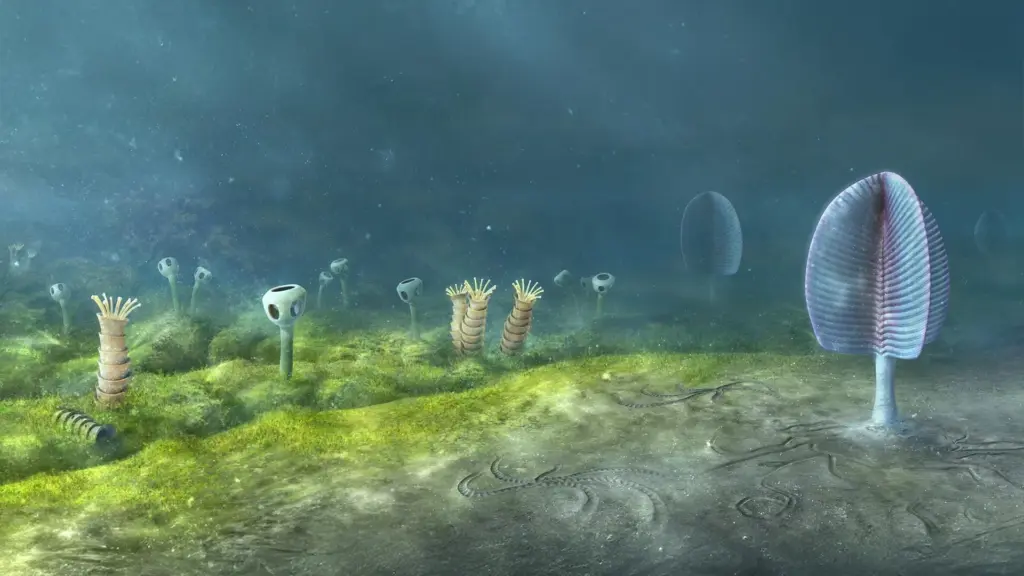
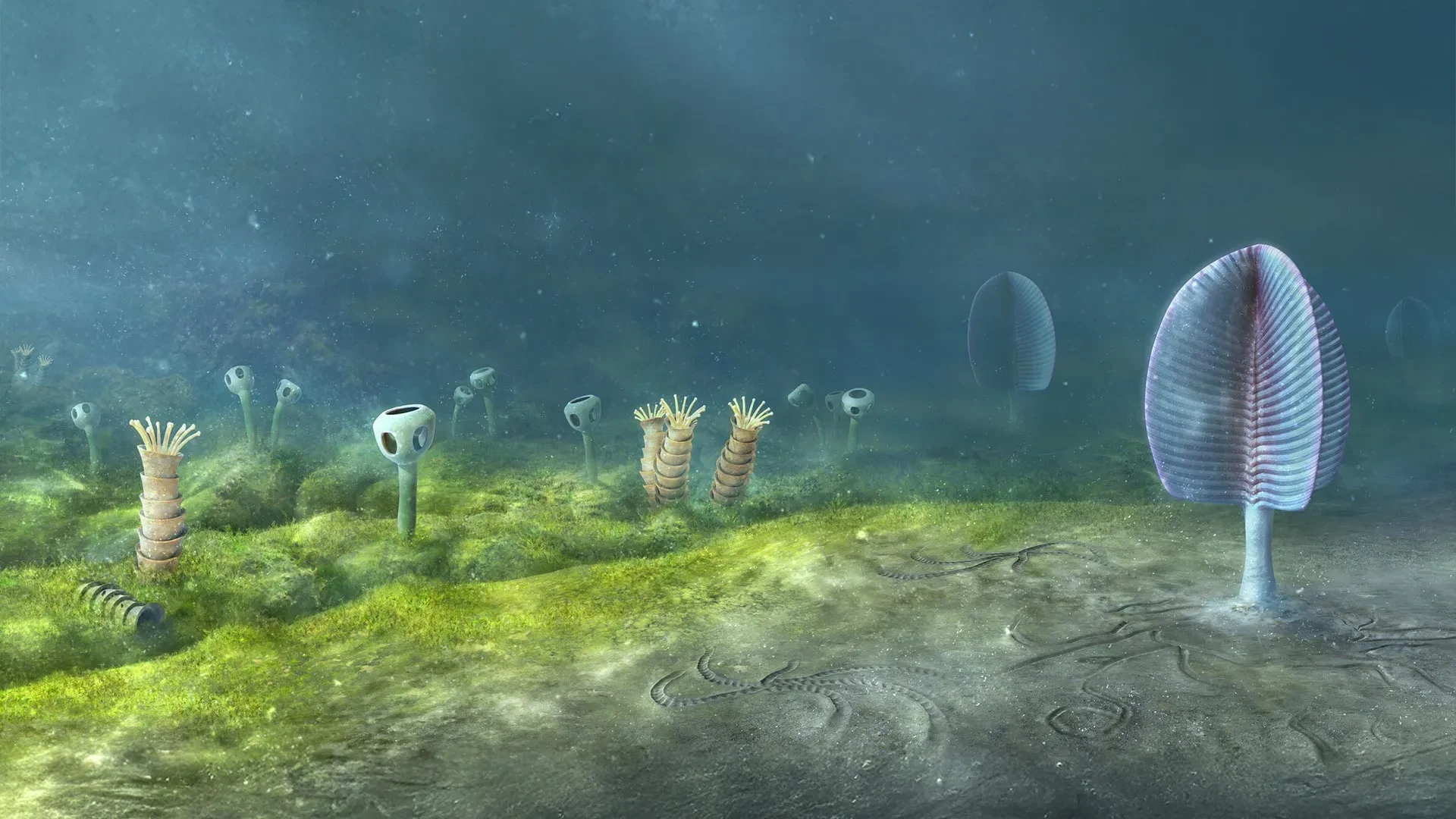
The first animals were not trilobites, vertebrates, or shelled mollusks. They were unimaginably primitive, small, soft-bodied organisms—likely akin to modern sponges, placozoans, or microscopic worm-like creeping forms. Organisms lacking hard biomineralized structures like bones, teeth, or shells possess an exceptionally low fossilization potential. When they died, their soft tissues decayed rapidly, consumed by microbes or scavenged before sedimentary layers could blanket and protect them.
Furthermore, fossilization is an exceptionally rare lottery. It requires a precise, highly improbable alignment of biological death, immediate burial in anoxic or low-oxygen sediment, and a delicate cascade of geochemical reactions (such as early-stage phosphatization or silicification) that can replace organic tissues with stone before they rot away.
Chemical Fossils and Biomarkers
Long before macrofossils began dotting ancient seabeds, organic geochemists had already begun finding phantom traces of ancient animal life encoded in the molecular architecture of the Earth’s crust.
Chemical fossils, or biomarkers, are stable organic molecules derived from biological lipids, proteins, or pigments that survive geological processing over hundreds of millions of years. For instance, specific steroid molecules known as steranes—specifically 24-isopropylcholestane—have been isolated from ancient sedimentary rocks and are widely recognized as diagnostic biomarkers produced by demosponges.
These chemical signatures have been recovered from rocks dating back at least 650 million years. If sponges were already complex enough to produce unique sterol biomarkers during this era, their evolutionary lineages must have branched off significantly earlier. The new Oxford-led study bridges the gap between these elusive chemical clues and the broader evolutionary timeline, providing a robust theoretical framework for why body fossils from this deep time period have remained so frustratingly elusive.
The "Snowball Earth" Conundrum
Perhaps the most profound philosophical implication of pushing the origin of animals back to the 800-to-730-million-year window involves its collision with one of the most violent climatic chapters in planetary history: the Cryogenian Period.
Beginning approximately 720 million years ago, Earth plunged into a series of extreme global glaciations commonly referred to as "Snowball Earth" events. During these epochs, continental ice sheets advanced from the poles toward the equator, eventually encasing the entire globe in ice sheets up to a kilometer thick, with oceans locked beneath a frozen ceiling.
For decades, scientists debated whether such apocalyptic environmental stress would have obliterated nascent multicellular life or whether it might have acted as an evolutionary crucible, driving the adaptations necessary for complex life to thrive.
If animals indeed originated between 800 and 700 million years ago, it means the lineage survived the profound ecological shocks of Snowball Earth, or perhaps even emerged from the dynamic, volatile environmental shifts that preceded and accompanied the global freeze.
Official Statements and Expert Perspectives
The academic community has received the study with a mixture of excitement, caution, and profound respect for the methodological rigor displayed by the team.
Associate Professor Ross Anderson, senior author of the study from the Oxford University Museum of Natural History, emphasized the paradigm-shifting nature of the Mongolian data:
"The Kheseen Biota breaks the argument that the exceptional microfossils of Weng’an mean we would have seen animal fossils in the assemblage had they existed at the time. The Kheseen microfossils are just as well-preserved, yet animals continue to be absent—despite the fact we know at that point they existed."
Anderson elaborated on the implications for ancient environments, explaining that the absence of animals in these pristine deposits likely stems from micro-environmental preferences. Early animals may have inhabited ecological niches entirely distinct from those captured in the Kheseen sedimentary environments, or localized chemical conditions simply lacked the precise taphonomic catalysts required to capture soft-bodied metazoan tissue.
Orin Lole Durbin, the study’s first author—who conducted the research as an undergraduate at the University of Oxford and is now pursuing his PhD at Virginia Tech—offered a measured, scientifically rigorous assessment of the findings:
"Pre-Ediacaran animal body fossils still elude us, and this analysis does not prove that animals existed 800 million years ago. However, our new fossil evidence from Mongolia undermines one of the main arguments for restricting animal origins to the Ediacaran interval. Meanwhile, our molecular-clock analyses show how much further back their evolutionary history could extend."
Independent evolutionary biologists have noted that the paper provides a much-needed reconciliation between genetic data and the stubborn silence of the Precambrian rock record. By demonstrating that absence of evidence in exceptional deposits is not evidence of absence, the study removes the artificial straitjacket that has constrained molecular clock models for over a decade.
Future Outlook: The Ongoing Quest for Deep-Time Animals
As the ink dries on this landmark publication in Science Advances, the paleontological community is already looking toward the horizon. The study does not mark the end of the quest for the earliest animal fossils, but rather the opening of a new frontier in how scientists hunt for them.
Shifting Exploration Paradigms
Moving forward, researchers argue that the search for pre-Ediacaran animal fossils must pivot away from assumptions of universal preservation. Paleontologists can no longer write off an entire geological epoch simply because a few famous, exceptionally preserved fossil sites fail to yield animal remains.
Instead, future expeditions will need to cast a much wider geographical and ecological net, examining microfossil deposits from a diverse array of depositional environments, ranging from deep-water basins to nearshore marine settings, and across varying chemical facies.
A Multidisciplinary Arsenal
Ultimately, the mystery of when the first animal took its first breath or absorbed its first nutrient cannot be solved by paleontology alone. The path forward demands an integrated, multidisciplinary approach that weaponizes every available line of scientific inquiry:
- Macro- and Micro-Body Fossils: Continued high-resolution microscopic analysis of Neoproterozoic cherts, shales, and phosphorites.
- Trace Fossils: Searching for subtle biogenic structures, such as early burrowing, grazing trails, or microbial mat disruptions that hint at motile, multicellular behavior.
- Biomarkers and Isotope Geochemistry: Refining the extraction and interpretation of lipid biomarkers to track the metabolic footprints of ancient sponges and other basal metazoans through the Cryogenian and Tonian periods.
- Advanced Molecular Clocks: Continually updating genetic databases and calibrating evolutionary rates with newly discovered geological constraints.
Until a definitive, undeniable body fossil of a pre-Ediacaran animal is plucked from an ancient rock face, the exact birth date of the animal kingdom will remain shrouded in the mists of deep time. Yet, as Professor Anderson aptly reminds us, the door to our planet’s hidden history is now wide open:
"Until that evidence becomes available, the precise birth date of the animal kingdom remains uncertain—but we now know that our old rules for searching were wrong, and the story of animal life likely stretches back much further into the shadows of Earth’s history than we ever dared to imagine."